Step Pyramid of Djoser
How did Egyptian builders make the leap from mudbrick tombs to the world's first monumental building in cut stone — a six-tiered, ~60-metre pyramid raised in stages by a single named architect, Imhotep — and why did they choose to do it here, all at once?
Why this rating?
- Construction difficulty
- 3/5
- Method uncertainty
- 2/5
- Capability gap
- 2/5
- Open questions
- 3/5
This is a genuinely pivotal but well-understood monument, not an anomaly. Raising a ~60 m stone pyramid with copper tools, ramps and organised labour was a real engineering feat for c. 2670 BCE, but the methods — quarrying, dressing and stacking small limestone blocks in inclined accretion layers — are attested and reconstructable, and the visible building phases let archaeologists read the sequence directly. The score reflects the size of the conceptual leap (mudbrick to monumental stone, in one reign) and the honest open questions about the exact order of the design changes and how the labour was organised at the dawn of the pyramid age — not any suggestion of lost or impossible technology.
Overview
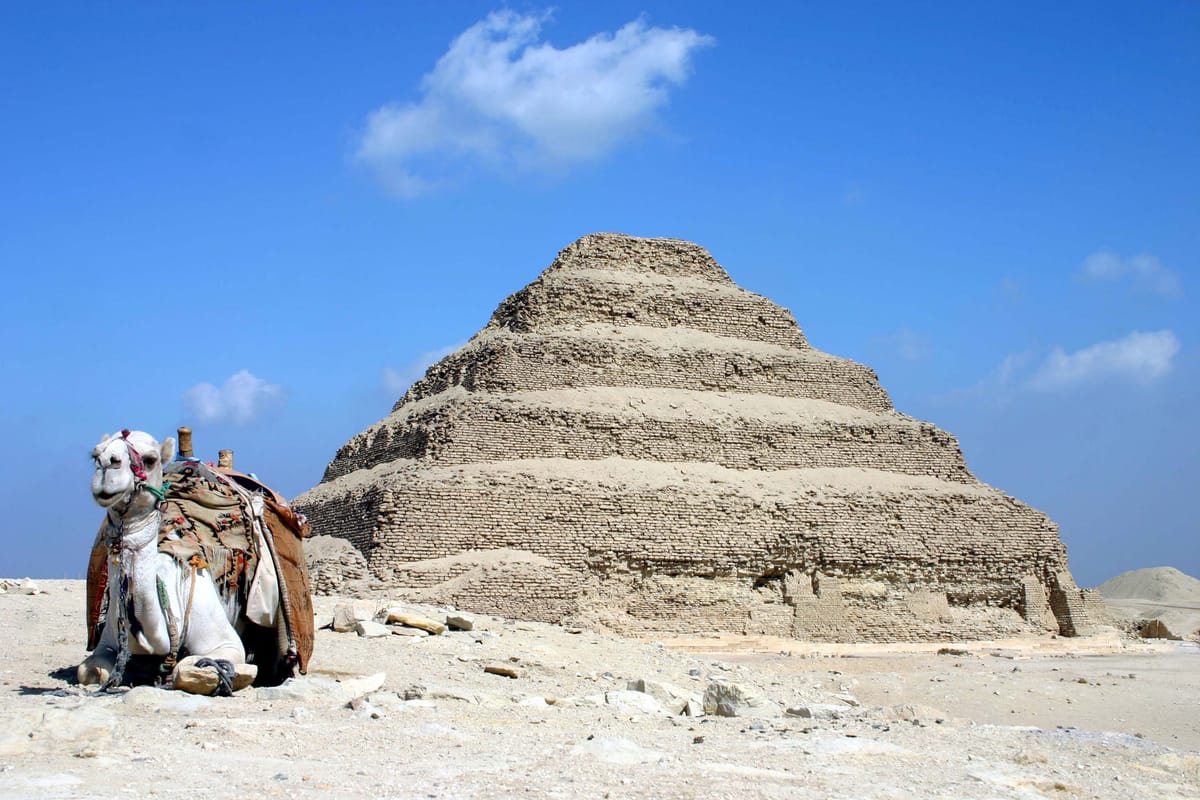
The Step Pyramid of Djoser at Saqqara holds a distinction that is easy to state and hard to overstate: it is the oldest known monumental building of dressed stone anywhere in the world. It was raised around 2670 BCE, at the very start of Egypt’s Third Dynasty, for the pharaoh Djoser — known in his own time by his Horus name, Netjerikhet — and tradition, backed by an ancient inscription found at the site, credits its design to his vizier Imhotep, the earliest architect in human history whom we can name. Before this pyramid, Egypt’s kings and nobles were buried under mastabas: low, flat-topped rectangular mounds of mudbrick and rubble, imposing but earthbound. What Imhotep built at Saqqara broke with that tradition twice over — it was made of cut limestone rather than mudbrick, and instead of a single mound it climbed the sky in six receding tiers to a height of roughly 60 metres. It is, in a real sense, the first skyscraper, and the ancestor of every pyramid that followed.
Saqqara itself sits on the desert escarpment west of the Nile, a few kilometres from the ruins of Memphis, the capital of the newly unified Old Kingdom state. It was the great necropolis of that capital, and Djoser’s monument is not a lone tower but the centrepiece of an enormous walled funerary complex — some 15 hectares enclosed by a bastioned limestone wall over a kilometre and a half around, filled with courts, shrines, and dummy buildings, and undercut by nearly six kilometres of shafts and galleries tunnelled into the bedrock. The genuine question the monument poses is not a fantastical one about who “really” built it. It is a developmental question, and a profound one: how, and why, did a civilisation that had always built its tombs of mud suddenly learn — apparently within a single reign — to quarry, dress, and stack stone on a monumental scale, and to organise the labour and design to do it? This study takes the structure, the building, and that question in turn.
The Structure
The pyramid proper is built of local limestone and once sheathed in finer white Tura limestone from across the river. Its base is roughly rectangular, about 121 by 109 metres, and it rises in six unequal steps to something on the order of 60 metres — sources give figures from about 60 to 62.5 metres, the imprecision reflecting erosion and the loss of the outer casing. Unlike the true pyramids that came later, its faces are not smooth: the six great tiers are plainly visible, giving the monument its name and its distinctive silhouette. And unlike the colossal blocks of the Giza pyramids a century or so later, the Step Pyramid is built of relatively small stones — pieces roughly the size of large clay bricks, laid in courses and bedded in clay mortar. That choice of small, manageable blocks is a crucial clue to how it was built, and to how early it is: these are masons feeling their way into a new material, using stone almost as if it were a more durable, more prestigious brick.
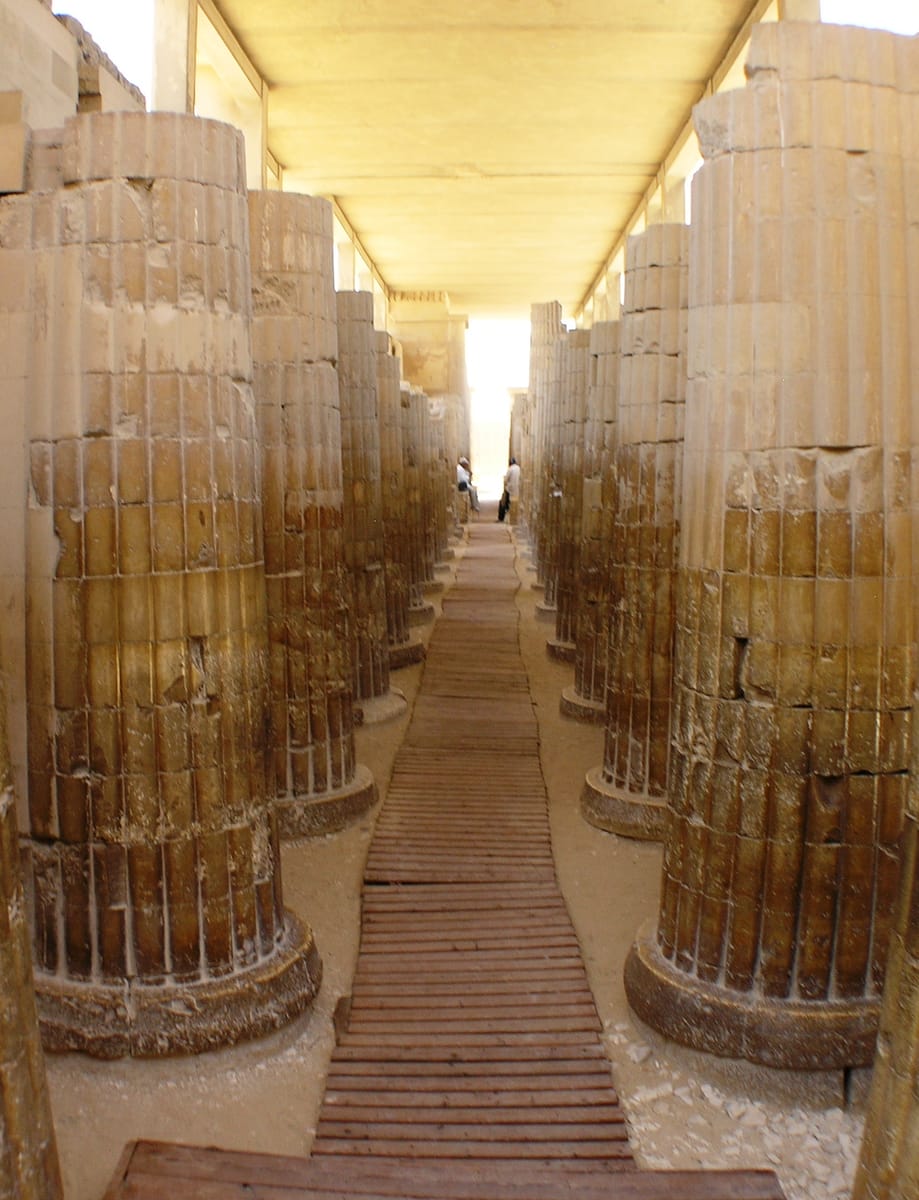
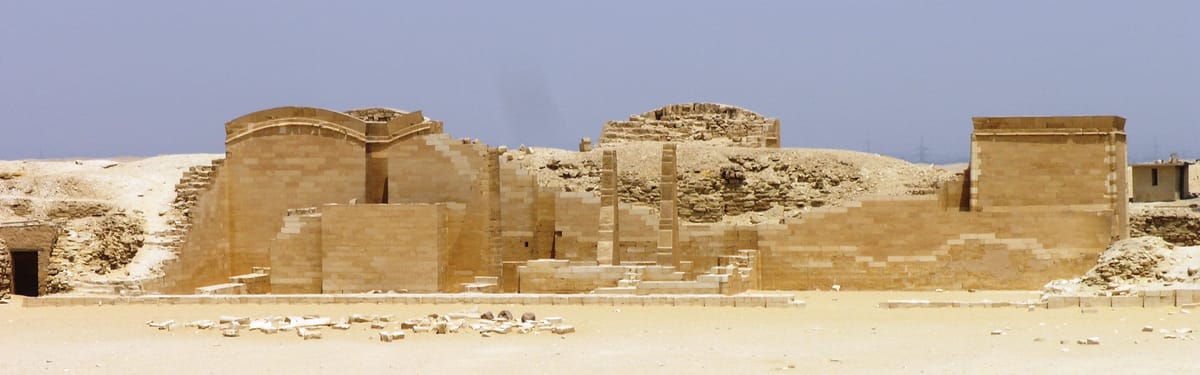
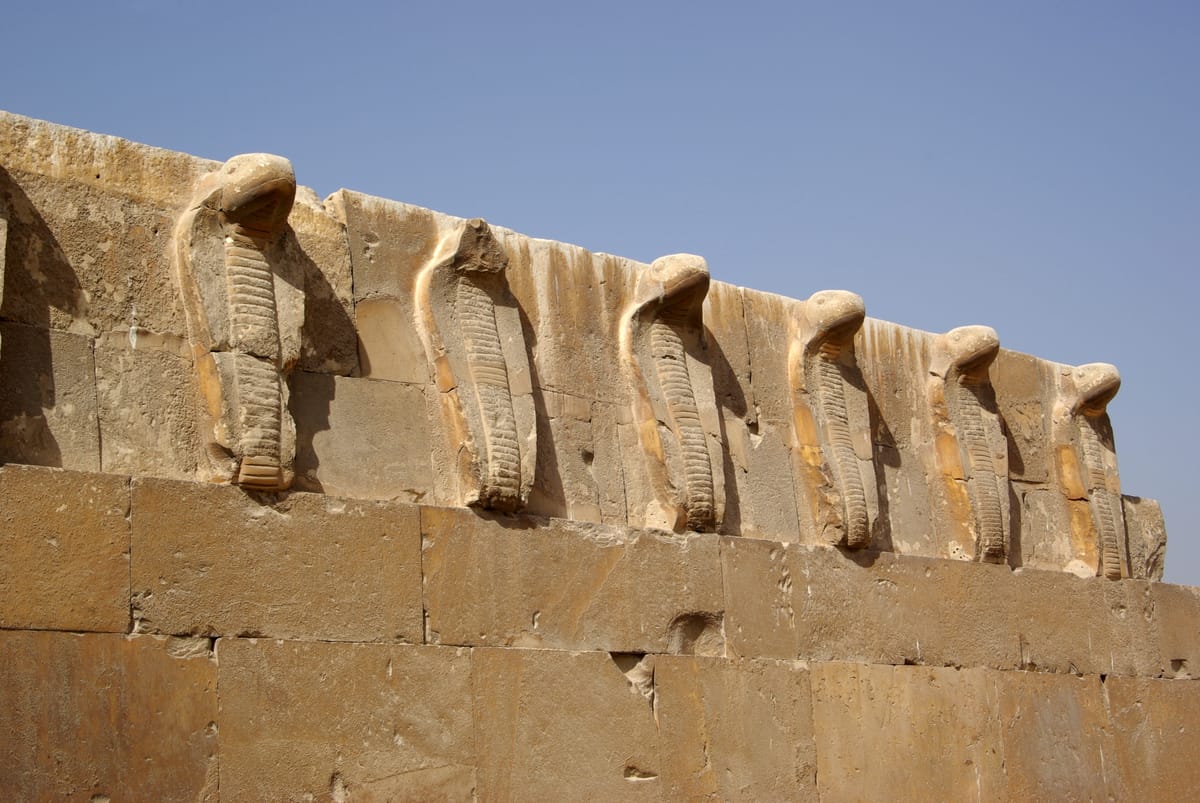
Around and beneath the pyramid spreads the funerary complex, which is arguably the more remarkable achievement. The whole precinct is wrapped in a recessed, panelled enclosure wall, originally about 10.5 metres high, studded with fourteen gateways of which only one was ever real — the other thirteen are false doors, solid stone imitations for the use of the king’s spirit rather than the living. The single true entrance leads through a roofed colonnade whose ranked limestone columns are carved to imitate bundles of plant stems. Inside lies a great court and, off it, the Heb-Sed court, a long narrow courtyard flanked by rows of chapels. These chapels are dummies: built solid, with no usable interior, they are stone stage sets for the Sed festival, the jubilee at which a king ritually renewed his powers. In stone, and forever, the dead Djoser could go on performing that renewal for eternity. Elsewhere in the complex stand two buildings conventionally called the House of the North and the House of the South, thought to represent the shrines of Lower and Upper Egypt and so the king’s rule over both lands.
Two features deserve particular note. On the north side of the pyramid, a small sealed stone box — the serdab — leans against the structure at an angle, pierced by two small holes. Inside sat a life-sized painted statue of Djoser (the original is now in the Egyptian Museum; a replica occupies the serdab today), positioned so the king’s eyes could gaze out through the holes toward the northern circumpolar stars, receiving offerings and watching over his cult forever. And in the southwest corner of the enclosure stands the South Tomb, a mastaba-like structure over its own deep shaft and granite-lined chamber — too small to hold a body, and variously interpreted as a symbolic second tomb, a resting place for the king’s ka spirit, or a burial for his viscera or his royal placenta.
Beneath it all runs the underground world. A central shaft some seven metres square descends about 28 metres to the granite burial chamber, once sealed by a three-tonne granite plug. Radiating from it is a labyrinth of galleries and store-rooms — nearly six kilometres of tunnelling in total — some lined with gleaming blue faience tiles set to imitate the reed-mat hangings of the royal palace, and carved with reliefs of the king. Tens of thousands of stone vessels, many inherited from earlier reigns, were stacked in these magazines. It is an entire subterranean palace for the dead, hewn out of the Saqqara bedrock.
How Was It Built?
The most illuminating thing about the Step Pyramid is that it does not hide how it was made. Because its casing is largely gone and its core is exposed, archaeologists — above all Jean-Philippe Lauer, who devoted much of the 20th century to studying and restoring the complex — have been able to read the building almost like a diagram, and what they read is not a single grand design but a sequence of revisions. The monument began as a mastaba: a low, square, flat-topped tomb of stone, quite unlike the oblong mudbrick mastabas of Djoser’s predecessors but recognisably in that tradition. This first mastaba (labelled M1 by scholars) was then enlarged twice — extended evenly on all four sides (M2), and then enlarged again on the east side (M3) — while still remaining a flat mastaba.
Only then came the decisive idea. Rather than a single mound, Imhotep’s builders stacked a series of diminishing mastaba-like layers one atop another, first as a four-stepped pyramid (P1) and finally, after a further enlargement of the base, as the six-stepped pyramid we see today (P2). The change in building technique between these phases is itself instructive: the earliest work uses roughly horizontal courses, but the later, taller phases lean their masonry inward, laying the blocks in accretion layers that slope toward the centre of the pyramid. That inward lean is what gave the growing structure the stability to rise safely — a piece of practical structural engineering worked out, it seems, in the course of the build itself. In other words, the Step Pyramid was not designed on a drawing board and then executed; it was designed by being built, revised at least five or six times as its makers grasped what stone could do.
The physical means were modest and are well understood. Limestone was quarried nearby with copper chisels, wooden wedges, and stone pounders, dressed to shape, and dragged into place on sledges over prepared surfaces and construction ramps; the small block size kept each piece within the reach of human muscle and simple hauling. The harder granite used for the burial chamber and plug came from Aswan, hundreds of kilometres upstream, and was moved by river — a logistical feat, but one Egyptians were already capable of. What the project demanded above all was organisation: quarrying, transport, masonry, and the feeding and housing of a large workforce, coordinated over years under a central authority. The Step Pyramid is as much a monument to administration as to masonry, and its very existence testifies to a state newly able to mobilise and sustain thousands of workers for a single long-term end. There is nothing here beyond the demonstrated capabilities of Third Dynasty Egypt — but there is the unmistakable sense of a technology being invented in real time.
The Mainstream View
Egyptologists regard the Step Pyramid as one of the best-understood, and most important, monuments in the world. Its date, its owner, and its designer are secure: it belongs to the reign of Netjerikhet (Djoser), around 2670 BCE, and the attribution to Imhotep rests on real ancient evidence — most strikingly an inscription found on the pedestal of a Djoser statue at the site giving Imhotep’s name and titles, and a long later tradition that remembered him as the inventor of building in dressed stone. Imhotep was a historical official — vizier, high priest, physician, and master builder — who was so revered that, uniquely for a commoner, he was eventually deified, worshipped as a god of wisdom and medicine two thousand years after his death and later identified by the Greeks with their healer Asclepius. The Step Pyramid is, in the mainstream view, exactly what it appears to be: the earliest and most consequential experiment in monumental stone architecture, made by a named genius for his king.
Scholars also read the complex as a coherent statement of early kingship. The whole precinct is a skeuomorphic monument — that is, it renders in permanent stone the forms of an older architecture of reeds, timber, and mudbrick: columns shaped like bundled plants, ceilings carved to imitate palm logs, walls panelled like woven matting, and wall-hangings reproduced in blue faience. It freezes the perishable royal palace and its ritual buildings into eternity, giving the dead king a stone stage-set — the Heb-Sed court, the dummy shrines, the false doors — on which to perform the rites of kingship forever. And its role in the history of the pyramid is understood as pivotal and direct: the Step Pyramid’s stacked-mastaba form is the conceptual bridge between the flat mastaba tombs before it and the true, smooth-sided pyramids that follow within a couple of generations — first the transitional monuments of Sneferu at Meidum and Dahshur, then the Great Pyramid at Giza. Modern conservation has kept pace with this understanding: after a fourteen-year restoration, the pyramid and parts of its interior were reopened to visitors in 2020. On the essential facts — who, when, why, and broadly how — there is no serious dispute.
The Open Case
The honest open questions about the Step Pyramid are not about aliens or lost technology; they are the genuinely interesting questions that surround the birth of an art. The first is one of sequence. We can see that the monument was revised repeatedly, but the exact order, timing, and motivation of those changes are still debated in the details. Was the shift from mastaba to stepped pyramid a single inspired decision or a series of smaller escalations? At what point, and why, did the builders switch from horizontal courses to inward-leaning accretion layers — a response to a structural problem they encountered, or a plan from partway through? Reading a building that was designed by being built leaves real ambiguity about what its makers were thinking at each stage.
The second question is the deepest: why stone, why now, why here? Egyptians had worked stone for small objects and had used it sparingly in tombs before, but the leap to a monument of this scale and ambition, in a single reign, is genuinely striking. What combination of a newly consolidated and wealthy state, an unusually gifted architect, a particular religious programme of eternal kingship, and the symbolic pull of imperishable material tipped Egypt over that threshold? These are questions of history and motivation more than of engineering, and they do not have tidy answers.
The third is the practical one archaeologists keep returning to: how, exactly, was the labour organised at this founding moment of the pyramid age? Later pyramid projects have left us workers’ villages, ration records, and quarry marks; for Djoser’s reign the evidence is thinner, and precisely how the workforce was recruited, housed, fed, and directed to raise the first great stone monument is still being reconstructed. None of these open threads casts doubt on what the Step Pyramid is. They are the ordinary, and extraordinary, uncertainties that cluster around any true beginning — and here the beginning is nothing less than the moment humanity first decided to pile dressed stone toward the sky.
Sources
Connected findings
- The Secret of the Pyramids Was a Truck Bearing — Imhotep froze a palace of reeds and matting into limestone for a dead king. Four and a half thousand years later a man in Florida carved himself a stone rocking chair, and told everyone he had worked out how the pyramids were done.
On screen
- The First Draft You Can Build — Pharaoh hands you Imhotep's plan and tells you to raise the first pyramid. Assassin's Creed Origins turns up 2,600 years late and finds bandits living in it.
- saqqara
- djoser
- imhotep
- egypt
- old-kingdom
- third-dynasty
- step-pyramid
- mastaba
- limestone
- funerary-complex
- heb-sed
- first-stone-architecture
- memphis
Gallery