Ollantaytambo
How did the Inca quarry six rose-rhyolite monoliths weighing tens of tonnes each from a mountainside across the Urubamba River, haul them down, across the valley, and up a second mountain to the Temple of the Sun, fit them with millimeter-tight joints, and then abandon the whole project before it was finished?
Why this rating?
- Construction difficulty
- 5/5
- Method uncertainty
- 3/5
- Capability gap
- 4/5
- Open questions
- 4/5
Quarrying multi-tonne rose-rhyolite monoliths on one mountainside, moving them across a river valley, and hauling them up a second mountain to be dressed into blade-tight joints is an extreme engineering feat, but Ollantaytambo is unusual among Inca sites in preserving direct physical evidence of the process itself, including quarry faces, ramps, transport roads, and blocks abandoned mid-journey. That evidence makes the general method well understood, while the exact river-crossing technique, the meaning of the carved reliefs, and the precise reason construction stopped mid-project remain genuinely open.
Overview
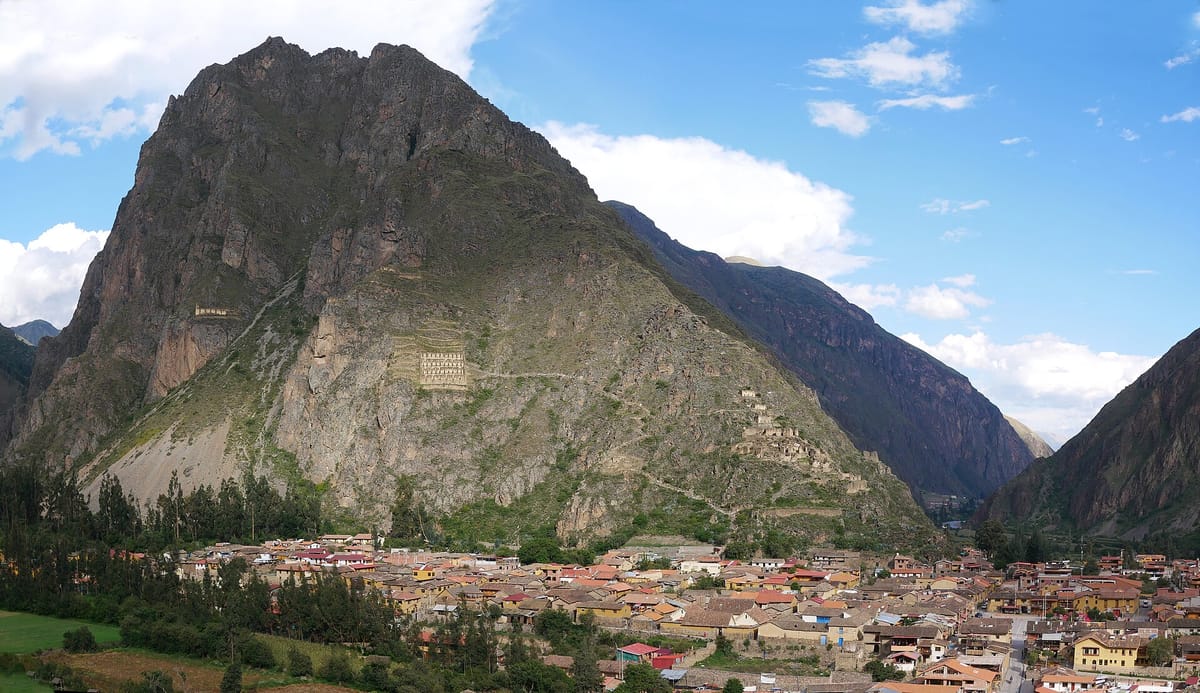
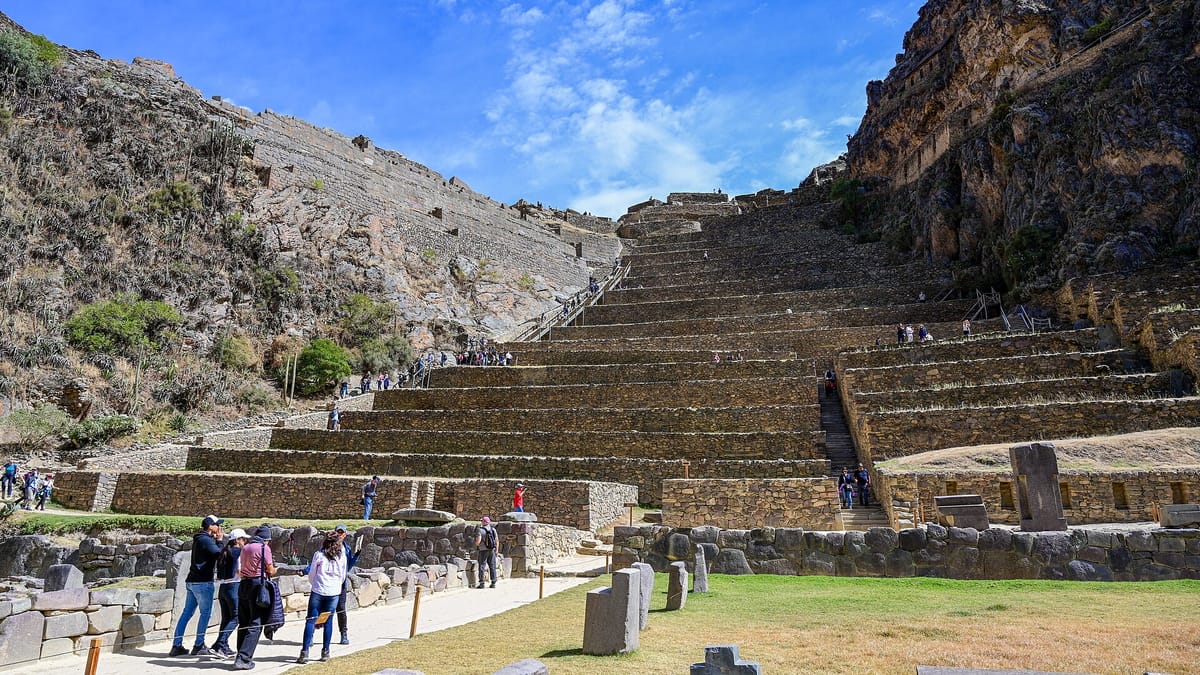
Ollantaytambo is an Inca town and archaeological complex in Peru’s Sacred Valley of the Urubamba River, about 72 kilometers by road northwest of Cusco at an elevation of roughly 2,792 meters. Built from the mid-15th century as a royal estate for the emperor Pachacuti, it combined a residential town, extensive agricultural terracing, and a ceremonial-defensive complex on the steep hillside above it, known today as the Temple Hill or Fortress sector. Uniquely among major Inca sites, Ollantaytambo’s old town is still lived in: its central plaza and surrounding blocks preserve the original Inca street grid and the walled compounds, called kanchas, that Inca families occupied, making it one of the oldest continuously inhabited settlements in South America. High on the Temple Hill sits the site’s most famous feature, the unfinished Temple of the Sun, centered on the Wall of the Six Monoliths — six colossal blocks of pink rose rhyolite, quarried from a mountain across the valley and raised into position but never fully completed. In 1537, the site briefly became the last stronghold from which the Inca ruler Manco Inca organized armed resistance against Spanish conquest, before the empire’s remaining leadership retreated further into the jungle at Vilcabamba.
The Structure
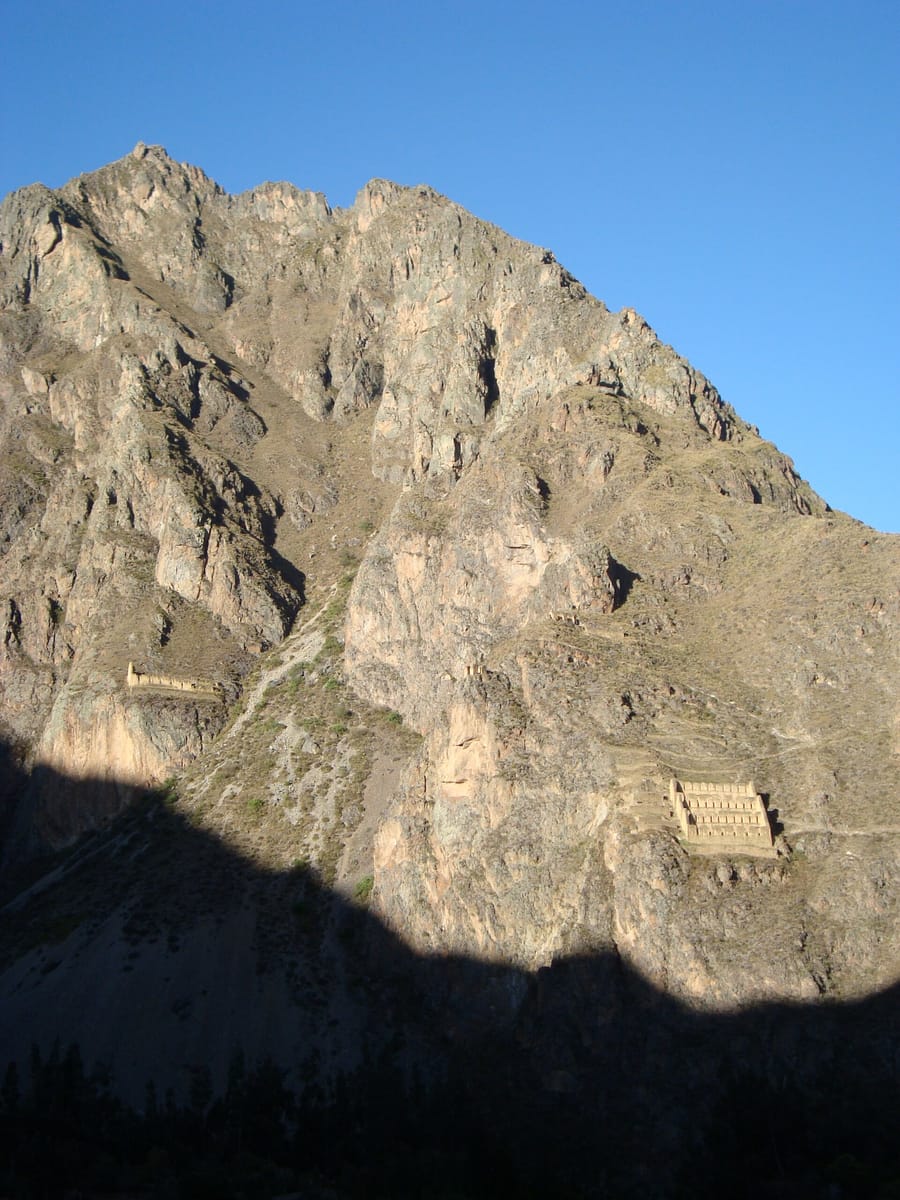
Pachacuti, the Inca ruler credited with transforming Cusco into the capital of a rapidly expanding empire, is traditionally said to have conquered the Ollantaytambo region and rebuilt the town and its surrounding land as a personal royal estate, a status distinct from an ordinary provincial settlement. The lower town follows a strict orthogonal plan, four long streets crossed by seven shorter ones around a central plaza, built up from kanchas — compounds of four single-room buildings arranged around a shared courtyard — many of which still stand on their original Inca foundations and are inhabited today. Terracing steps up the hillsides on both sides of the valley, engineered for farming across different elevations and microclimates, and fed by stone-lined water channels and fountains, including the finely carved Baño de la Ñusta, or Princess’s Bath. Higher on the mountainside, rows of qolqas — storehouses built with deliberate gaps in their walls to catch cool, drying wind — preserved grain and other goods at an elevation and temperature that slowed spoilage. The Temple Hill complex above the town combines defensive terracing, ceremonial platforms, and the unfinished Temple of the Sun. In 1537, Manco Inca, having withdrawn from the Spanish siege of Cusco, made Ollantaytambo his base and defeated an expedition led by Hernando Pizarro on the plain below the terraces, reportedly by flooding the ground to bog down Spanish cavalry — one of the few clear Inca battlefield victories of the conquest era — before judging the position untenable and retreating deeper into the Vilcabamba region the following year.
How Was It Built?
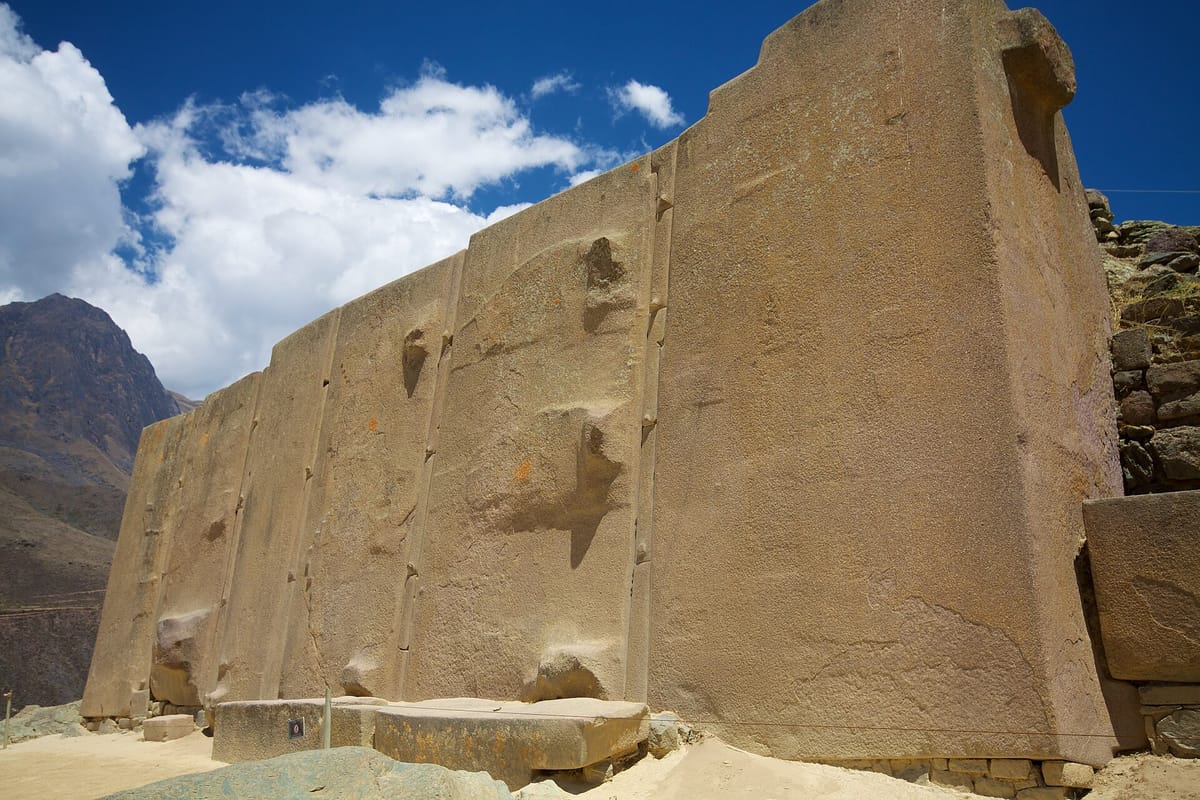
The Wall of the Six Monoliths, in the Temple of the Sun sector, is built from rose-colored rhyolite, a volcanic stone entirely different from the local grey andesite and limestone used elsewhere at the site. Each of the six surviving blocks stands roughly 4 meters tall, 1.5 to 2 meters wide, and more than a meter thick, with individual weights commonly estimated at around 50 tonnes. Narrow vertical stones are set as spacers between the larger blocks, and a low-relief stepped, zigzag motif is carved across the wall’s face, an interpretation that most scholars connect to a stairway or sun-ray motif tied to Inca solar ritual, though its precise meaning is not settled. The source of the rhyolite is Kachiqhata, a set of quarries roughly 5 kilometers away on the slopes of Yana Urqu mountain, on the far side of the Urubamba River from the temple. Getting stone from there to the temple required quarrying blocks from the mountainside, roughing them into shape on-site to reduce the weight hauled onward, moving them down the mountain and across the valley floor, fording or diverting the river, and then hauling them up a second, steep incline to the temple terraces using an engineered system of ramps and roads. Archaeologists have documented carefully built clay-and-gravel roadbeds and, beneath at least one abandoned megalith, wooden rollers still in place, direct physical evidence for how the blocks were moved. Along the transport route, several blocks were left where the effort to move them stopped, known locally as piedras cansadas, or “tired stones,” including one still resting at the base of a ramp leading up to the temple.
The Mainstream View
Archaeologists treat Ollantaytambo’s construction as a large, well-organized Inca state project, carried out using the mit’a system of rotational labor tribute, under which able-bodied subjects across the empire owed periods of work on roads, terraces, and monumental building in place of tax. Unlike many Inca sites, where the finished stonework is all that survives, Ollantaytambo preserves an unusually complete record of the building process itself: the Kachiqhata quarry faces show where blocks were split and roughed out, the transport roads and ramps between quarry and temple are still traceable on the ground, and the abandoned “tired stones” mark specific points where hauling stopped. This physical record, combined with experimental fieldwork by researchers such as Jean-Pierre Protzen, who carried out extensive on-site studies of Inca quarrying and stone-dressing methods at Ollantaytambo specifically, supports a consistent picture: masons used hard stone hammerstones rather than metal tools to peel and dress the rhyolite, exploiting the rock’s natural fracture planes, while crews without draft animals or wheeled transport moved the roughed blocks using ropes, log rollers, sledges, and earthen or clay-surfaced ramps, with final fitting achieved by repeated pounding and test-fitting at the building site. The scale of the operation, mainstream scholarship holds, reflects the Inca state’s exceptional capacity to mobilize, feed, and direct thousands of workers over months or years, not any technology beyond stone tools, ropes, timber, and coordinated human labor.
The Open Case
What makes Ollantaytambo distinctive is not doubt about whether the Inca built it — the quarry, roads, and abandoned stones leave a clearer trail of physical evidence here than at almost any other Inca megalithic site — but the specific gaps that trail still leaves unfilled. No definitive account survives, documentary or archaeological, of exactly how multi-tonne blocks were carried across the Urubamba River itself; proposals have included a temporary causeway, a partial diversion of the river’s channel, or fording at a drier-season low point, but which method, or combination, was used is not conclusively established. The precise meaning of the stepped relief motif carved into the Wall of the Six Monoliths remains interpretive rather than confirmed. Most consequentially, the temple was plainly left unfinished — additional blocks lie roughed-out at the quarry and abandoned along the route, and the wall itself was never completed to its evident design — and why work stopped is still debated: candidate explanations include the succession war between Huáscar and Atahualpa that convulsed the empire in the 1520s and 1530s, the disruption of the Spanish invasion itself, or some combination of political upheaval that pulled labor and attention away from a project only the Inca state could sustain. Ollantaytambo’s monoliths have long attracted popular claims of “impossible” precision or lost technology, but the site itself is precisely what undercuts that reading: it is the clearest surviving record anywhere in the Inca world of a megalithic project caught mid-process, its quarry, its roads, and its abandoned stones still lying where the work stopped, evidence of an ambitious, thoroughly human effort rather than a finished mystery.
Sources
- Wikipedia — Ollantaytambo
- Wikipedia — Inca architecture
- Wikipedia — Pachacuti
- Encyclopaedia Britannica — Ollantaytambo
- Jean-Pierre Protzen — Inca Architecture and Construction at Ollantaytambo (Oxford University Press, 1993)
- Peru Ministry of Culture (Cusco) — Parque Arqueológico de Ollantaytambo
- Encyclopedia of Latin American History and Culture — Ollantaytambo
- World History Encyclopedia — Inca Architecture
- Humanities LibreTexts — The Incas (Boundless Art History)
Connected findings
- One Kept the Stone, One Kept the Hole — A million cubic metres of Chinese sandstone went somewhere and nobody can find it. Fifty-tonne Peruvian blocks are still lying beside the road, exactly where the hauling stopped.
Gallery