The Impossible Delivery
An island with no wheels moved an 80-tonne statue on foot. A kingdom with no draft animals floated a 700-tonne one down a river. Neither had met the other.
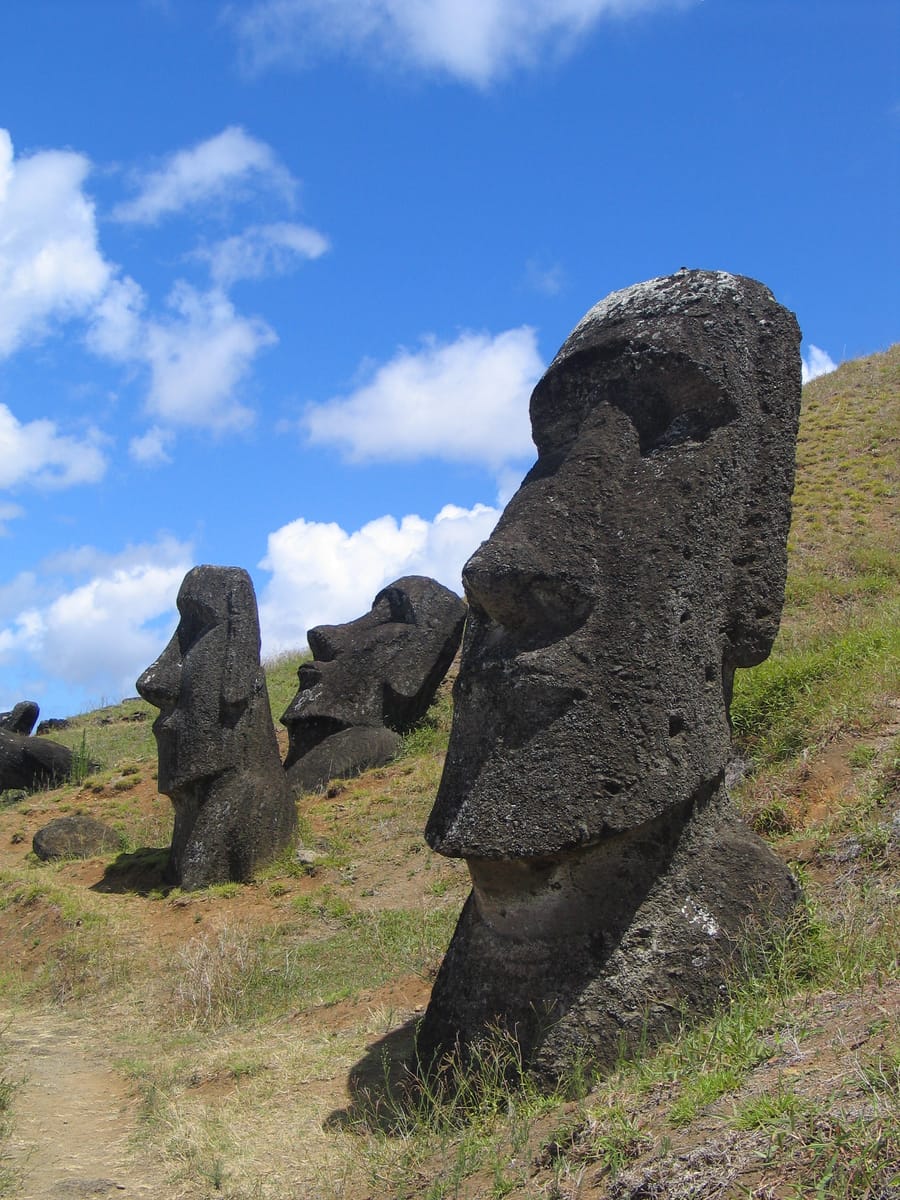
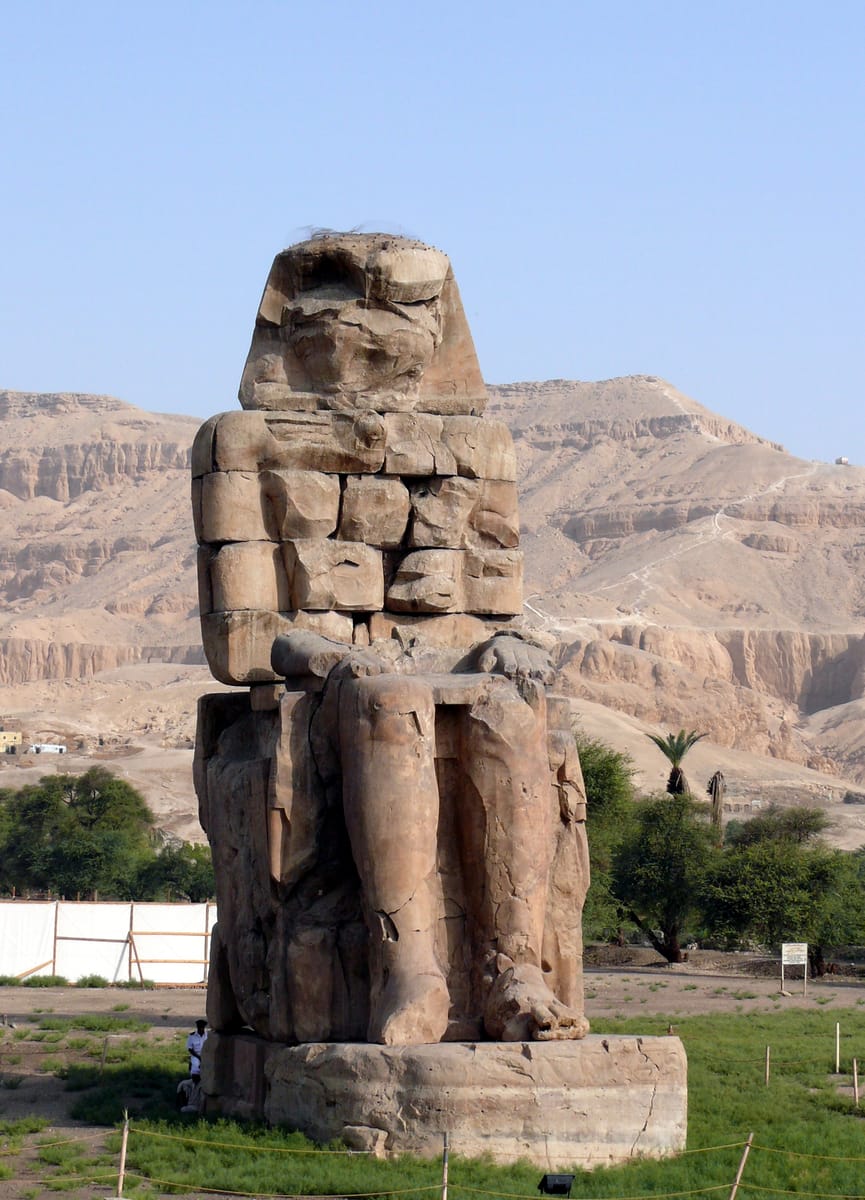
Picture a stone figure taller than a house, standing upright on open ground with no wheel beneath it and no ox harnessed to it — and it is moving. On Rapa Nui, the most isolated inhabited island on Earth, Polynesian carvers finished statues weighing up to 80 tonnes at a quarry called Rano Raraku and got them, somehow, to platforms miles away along the coast. Now picture a stone ten times heavier: a seated king carved from a single block of quartzite, roughly 700 tonnes, that began its journey 675 km away at a quarry near modern Cairo and ended up on the Theban plain across the river from Luxor. Two societies with no wheeled vehicles and no draft animals each moved a stone that, by ordinary logic, shouldn’t have been movable at all.
They didn’t do it the same way. Working roughly a millennium after the Egyptians, the Rapa Nui seem to have walked their moai to their destinations — literally. Statue bases were carved wide and D-shaped, with a deliberate forward lean, so a standing moai could be rocked side to side on ropes and walked forward in a swaying gait, the trick that lets a person shuffle a heavy refrigerator across a floor. Teams of under twenty people have replicated the walk with a multi-tonne replica, and the ancient quarry roads show exactly the wear a rocking statue leaves. Amenhotep III’s engineers, by contrast, almost certainly never stood their colossus upright until it reached its final base. Each quartzite giant was levered onto a sledge, dragged overland on a track lubricated with water or mud, loaded onto a barge, and floated south with the Nile’s current — dragging that mass upstream was beyond reach — before one last haul up a ramp to the temple gate.
Rocking a statue on its own feet, and floating one down a river: these are not variations on a shared idea. They are two separate answers, invented three thousand kilometers and twenty-six centuries apart, by people who never traded a rope, a tool, or a story with each other. Rapa Nui had no river worth the name and no draft animals; Egypt had the Nile doing half the work and a state’s organized labor doing the rest. Each people faced the same brute fact — one stone, too heavy, too far — and, entirely alone, found the solution its own landscape allowed. The stone never cared whose civilization moved it. It only insisted on being moved, and twice, it was.
Read the full studies: The Moai of Rapa NuiColossi of Memnon
Sources
- UNESCO World Heritage Centre — Rapa Nui National Park
- Wikipedia — Moai
- ScienceDaily — Scientists just proved the moai could walk, solving a 500-year mystery
- Binghamton University — Easter Island's statues actually 'walked' — and physics backs it up
- Wikipedia — Colossi of Memnon
- Encyclopaedia Britannica — Colossi of Memnon
- Wikipedia — El-Gabal el-Ahmar (quartzite quarry)