Colossi of Memnon
How did New Kingdom Egypt quarry, load, and move two seated statues carved from single blocks of quartzite — each weighing on the order of 700 tonnes — roughly 675 km across the country to the Theban plain, and why did one of them 'sing' at dawn for two hundred years?
Why this rating?
- Construction difficulty
- 5/5
- Method uncertainty
- 3/5
- Capability gap
- 2/5
- Open questions
- 3/5
The engineering is genuinely at the extreme edge of what any pre-industrial society attempted: two seated statues carved essentially as single monoliths of hard quartzite, roughly 18 m tall and estimated near 720 tonnes each, with the best-matching quarry some 675 km away — heavier than most obelisks and moved much farther. That earns a 5 for difficulty. Uncertainty and the capability gap are moderate, not high: Egypt demonstrably did move colossal quartzite (this is not an anomaly), and the broad method — sledges overland, barges on the Nile, earthen ramps and levers on site — is well attested, so nothing here is beyond New Kingdom capability. What stays open is the specifics: exactly how blocks this large were detached, loaded onto vessels, and hauled that distance is reconstructed from analogy rather than documented, the stone source for the southern colossus is still debated, and the acoustics of the 'singing' northern statue were never conclusively pinned down before Roman repairs ended it.
Overview
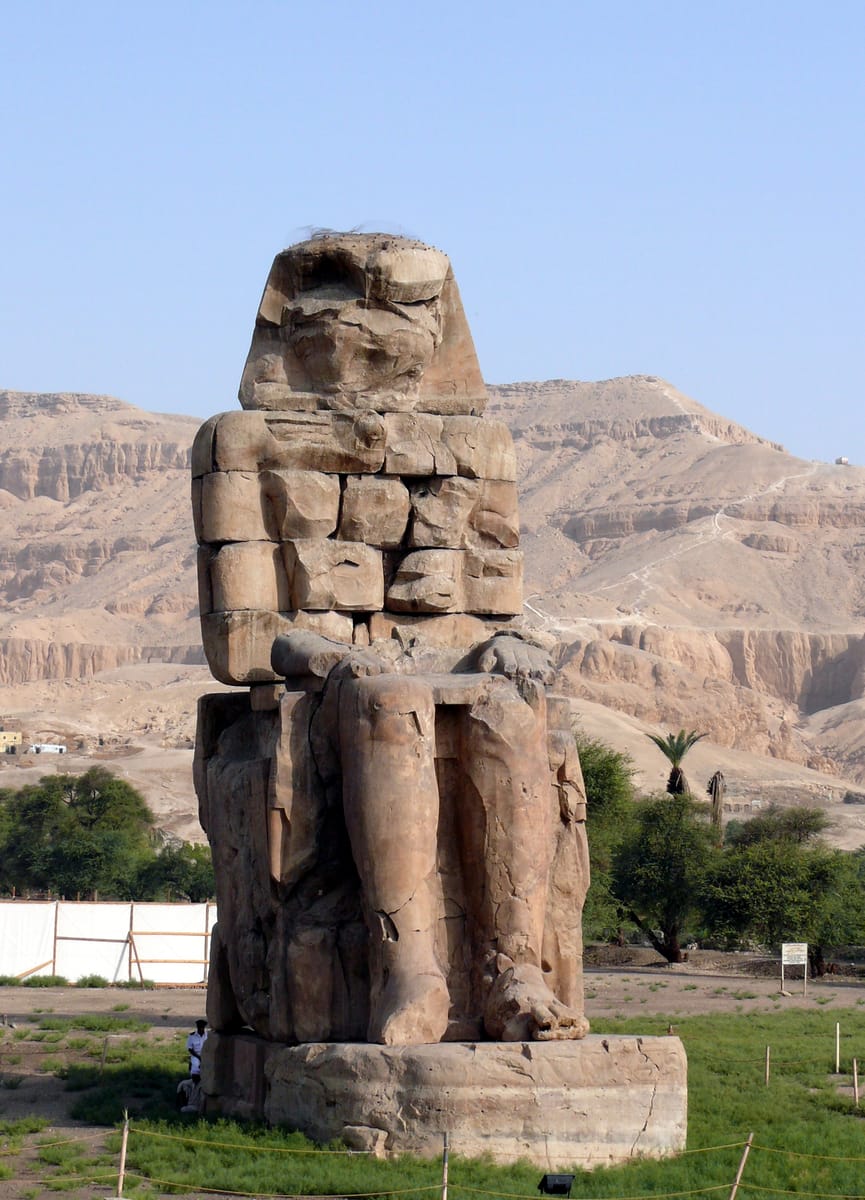
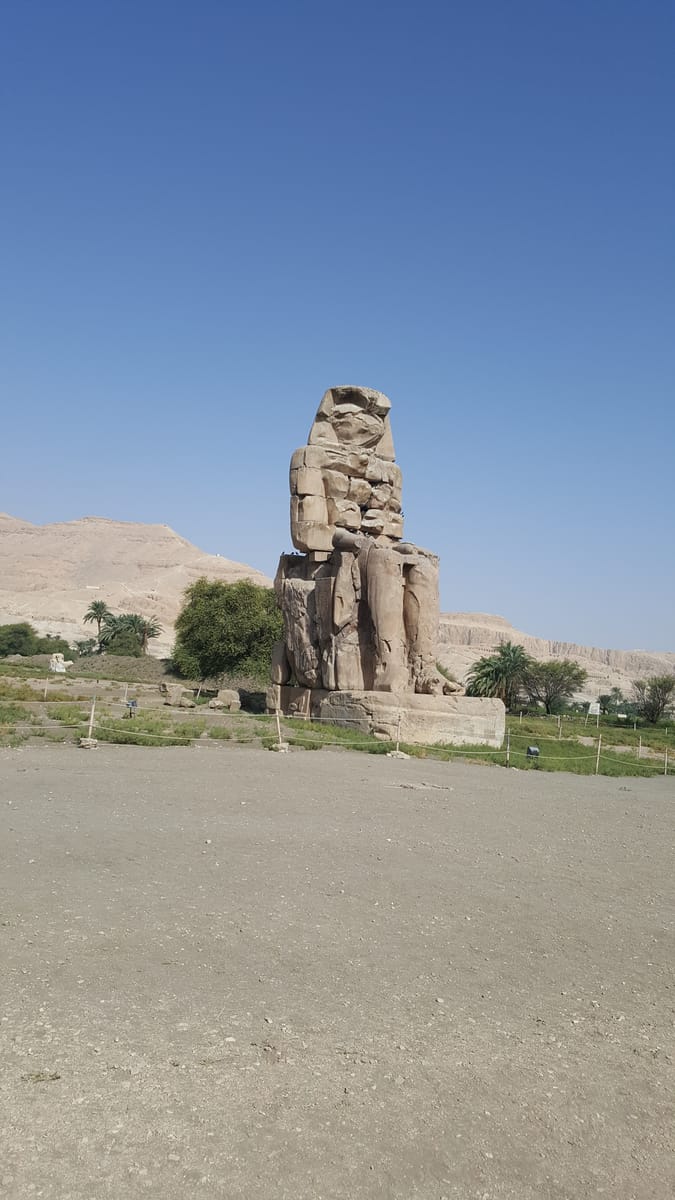
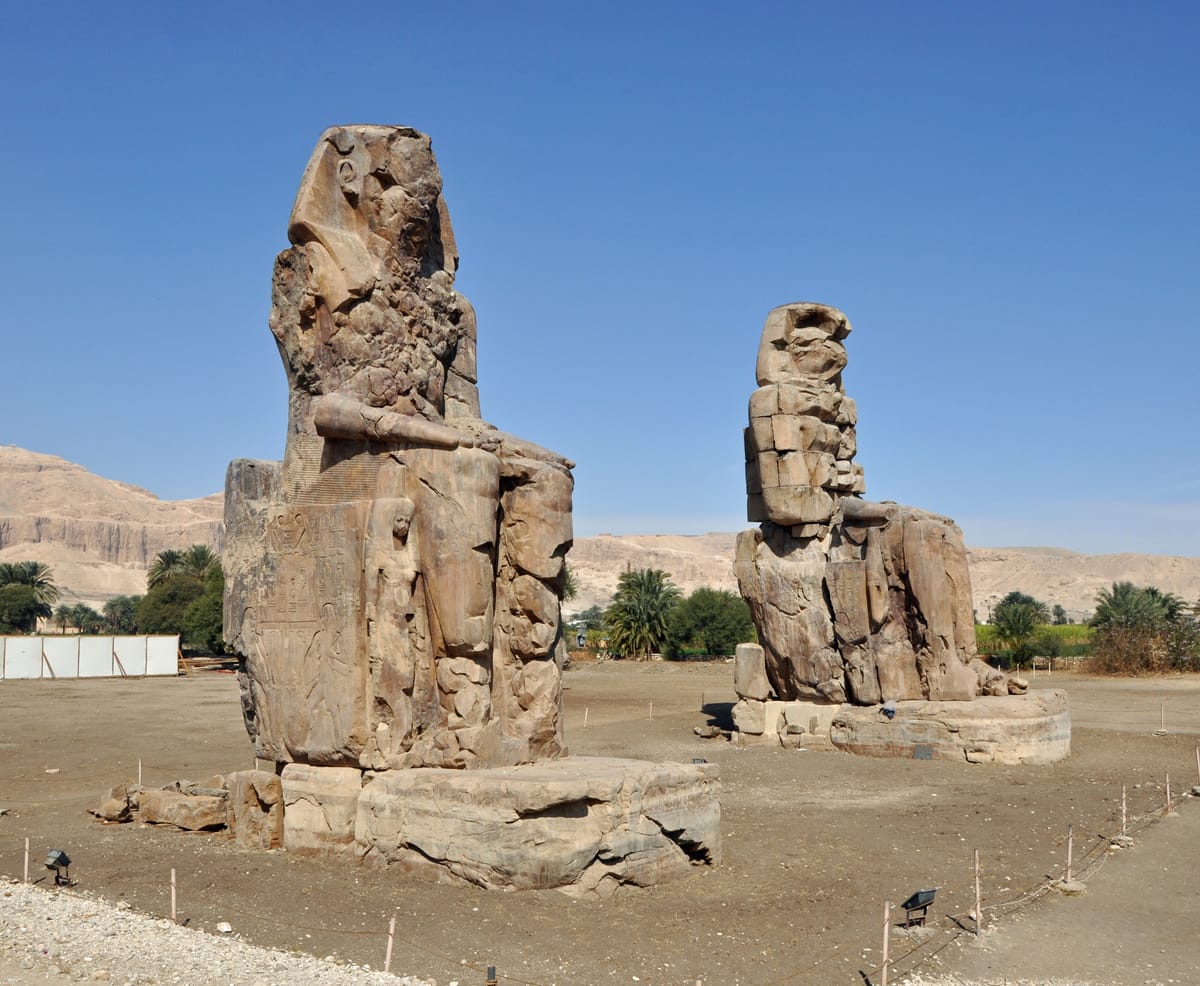
On the flat farmland of the Theban west bank, across the Nile from modern Luxor, two enormous seated figures rise out of the fields with almost nothing around them. They are the Colossi of Memnon: twin statues of the pharaoh Amenhotep III, who ruled Egypt at the height of the 18th Dynasty in the fourteenth century BCE. Each is around 18 metres tall including its base — roughly the height of a six-storey building — and each is estimated to weigh on the order of 700 tonnes. They sit side by side, hands on knees, gazing east toward the river and the rising sun, as they have for close to 3,400 years.
What makes their isolation striking is that they were never meant to stand alone. The colossi were the gateway figures of Amenhotep III’s mortuary temple, a building erected so the king’s cult could be sustained after his death. In its day that temple was the largest and most lavish in all of Egypt, covering an area larger than the Karnak temple as it then existed. Almost none of it survives. Built too close to the floodplain, it was undermined by the annual Nile inundation, toppled by earthquakes, and quarried for its stone by later kings, until only the two guardians of its front gate were left. The colossi are, in effect, the doorway to a vanished cathedral.
They owe their name to a case of mistaken identity. To the Greeks and Romans who visited Egypt centuries later, the northern statue became associated with Memnon, a hero of the Trojan War said to be the son of Eos, goddess of the dawn — because, remarkably, that statue had begun to make a sound each morning at sunrise. Ancient tourists came from across the Mediterranean to hear “Memnon” greet his mother the dawn, and many carved their names into his legs. The real wonder of the colossi, though, is not the myth but the stone itself: two of the largest single blocks ever shaped by the Egyptians, made from a material quarried, on the best evidence, hundreds of kilometres away.
The Structure
Each colossus depicts Amenhotep III enthroned, in the rigid, frontal, symmetrical pose that Egyptian royal sculpture had used for two thousand years. The king sits with his hands resting flat on his knees, wearing the royal nemes headdress. Measured to the top, the statues stand about 18 metres (around 60 feet) tall, and that figure includes the stone platforms beneath them, which are themselves roughly 4 metres high; the seated figures alone are on the order of 14 metres. They stand about 15 metres apart. The commonly cited estimate for the weight of each is around 720 tonnes — comparable to or heavier than the largest Egyptian obelisks.
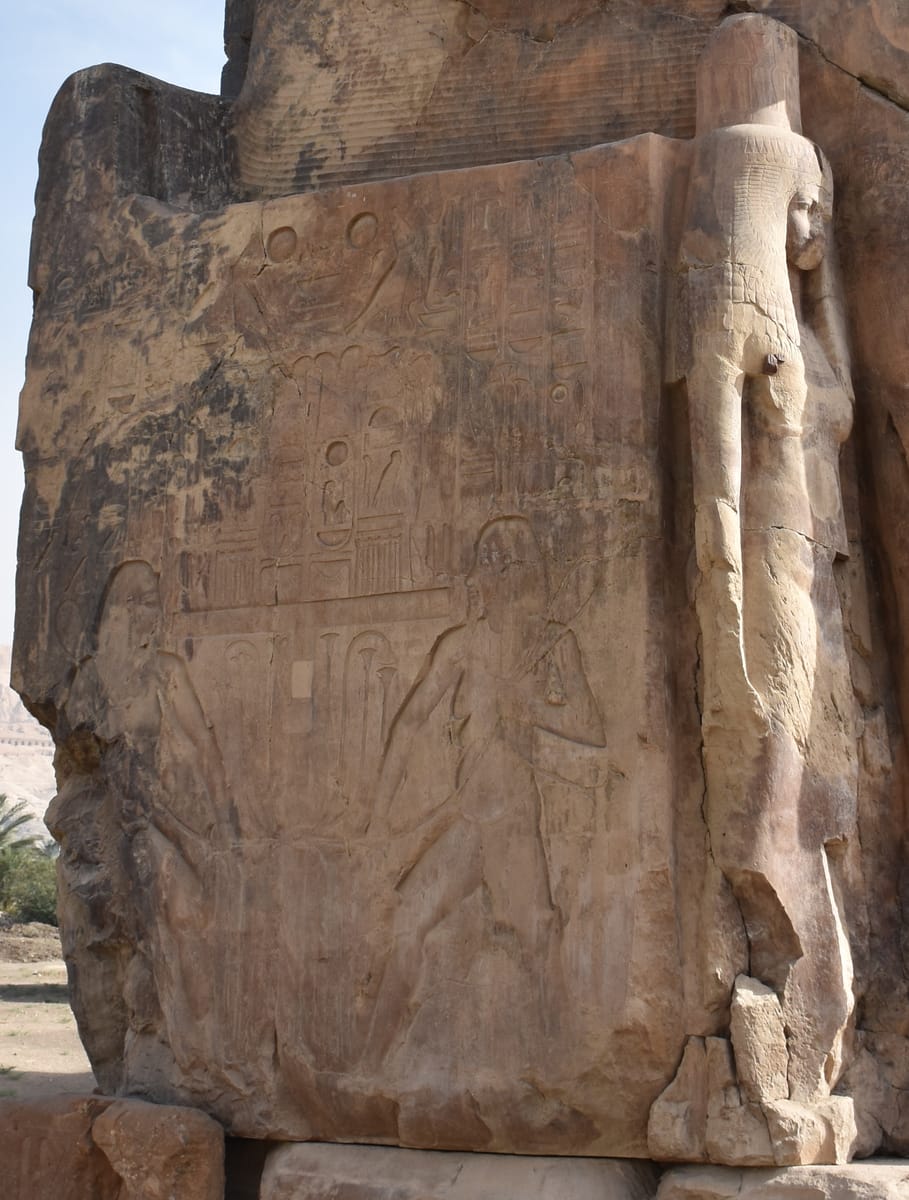
They are not solid abstractions of a king in isolation. Carved against the pharaoh’s lower legs, at a much smaller scale, are members of his family: his principal wife, Queen Tiye, and his mother, Mutemwiya, stand beside his shins, and a figure of a royal daughter once stood between his feet at the front. The sides of the thrones carry relief decoration, including the recurring image of two Nile gods named Hapi knotting together the heraldic plants of Upper and Lower Egypt — the sema-tawy, or “uniting of the Two Lands,” a standard emblem of the pharaoh’s rule over a unified Egypt.
The two statues are not in the same condition. The southern (left) colossus is a single monolithic block, weathered and battered but structurally whole. The northern (right) colossus — the one that “sang” — is different: at some point its upper body was shattered, and its torso and head are now built up from several courses of smaller sandstone blocks, a later reconstruction stacked on top of the surviving legs and lower body. Both figures are heavily eroded. The faces are essentially gone, and much of the fine detail has been lost to flood water, earthquakes, salt weathering, and the slow abrasion of millennia, so that what remains is monumental mass rather than delicate carving. The material is a hard, dense quartzite sandstone (sometimes called silicified sandstone), a stone valued for its durability and for a warm colour that ranges from yellow to red — and, crucially, a stone that does not occur naturally at Thebes.
How Was It Built?
The making of the colossi divides into two problems: shaping the stone, and getting it there. The shaping is the more ordinary of the two. Egyptian sculptors were entirely capable of dressing and carving quartzite at colossal scale using stone pounders, copper and bronze tools, and abrasive sand; the seated-pharaoh form was standard, and the surface would have been worked down, detailed, and polished by teams of craftsmen over a long period. The traditional attribution links the project to Amenhotep son of Hapu, Amenhotep III’s celebrated official and architect, who in one of his own inscriptions claims to have overseen the transport of monuments for the king — a boast that fits the colossi even if it does not prove them.
The genuinely extraordinary part is the transport, and it turns on where the stone came from. Petrographic study of the quartzite points to el-Gabal el-Ahmar (“the Red Mountain”), a quarry near Heliopolis on the outskirts of modern Cairo — roughly 675 km (about 420 miles) down the Nile from Thebes. If that is right, then two blocks each weighing several hundred tonnes were detached at a quarry in the far north of the country and moved almost the entire length of Egypt to the south. (The source of the southern colossus is less settled; some researchers have argued for a different quarry, and the blocks Roman engineers later used to rebuild the northern statue’s torso may have come from Edfu, nearer to Thebes.)
The reconstructed method draws on what Egyptian art and archaeology show elsewhere. A rough-cut block would have been levered onto a massive wooden sledge and dragged overland from the quarry to the river, hauled by large gangs of men, probably over a prepared track lubricated with water or Nile mud — the technique famously depicted in the tomb of Djehutihotep, where a colossal statue is shown being pulled on a sledge while a man pours liquid before the runners. At the river the block had to be loaded onto a heavy wooden barge and floated the rest of the way. Here the colossi pose a well-known puzzle: many analyses conclude the blocks were simply too heavy to be dragged upstream against the current, which is one reason the direction of transport — quarry in the north, temple in the south, moving with the Nile’s flow — matters, and why the northward-quarry hypothesis is attractive. On arrival at Thebes, the statues would have been dragged up earthen embankments or ramps and levered upright onto their prepared bases in front of the temple. Every individual step in this chain is attested somewhere in the Egyptian record; what has no surviving step-by-step account is this specific, near-maximal example.
The Mainstream View
Among Egyptologists there is no real mystery about what the colossi are, who made them, or when. They are firmly dated to the reign of Amenhotep III, around 1350 BCE, on the abundant evidence of the king’s own inscriptions, the temple’s stratigraphy, and the sculptural style of the period. They are mortuary-temple statues of a well-documented pharaoh, and the temple they fronted has been excavated and studied for decades, its buried remains, foundation deposits, and hundreds of fallen sculptures still being recovered by the long-running conservation project on the site.
The transport, likewise, is treated as an exceptional but explicable achievement, not an impossible one. New Kingdom Egypt is known to have quarried, moved, and raised very large quartzite and granite monuments — obelisks, colossal statues, architraves — using sledges, barges, ramps, levers, and enormous organised labour forces. The colossi sit at the upper limit of that capability, which is exactly why they are impressive; but nothing about them requires a technique the Egyptians did not otherwise possess. The mainstream account is straightforward: quartzite from a northern quarry, hauled overland on sledges to the Nile, shipped south on barges with the current, and erected on the west Theban plain.
The famous “singing” also has a broadly accepted framework. The northern colossus began to emit a sound at dawn only after an earthquake in 27 BCE cracked it; the sound then ceased, apparently for good, after the Roman emperor Septimius Severus had the statue repaired around 199 CE — the very act of filling and rebuilding the fractured upper body being the plausible reason the noise stopped. The usual physical explanation is that, at sunrise, rapid warming and the evaporation of overnight dew inside the cracked, porous stone produced small movements and released trapped air, generating a tone that visitors variously described as like a lyre string breaking, a sharp blow, or a whistle. To Greek and Roman visitors this was the hero Memnon calling to his mother Eos; more than a hundred of them recorded their visits in Greek and Latin graffiti on the statue’s legs, dated between roughly 20 and 250 CE, including verses left by the poet Julia Balbilla during a visit by the emperor Hadrian in 130 CE — making the colossi one of the best-documented tourist attractions of the ancient world.
The Open Case
The colossi are not a case of “this could not have been built.” Egypt clearly did build them, and the general method is understood. What remains genuinely open is the level of detail — and, honestly, that is where the wonder should be directed.
First, the transport. To say the blocks were “dragged on sledges and shipped by barge” is to describe a category, not a solved problem. We do not have an ancient account of how a single block of this particular size was undercut and detached at the quarry, how it was manoeuvred onto a sledge and then onto a vessel without crushing it, what a barge capable of carrying several hundred tonnes actually looked like, or how many people and how much time the whole operation consumed. These are reconstructed by analogy from smaller, better-illustrated jobs and from experimental estimates, and reasonable scholars differ on the numbers. The colossi sit near the very ceiling of pre-industrial heavy transport, and near that ceiling the ordinary explanations are stretched thin — not broken, but not comfortably demonstrated either.
Second, the stone source itself is not fully settled. The northern-quarry (el-Gabal el-Ahmar) attribution is well supported for at least one colossus, but the origin of the southern statue’s block has been argued differently, and the question bears directly on the transport puzzle, since a southern source near Aswan or Gebel el-Silsila would imply moving the block downstream rather than up, a very different logistical picture. Pinning each block to a specific quarry is still a live petrographic question.
Third, the singing was never conclusively explained while it could still be studied. The dew-and-warming hypothesis is reasonable and widely repeated, but it rests on descriptions from ancient witnesses, not on measurement; the phenomenon vanished under Roman masonry nearly two thousand years ago and cannot be tested on the original cracked statue again. Exactly what resonated, and why it happened at dawn and (mostly) not otherwise, is an inference rather than a demonstrated mechanism.
None of these open threads points to lost civilisations or vanished technologies. They point to the real and more interesting fact that when a Bronze Age state pushed its engineering to the absolute limit — two 700-tonne monoliths, moved most of the length of a country, one of them singing to Roman emperors — it left behind monuments whose sheer scale still outruns our documentation of how, precisely, it was done.
Sources
Connected findings
- The Impossible Delivery — An island with no wheels moved an 80-tonne statue on foot. A kingdom with no draft animals floated a 700-tonne one down a river. Neither had met the other.
On screen
- The Whisper You Can't Hear Yet — A note left on the statue tells you to listen at dawn. In the year the game is set, there is nothing to hear — the earthquake that gave the Colossus a voice is still seven years away.
- egypt
- thebes
- luxor
- amenhotep-iii
- new-kingdom
- 18th-dynasty
- colossal-statue
- quartzite
- monolith
- megalith-transport
- mortuary-temple
- singing-statue
- memnon
- amenhotep-son-of-hapu
Gallery