The Yangshan Quarry Stele
How did Ming quarrymen imagine moving and erecting three stone pieces weighing thousands of tonnes each, and what finally convinced them, mid-project, that it could not be done?
Why this rating?
- Construction difficulty
- 5/5
- Method uncertainty
- 4/5
- Capability gap
- 5/5
- Open questions
- 4/5
Isolating single limestone blocks up to 16,250 tonnes from bedrock by hand is an extreme quarrying feat, but the truly unresolved element is how planners ever expected to move and erect stones of this mass 15km to the tomb site: no transport plan, sledge, or ramp evidence survives, and the project was abandoned mid-course as physically unworkable — a rare case where the builders' own ambition outran their era's capability.
Overview
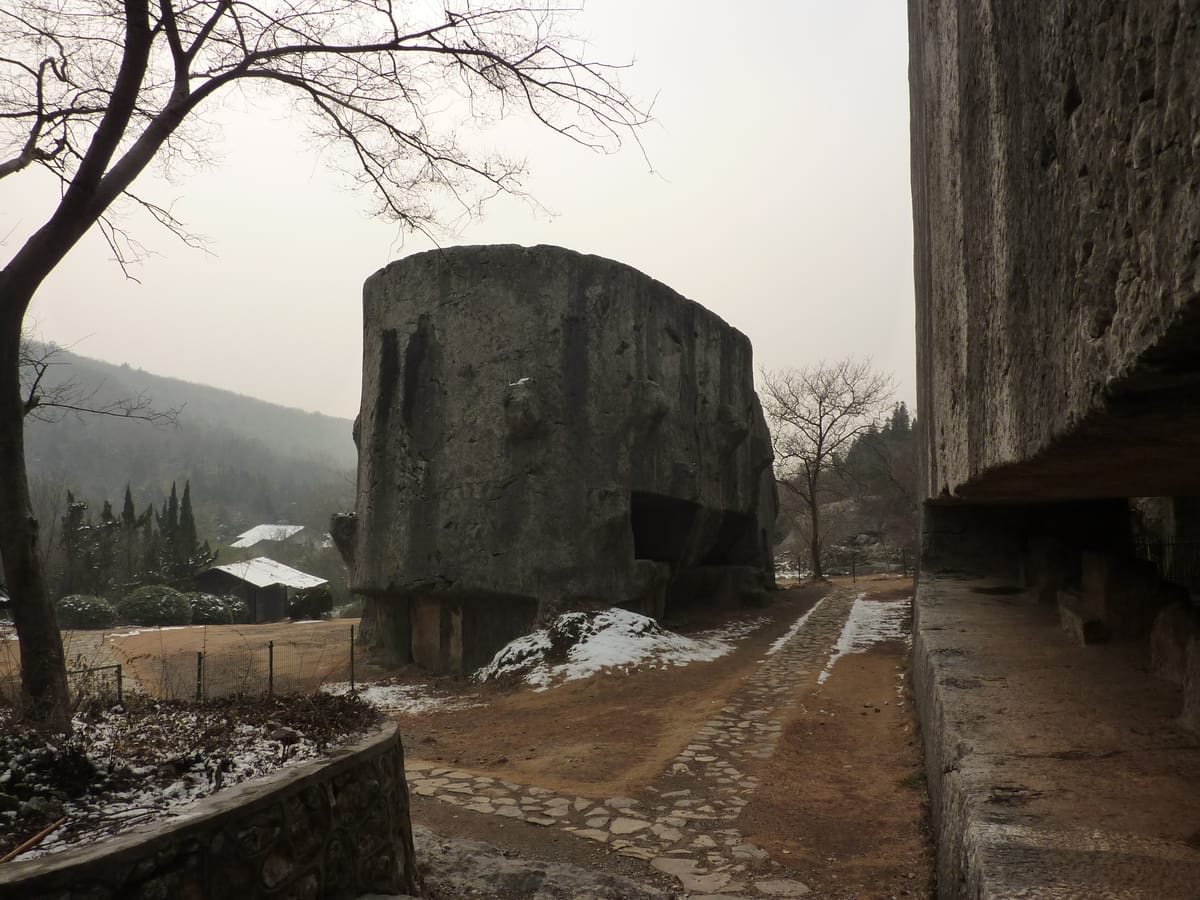
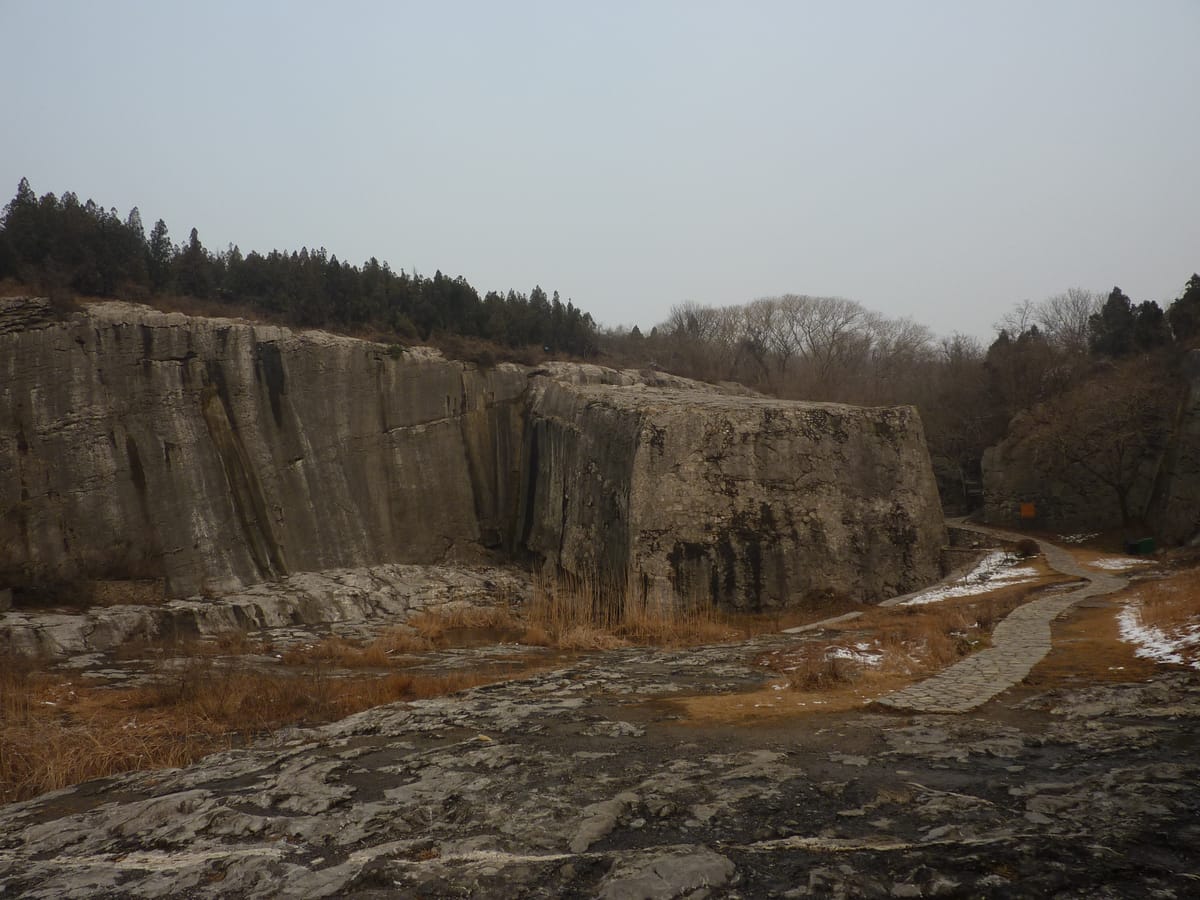
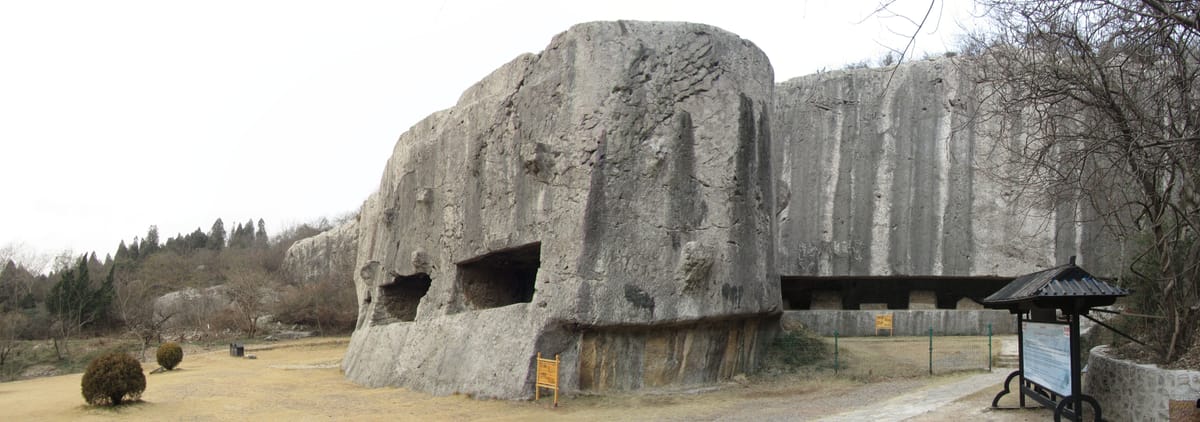
On the eastern outskirts of Nanjing, in Jiangsu Province, a hillside quarry at Yangshan holds three enormous pieces of cut limestone that were never moved from the spot where they were carved. Together they were meant to form a single memorial stele — a base, a rectangular tablet body, and a crowning head — commissioned in 1405 CE by the Yongle Emperor of the Ming dynasty to honor his late father, Zhu Yuanzhang, the Hongwu Emperor and founder of the dynasty, at his tomb complex, the Ming Xiaoling Mausoleum. Had it ever been finished, moved, and assembled, the stele would have stood roughly 73 meters (240 feet) tall, making it by far the largest memorial tablet ever attempted in Chinese history, and among the largest single monuments ever conceived anywhere. It never got that far. After years of quarrying, the project’s planners concluded that stones of this size — the heaviest piece alone is estimated at around 16,250 metric tons — simply could not be transported the roughly fifteen kilometers to the tomb site, let alone raised and stacked once they arrived. The work stopped, the three pieces were left in place, and they remain there today, protected since 1956 as a national historical and cultural heritage site and now part of a scenic and cultural park on Nanjing’s outskirts.
The Structure
Yangshan (also called Tangshan) had been quarried for building stone since at least the Six Dynasties period, centuries before the Ming dynasty made Nanjing its capital in 1368. Once Nanjing became the seat of Ming imperial power, Yangshan’s fine-grained limestone became the principal source of stone for the city’s major construction projects, including the Ming city wall. It was against this backdrop that the Yongle Emperor, having seized the throne from his nephew in 1402, ordered in 1405 that a stele of unprecedented scale be cut at Yangshan to commemorate his father’s reign and legitimize his own succession. The design called for three separate components, each cut from a single mass of bedrock: a stele base (a pedestal roughly 30.35 meters long, 13 meters thick, and 16 meters tall, weighing an estimated 16,250 tonnes), a stele body or tablet (about 49.4 meters long, 10.7 meters wide, and 4.4 meters thick, at roughly 8,799 tonnes), and a stele head or crown, intended to be carved with dragon motifs (around 10.7 meters tall, 20.3 meters wide, and 8.4 meters thick, at roughly 6,118 tonnes). Combined, the three pieces amount to more than 31,000 tonnes of stone. All three still sit in the quarry today, in separate pits a short walk from one another, largely freed from the surrounding rock on most sides but never fully detached or moved even a short distance. Because the project was abandoned, a much smaller substitute — the Shengong Shengde (“Divine Merits and Sacred Virtues”) Stele, about 8.78 meters tall and mounted on a stone tortoise base — was carved separately and installed at Ming Xiaoling’s Square City pavilion in 1413, where it stands to this day inscribed with a lengthy eulogy composed by the Yongle Emperor himself.
How Was It Built?
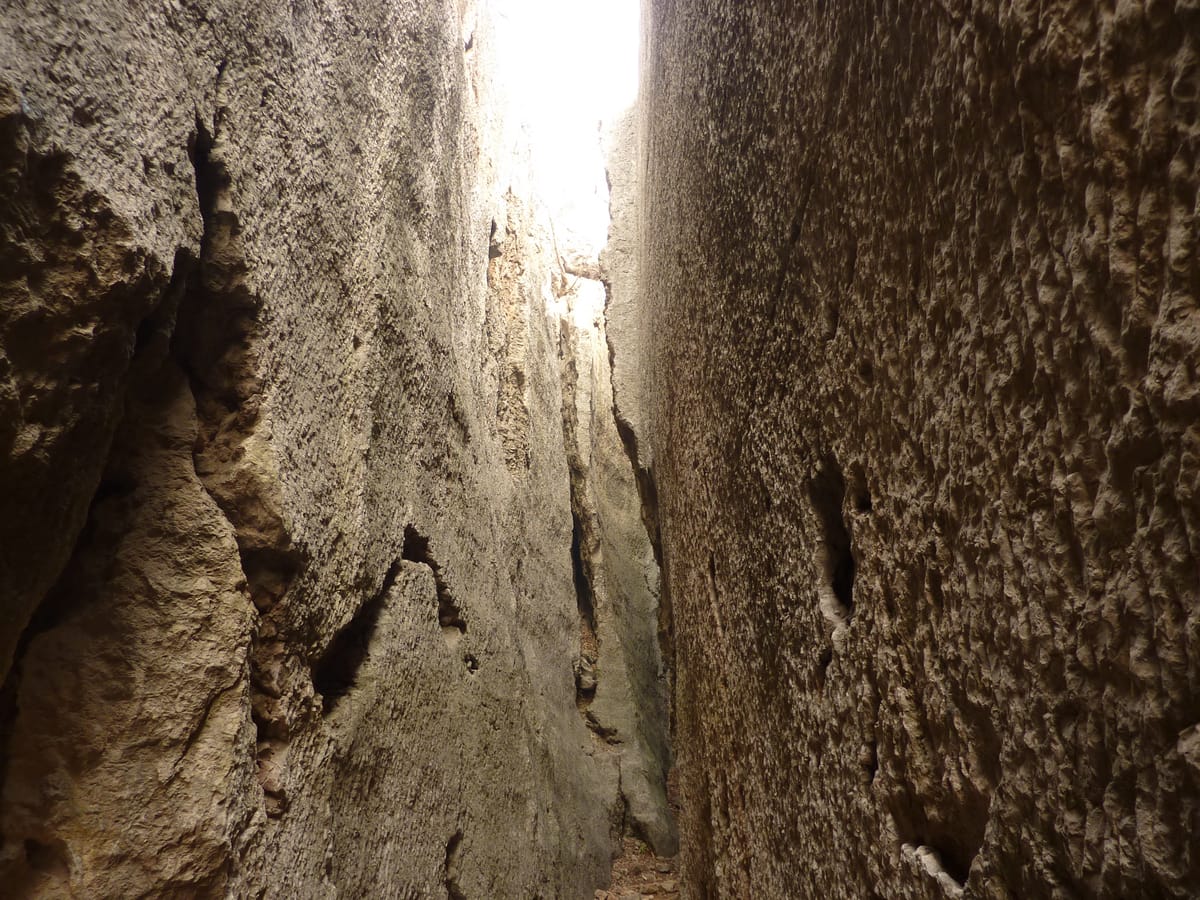
Quarrying stone of this scale used techniques attested at other large East Asian and ancient quarries: workers marked out the desired shape of each block on the exposed limestone shelf, then cut narrow galleries and trenches by hand around and beneath it, gradually isolating the block from the surrounding mountain while it remained supported on a stone shelf or a series of uncut “feet” until the final separation. Visitors to the site today can still see these channels — cut just wide enough for a worker to stand and swing a tool — running between the stele body and the head, and between the body and the mountain itself, exactly where the stonecutters stopped. What is much less clear, and not documented in any surviving Ming record, is how the builders intended to finish the job: how they planned to fully separate pieces weighing thousands of tonnes from the bedrock, drag or roll them roughly fifteen kilometers of hilly terrain to the tomb site, and then raise and stack them into a finished monument dozens of meters tall. No specifications, sledges, ramps, or transport apparatus related to the project survive, and no similar stele of even a fraction of this scale was ever completed and erected anywhere in Chinese history to serve as a working precedent.
The Mainstream View
Historians and heritage authorities treat the Yangshan project as a real but ultimately unrealistic imperial commission, not a completed engineering feat. The chronology is secure: the order to Yongle in 1405, the extensive but incomplete cutting of the three pieces, and the 1413 installation of the far smaller substitute stele at Ming Xiaoling are all corroborated across Chinese heritage records and independent historical sources. The scholarly consensus is that Ming engineers, after investing years of skilled labor in freeing the blocks from the rock, recognized partway through the project that moving stones of this mass with the sledges, rollers, capstans, and manpower available in the early fifteenth century — even methods that had successfully moved multi-hundred-tonne stones elsewhere in Chinese and world history — was not physically achievable at this scale, and the project was quietly abandoned in favor of a monument that could actually be built and installed. This is not read as a mystery of lost capability but as the opposite: a rare, well-documented case of an ambitious state project outrunning the technology available to finish it, with the evidence — the unfinished blocks themselves, still bearing the marks of the quarrying process partway through — left in plain sight rather than erased or explained away.
The Open Case
What makes Yangshan genuinely striking is not doubt about who built it or when — those facts are about as well anchored as any in Ming history — but the sheer gap between ambition and means that the site preserves intact. Nowhere in the historical record is there an explanation of exactly how the planners of 1405 expected to move and erect stones of 8,000 to over 16,000 tonnes; if a transport plan existed on paper, it has not survived, and the abandoned blocks are the only physical evidence that the attempt was ever seriously begun. That leaves real, unresolved questions for historians of engineering: how far into the project did confidence persist that the plan was workable, what specifically triggered the decision to stop, and whether any intermediate transport or lifting trials were attempted and left no trace. Unlike many “impossible stone” sites, Yangshan does not require alternate builders or lost technologies to explain it — it is exactly what it looks like: an imperial commission that reached, and then honestly hit, the hard physical limits of pre-modern stone-moving. The wonder here is not that something impossible was achieved, but that a state powerful enough to conscript the labor to cut 31,000 tonnes of stone by hand still could not find a way to carry it fifteen kilometers down a hill.
Sources
Connected findings
- The Stones Too Big to Move — Three civilizations, twenty-nine centuries apart, each pushed stone-moving to its exact breaking point — and left the proof lying exactly where it failed.
Gallery