Tikal Temple I
How do you bury a king with a 3.9-kilogram jade necklace and a bundle of inscribed bones at the bottom of a hole, then raise fifty-five metres of limestone on top of him — and cut the doorway lintels from a wood that is still holding thirteen centuries later?
Why this rating?
- Construction difficulty
- 4/5
- Method uncertainty
- 2/5
- Capability gap
- 2/5
- Open questions
- 3/5
Raising 55 metres of limestone in nine steeply battered tiers over a sealed tomb, capped with a hollow roof comb, using stone tools and no wheeled transport, is a substantial feat — but Maya construction is well understood and the Penn tunnelling exposed the sequence directly, so almost nothing about the method is mysterious. The open questions are evidential rather than technical: two of the carved sapodilla lintels were removed in the nineteenth century and are simply lost, the purpose of a bone archive whose longest text outruns every Late Classic monument at the site is unresolved, and someone reopened the burial shaft centuries later and buried a second body in it.
Overview
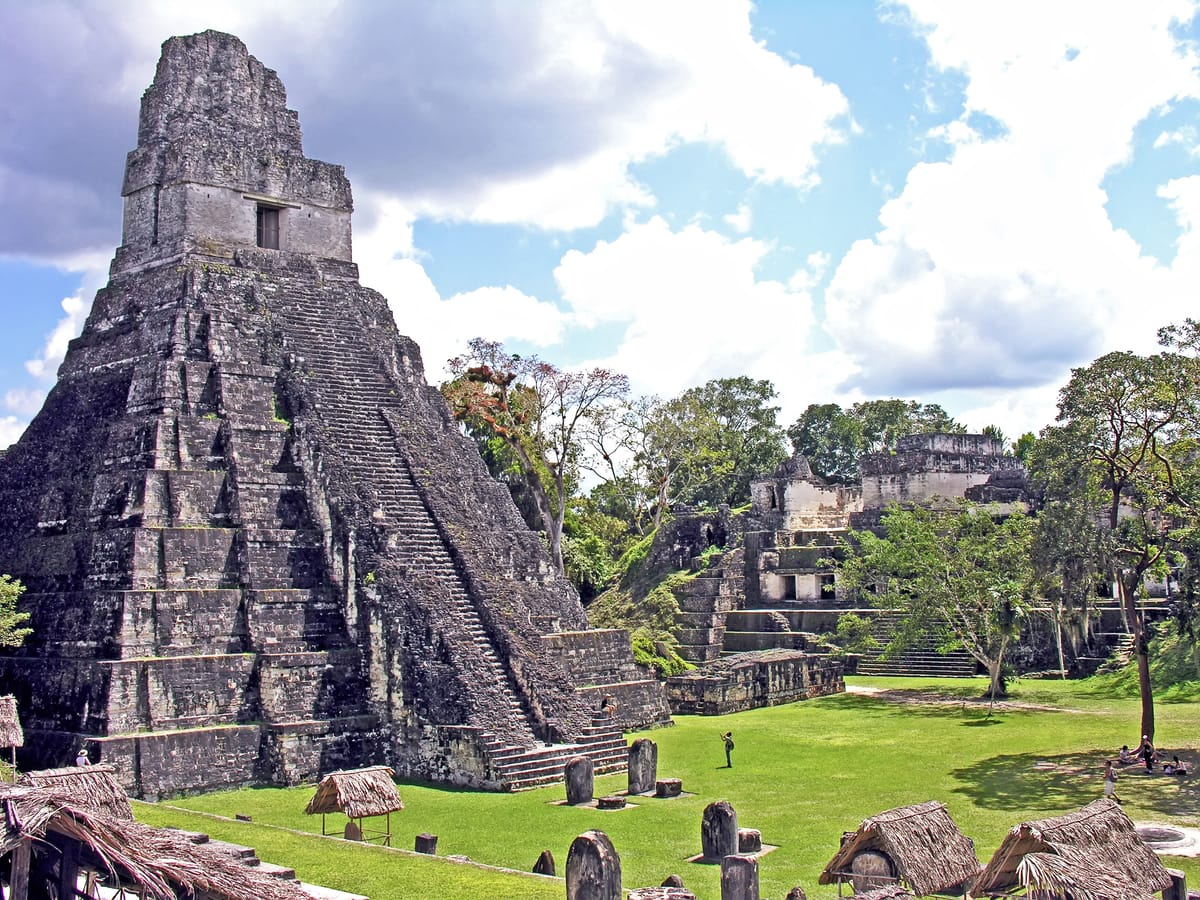
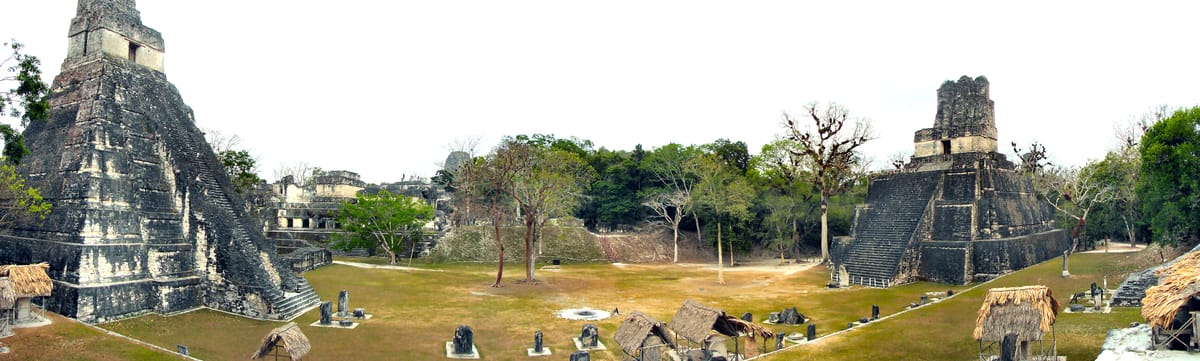
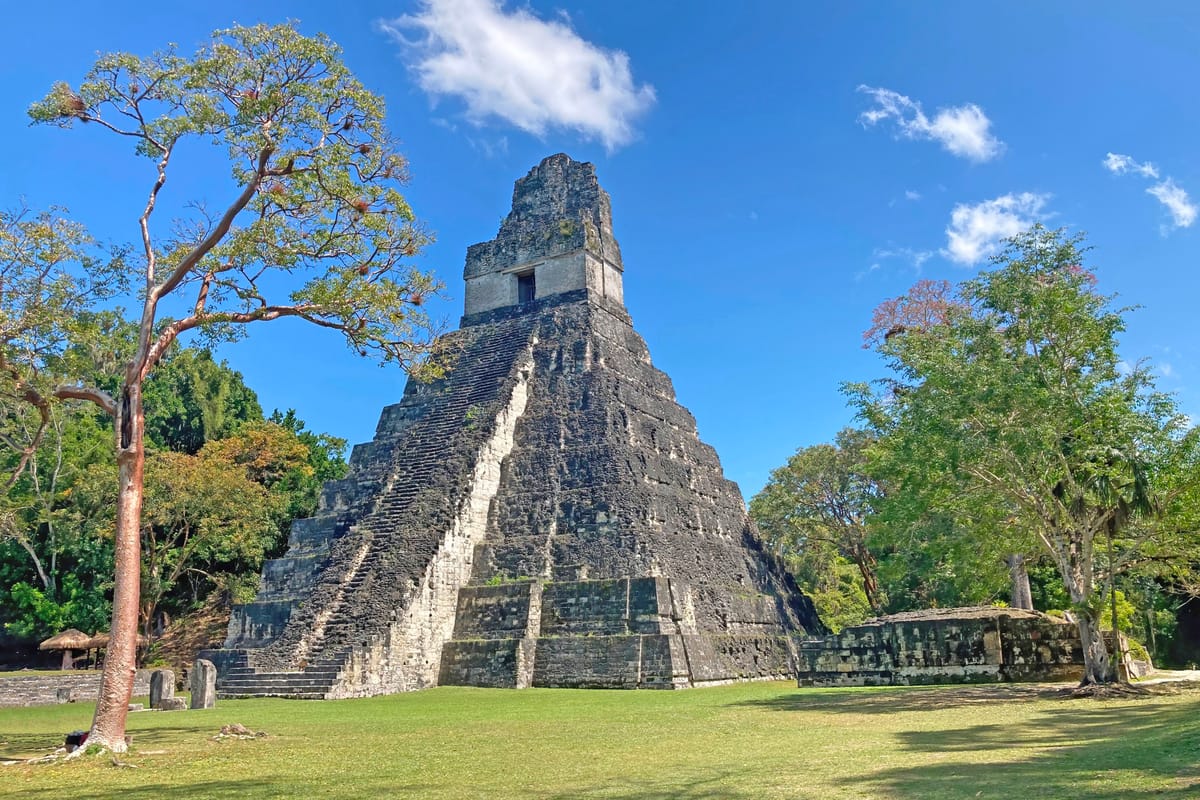
Tikal’s Great Plaza is bounded on the east and west by two temple-pyramids that face each other across the open ground. The eastern one is Temple I, known as the Temple of the Great Jaguar, and it is the image most people carry of the Maya: a steep, narrow, nine-stepped pyramid rising 55 metres out of the Petén rainforest, crowned by a small shrine and a tall crest of stone.
It is a tomb. Beneath the stairway, at plaza level, lies Burial 116 — the grave of Jasaw Chan Kʼawiil I, who ruled Tikal from 682 to 734 and who, in 695, defeated the rival superpower of Calakmul and ended a long period in which Tikal had been the losing side. The pyramid was raised over him after his death, under the direction of his son and successor, Yikʼin Chan Kʼawiil.
Its near-twin, Temple V, stands a short distance to the south, 57 metres tall and two metres taller — and nobody can say for certain whose it is. Temple I has no such problem. We know who is in it, when he died, what he did, and, in unusual detail, what was buried with him.
The Structure
The pyramid rises in nine stepped levels of local limestone, a number widely read as the nine layers of the Maya underworld. Its profile is severe: a narrow footprint, sharply battered sides, and a staircase running the full height of the north face. The overall effect is vertical in a way most Mesoamerican pyramids are not.
The summit shrine holds three narrow, dark chambers arranged one behind the next, entered through a single doorway. Their ceilings are corbel vaults braced with wooden beams. Above the shrine sits a roof comb built as two parallel walls with an enclosed vaulted hollow between them — a weight-saving void that lets the crest reach for height without loading the vaults underneath. The comb carried a carved image of the seated king framed by scrolls and serpents, finished in moulded plaster.
The most remarkable survivals are wooden. The shrine’s doorways were spanned by carved lintels of sapodilla (Manilkara zapota), a very hard red-brown timber available locally, and the carving on them survives. One shows a seated figure beneath an enormous rearing serpent. Two of these planks are now in the British Museum. Two more were removed in the nineteenth century and are lost — not mislaid in a store, but gone.
Burial 116 was found in 1962 by Aubrey Trik, during the University of Pennsylvania’s Tikal Project (1955-1964), by driving an exploratory tunnel in from the base of the stairway. The king lay on a woven mat. With him: jaguar pelts, jadeite, painted ceramics, pearls, mirrors, rare spondylus shells, an ornate jade mosaic vessel with a sculpted portrait lid, and a jade necklace of 114 large beads weighing 3.9 kilograms.
And there were the bones: a collection of incised human bones carrying, by Linton Satterthwaite’s count in 1963, no fewer than thirty-seven hieroglyphic texts and fourteen explanatory pictures — thirty of them substantially different once duplicates are set aside. The imagery includes scenes of the maize deity, and the texts touch on the king’s lineage and on other Maya courts. But their bulk is not dynastic history at all. Fourteen of the thirty carry dates, and the emphasis across the collection falls on calendrical and divinatory calculation — a working archive rather than a monument.
How Was It Built?
Temple I was built the way Tikal built: limestone quarried locally, soft when freshly cut and hardening on exposure, dressed with stone and hardwood tools; a core of rubble fill retained inside cells of masonry; lime burnt from the same limestone for mortar and plaster; corbel vaults for every roofed space. No metal, no wheeled transport, no draft animals.
What makes the building interesting is the order of operations, and it is the same problem Palenque solved a generation earlier at the Temple of the Inscriptions. The tomb is at the bottom. The pyramid is on top of it. There is no way to introduce a burial chamber, a body, and several hundred grave goods into the base of a finished 55-metre pyramid — so the chamber was cut and the king interred first, and the pyramid went up over the sealed tomb afterwards.
The difference between the two buildings is when. At Palenque, the crypt was prepared during Pakal’s lifetime and the sarcophagus lid slid over him after death, which is why it is described as the only known Maya pyramid built before its occupant died. At Tikal, the evidence points to Jasaw Chan Kʼawiil having planned his temple long in advance, but the construction itself belongs to his son. The tomb came first either way; the question is whether the client lived to watch.
The load-shedding is worth noticing too, because it is everywhere in the building. Corbel vaults cannot span much and demand heavy walls, so the shrine’s three rooms are narrow and dark. The roof comb, which exists purely to make the building taller and more visible from the plaza, is hollowed out inside rather than built solid. Every decision is about getting height and drama out of a structural system that punishes both.
The Mainstream View
There is no controversy here, and that is largely because Tikal’s rulers wrote things down and Pennsylvania’s archaeologists dug carefully.
The temple is a Late Classic Maya funerary pyramid, built around 732 CE for a named king whose reign, victories, allies and death date are attested in inscriptions across the site and beyond. Its form belongs to a well-documented regional tradition; its construction techniques are visible in its own fabric and matched at dozens of contemporary sites. The Penn Tikal Project’s tunnelling established the relationship between tomb and superstructure directly rather than by inference.
Its pairing with Temple II across the plaza is read as deliberate: two funerary monuments set to face one another, with Temple II conventionally associated with Jasaw Chan Kʼawiil’s wife. The building was patched rather than reinvented in modern times — Proyecto Nacional Tikal repaired cracks in the roof comb in 1986 — and the stairway is no longer open to visitors, who climb Temple IV instead.
The Open Case
What is unresolved at Temple I is mostly a matter of things that were taken, or things nobody has finished reading.
Two of the carved sapodilla lintels were removed from the summit shrine in the nineteenth century and have never been located. They were primary documents — Maya monumental carving on wood almost never survives the climate, and Tikal’s did, for eleven hundred years, until someone carried it away. Whatever text or imagery they held is simply subtracted from the record.
The inscribed bones are the opposite problem: they are still here, and they are dense. Satterthwaite noticed something odd about them almost immediately. One text, catalogued MT-28, runs to sixty glyph-blocks — longer than any text on a major Tikal monument of the Late Classic period. The longest surviving inscription from Tikal at the height of its power is not carved on a stela in the plaza where everyone could see it. It is scratched onto a bone, at the bottom of a shaft, under a pyramid, in the dark.
That inverts what monumental writing is supposed to be for. And it leaves open what the collection was: the bones read less like a royal biography than like working notes — dates, calculations, divination — buried with the man who used them. Whether that makes them a trophy, a relic, a personal library, or something with no modern category is not settled.
And then there is the second burial. In the Postclassic, centuries after Tikal’s collapse, someone reopened the Late Classic burial shaft and interred another body in it, leaving ceramics and censers that date to before the fifteenth century. The city was long past its power. The forest had taken most of it. Somebody still knew what that shaft was, still knew it mattered, and went back down into the dark under a ruined pyramid to put someone else there.
That is the strange note Temple I ends on. It is a monument built to be permanent and legible — a king’s name, his war, his jade, his bones, fifty-five metres of limestone to hold it all up. Most of that worked. The parts that failed were not structural. Somebody sawed the lintels out; somebody else came back and used the tomb again; and the plaster king on the roof comb, who was supposed to be the most visible thing at Tikal, has weathered down to almost nothing.
Sources
On screen
- The Wonder You Race to Finish — Age of Empires II makes Temple I your victory condition — and, in another scenario, re-fights the war the king buried under it actually won.
Gallery