The Stone Spheres of the Diquís
How did a society without metal tools or writing shape hundreds of hard igneous boulders into spheres accurate to within a few centimeters, and what did the careful arrangements of these stones mean to the people who placed them?
Why this rating?
- Construction difficulty
- 3/5
- Method uncertainty
- 3/5
- Capability gap
- 2/5
- Open questions
- 4/5
Shaping hard gabbro boulders to close-to-spherical form with only stone hammerstones and abrasives is a genuine hand-craft achievement, and no measuring tool has ever been recovered to explain the roundness checks, but the technique itself is reconstructed from unfinished quarry examples and involves no exotic capability; the deeper open question is that 20th-century plantation clearing and relocation destroyed the original context for most spheres, leaving their arrangement and symbolism largely unrecoverable.
Overview
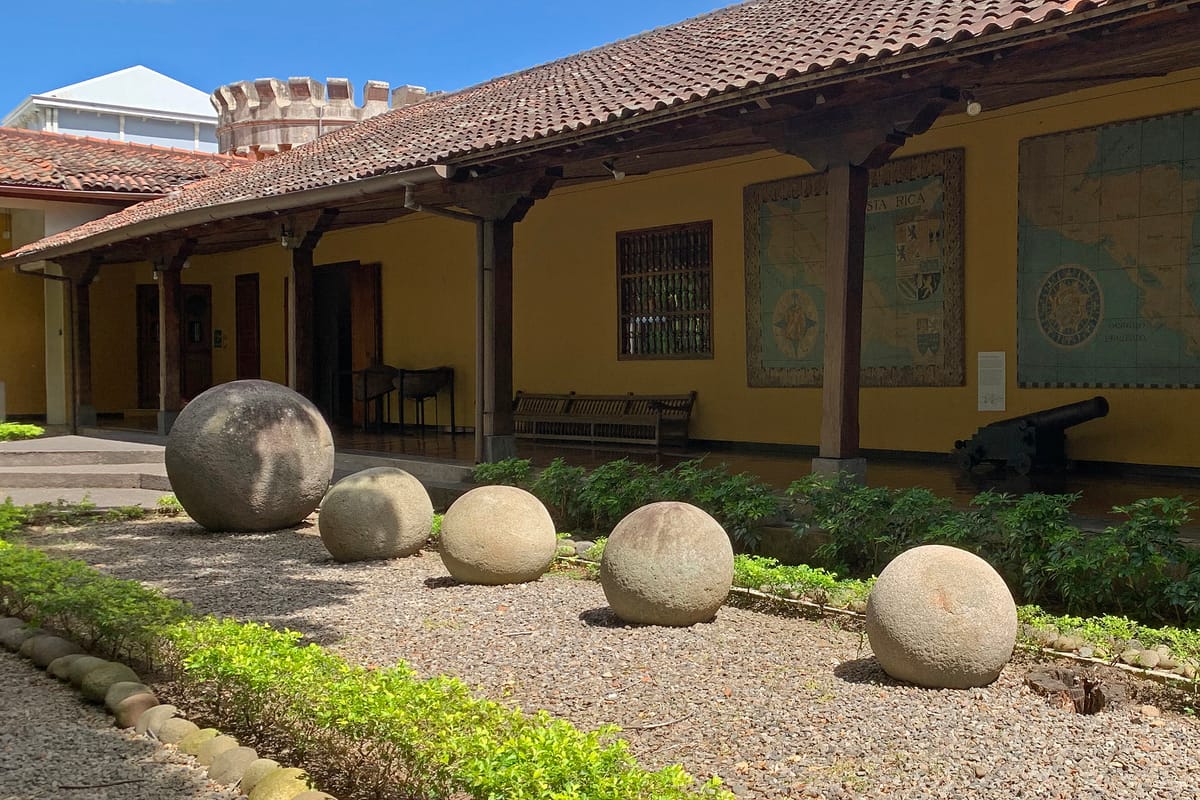
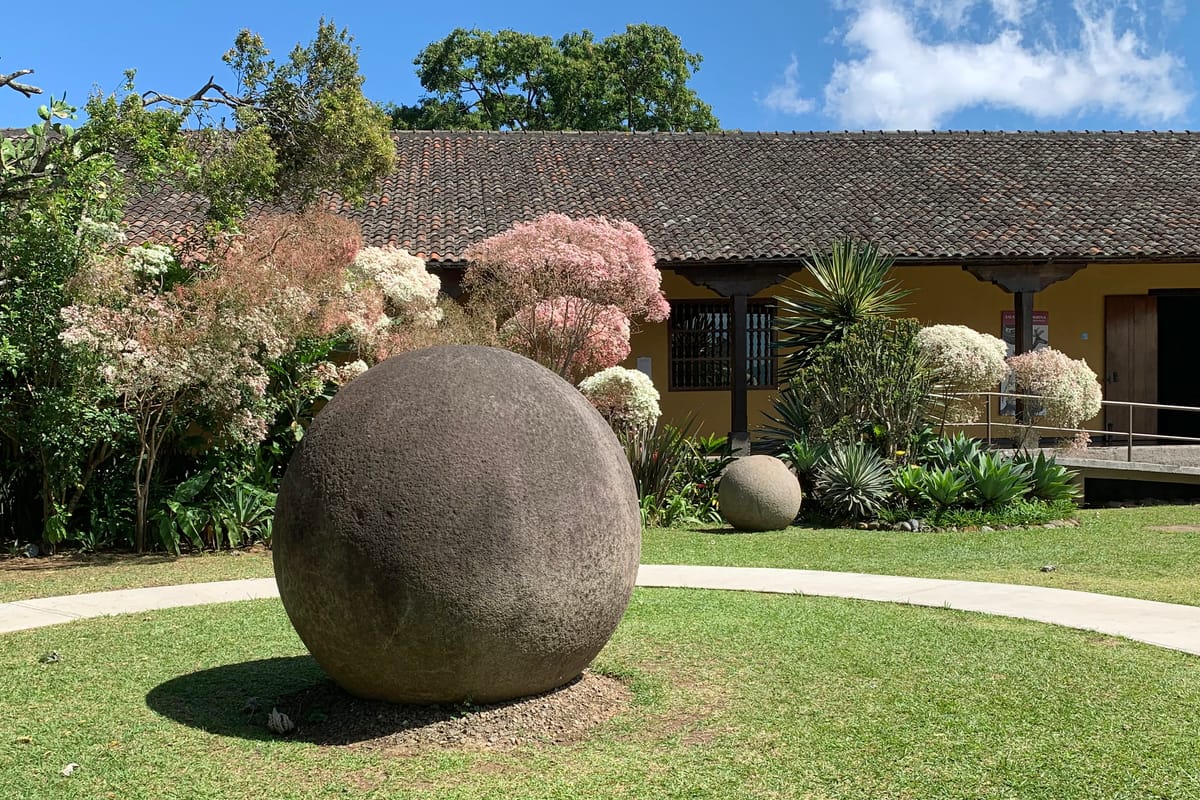
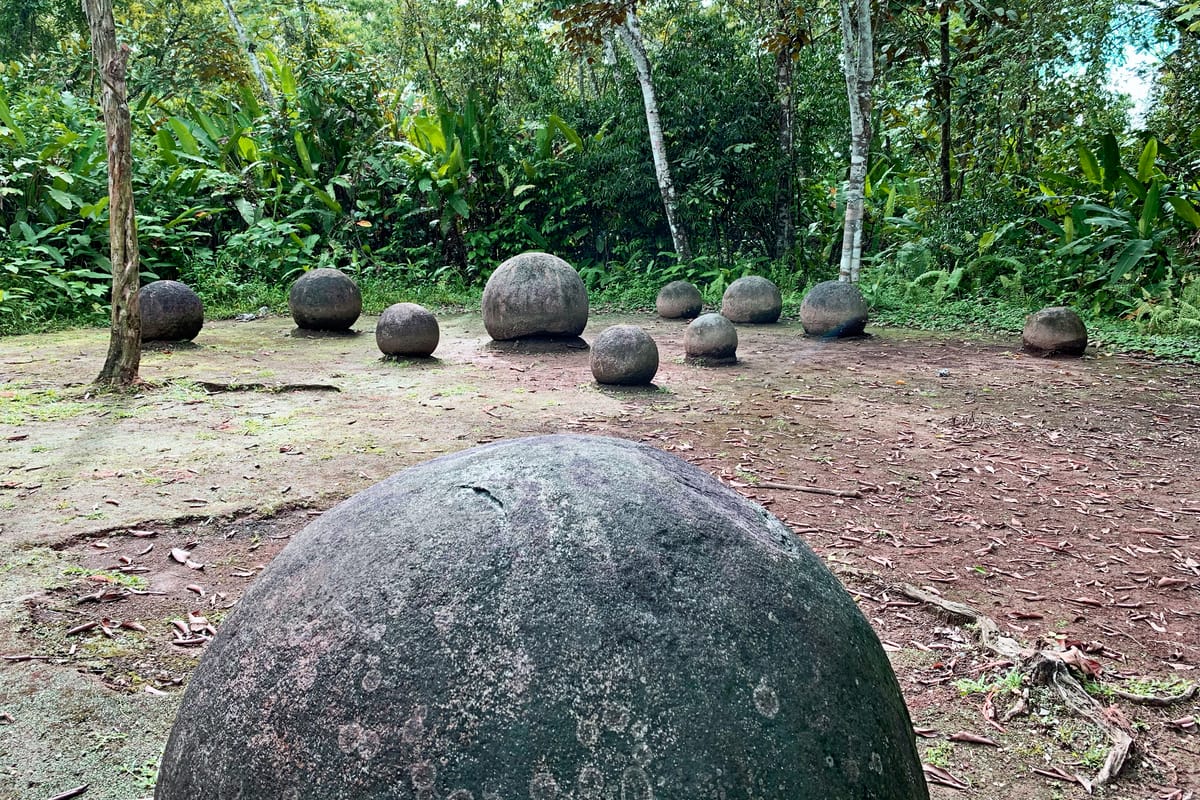
Scattered across the floodplain of the Diquís Delta in southern Costa Rica’s Osa region are hundreds of carved stone balls, known locally as “las bolas.” Some are barely bigger than a grapefruit; the largest are over two meters across and weigh as much as 15 tonnes. Nearly all were made from gabbro, a hard, coarse-grained igneous rock (a small number are limestone or sandstone), and many were shaped to a striking degree of roundness. They were made by the Diquís, an Indigenous chiefdom society that occupied the delta and surrounding valleys during the Aguas Buenas period (roughly 300–800 CE) and the following Chiriquí period (roughly 800–1550 CE), with most of the surviving spheres dating from after about 1000 CE. Rediscovered in numbers in the 1930s when the United Fruit Company cleared jungle for banana plantations, they were long treated as curiosities — moved, used as garden ornaments, even dynamited by treasure hunters — before archaeologists recognized them as part of a coherent settlement pattern. Four sites in the delta (Finca 6, Batambal, El Silencio, and Grijalba-2) retain spheres close to or in their original positions, together with mounds, paved areas, and burial grounds, and in 2014 UNESCO inscribed them as a World Heritage Site: the “Precolumbian Chiefdom Settlements with Stone Spheres of the Diquís.” What survives is valued not just for the individual stones but for what their arrangement reveals about how the Diquís organized their most important places.
The Structure
The stone spheres are not isolated artifacts but part of the built landscape of Diquís chiefly centers. Excavations, especially at Finca 6, have shown spheres positioned in lines, arcs, and clusters — associated with artificial earthen mounds, cobblestone-paved surfaces, and burial areas — suggesting they marked processional routes, defined the approach to a chief’s residence, or signaled the social importance of particular spaces. UNESCO’s inscription documents spheres ranging from about 0.7 meters to 2.57 meters in diameter, with the very largest examples elsewhere reported at up to roughly 2.66 meters and an estimated weight near 15–16 tonnes. Most known spheres, however, are considerably smaller, and their sizes vary widely even within a single site. Early claims that they were engineered to near-perfect sphericity have been tempered by later measurement: some documented spheres vary by several centimeters across their diameter, and the often-repeated figure of accuracy to a fraction of a percent traces back to Doris Stone’s and Samuel Lothrop’s mid-20th-century surveys, whose averaged tape measurements were more precise on paper than the underlying method could support. Even so, many of the spheres remain visually very close to true spheres, an impressive result achieved without metal tools, wheels, or writing. Of the roughly 300 known spheres, only a small fraction remain in a documented original context; the great majority were removed from the delta over the 20th century and now sit as decorative pieces in gardens, museums, government buildings, and public plazas across Costa Rica, including the National Museum, the Supreme Court, and the Legislative Assembly in San José — a dispersal that preserved many stones physically while erasing the archaeological context that would explain their original placement.
How Was It Built?
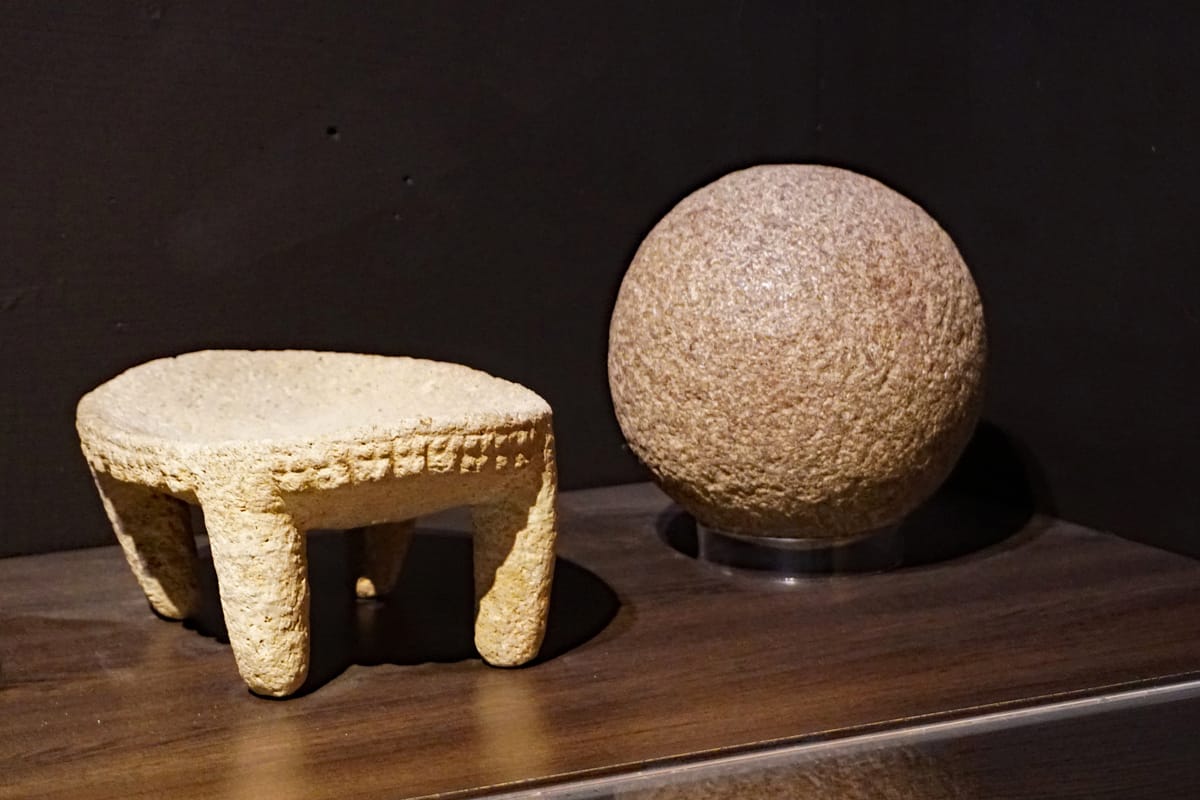
The Diquís had no iron or bronze tools, no wheeled transport, and no draft animals; the spheres were worked entirely with hand tools of stone. Archaeologists reconstruct the process, based on unfinished examples left in quarry areas a few kilometers from the delta, as beginning with selecting a suitably sized boulder of gabbro — a rock that fractures in a workable, somewhat predictable way — and then reducing it toward a spherical form through a combination of controlled fracturing (knocking off large flakes in a planned sequence), pecking and hammering with harder hammerstones to remove smaller irregularities, and finally grinding and polishing, likely using sand as an abrasive, to smooth the surface and correct its curvature. Some form of measuring template or repeated-radius check was probably used to test roundness as the work progressed, though no such tool has been recovered. The scale of labor this implies — weeks or months of skilled, physically demanding work per large sphere, multiplied across hundreds of stones — points to a society able to mobilize and coordinate significant collective effort, consistent with the chiefdom-level social organization archaeologists infer from the surrounding settlements.
The Mainstream View
Archaeologists, including John Hoopes of the University of Kansas, who evaluated the site for its UNESCO nomination, treat the spheres as the material product of ordinary (if skilled) Diquís stone craft rather than anything requiring unexplained technology. The chronology is reasonably well anchored by the Aguas Buenas and Chiriquí cultural sequence and by radiocarbon and stratigraphic work at Finca 6 and related sites, placing sphere production mainly in the centuries before Spanish contact. The favored explanation for their function is social and political: the spheres, like the mounds and paved areas they accompany, are read as markers of status and of significant space — lining approaches to the residences of chiefs, framing plazas, or signaling a lineage’s standing — rather than as tools, calendars, or religious idols in any narrow sense. This view rests on consistent patterns across the excavated sites (spheres recurring alongside elite architecture and burials), on the reconstructed manufacturing sequence supported by unfinished quarry examples, and on ethnographic and archaeological parallels for monument-building as a display of chiefly power in other pre-Columbian Central American societies. Hoopes and colleagues have been explicit in public statements that there is no evidence for lost civilizations, extraterrestrial involvement, or any technology beyond controlled stone-on-stone shaping — the craftsmanship is real, but it is Indigenous Diquís craftsmanship.
The Open Case
The Diquís left no writing, so everything about the spheres’ meaning has to be inferred from physical remains, and the physical remains were badly disturbed before serious study began. United Fruit Company bulldozers pushed spheres aside or damaged them during plantation clearing in the 1930s and after; treasure hunters, acting on rumors of gold hidden inside, drilled into and dynamited a number of spheres before the practice was stopped; and most of the surviving stones were relocated as ornaments long before anyone recorded their original position, orientation, or grouping. That loss of context is the central obstacle: archaeologists can describe how a sphere was probably shaped and can point to general associations between spheres and elite space at the few sites that escaped major disturbance, but for the majority of known spheres nobody can say with confidence exactly where they originally stood, in what configuration, or relative to what other features — which makes reconstructing their precise purpose, and dating individual examples, far harder than it would otherwise be. Even at the best-preserved locations, questions remain open: whether particular alignments encoded anything beyond status display — solar or astronomical references have been proposed but are not firmly demonstrated — and exactly how consistently Diquís crews were able to check and correct sphericity during shaping without instruments more precise than a straightedge or cord. None of this points toward lost technology or non-human builders; the stones are squarely the achievement of the Indigenous Diquís. But it leaves a real, still-open scholarly question about the fuller social and symbolic world these spheres belonged to — one that further excavation at the least-disturbed sites may still be able to answer.
Sources
- UNESCO World Heritage Centre — Precolumbian Chiefdom Settlements with Stone Spheres of the Diquís
- Wikipedia — Stone spheres of Costa Rica
- ScienceDaily — Mysterious Stone Spheres in Costa Rica Investigated (University of Kansas / John Hoopes)
- EurekAlert! — University of Kansas Researcher Investigates Mysterious Stone Spheres in Costa Rica
- lacgeo.com — Stone Spheres of Diquís, Costa Rica
Gallery