Machu Picchu
How did the Inca raise a stone city on a knife-edge Andean ridge at 2,430 meters — terracing near-vertical slopes, fitting granite blocks so tightly a blade won't slip between them, and hiding a drainage system beneath it all — so well that it has outlasted five centuries of torrential rain and earthquakes?
Why this rating?
- Construction difficulty
- 5/5
- Method uncertainty
- 2/5
- Capability gap
- 3/5
- Open questions
- 3/5
Terracing a near-vertical ridge at 2,430 meters, fitting mortarless granite walls, and burying a drainage network beneath the whole site so it survives five centuries of heavy rain and earthquakes is an extreme engineering challenge. But the methods are unusually well documented — Protzen's experiments reconstruct the hammerstone quarrying and trial-and-error fitting, and Wright's fieldwork maps the springs, canal, and hidden foundations — so relatively little of the 'how' is truly unresolved; the live debates are about the site's purpose, its exact chronology, and how deliberately its astronomical alignments were intended.
Overview
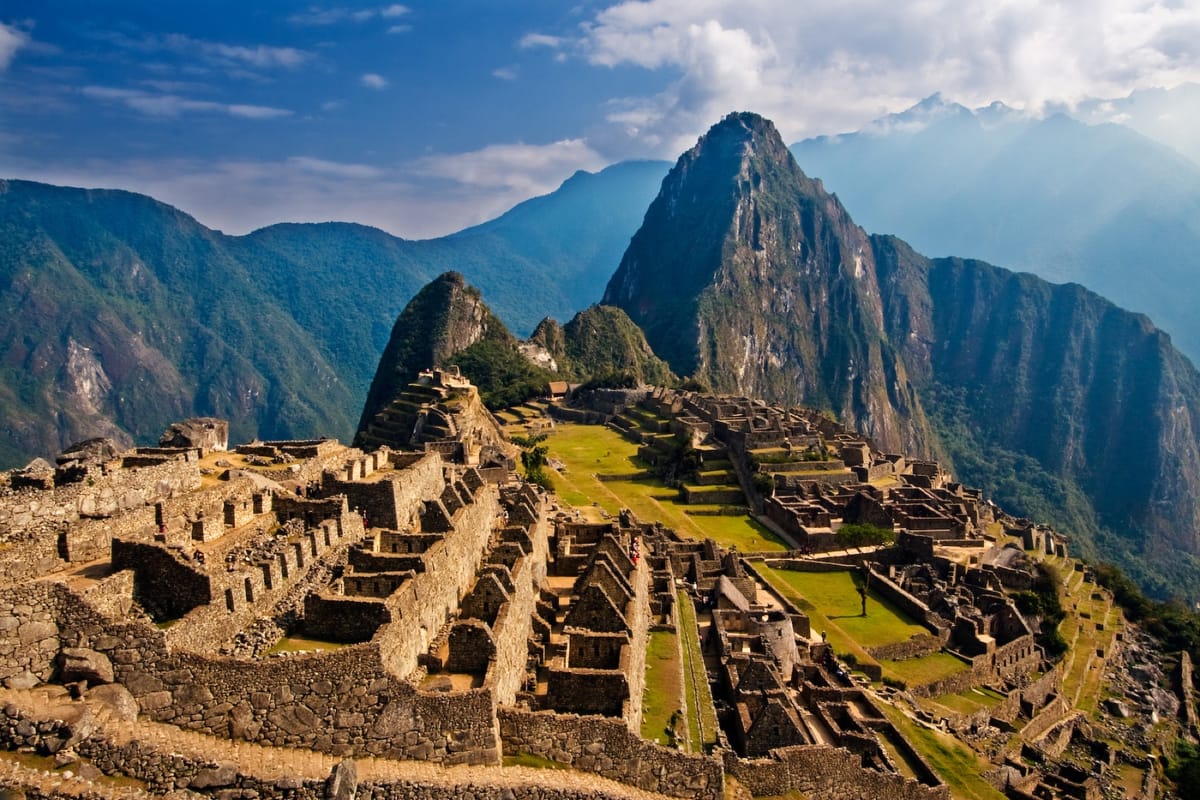
Machu Picchu is a 15th-century Inca settlement built on a narrow mountain saddle in the Cusco Region of southern Peru, roughly 80 kilometers northwest of Cusco and about 2,430 meters above sea level. It occupies the ridge between two peaks — Machu Picchu (“Old Mountain”) and Huayna Picchu (“Young Mountain”) — with the Urubamba River curling around three sides of the site far below, in a gorge whose walls fall away in cliffs of several hundred meters. The complex holds on the order of 200 structures: temples, houses, storerooms, plazas, and a broad apron of agricultural terraces, all built in the dry-fitted granite masonry for which the Inca are famous. Most scholars now read Machu Picchu as a royal estate — a country palace and religious retreat associated with the emperor Pachacuti — rather than a city in the ordinary sense; at its height it may have housed only around 750 people, most of them the retainers and specialists who ran the estate. Occupied for perhaps 80 years, it was abandoned around the time of the Spanish conquest in the 1530s and, crucially, never recorded by the Spanish, which is why it survived largely intact. Known locally but unknown to the wider world, it was brought to international attention in 1911 by the American explorer Hiram Bingham, and is today Peru’s most visited site and one of the most recognizable ancient places on Earth.
The Structure
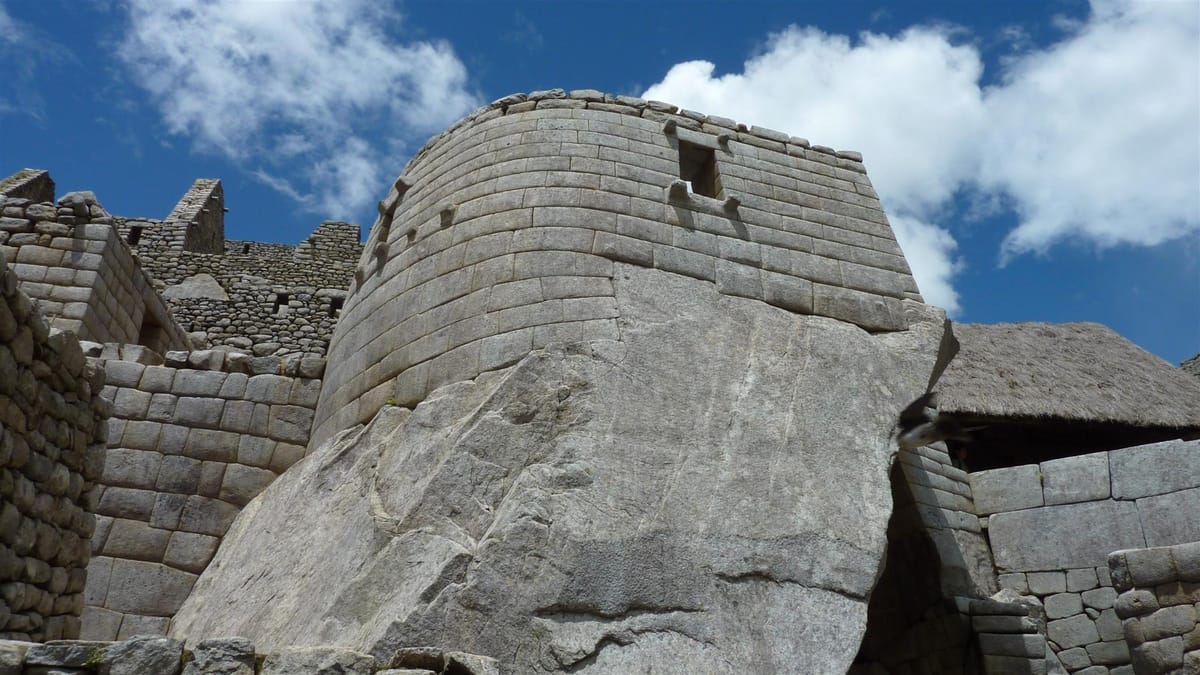
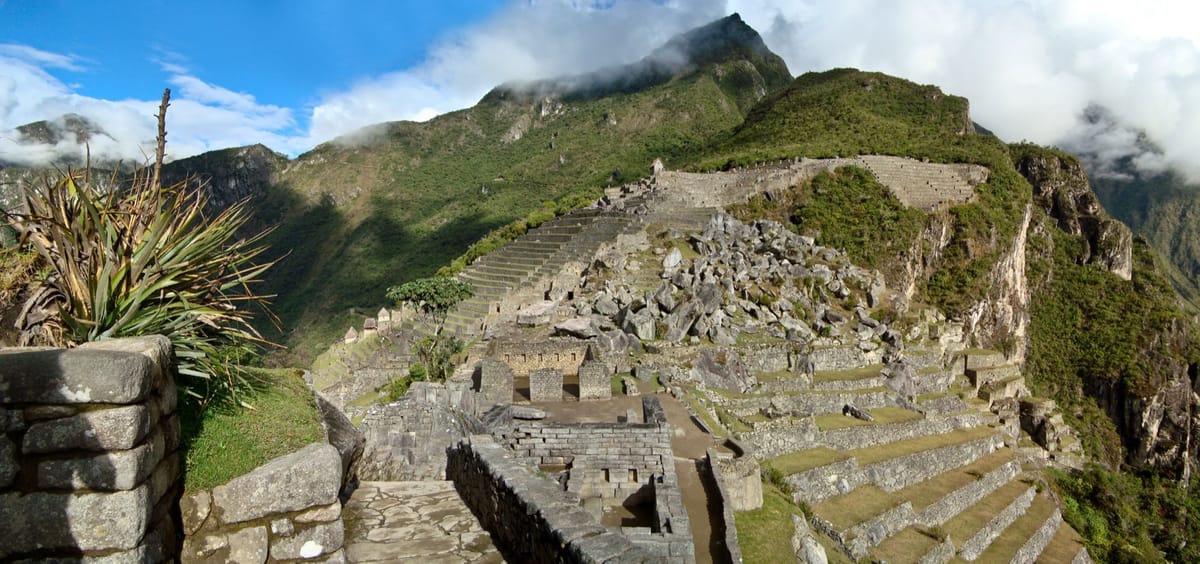
Pachacuti (Pachacuti Inca Yupanqui), the ruler who transformed the Inca from a regional power into an empire in the mid-15th century, is generally credited with founding Machu Picchu as a personal royal estate, with construction continuing under his successors; radiocarbon dates now place the main occupation from roughly 1420 to 1530, somewhat earlier than the traditional figure of about 1450 tied to Pachacuti’s reign. The site is organized into two broad zones. An agricultural sector of stepped terraces — andenes — wraps the southern and eastern slopes, turning steep ground into workable, well-drained fields and buttressing the mountainside against erosion and landslides. An urban sector, divided into an upper and a lower town by a long central plaza, holds the residential compounds, workshops, and the site’s principal religious architecture. The finest stonework is concentrated in the ceremonial buildings: the Temple of the Sun, a semicircular tower (the Torreón) raised over a natural boulder, with a window positioned to catch the June-solstice sunrise; the Temple of the Three Windows and the adjacent Principal Temple on the Sacred Plaza; and the Intihuatana, a stone pillar carved in one piece from the living bedrock, whose name is often glossed as a “hitching post of the sun” and which is tied to solar and calendrical ritual. The dominant building material is the pale granite of the ridge itself, quarried on site. Machu Picchu was abandoned as Inca authority collapsed under the Spanish invasion and the epidemics that ran ahead of it; because it lay off the main routes and was never plundered by the conquistadors, its buildings, terraces, and water system came down to the modern era in remarkable condition.
How Was It Built?
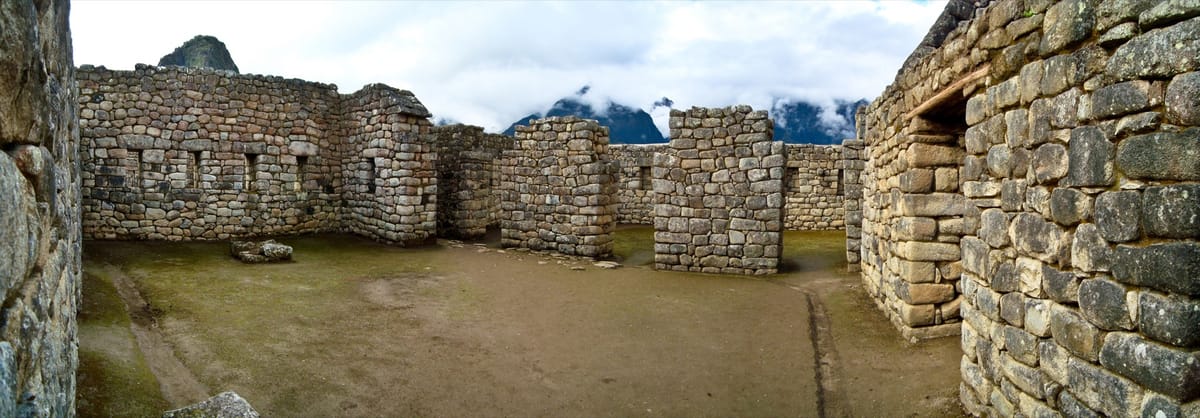
Machu Picchu was built almost entirely from granite that the Inca did not have to carry far: the ridge sits on fault-fractured bedrock, and the quarry lay within the site, a jumble of already-broken blocks that masons split further and dressed in place. Fieldwork by the architect Jean-Pierre Protzen, who reconstructed Inca quarrying and stonecutting experimentally, showed that the builders shaped stone not with iron chisels — which they did not have — but with hammerstones: rounded, hard river cobbles used in graded sizes, taking coarse “bites” with the largest and finishing with progressively smaller ones. Blocks were fitted by cut-and-try: a stone was offered up to those already laid, the contact surfaces were pounded down where they bound, and the piece was tested again until it seated tightly, so that each block was custom-cut to its neighbors like a piece of an irregular jigsaw. The best walls are true ashlar masonry — dressed blocks set without mortar in joints so fine that, famously, a knife blade will not slip between them. That mortarless fit was also structural insurance: in an earthquake-prone valley, the loosely bedded stones can shift and resettle rather than crack, letting the walls flex and settle back into place.
The less visible half of the work was, if anything, the greater achievement. On a ridge that receives heavy seasonal rain, the Inca first had to make the ground stable and dry. The terraces were built as engineered sandwiches — a base course of larger stones, then gravel, then a layer of mixed sand and gravel, capped with imported topsoil — so that water drained through them instead of pooling, saturating, and slumping. Beneath the plazas and pathways runs a hidden network of stone-lined channels and rock-chip beds that collect stormwater and carry it off the site, with roughly 130 drainage outlets built into the architecture. Drinking water came from a spring on the slope above, at about 2,458 meters, whose flow the Inca enhanced with a collection wall and then carried into the settlement by a stone canal about 749 meters long, laid at a gentle grade of roughly three percent, feeding a chain of 16 fountains that stepped down through the town — the first reserved for the emperor. The engineer Kenneth Wright, who surveyed the site’s hydraulics in detail, estimated that a majority of the total construction effort at Machu Picchu lies underground, in these foundations, terraces, and drainage works — the reason the visible city has held its ground for five centuries.
The Mainstream View
Archaeologists and engineers treat Machu Picchu as a large but thoroughly explicable Inca state project: an imperial estate raised by mobilized labor using stone tools, timber, rope, and expert planning, not any technology beyond that. The Inca state could command enormous coordinated workforces through the mit’a, a system of rotational labor tribute owed to the state, and could feed and house them for the years such a project demanded. Because the quarry was on site and the granite came pre-fractured, the hardest transport problem that dogs other Inca sites — moving multi-tonne megaliths across country — barely arose here; the blocks at Machu Picchu are large but generally movable by crews with ramps, levers, and rollers. Protzen’s experimental work supplies a consistent, tested account of how the stone was quarried, dressed, and fitted, and Wright’s surveys supply an equally concrete account of how the water was captured, moved, and drained. The archaeoastronomy is read the same grounded way: features like the Torreón window and the Intihuatana do line up with solstice sunrises and sacred peaks, but detailed modern analyses suggest they encode ritual and calendrical orientations rather than functioning as precision instruments. In this view Machu Picchu’s brilliance is one of organization and craft — an empire that could plan a whole mountaintop, drain it, terrace it, and dress its stone to a fraction of a finger’s width — rather than any lost or unexplained method.
The Open Case
What remains genuinely unsettled about Machu Picchu is less how it was built than why, when, and what for. The estate reading — a palace and retreat of Pachacuti — is the strongest, but the site has also been interpreted as a religious center, a pilgrimage destination, or a place with a shifting purpose over its short life, and the evidence does not force a single answer. Its chronology has moved: radiocarbon dating of human remains now suggests the site was in use from around 1420, a generation earlier than the date implied by tying its founding to Pachacuti’s conquests, which unsettles the neat one-emperor story. How deliberately its buildings were oriented to the sun, stars, and surrounding peaks is debated case by case, between those who see careful astronomical intent and those who see looser ceremonial alignment. Even the name is uncertain — “Machu Picchu” is the mountain’s name, attached to the ruins largely through Bingham’s publications, and what the Inca themselves called the place is not securely known. None of this is a gap that invites lost-civilization explanations; the quarry, the tool marks, the terraces, and the plumbing all read as the work of a well-documented empire at the height of its powers. The wonder of Machu Picchu is that a 15th-century state chose one of the least forgiving building sites imaginable — a rain-lashed, earthquake-prone knife of rock between two peaks — and engineered it so completely, above ground and below, that it is still standing there today, waiting to be asked how.
Sources
- Wikipedia — Machu Picchu
- UNESCO World Heritage Centre — Historic Sanctuary of Machu Picchu
- Encyclopaedia Britannica — Machu Picchu
- Wikipedia — Inca architecture
- Wikipedia — Pachacuti
- Kenneth R. Wright & Alfredo Valencia Zegarra — Machu Picchu: A Civil Engineering Marvel (Water Supply and Drainage)
- Jean-Pierre Protzen — Inca Quarrying and Stonecutting (Journal of the Society of Architectural Historians, 1985)
- World History Encyclopedia — Machu Picchu
Connected findings
- Same Staircase, Opposite Plumbing — Ifugao rice farmers and Inca stonemasons carved identical stone staircases into opposite sides of the Pacific — one built to hold water in, the other to force it out.
On screen
- The Wonder You Keep Rebuilding — You have raised Machu Picchu on a mountain tile more times than you can count.
Gallery