Karahan Tepe
How did a community with no metal tools, agriculture, or pottery organize the labor to carve hundreds of T-shaped pillars and an entire chamber of monumental pillars directly out of the bedrock, and what did the room's carved head and snake mean to them?
Why this rating?
- Construction difficulty
- 4/5
- Method uncertainty
- 3/5
- Capability gap
- 4/5
- Open questions
- 5/5
Carving hundreds of pillars and an entire sunken chamber directly out of bedrock with stone and flint tools, and no metal, pottery, or draft animals, required immense coordinated effort from communities usually assumed too mobile and unstratified to sustain it, and while the carving techniques themselves are reconstructible, the social organization behind them, the sequence and purpose of the chamber's carvings, and the meaning of its pillars, head, and snake motif remain genuinely unresolved, especially with an estimated 90%+ of the site still unexcavated.
Overview
Karahan Tepe is a Pre-Pottery Neolithic archaeological site on a limestone ridge in Şanlıurfa Province, southeastern Türkiye, roughly 35-45 kilometers southeast of the better-known Göbekli Tepe. It belongs to the “Taş Tepeler” (“Stone Hills”) group, a cluster of more than a dozen related hilltop sites — among them Sayburç, Nevalı Çori, Sefer Tepe, and Harbetsuvan Tepe — that together are reshaping how archaeologists understand the earliest stages of settled human life. Karahan Tepe was first surveyed in 1997 by Bahattin Çelik of Harran University, but its scale only became clear after large-scale excavation resumed in 2019 under Necmi Karul of Istanbul University, working with the Şanlıurfa Archaeology Museum as part of Türkiye’s coordinated Taş Tepeler Project. Radiocarbon and stylistic dating place its main phases at roughly 9500 to 8200 BCE, contemporary with or in places possibly predating Göbekli Tepe. Like its sister site, Karahan Tepe was built by hunter-gatherers who had not yet developed pottery, metallurgy, or domesticated cereal agriculture — making it, by conventional chronology, well over 11,000 years old.
The Structure
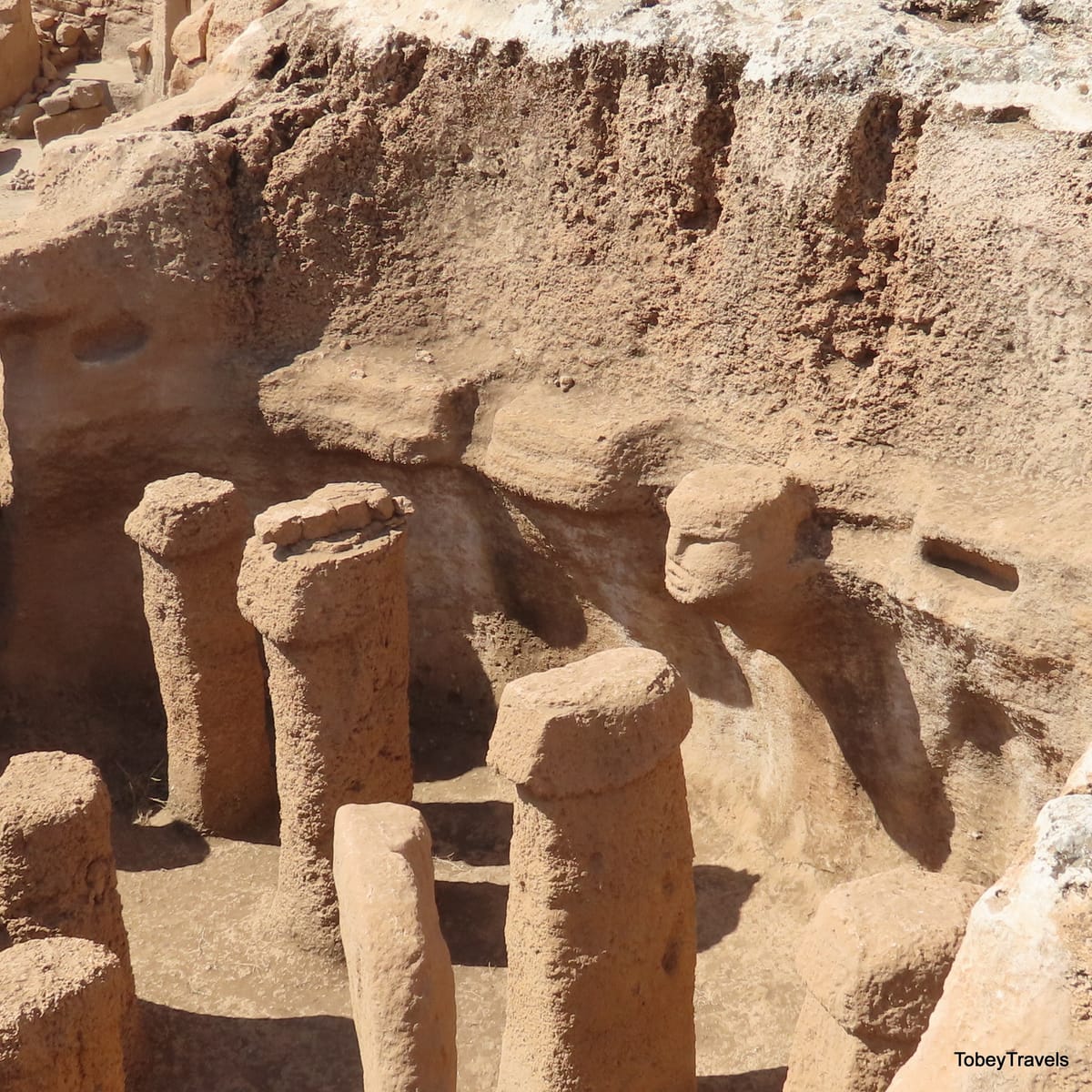
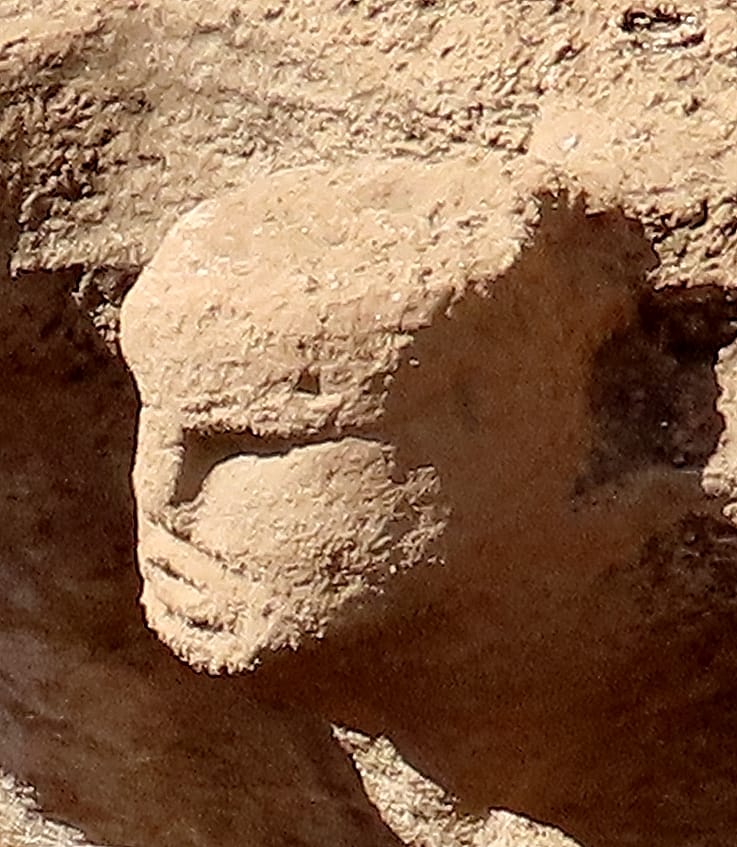
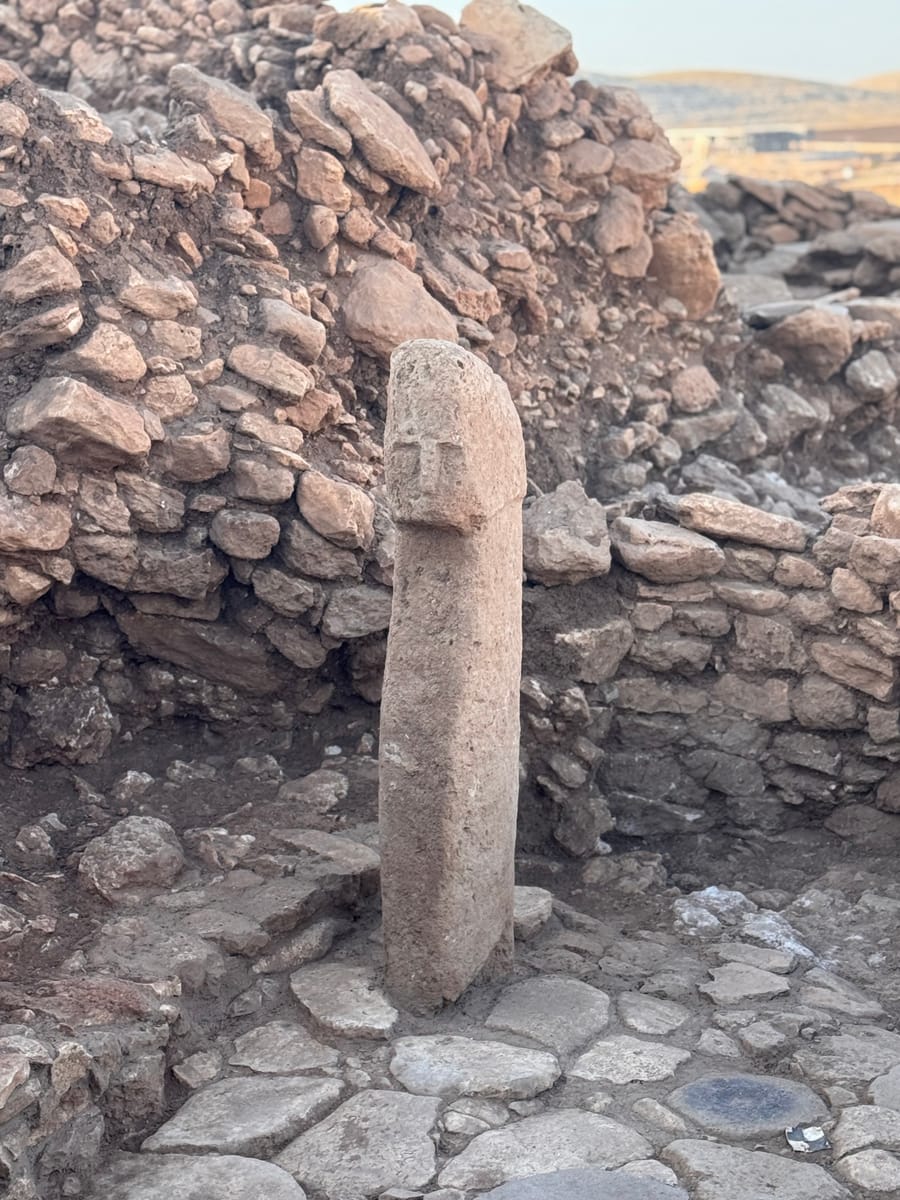
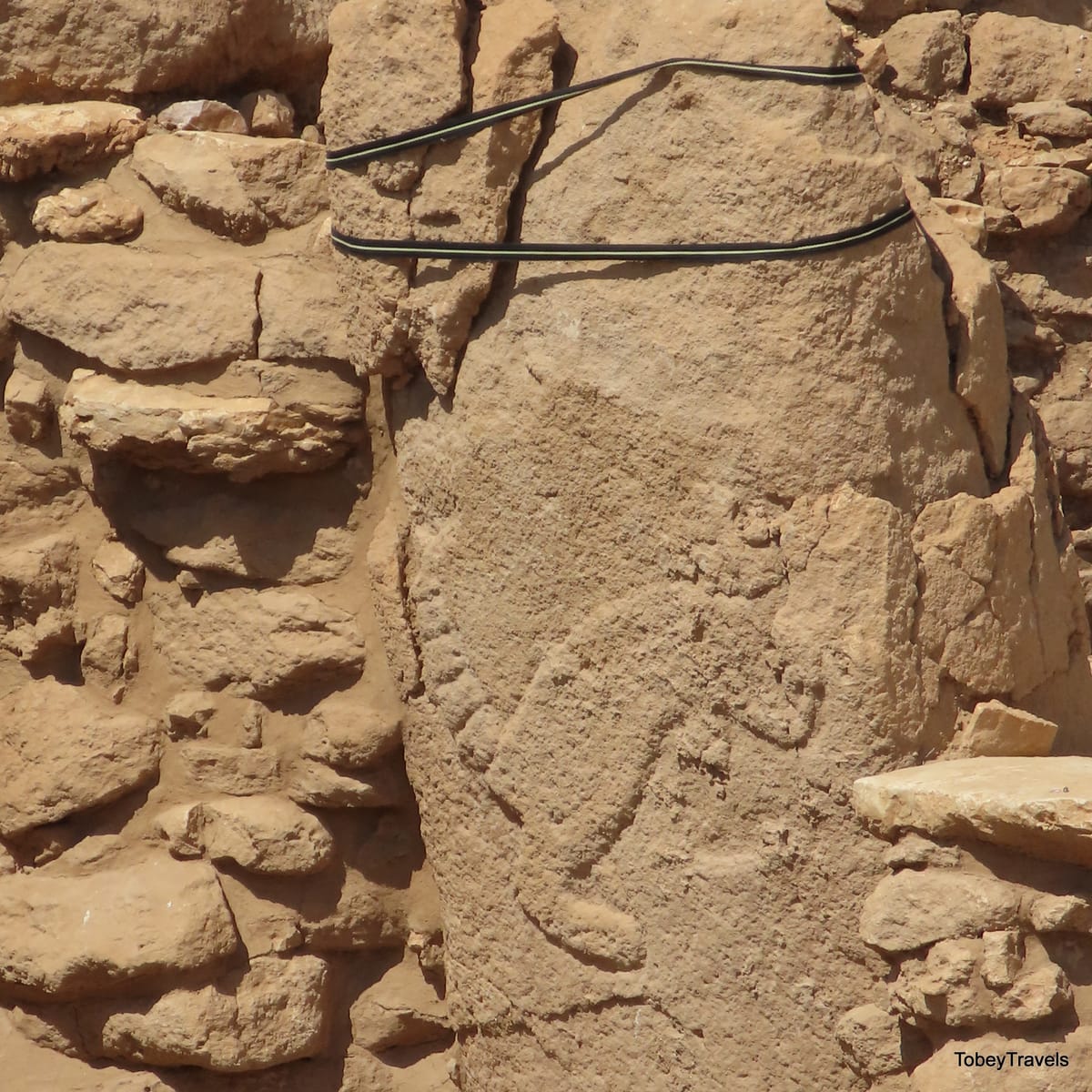
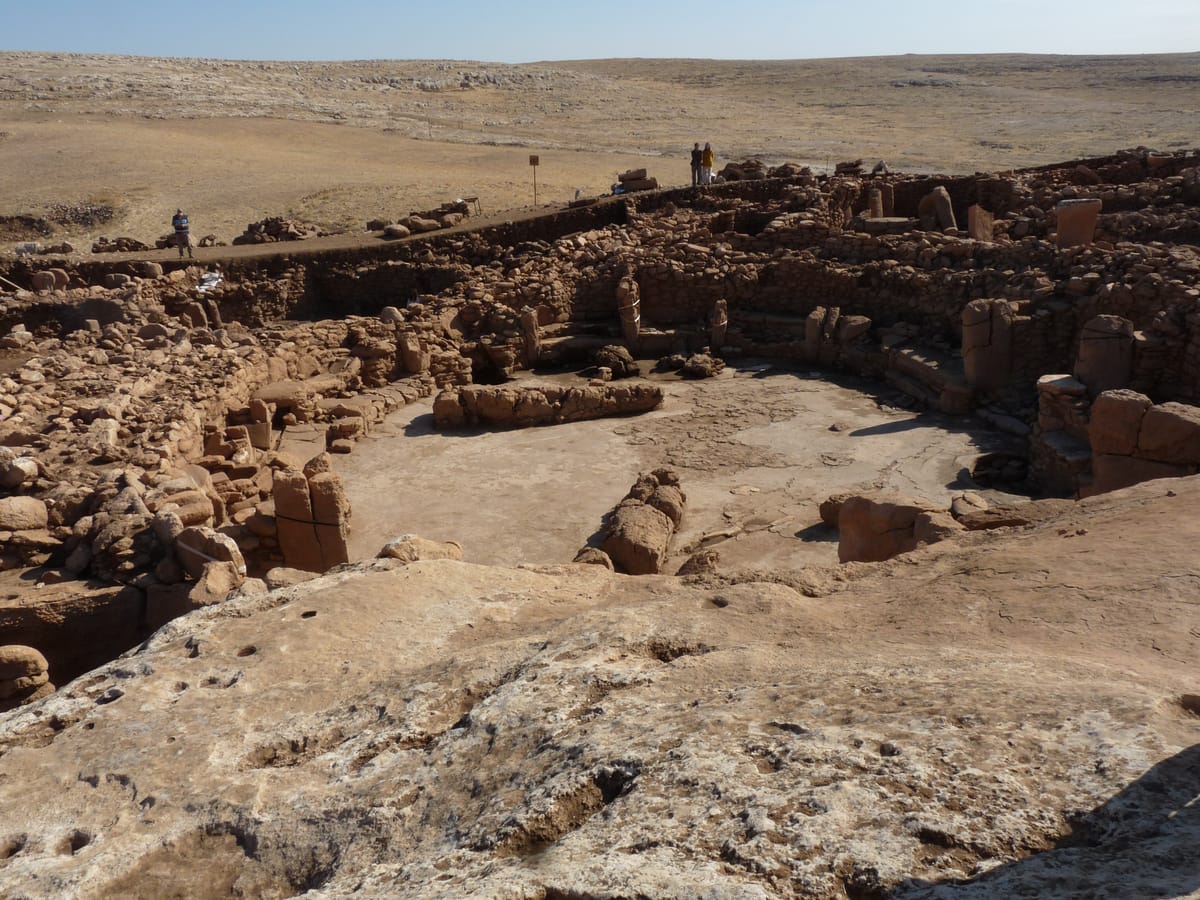
The site spans roughly 9-12 hectares of exposed bedrock, expanding further if the associated quarries are included, and geophysical survey suggests dozens of buried structures beneath its low, dome-shaped mounds. More than 250 T-shaped pillars have been documented across the hillside, many of them, unlike the free-standing megaliths of Göbekli Tepe, carved directly from the living limestone bedrock rather than quarried and erected separately. The most striking is Structure AB, a semi-subterranean, roughly circular chamber that excavators have nicknamed the “Chamber of the Pillars” or “Pillar Shrine.” Around its walls and bench rise about a dozen tall pillars carved from the bedrock floor, several with pronounced phallic form; scholars have also described these as stylized T-pillars in the same tradition seen across the Taş Tepeler sites. Dominating the chamber from the western wall is a large, three-dimensional human head with heavy brow ridges and an elongated neck, carved in place so it appears to gaze down over the room, and excavators have also recorded a carved snake or serpent motif associated with the chamber and its passageways. Other excavated areas include Structure AD, connected to AB and decorated with animal reliefs (foxes, wild donkeys, and other creatures), and — reported through 2025 — over thirty rounded, partly rock-cut domestic structures three to six meters across, arranged in a dense, honeycomb-like cluster with hearths, stone floors, storage bins, and grinding platforms. Excavators have also recovered life-sized human statues, including a seated figure grasping its own phallus and, in 2025, the first known T-shaped pillar carved with a fully modeled human face. Faunal and botanical remains indicate the inhabitants relied heavily on gazelle meat and wild legumes rather than the cereal-based diet later associated with farming societies. As of the mid-2020s, excavators estimate that only around 5% of the site has been opened, meaning well over 90% of Karahan Tepe remains buried and unexamined.
How Was It Built?
Karahan Tepe’s builders worked with a Pre-Pottery Neolithic toolkit: chipped flint and obsidian blades, hammerstones, antler and bone picks, and almost certainly wood and fiber for levers, ropes, and scaffolding, since obsidian sourced from central Anatolian volcanoes shows that raw materials and, presumably, ideas moved across considerable distances. Because so many of the pillars at Karahan Tepe were carved in place rather than quarried and transported, the engineering challenge here differs from Göbekli Tepe’s free-standing megaliths: instead of moving multi-ton stones, workers had to excavate the space around a column of living bedrock, squaring and shaping it while leaving it rooted to the floor, then carve its relief details by hand with stone tools. That approach demanded patient, skilled, repetitive labor over a large excavated area, along with the removal and disposal of enormous quantities of quarried rock and soil. Archaeologists broadly agree the physical techniques — pounding, pecking, grinding, and abrading limestone with harder stone tools — are reconstructible and unremarkable in themselves. What is harder to explain is the coordination behind them: raising and finishing a chamber like Structure AB, or maintaining dozens of rock-cut houses and workshops across a hillside, implies sustained cooperative labor, shared planning, and probably seasonal gathering of people from a wider region — organizational capacities not traditionally expected of mobile, pre-agricultural hunter-gatherer groups.
The Mainstream View
The consensus among archaeologists working at Karahan Tepe and the wider Taş Tepeler sites is that these were communal, likely ritual or symbolic gathering places built and used by increasingly settled — though still pre-agricultural — hunter-gatherer communities, whose labor was organized through social or religious structures rather than a centralized state or elite hierarchy. The presence of domestic structures alongside monumental ones at Karahan Tepe, unlike at Göbekli Tepe, has strengthened the view that the site combined everyday habitation with periodic communal ceremony, and researchers increasingly treat construction of these shared monuments as a plausible catalyst that drew mobile groups into more settled life, arguably preceding rather than following the adoption of agriculture. The phallic pillars, human head, and animal reliefs are generally interpreted as expressions of a shared symbolic or belief system — concerned with fertility, ancestry, or the natural world — though no one has deciphered a specific narrative or “reading” of the imagery, and archaeologists caution against imposing later religious concepts onto structures this old. The T-shaped pillar form itself, seen across the Taş Tepeler sites and at Göbekli Tepe, is widely thought to be an abstracted human figure, based on pillars elsewhere in the region carved with arms, hands, and belts.
The Open Case
What remains genuinely unresolved is not whether Karahan Tepe’s builders could carve bedrock — they clearly could — but how a still-mobile, pre-agricultural society mustered and coordinated the sustained labor force needed to do it at this scale, sustaining work on quarries, chambers, and dozens of rock-cut houses without the food surpluses, social stratification, or administrative tools that later monumental societies relied on. The purpose of Structure AB itself is debated: was it a space for initiation rites, seasonal gatherings, ancestor veneration, or something else entirely, and why carve the human head and snake motif into that particular room rather than elsewhere on the hillside? The relationship between Karahan Tepe and Göbekli Tepe — sister sites separated by some 35-45 kilometers and possibly a few centuries — is itself an active research question: were they built by the same community, rival groups, or loosely connected networks sharing a common symbolic language across the wider Taş Tepeler world? With excavation estimated to have reached only a small fraction of the site, every new season has so far added new structures, statues, and questions rather than settling old ones — leaving open just how much of this hillside’s story, and the society that carved it, is still waiting underground.
Sources
Connected findings
- The Hills That Were Carved Into People — Ten thousand years and sixteen thousand kilometres apart, two peoples with no metal reached the same conclusion: don't move the stone to carve it. Carve it where it lies.
Gallery