Great Sphinx of Giza
How did Old Kingdom Egyptians carve the largest monolithic statue of antiquity — a 73-metre human-headed lion — in place from a single limestone ridge, and why, four and a half thousand years later, can we still not name with certainty the pharaoh who ordered it?
Why this rating?
- Construction difficulty
- 3/5
- Method uncertainty
- 2/5
- Capability gap
- 1/5
- Open questions
- 3/5
Nothing about the Sphinx demands an explanation beyond Old Kingdom Egypt: it was carved in place from the plateau's own limestone using the copper tools and stone abrasives well attested for the period, and the same quarry supplied blocks for the adjacent temples. Carving a single 73-metre statue directly from bedrock was a genuine feat of scale and planning, hence a moderate construction score, but the technique is well understood, so method uncertainty and the capability gap are low. What keeps the open-questions score up is real and specific: the statue carries no builder's inscription, and serious Egyptologists still disagree over whether Khafre, Khufu, or Djedefre commissioned it and exactly when — an honest, unresolved question of attribution, not of lost technology. The fringe 'water erosion' claim of a far older Sphinx is rejected by mainstream geology and does not raise the score.
Overview
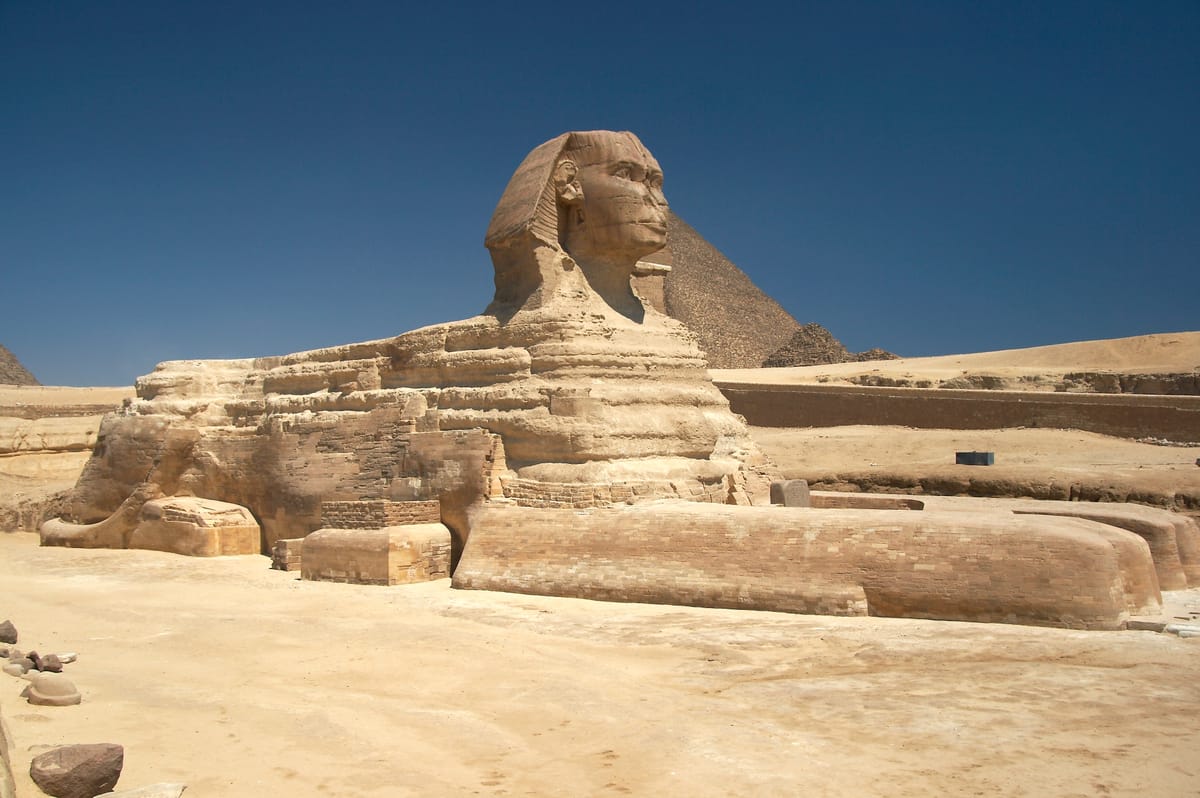
The Great Sphinx of Giza is the largest monolithic statue to survive from the ancient world, and one of the most instantly recognisable objects ever made by human hands. It takes the form of a recumbent lion with a human head, carved directly out of the limestone bedrock of the Giza plateau on the west bank of the Nile, a short distance southwest of modern Cairo. Measured from the outstretched front paws to the curl of the tail it runs about 73 metres long; it stands roughly 20 metres high at the crown of the head and about 19 metres wide across the haunches. Unlike almost every other colossal statue of antiquity, it was not built up from quarried blocks and hauled into position — it was cut in situ, freed from the plateau by carving away the rock all around it, so that the body, legs, and head are essentially a single continuous piece of the ground on which it sits.
The Sphinx does not stand alone. It lies at the eastern edge of the Giza necropolis, the vast Fourth Dynasty cemetery dominated by the three great pyramids of Khufu, Khafre, and Menkaure — a landscape inscribed by UNESCO as part of the “Memphis and its Necropolis” World Heritage Site. It sits immediately beside the Valley Temple of Khafre and at the foot of that king’s causeway, facing due east toward the rising sun. This physical link to Khafre’s pyramid complex is the backbone of the mainstream case for who made it and when: most Egyptologists date the monument to Khafre’s reign, around 2500 BCE, in the Old Kingdom. What makes the Sphinx a genuine puzzle rather than a simply famous ruin is that, for all its scale and prominence, it bears no contemporary inscription naming its builder or stating its purpose. Its face has been deliberately mutilated, its beard has fallen, and it has been buried and dug out of the sand more times than any monument on Earth. Around that silence has grown a serious scholarly debate over the exact king responsible — and a much louder popular argument, rejected by geologists, that the statue is thousands of years older than the pyramids beside it. This study takes the solid history first, then the questions that remain honestly open.
The Structure
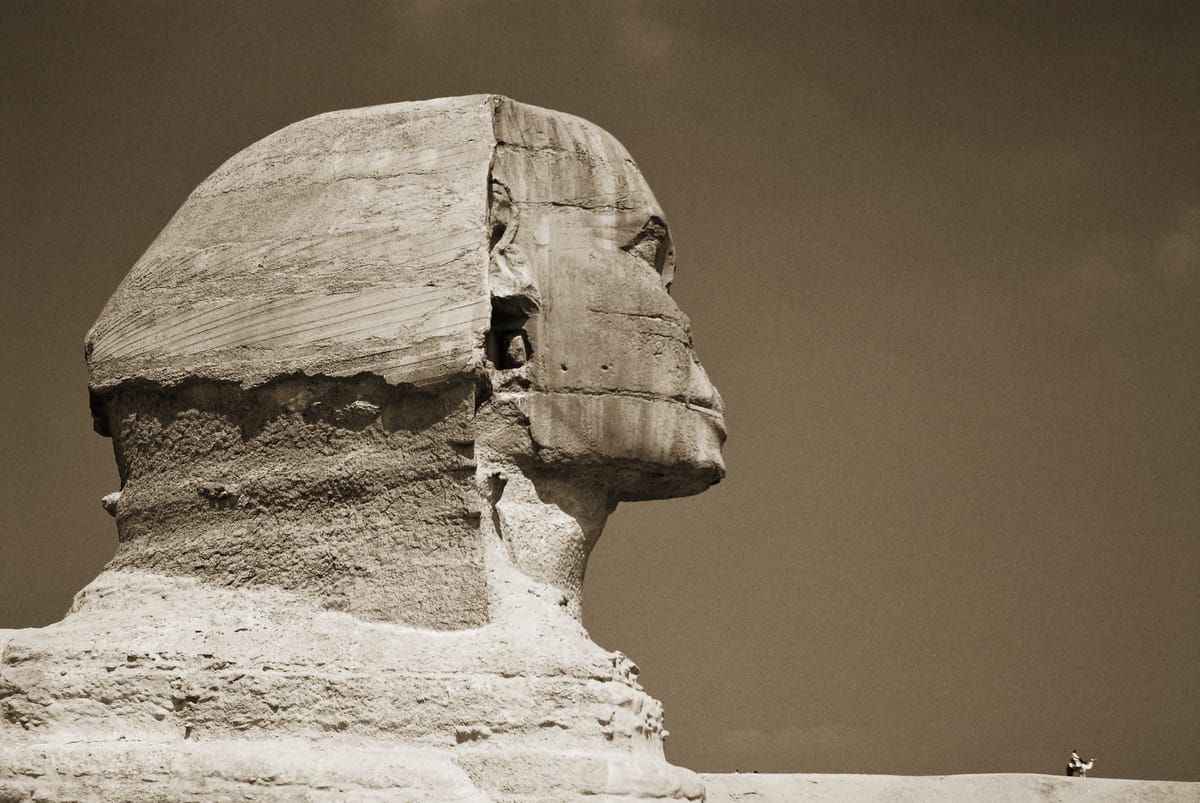
The Sphinx was carved from the nummulitic limestone of the Mokattam Formation, laid down in a shallow Eocene sea tens of millions of years ago. Crucially for its history, this rock is not uniform. Geologists describe the ridge in horizontal layers of markedly different hardness: a hard but jointed lower stratum that forms the base and paws, a thick sequence of soft, chalky, easily eroded layers that make up most of the body, and a harder, more homogeneous upper layer from which the head and neck were shaped. This layer cake explains much of what a visitor sees today. The head, cut from durable stone, has kept its human features across forty-five centuries; the body, cut from the soft middle strata, has weathered into deep horizontal recesses and repeatedly crumbled, requiring restoration campaign after restoration campaign. The differential decay is not a mystery so much as a direct read-out of the geology the sculptors were given to work with.
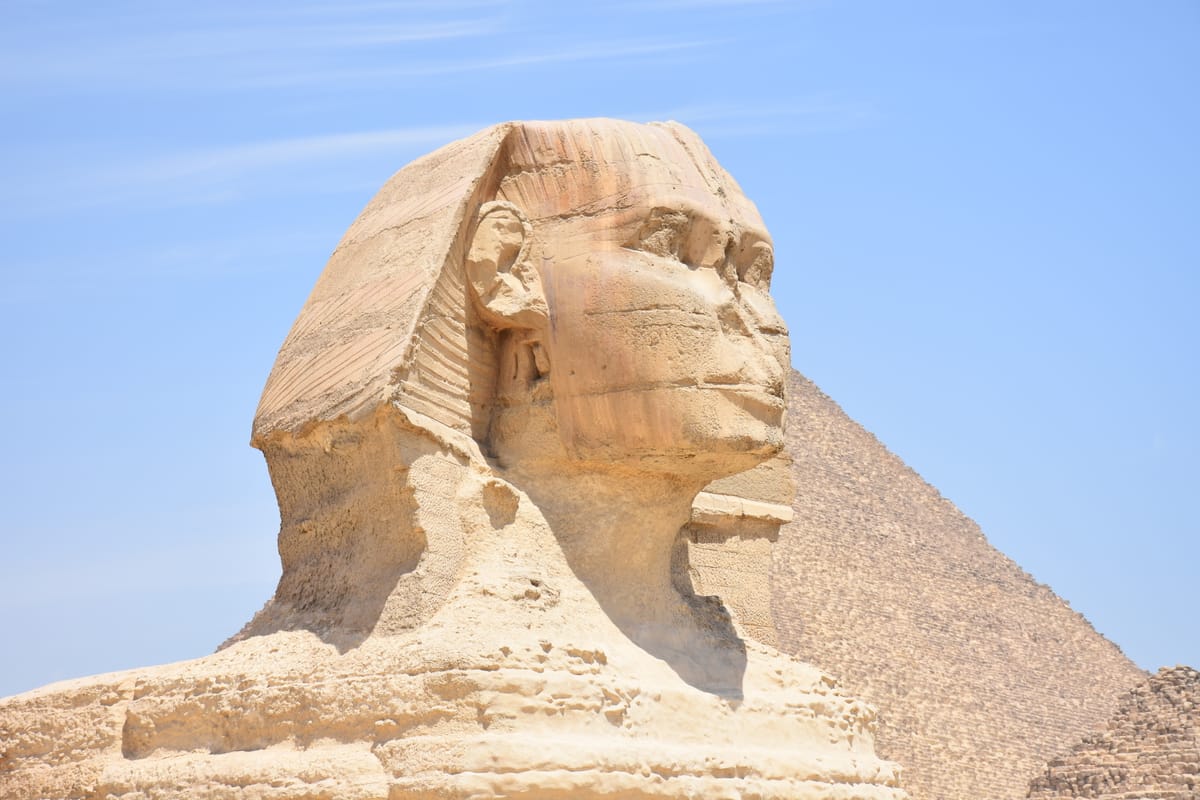
The human head wears the royal nemes, the striped linen headcloth of the pharaohs, and once bore a uraeus cobra at the brow and a long plaited ceremonial beard at the chin. Fragments of that beard, which broke away in antiquity, are today divided between the British Museum in London and the Egyptian Museum in Cairo; some scholars argue from the way it was attached that the beard may have been a later addition rather than part of the original carving. Traces of pigment surviving on the face — reds, yellows, and blues — show that the Sphinx, like most Egyptian statuary, was once brightly painted rather than the bare stone we see now. The lion’s body, paws stretched forward, embodies royal power and a solar-guardian role; the fusion of lion and king expresses the pharaoh as a divine protector of the sacred necropolis behind him.
The statue lies in a rock-cut hollow, sometimes called the Sphinx enclosure or “ditch,” the quarry-like depression left when the surrounding stone was removed to isolate the body. Directly in front of it, to the east, stand the ruins of the Sphinx Temple, built from limestone blocks quarried out of that same enclosure — some of them enormous, weighing on the order of a hundred tonnes or more — and immediately to the south lies Khafre’s near-identical Valley Temple. Between the great paws, later kings placed monuments of their own. The most famous is the Dream Stele of Thutmose IV, a granite slab about 3.6 metres tall erected around 1400 BCE, more than a thousand years after the Sphinx was carved. Its inscription tells how the young prince, resting in the statue’s shadow during a hunt, dreamed that the Sphinx — worshipped by then as the solar god Horemakhet, “Horus in the Horizon” — promised him the throne of Egypt if he would clear the sand that was burying it. A partly damaged line of that text mentions the name “Khaf,” which early Egyptologists such as Thomas Young restored as “Khafre,” and which became one strand of evidence linking the monument to that king — though the stele itself is a New Kingdom document, not a foundation record. Notably, the granite stele is itself a recycled block: pivot sockets on its back match the doorway of Khafre’s mortuary temple, so Thutmose IV had it reused from an Old Kingdom structure.
How Was It Built?
The making of the Sphinx was, at heart, an act of subtraction. The Giza plateau was already an active quarry supplying limestone for the pyramids and their temples, and the Sphinx appears to have been shaped from a knoll of rock left standing within that quarry. Workers cut a deep, U-shaped trench around the chosen mass of stone, hauling the excavated blocks away — many of them going straight into the walls of the adjacent Sphinx Temple — and in doing so freed the rough body of the lion. From this isolated core they then carved downward and inward to model the paws, flanks, haunches, and finally the head. The geologist Farouk El-Baz has suggested the head may even have begun as a natural yardang, a mound of harder rock already sculpted by wind erosion, which the Egyptians then refined into a royal portrait; not all specialists accept this, but it fits the way the durable upper layer stands proud of the softer stone below.
The tools were those of the Old Kingdom, and they were adequate to the task. Egyptian masons of the third millennium BCE worked limestone — a relatively soft stone — with copper chisels and picks, wooden mallets, stone pounders (typically dolerite), and abrasive sand for smoothing and finishing. Copper edges dull quickly, but they cut limestone perfectly well and could be resharpened endlessly by a supporting workforce of smiths, and the scale of labour available at Giza was vast: the nearby workers’ town excavated by Mark Lehner and Zahi Hawass has yielded the bakeries, breweries, and barracks of the organised, state-fed crews who built the whole necropolis. Carving a single 73-metre figure in place was a formidable exercise in planning and proportion — the sculptors had to visualise the finished statue inside the rock and could not correct a cut that went too deep — but it required no tool, material, or organisational capacity that Old Kingdom Egypt is not otherwise known to have possessed. The evidence for that capacity is all around the Sphinx, in the pyramids and temples raised by the same administration within the same few generations.
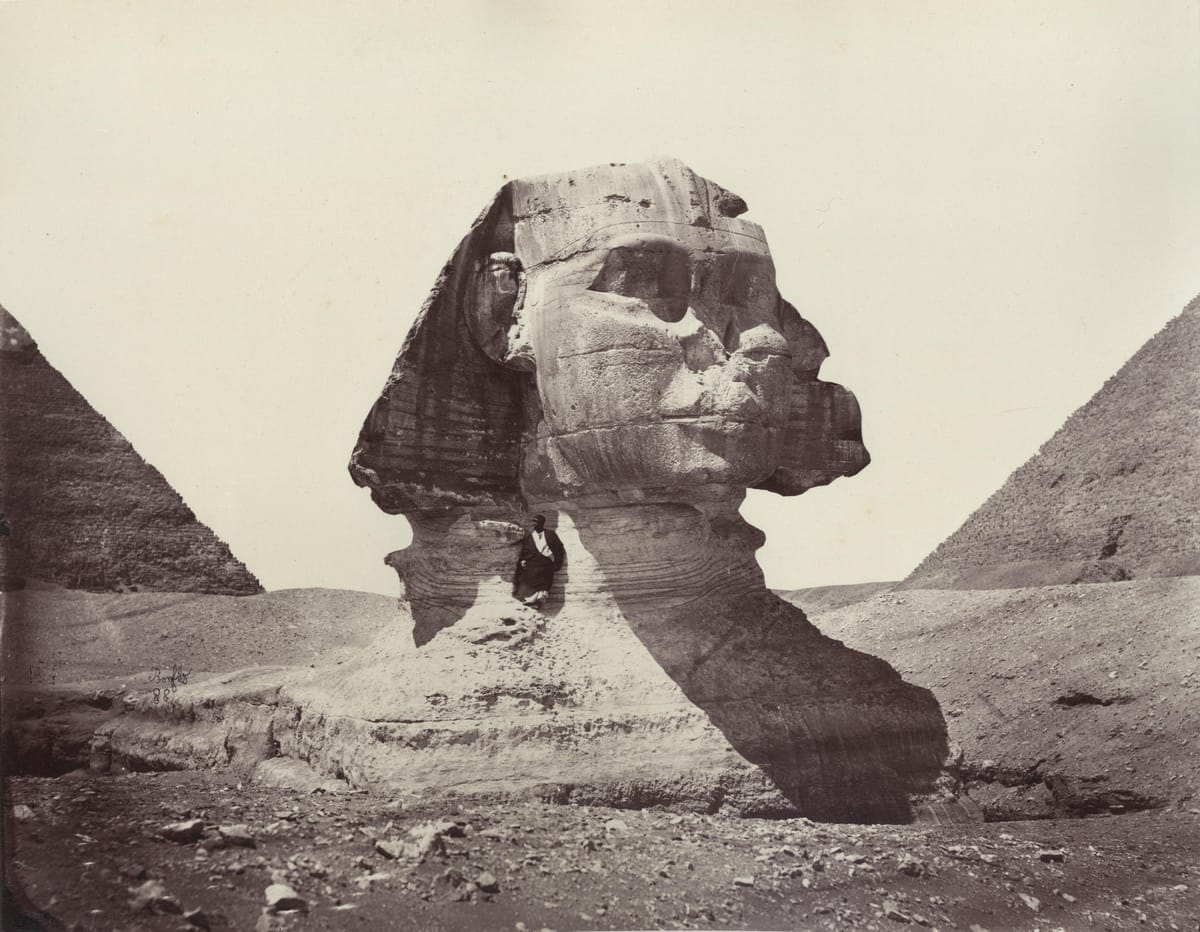
The Sphinx also began to decay almost as soon as it was finished, and its history is in large part a history of repair. The soft body stone flaked and eroded so quickly that restoration was already under way in the New Kingdom, when large limestone veneer blocks were added to protect and rebuild the base and flanks. Further campaigns followed under later Egyptian, Greek, and Roman rulers — the Romans cleared the sand and built a stairway and viewing platform — and modern conservation, from Giovanni Battista Caviglia’s excavation in 1817 through the full clearance completed by Émile Baraize and others in the 1920s and 1930s, down to the sometimes controversial block-and-mortar repairs of the late twentieth century, has continued the same endless struggle against the plateau’s own crumbling rock.
The Mainstream View
Among Egyptologists there is a strong consensus that the Great Sphinx is an Old Kingdom monument, carved in the mid-third millennium BCE, and that it belongs to the reign of Khafre, builder of the second great pyramid, around 2500 BCE. The case rests on the archaeology of the site rather than on any single inscription. The Sphinx, its enclosure, the Sphinx Temple, and Khafre’s Valley Temple form one integrated architectural group: they share the same orientation, the same quarry, and the same construction techniques and block styles, and the layout ties the Sphinx directly into Khafre’s causeway and pyramid complex. Excavation has shown a construction sequence consistent with this — for example, the building of the Sphinx Temple appears bound up with Khafre’s works — and statues of Khafre himself, including the celebrated diorite seated figure now in the Egyptian Museum, provide a royal face of the period to compare with the Sphinx’s own. The reused Khafre-temple block that became the Dream Stele, and that stele’s mention of “Khaf,” add further, if softer, links. Set against the abundant, tightly dated record of the Giza necropolis, the Sphinx sits comfortably as one element of a single Fourth Dynasty programme.
Within that consensus, the exact attribution is not quite unanimous, and the disagreement is a legitimate scholarly one rather than a fringe dispute. The Egyptologist Rainer Stadelmann argued from details of the nemes headcloth and the proportions of the face that the Sphinx more closely resembles Khafre’s father Khufu, builder of the Great Pyramid, and should be credited to him. Vassil Dobrev of the French Institute in Cairo has proposed instead that Khafre’s short-reigned brother Djedefre built the Sphinx as a monument to their deified father Khufu. These arguments turn on iconography, on the placement of the monument within the evolving Giza plan, and on the awkward absence of any contemporary text — but they all operate firmly within the Fourth Dynasty and the mid-third millennium BCE. On the questions that matter most for understanding what the Sphinx is, the mainstream view is settled: it is a colossal royal guardian statue of the Old Kingdom, carved from the plateau by the same civilisation, and with the same means, that raised the pyramids behind it.
That consensus also disposes of two persistent popular myths. The missing nose was not shot off by Napoleon’s soldiers: European drawings by Frederic Louis Norden made in 1737, decades before Napoleon’s 1798 campaign, already show the Sphinx noseless, and chisel marks on the face indicate the nose was deliberately levered off with rods — an act the fifteenth-century Arab historian al-Maqrizi attributed to a Sufi iconoclast, Muhammad Sa’im al-Dahr, who is said to have defaced it around 1378 in anger at people making offerings to it. And the frequent claim that the Sphinx “faced the constellation Leo” as a secret date-stamp is an astronomical argument built on the monument, not evidence from it.
The Open Case
The honest open questions about the Sphinx are questions of history, not of technology. The largest is simply this: no ancient text names the king who built it. Everything linking the statue to Khafre is contextual and circumstantial — powerful, mutually reinforcing, and accepted by most scholars, but inferential all the same. That is why respected Egyptologists can still argue in print for Khufu (Stadelmann) or Djedefre (Dobrev) instead. The exact placement of the Sphinx within the roughly half-century of Fourth Dynasty kings who built at Giza therefore remains genuinely, if narrowly, unsettled. So too, in finer detail, does the precise sequence of carving and the original design of features such as the beard — whether it was part of the first conception or added later. These are ordinary, tractable problems of archaeology and art history, and they are where a reader’s curiosity is best spent.
The loudest “mystery,” by contrast, does not survive scrutiny, and intellectual honesty means saying so plainly. Beginning with the writer René Schwaller de Lubicz and popularised by John Anthony West and the geologist Robert Schoch from the late 1980s, the water erosion hypothesis holds that the deep vertical and rounded weathering on the walls of the Sphinx enclosure could only have been produced by centuries of heavy rainfall, which would push the statue’s origin back to a far wetter era — Schoch has proposed dates of 7000 BCE or earlier, and West and others have suggested even remoter millennia, implying a lost civilisation predating dynastic Egypt. It is a serious-sounding claim, and it deserves a serious answer.
Mainstream geologists and Egyptologists reject it for converging reasons. Geologically, the enclosure’s weathering is better explained by the soft, salt-laden limestone itself: specialists such as K. Lal Gauri and James Harrell attribute much of the decay to haloclasty — salt crystallising in the porous rock as groundwater rises and evaporates, prising the stone apart flake by flake — together with wind-driven sand abrasion and the sheer poverty of the middle strata, a weakness Zahi Hawass and others stress is visible across Giza. The differential erosion tracks the rock layers, exactly as a haloclasty-and-wind model predicts, rather than the top-down pattern pure rainfall would leave. Climatologically, newer palaeoenvironmental work indicates that appreciable rainfall persisted in the region until roughly 2200 BCE, near the end of the Old Kingdom, so the plateau saw plenty of moisture after a c. 2500 BCE Sphinx was carved — no deep antiquity is needed to wet the enclosure. And archaeologically, the objection Kenneth Feder and others raise is decisive: a monument on this scale implies a society with the organisation, tools, agriculture, and workforce to make it, and there is no trace whatever of such a civilisation on the Nile in 7000 BCE, let alone earlier. Mark Lehner’s excavations, showing the Sphinx and its temples as one Fourth Dynasty building programme, anchor the statue firmly in Khafre’s Giza. For these reasons the water erosion hypothesis is classed by mainstream scholarship as pseudoarchaeology.
What remains, then, is a monument whose method we largely understand and whose age we can bracket with confidence to the Old Kingdom, yet whose builder’s name Egypt itself never wrote down — a silence that leaves a real, bounded question standing between Khufu, Djedefre, and Khafre. The Great Sphinx does not ask us to imagine lost technologies or vanished civilisations. It asks something quieter and, in its way, more haunting: how a people could raise the largest statue in the ancient world at the very dawn of monumental building, and leave it staring east at the sunrise without ever telling us, in their own words, whose face it wears.
Sources
On screen
- The Statue You Walk Inside — The real Sphinx has never given up a room, a text, or a name. Games cannot leave it alone — they keep opening it up.
- giza
- sphinx
- khafre
- khufu
- egypt
- old-kingdom
- fourth-dynasty
- monolith
- limestone
- dream-stele
- water-erosion-hypothesis
- harmachis
Gallery