The Statue You Walk Inside
The real Sphinx has never given up a room, a text, or a name. Games cannot leave it alone — they keep opening it up.
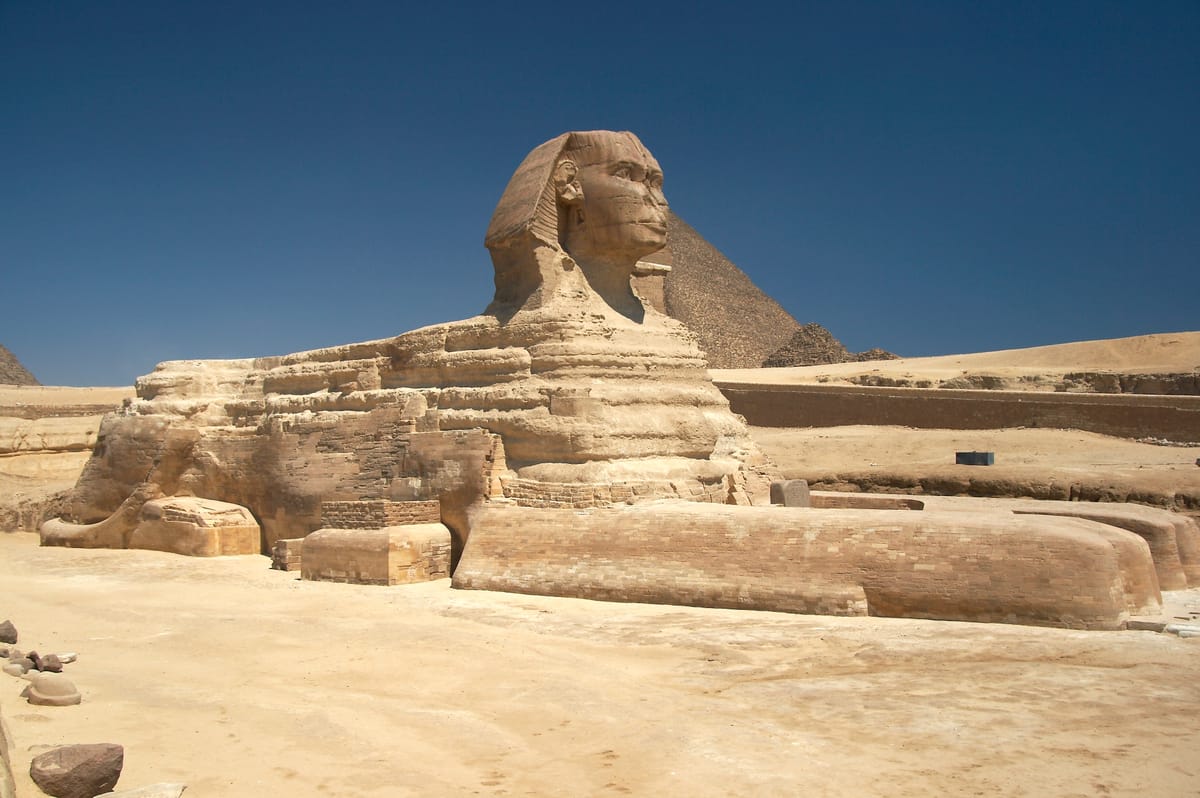
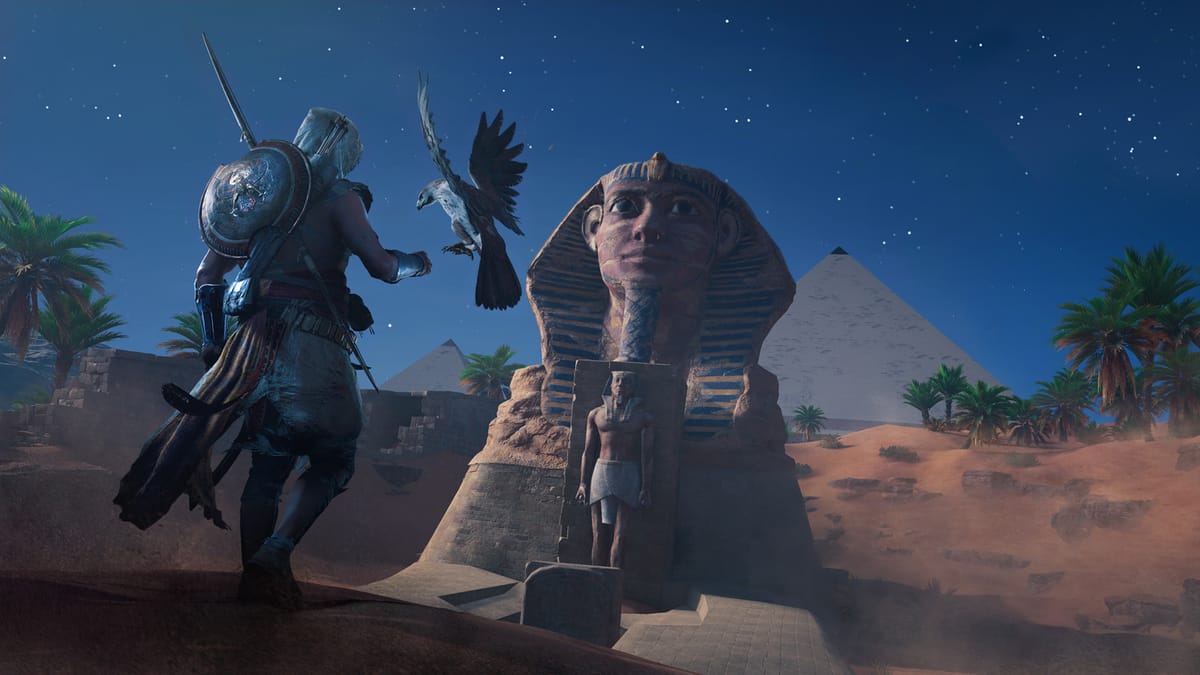
The Great Sphinx is a solid thing. It was carved down out of the plateau it still sits in, one continuous piece of Mokattam limestone, and in forty-five centuries it has never produced a room, a text, or the name of the king who ordered it. Assassin’s Creed Origins fixes all of that in an afternoon. Ubisoft Montreal’s Giza gives the statue its nose back and repaints it — blue and gold across the nemes, red on the face, which is a better-founded guess than it looks, since real pigment traces survive on the stone. Then it cuts a passage into the base. Follow it and you reach a blue-lit chamber with a map table marking twelve stone circles scattered across Egypt; find and solve all twelve, come back, and the table lifts to reveal a sealed vault below. The free Discovery Tour mode, built with historians and aimed at classrooms, walks the same Sphinx with the combat switched off — a guided lesson wrapped around a monument the same game has quietly hollowed out.
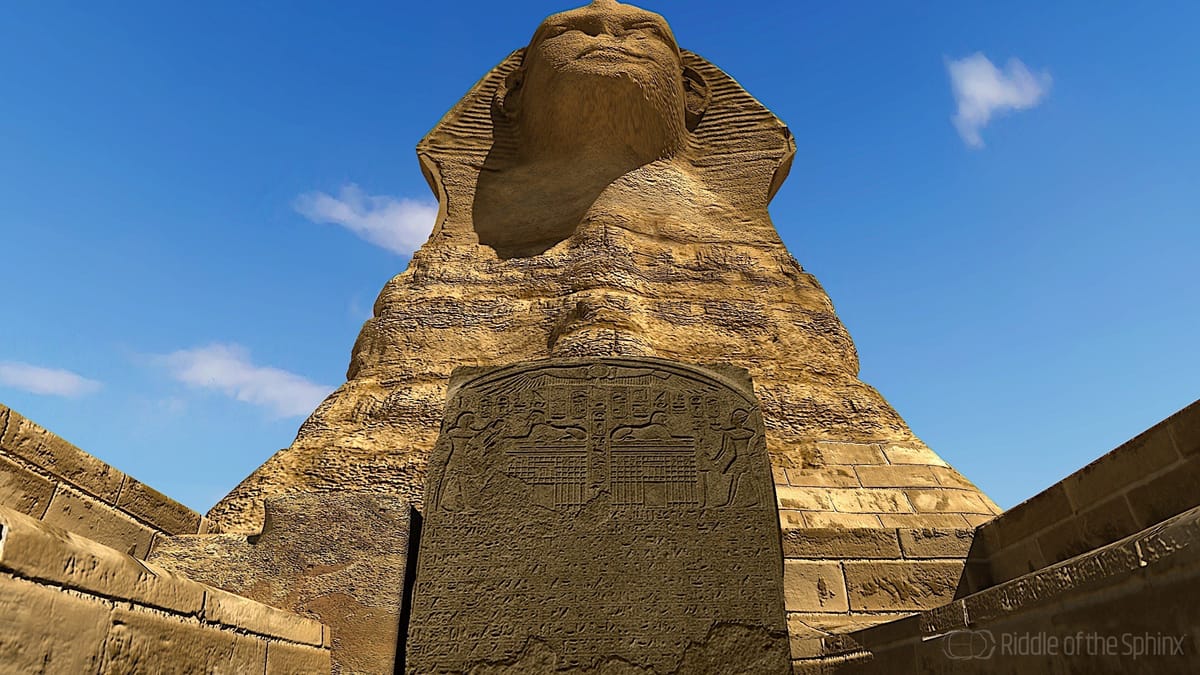
Riddle of the Sphinx skips the wrapper and makes the hollowing-out the entire game. Old World Studios’ 2000 adventure, remade by the original team in 2021, drops you alone on the plateau as an archaeologist hunting a vanished mentor, and its selling point was accuracy: the developers recreated the Sphinx and its enclosure in detail, imperfections included, then filled the rock beneath with everything the real survey work never found. The screenshot above shows how seriously they took the outside. That granite slab between the paws is the Dream Stele — set there by Thutmose IV around 1400 BCE, a thousand years after the carving, to record how the Sphinx appeared to him in a dream and asked to be dug out of the sand. It is the closest thing the monument has to an origin story, and it was written by a king who arrived eleven centuries late.
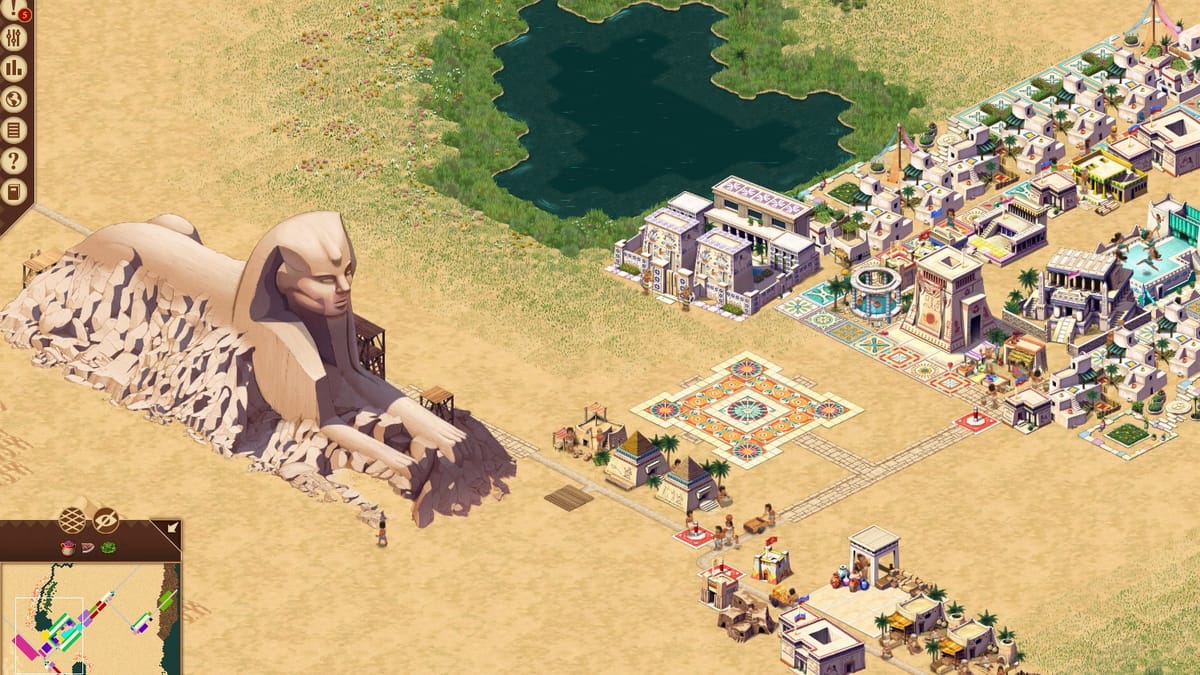
Pharaoh, alone among the three, is interested in the part we actually understand. In Dotemu’s 2023 remake of the 1999 city-builder — as in the original, where the Giza mission asks you to raise the Sphinx beside Khufu’s pyramid complex — the statue is a monument you commission. You site it, import the stone, keep the workforce fed, and it appears in stages. The result is the picture above: a head and a pair of paws finished to a polish while the rest of the body is still a heap of raw, unquarried rock. Nobody at Triskell Interactive was making an argument, but the image is the correct one. The Sphinx was not built up; it was released, by carving away everything that wasn’t it.
Three games, three incompatible answers about what the Sphinx is hiding — a vault, a lost hall, a construction schedule. The plateau’s own answer has not changed in 4,500 years: limestone all the way down, and a face nobody signed.
Read the full study: Great Sphinx of Giza
Sources
- Steam — Assassin's Creed Origins
- GamesRadar+ — How to get the Assassin's Creed Origins secret armour (the Sphinx vault)
- Ubisoft — Discovery Tour by Assassin's Creed: Ancient Egypt
- Wikipedia — Riddle of the Sphinx: An Egyptian Adventure
- Steam — Riddle of the Sphinx: The Awakening (Enhanced Edition)
- Steam — Pharaoh: A New Era
- Pharaoh Heaven — Rostja (Giza) walkthrough
- Dotemu — Pharaoh: A New Era press kit