Cyclopean Walls and the Lion Gate of Mycenae
How did Late Bronze Age builders working without iron tools, pulleys, or draft-animal cranes quarry, move, and raise limestone blocks weighing many tonnes each — including an roughly 18-tonne lintel over the Lion Gate — into fortification walls so massive that Iron Age Greeks themselves could only credit the mythical one-eyed Cyclopes?
Why this rating?
- Construction difficulty
- 4/5
- Method uncertainty
- 3/5
- Capability gap
- 3/5
- Open questions
- 2/5
Raising limestone blocks of many tonnes — including a lintel on the order of 18 tonnes — into a fortification circuit using only Bronze Age tools was a major engineering feat for its era, and the general method (ramps, levers, sledges, massed labor) is well supported by comparative archaeology even though no Mycenaean text describes it directly. The builders, date, and purpose of the citadel are secure, so open scholarly debate is narrower than at more enigmatic sites, concentrated mainly on the fine mechanics of lifting the largest stones.
Overview
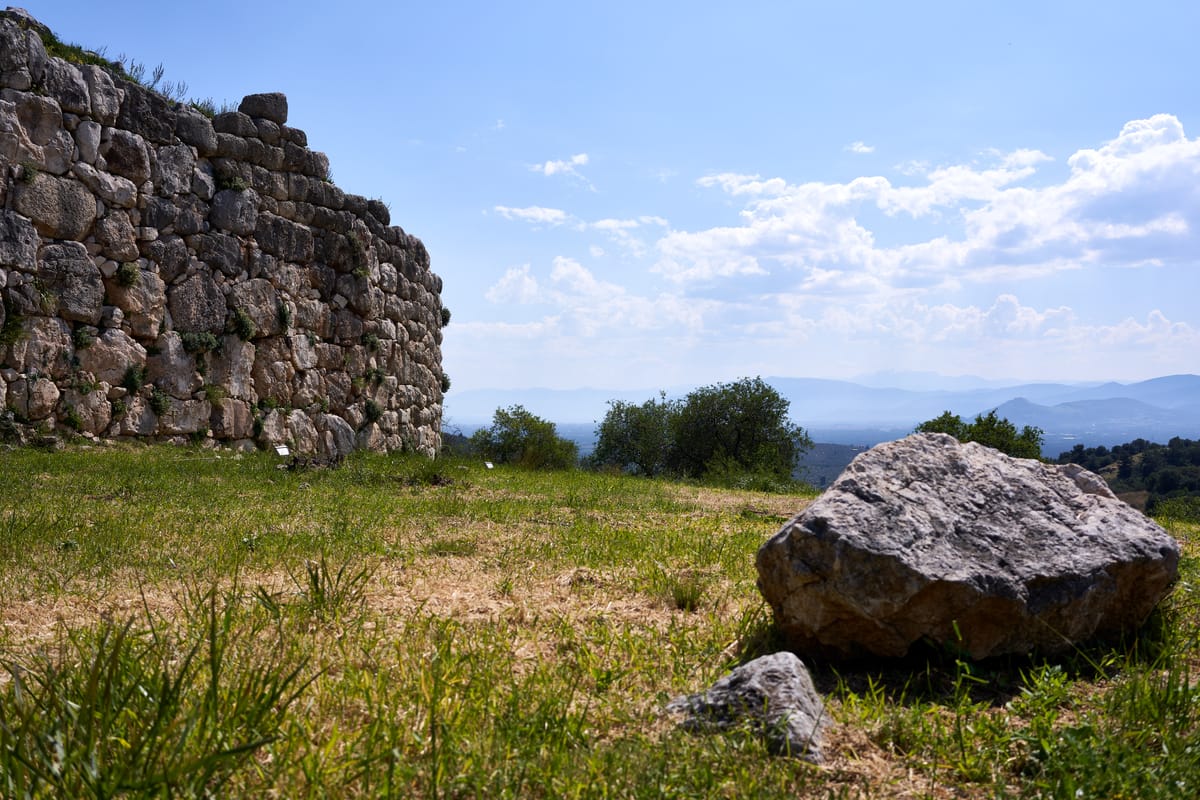
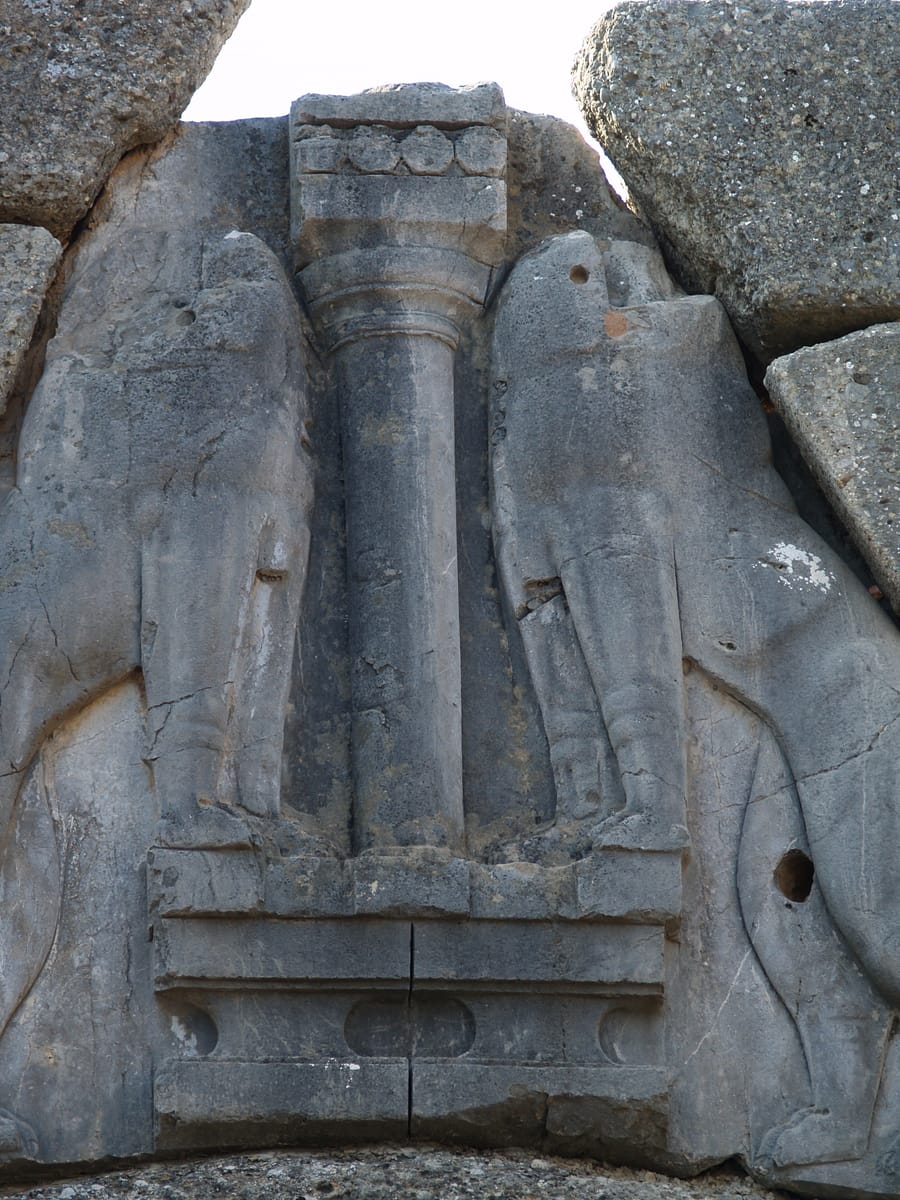
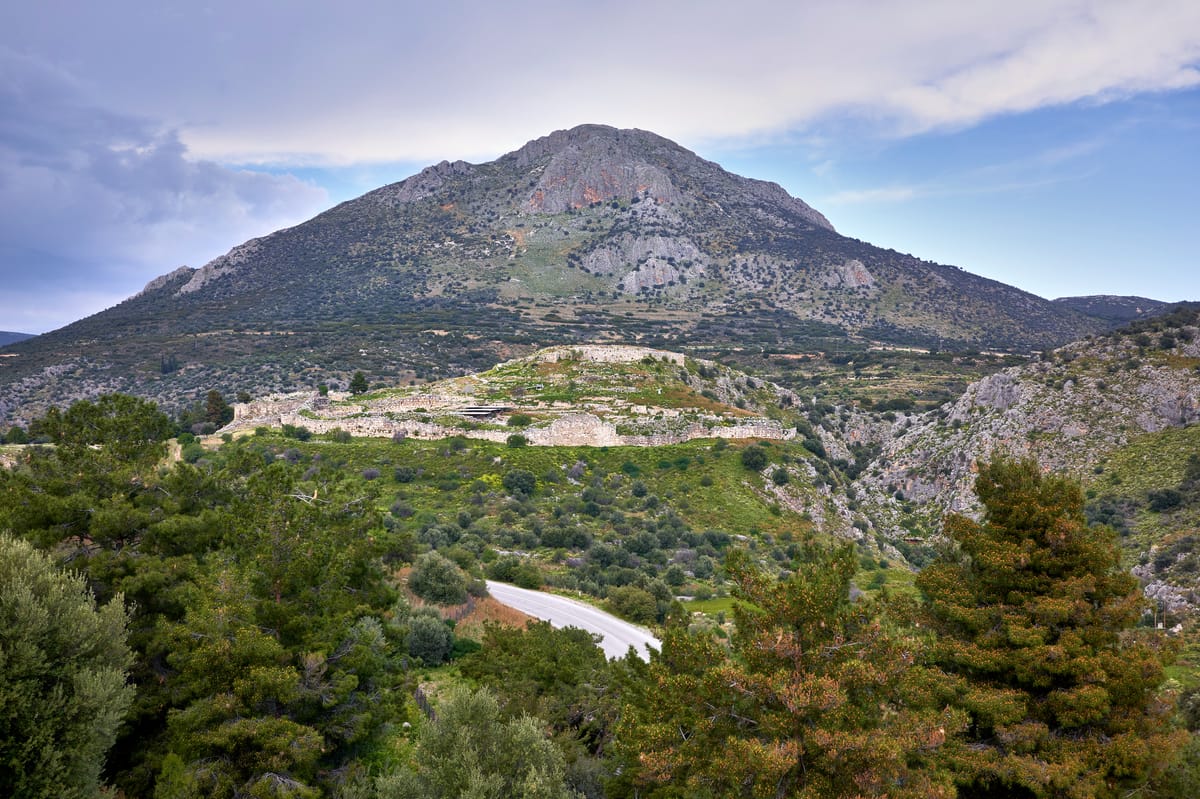
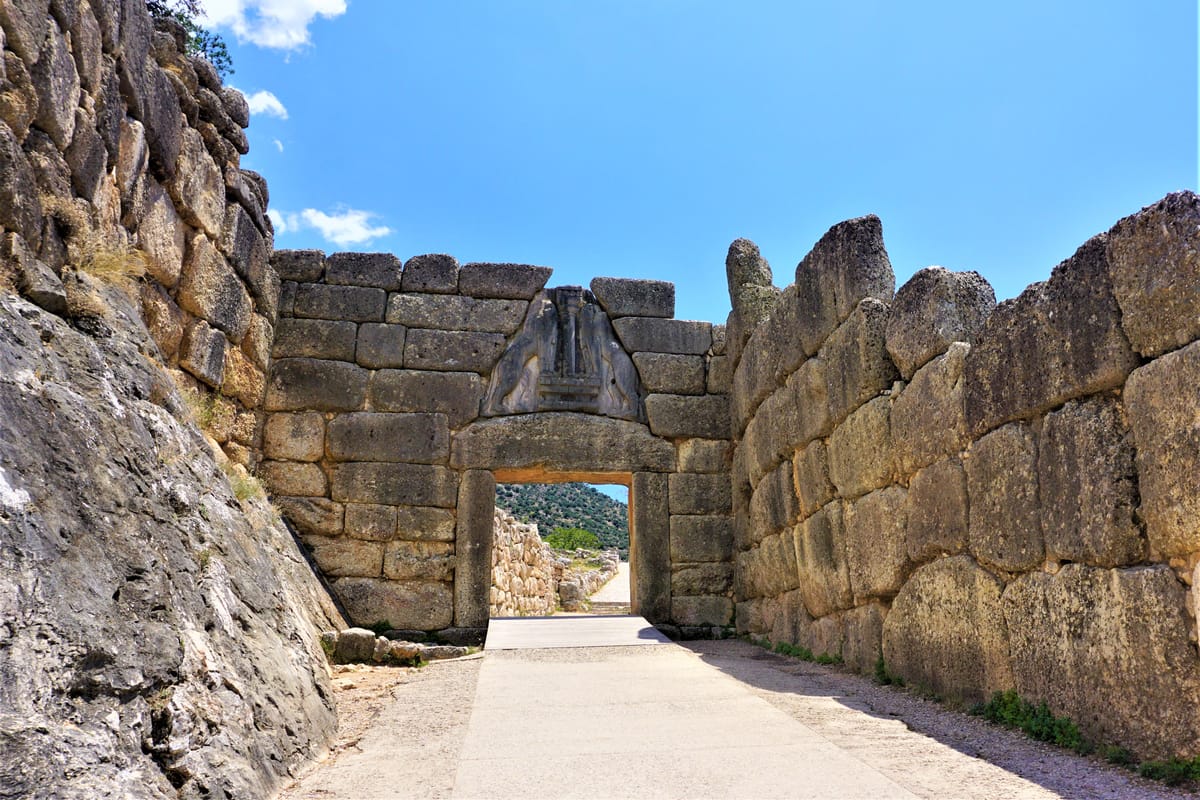
On a low, defensible hill in the Argolid region of the Greek Peloponnese stand the ruins of Mycenae, the citadel that gave its name to an entire civilization. Its most striking feature is its fortification wall: a circuit of huge, irregular limestone boulders, some standing taller than a person and weighing many tonnes apiece, fitted together with only rough shaping and packed with smaller stones and clay in the gaps. The main entrance, the Lion Gate, is framed by two colossal upright stones and capped by a single massive lintel, above which a triangular limestone slab carved with two facing lionesses (or lions) flanking a column looks down on everyone who passes beneath. The walls and gate were built by the Mycenaean Greeks at the height of their Late Bronze Age palatial civilization, roughly the 14th-13th centuries BCE — the era later mythologized by Homer as the age of Agamemnon, “golden Mycenae,” and the Trojan War. By the time Classical and later Greeks looked at these walls, the stones seemed so impossibly large that they attributed the construction to the Cyclopes, the one-eyed giants of myth — which is why this building technique is still called “Cyclopean masonry” today. Mycenae and the related site of Tiryns were jointly inscribed as a UNESCO World Heritage Site in 1999, recognized as the type-sites of an entire Bronze Age civilization and among the most influential architectural and archaeological complexes in the Western world.
The Structure
Mycenae had been inhabited since the Middle Bronze Age, but it rose to its greatest power during the Late Helladic period, roughly the 14th and 13th centuries BCE, when it functioned as the seat of a Mycenaean palatial kingdom and one of the dominant centers of the wider Mycenaean world, which also included citadels such as Tiryns, Pylos, and Thebes. The Cyclopean circuit wall enclosing the acropolis was built in phases: an initial fortification around the mid-14th century BCE, extended outward around 1250 BCE to enclose Grave Circle A — a royal burial precinct where Heinrich Schliemann’s 1876 excavations uncovered gold funerary masks, weapons, and jewelry that convinced him, wrongly as it turned out chronologically, that he had found the tomb of Agamemnon — and extended again around 1200 BCE, when a secret postern stairway down to a hidden water source was added using corbelled construction. The enclosed citadel covers roughly 30,000 square meters (about 3 hectares) atop the hill, with the wider archaeological zone of the site, including the lower town and outlying tombs, extending across a considerably larger area. The Lion Gate, built around 1250 BCE as part of the wall’s expansion, was the citadel’s grand ceremonial and defensive entrance: its opening is roughly 3 meters wide, narrowing slightly toward the top, and its threshold and door jambs are dressed, fitted limestone rather than the rough boulders used elsewhere in the wall — cut masonry was reserved for gateways, where precision mattered most. The relief above the lintel, showing two lionesses (their heads, carved separately and now lost, likely faced outward) resting their forepaws on twin altars flanking a Minoan-style column, is generally regarded as the oldest surviving monumental sculpture in mainland Europe. Mycenae’s power collapsed along with the rest of the Mycenaean palatial system around 1200-1100 BCE, amid destructions whose causes remain debated (earthquake, invasion, and internal collapse have all been proposed), and although the site saw continued, diminished habitation for centuries afterward, it never regained its Bronze Age stature.
How Was It Built?
The fortification walls are built from massive blocks of local limestone, largely unworked or only roughly hammer-dressed on their outer faces, laid without true courses and packed with smaller stone chunks and clay mortar to fill the irregular gaps between boulders — the defining technique of what archaeologists call Cyclopean masonry. According to World History Encyclopedia, the largest stones used in the walls, including the Lion Gate’s lintel and jambs, weighed well over 20 tonnes, with some estimated to approach 100 tonnes. The Lion Gate’s lintel block alone measures approximately 4.5 by 2.0 by 0.8 meters, which — worked out from its volume and the density of local limestone — corresponds to a weight in the region of 18 tonnes, consistent with the figure most commonly cited for it. Above the lintel, the builders left a triangular gap and filled it with a lighter, carved slab rather than solid stone: this “relieving triangle” diverts the crushing weight of the wall above around the lintel rather than down through it, an early and effective solution to a basic structural problem in load-bearing stone architecture, and one also used elsewhere at Mycenae, including above the entrances to the great corbelled tholos tombs such as the nearby Treasury of Atreus. The walls themselves were founded directly on shallow beddings cut into the bedrock of the hill, giving the huge boulders a stable base without deep foundations. All of this was accomplished with Bronze Age technology: bronze (not iron) tools for shaping stone, and no evidence of pulleys, block-and-tackle systems, or wheeled cranes, which had not yet been developed in the Aegean world at this date.
The Mainstream View
Archaeologists do not dispute who built Mycenae’s walls or roughly when: they are a securely dated product of the Mycenaean palatial civilization, built in stages across the 14th to 13th centuries BCE as the citadel’s population, wealth, and regional power grew, and their function as defensive fortification is not in question. The mainstream engineering explanation for how such enormous blocks were quarried and set in place draws on general, well-attested Bronze Age construction practice rather than any surviving Mycenaean instruction manual: stones were most likely levered out of nearby outcrops, then dragged on wooden sledges over log rollers or greased timber tracks to the building site, and raised into position using earthen ramps built up against the growing wall, combined with wooden levers, timber cribbing, and ropes to walk each block the final distance into place — the same basic toolkit documented or inferred at other massive stone constructions of the ancient world. None of this required metal beyond bronze levers and chisels, and none of it required a workforce beyond what a Mycenaean palatial economy, with its centralized administration and capacity to mobilize labor (attested by the Linear B palace records at other Mycenaean sites), could plausibly organize over the months or years such a project would take. The relieving triangle above the Lion Gate is likewise well understood structurally: it is a straightforward, effective way to keep the tremendous dead weight of an unreinforced stone wall from cracking the load-bearing lintel beneath it, and comparable corbelling and weight-relief techniques appear across Mycenaean architecture, including the tholos tombs. Scholars are confident the walls represent skilled, organized Bronze Age engineering — not evidence of any technology beyond what a wealthy, complex Late Bronze Age state could bring to bear.
The Open Case
What remains open is not who built Mycenae’s walls, or broadly why, but the precise mechanics of raising its very largest stones. No Mycenaean text or diagram describing construction technique has survived — Linear B tablets record palace administration, rations, and inventories, not engineering methods — so the ramp-and-lever reconstruction, however well supported by comparative archaeology and by the physical plausibility of the technique, is an inference rather than a documented procedure. Exactly how many workers a single lift of an 18-tonne lintel required, how the final, delicate positioning onto the jamb tops was controlled without slipping or shattering the stone, and how the enormous, irregular boulders elsewhere in the wall were maneuvered and fitted with the tight joints still visible today, are questions current scholarship answers with confident general principles rather than step-by-step certainty. It is worth remembering that the “Cyclopean” label itself is ancient folklore, not history: Iron Age and Classical Greeks, living among ruins built by a civilization whose script and methods they no longer understood, simply could not imagine human builders moving stones that size, and reached for a myth instead. Modern archaeology has firmly replaced the giants with a very human explanation — skilled Mycenaean engineers, organized labor, and patient, practical technique — but the exact choreography of that labor at Mycenae’s most extreme lifts is a genuinely unresolved detail of Bronze Age engineering, not a mystery beyond human capability.
Sources
Connected findings
- Two Continents, One Impossible Wall — In Peru and in Greece, people who could never have met built the same impossible thing: walls of giant stones, fitted without mortar.
On screen
- The Gate You Walk Through — In Assassin's Creed Odyssey, you can ride straight up to the citadel of Mycenae and walk beneath the same lionesses that convinced later Greeks only giants could have built it.
- mycenaean-civilization
- greece
- bronze-age
- fortification
- cyclopean-masonry
- lion-gate
- unesco-world-heritage
- citadel
Gallery