The Buddhas of Bamiyan
How do you carve the two largest standing Buddhas on Earth out of a cliff so weak it crumbles under a tenth of the load ordinary concrete carries — and how much of what stood there for fourteen centuries was actually rock at all?
Why this rating?
- Construction difficulty
- 4/5
- Method uncertainty
- 2/5
- Capability gap
- 3/5
- Open questions
- 3/5
Cutting 55-metre figures out of a conglomerate with roughly a tenth the compressive strength of ordinary concrete, then holding a modelled plaster surface onto that crumbling rock with thousands of pinned dowels, was a serious feat of both sculpture and improvised engineering — and it worked for fourteen centuries. The method itself is unusually well documented, because the destruction and the surveys that followed exposed the internal structure; what remains open is the earliest phase of the site, the reliability of Xuanzang's report of a third colossal Buddha, and whether anything should be rebuilt.
Overview
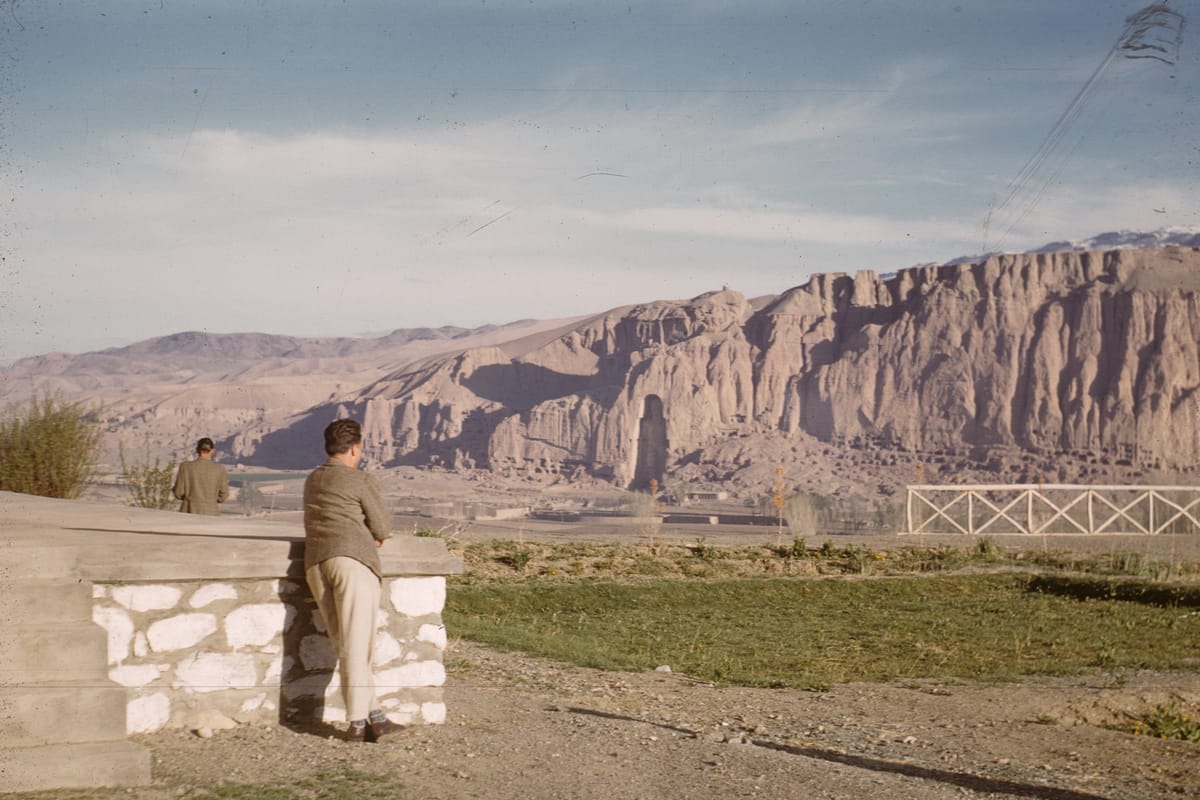
Bamyan sits at about 2,500 metres in the Hindu Kush, on the corridor that carried the Silk Road between India, Central Asia and China. Into the north cliff of its valley, Buddhist communities cut two standing Buddhas: an eastern figure roughly 38 metres tall and, several hundred metres west along the same cliff, a western figure roughly 55 metres tall. They were the largest standing Buddha statues ever made. Radiocarbon dating of organic material from inside them places the eastern statue at about 544-595 CE and the western at about 591-644 CE — so the smaller one came first, and the two were separated by roughly half a century of ambition.
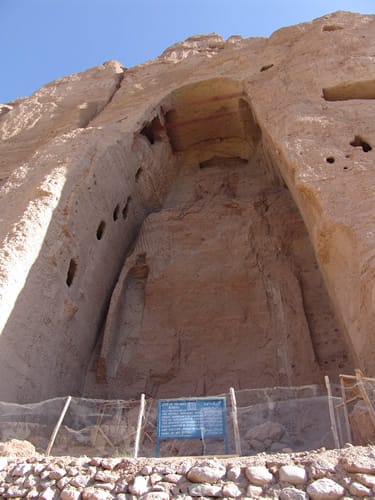
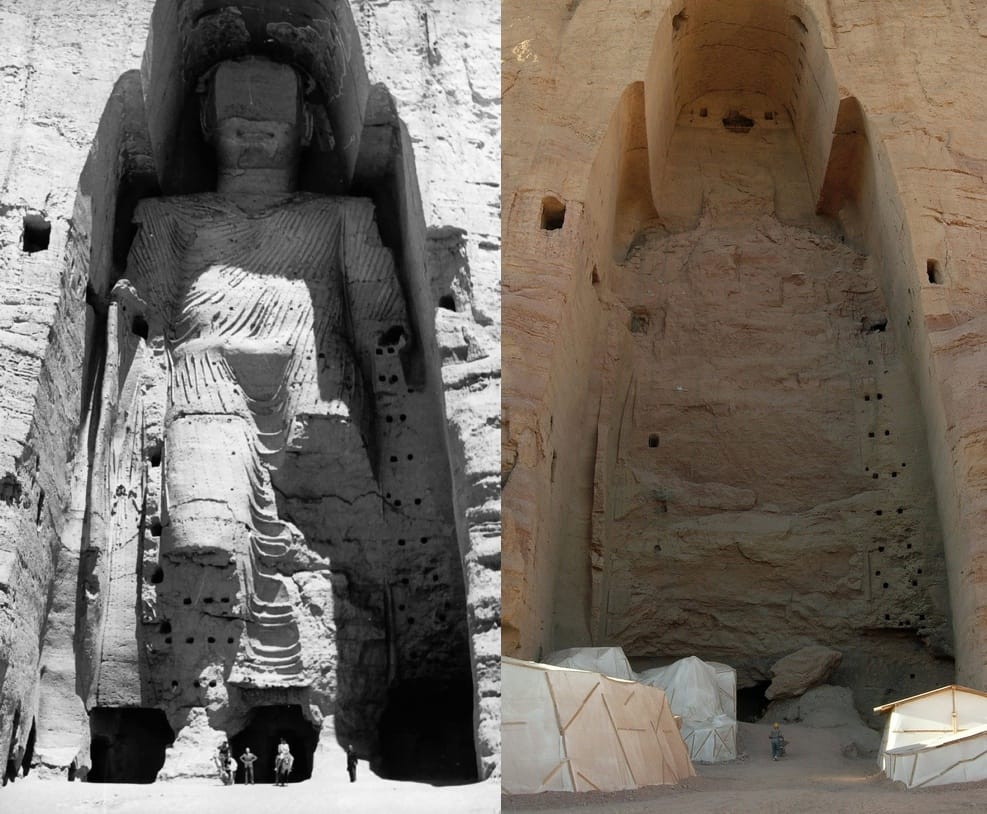
They stood for some fourteen hundred years. In March 2001 the Taliban destroyed them with artillery, anti-tank mines and explosives lowered into drilled holes, over a campaign that took weeks because, as one official complained at the time, the statues would not come down easily. What is left is two empty niches, a great deal of rubble that has been catalogued and stored, and an unresolved argument about whether anything should be put back.
This study is about how they were made, which turns out to be a stranger and more precarious story than their reputation suggests. Very little of what visitors admired was carved stone at all.
The Structure
The valley was a major Buddhist centre for centuries. The Chinese pilgrim Xuanzang reached it on 30 April 630 CE, while the western Buddha was probably still being finished, and described a flourishing place of more than ten monasteries and over a thousand monks. He recorded both standing figures as ornamented with gold and jewels — and also mentioned a third, reclining Buddha, larger still, which has never been located.
The two colossi were technically high reliefs rather than free-standing statues: each was cut back into the cliff inside a deep niche, still joined to the rock behind. The cliff around them is honeycombed with hundreds of caves — monastic cells, sanctuaries and assembly halls — many of them painted between the 6th and 8th centuries in a style that fuses Gandharan Greco-Buddhist form with Indian Gupta, Sasanian and Byzantine influence. The ceiling above the eastern Buddha carried a solar deity in a horse-drawn chariot, framed by ranks of kings, donors, Buddhas and bodhisattvas. Analysis of these murals published in the 2000s identified drying oils bound with resins and gums — which would make them among the oldest known oil paintings anywhere, predating the technique’s European use by centuries.
The statues themselves were painted and, per Xuanzang, gilded and jewelled: the western figure reportedly carmine red, the eastern in several colours. Local tradition gave them names — Salsal for the larger, Shamama for the smaller.
How Was It Built?
Everything depends on the rock, and the rock is bad. The Bamyan cliff is not the sandstone it is often called but a conglomerate — rounded pebbles and rock fragments set in a carbonate-cemented matrix — interbedded with siltstone. Geotechnical testing carried out during the UNESCO safeguarding programme measured its unconfined compressive strength at about 2.99 MPa for the conglomerate and roughly 6.7-6.9 MPa for the siltstone. Ordinary structural concrete runs somewhere around 20-40 MPa. This is a material you can dig with hand tools, and one that will not hold a carved detail: try to cut a face or a fold in it and the pebbles pluck out and the edge crumbles.
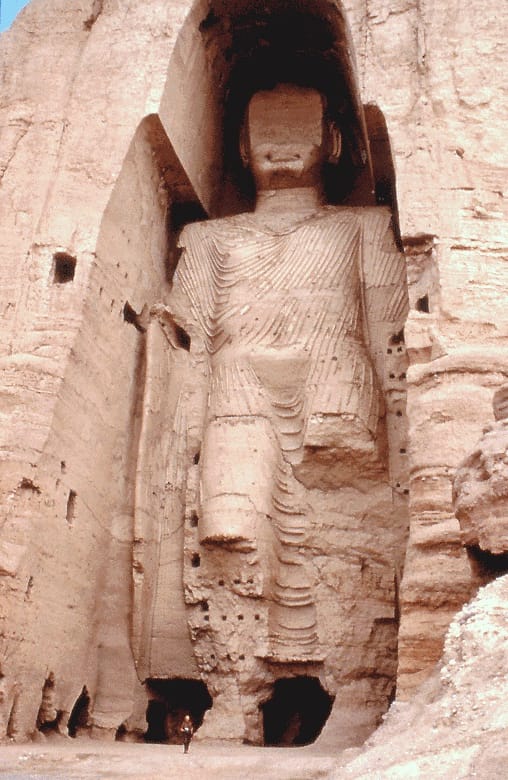
So the sculptors did not try. They quarried out the niche and roughed the body of the figure from the conglomerate — the mass, the posture, the general volumes — and then built the surface on top of it. The visible statue was a skin of mud mixed with straw, coated with a lime stucco, painted and gilded. The famous deep folds of the robes, so regular they look machined, were modelled in that plaster rather than chiselled from rock. The lower arms were not rock at all: they were carried on wooden armatures and packed out in mud and straw. Current research indicates the upper parts of the faces were wooden masks.
Holding all of that onto a crumbling cliff was the real engineering problem, and the solution is still visible in every photograph of the empty niches: thousands of holes, drilled in regular rows across the rock, which took wooden pegs and dowels. Ropes and pegs anchored the plaster skin to the body of the mountain. What stood at Bamyan was a composite structure — a rough stone core, a pinned mud-and-straw surface, timber where the geometry demanded strength — and it held for fourteen centuries in a valley with hard winters.
The destruction, grimly, is part of why we know this. The 2001 demolition and the international survey work that followed exposed the internal construction directly, and the recovered fragments let conservators study the plaster, the fibre and the fixings at close range.
The Mainstream View
There is no dispute about who made the Bamiyan Buddhas, when, or why. They were Buddhist devotional monuments, made by the Buddhist community of a wealthy Silk Road valley in Tokharistan during a period of Hephthalite-era local rule, in a sculptural idiom descended from Gandhara — a tradition that had already been blending Hellenistic figure conventions with Buddhist iconography for centuries. The radiocarbon dates from organic material within the statues are consistent with the archaeology of the surrounding caves and with Xuanzang’s eyewitness account, and they settled a long-running debate that had placed the figures anywhere from the 3rd to the 8th century.
The site survived a great deal before 2001. Genghis Khan’s army destroyed Bamyan’s population in 1221 and left the statues alone. The Mughal emperor Aurangzeb is reported to have had artillery fired at them in the 17th century, causing some damage. Iconoclastic damage over the centuries removed the faces below the wooden masks. The 2001 destruction was of a different order and was carried out deliberately and publicly.
UNESCO inscribed the Cultural Landscape and Archaeological Remains of the Bamiyan Valley as a World Heritage Site in 2003, simultaneously placing it on the List of World Heritage in Danger, where it remains. Emergency consolidation has since stabilised the niches themselves — the eastern niche and its rear wall have been successfully reinforced — because the same weak conglomerate that shaped how the statues were built now threatens to bring the cliff down on what is left.
The Open Case
The open questions here are not about capability. They are about evidence that no longer exists, and about a decision nobody has been able to make.
The first is Xuanzang’s third Buddha. He described a reclining figure larger than either standing one, and he was an accurate observer on almost everything else at Bamyan. Repeated survey work, including geophysical prospection, has failed to find it. Whether it was destroyed, was never completed, has simply not been located yet, or was misreported is unresolved.
The second is the site’s earliest phase. Buddhist activity in the valley is attested from around the 3rd century CE, but how the cliff was used before the colossi were begun in the mid-6th — what stood there, and what the two statues replaced or completed — is only partly reconstructed, and much of the stratigraphy that might answer it has been damaged by war, looting and the demolition itself.
The third is not an archaeological question at all. Roughly half the fragments are thought to be recoverable, and anastylosis — reassembling original material with modern supports — is technically feasible for at least the eastern Buddha. A 2011 UNESCO expert working group issued recommendations that pointedly declined to settle it, suggesting the larger western niche be left empty as a memorial to the destruction while a feasibility study proceeded on the smaller. Against that sit two serious objections: that a rebuilt Buddha is a replica pretending to be a survivor, and that the money would be better spent on housing and electricity for the people who live in the valley now.
So the wonder at Bamiyan is doubled and inverted. Its builders solved a genuinely hard problem — how to put a 55-metre figure onto a cliff that cannot hold one — with mud, straw, timber, thousands of wooden pegs and an accurate understanding of exactly how little their mountain could bear. It worked for fourteen hundred years. What finally defeated it was not the rock.
Sources
- UNESCO World Heritage Centre — Cultural Landscape and Archaeological Remains of the Bamiyan Valley
- Wikipedia — Buddhas of Bamiyan
- Encyclopaedia Britannica — Bamiyan Buddhas
- Margottini, C. — Instability and geotechnical problems of the Buddha niches and surrounding cliff in Bamiyan Valley, central Afghanistan
- Nagaoka, M. (ed.) — The Future of the Bamiyan Buddha Statues: Heritage Reconstruction in Theory and Practice (UNESCO / Springer)
- Springer — Recovery of the Buddha's Niches and Cliff in Bamiyan (Central Afghanistan) after the Taliban Destruction of 2001
- rock-cut
- buddhist
- afghanistan
- silk-road
- colossal-statue
- conglomerate
- unesco-world-heritage
- world-heritage-in-danger
- destroyed
Gallery