Vittala Temple (Hampi)
How did Vijayanagara stonemasons carve dozens of slender granite pillars — each cut from a single block — so precisely that they ring with distinct musical notes when struck, and assemble a 'stone chariot' from separate granite slabs with joints so fine the whole appears cut from a single rock, on wheels that once turned on stone axles?
Why this rating?
- Construction difficulty
- 3/5
- Method uncertainty
- 3/5
- Capability gap
- 2/5
- Open questions
- 3/5
The Vittala Temple is a triumph of finesse rather than brute scale: its difficulty lies in carving hard granite to acoustic and jointing tolerances, not in moving colossal masses, so construction difficulty is moderate. Vijayanagara was a wealthy, well-documented empire with master stone guilds working locally abundant granite, so the capability gap is small. What genuinely remains open is method — no contemporary record explains how the pillars were tuned to ring at distinct pitches, and conservation restrictions now limit hands-on acoustic study — leaving a real but ordinary archaeological gap rather than an exotic one.
Overview
Among the boulder-strewn ruins of Hampi — the former capital of the Vijayanagara Empire on the banks of the Tungabhadra River in Karnataka — stands the Vittala Temple, widely considered the finest and most ornate temple the empire ever produced. It is dedicated to Vitthala (also written Vithoba), a form of the god Vishnu especially venerated in the Deccan and Maharashtra. Construction is generally placed in the 15th century, begun during the reign of Devaraya II (who ruled 1422–1446), and the complex was enlarged and lavishly embellished by later kings, most famously Krishnadevaraya (1509–1529), the greatest of the Vijayanagara rulers. Work continued in phases for more than a century — and then simply stopped. In 1565 the empire’s army was destroyed at the Battle of Talikota, and the victorious Deccan sultanates sacked Hampi over months, after which the city was abandoned. The Vittala Temple was left unfinished, and unlike many temples of southern India it is no longer an active place of worship. Today it anchors the UNESCO World Heritage “Group of Monuments at Hampi,” and its fame rests on two features that draw visitors and puzzle engineers alike: a hall of slender granite pillars that ring with musical notes when struck, and an exquisite stone chariot in the courtyard that has become the visual emblem of Hampi.
The Structure
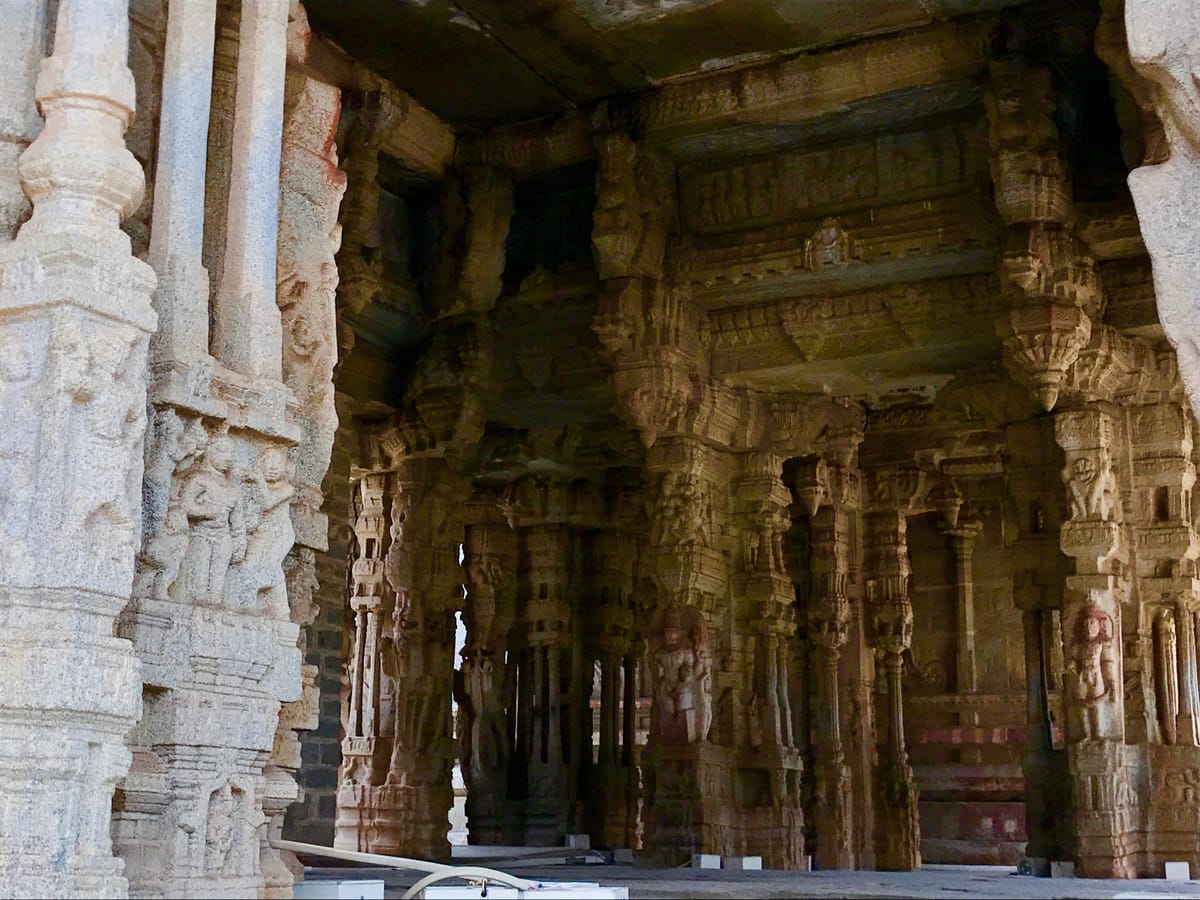
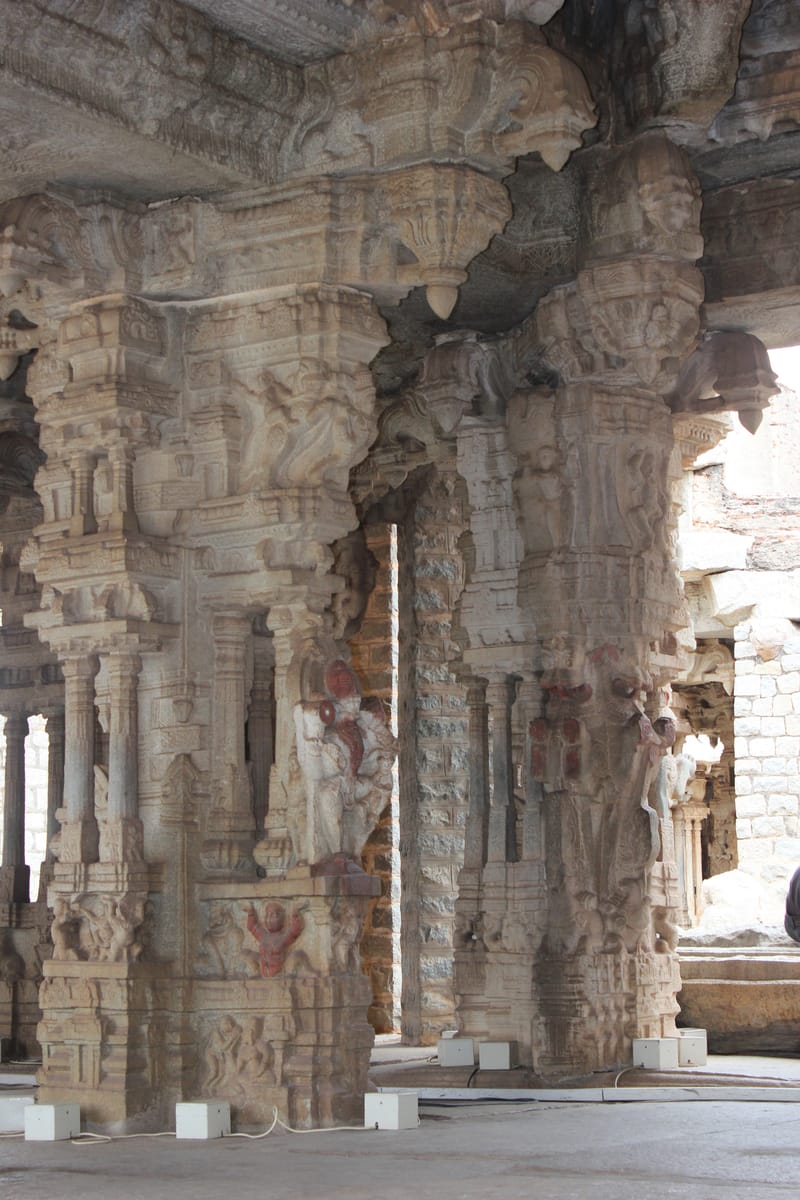
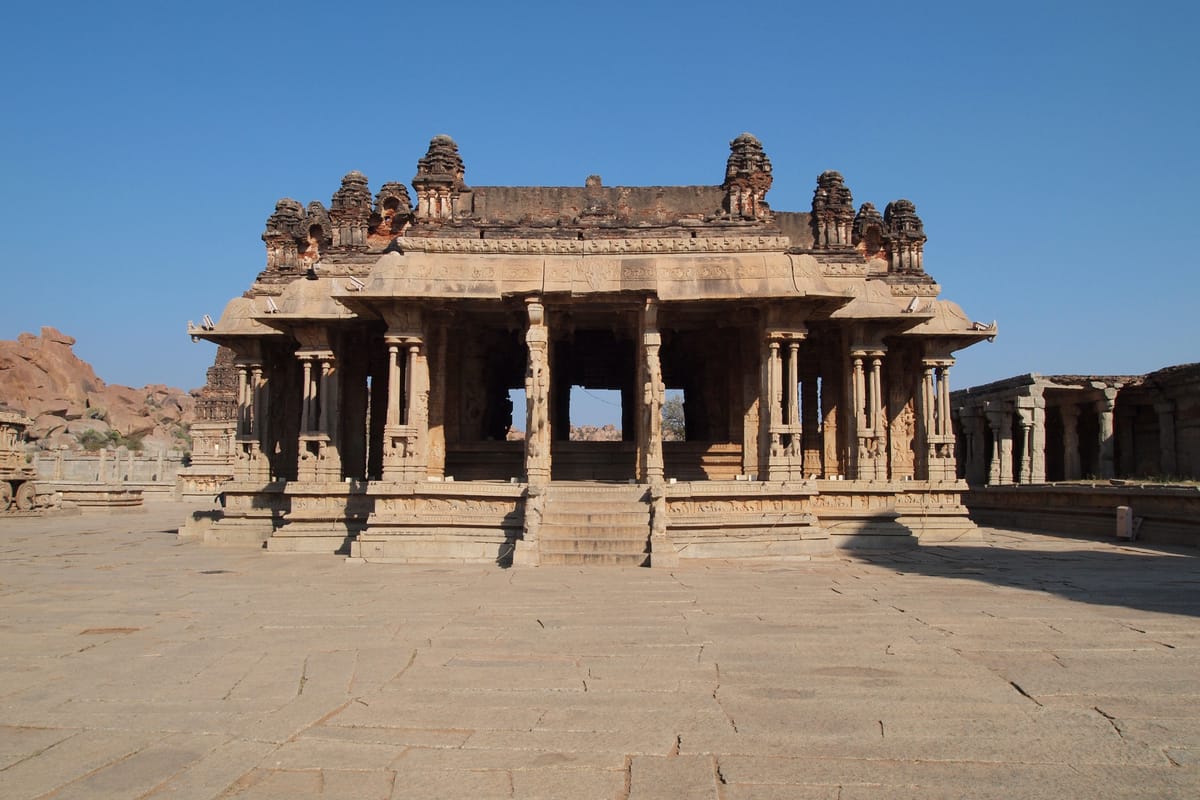
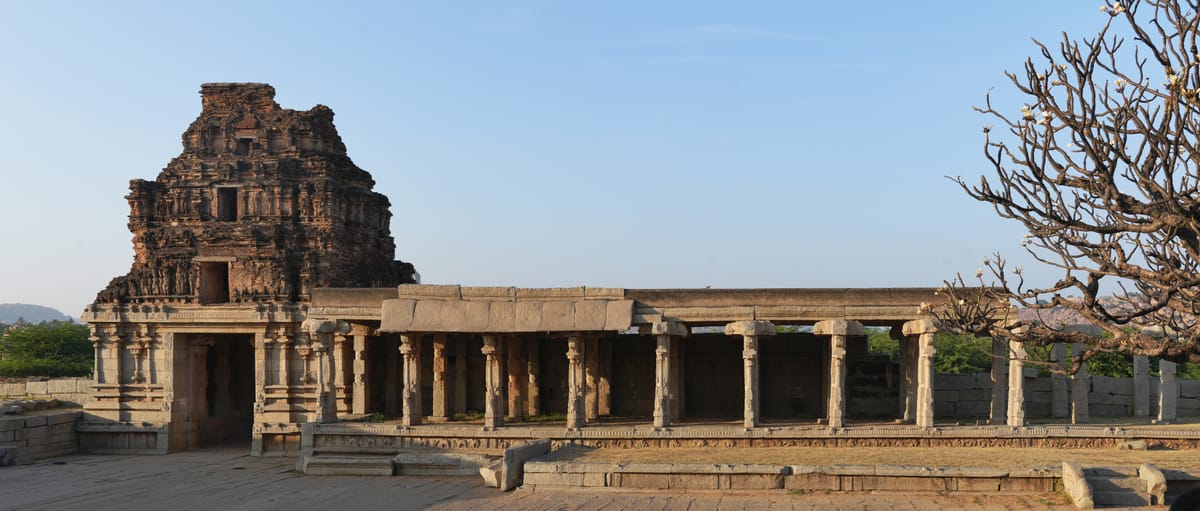
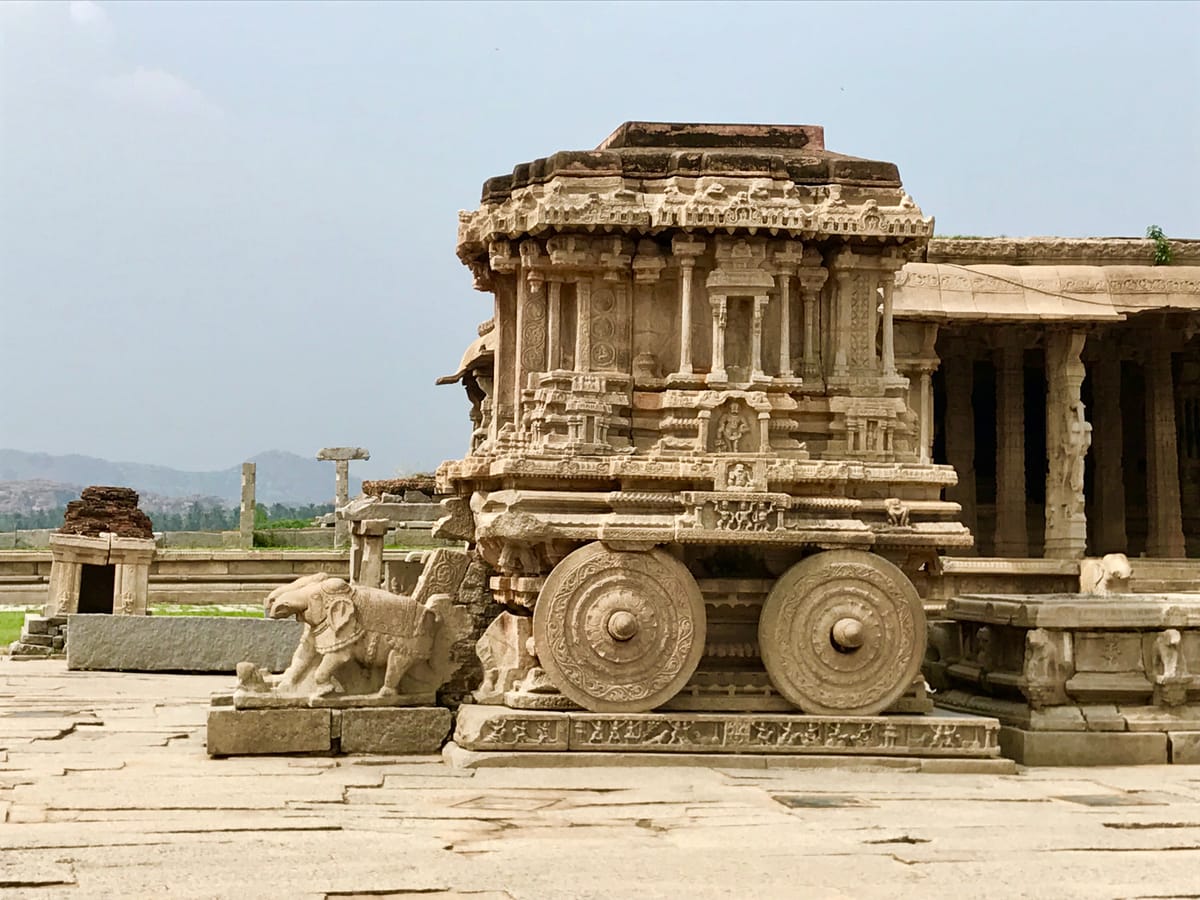
The temple sits inside a large rectangular walled enclosure entered through towering gopuram gateways, several of them left incomplete. Within are a cluster of halls and shrines: the central Vitthala sanctuary, a number of subsidiary mandapas, a kalyana (marriage) hall, a long colonnaded tank, and — facing the main shrine — the celebrated stone chariot. The showpiece is the great pillared hall, the maha mantapa (also called the ranga mantapa), raised on a richly carved moulded plinth and famous for its columns. These are the “musical” or “SaReGaMa” pillars, named for the first syllables of the Indian solfège; the hall is usually described as having 56 of them. Each is not a plain shaft but a composite: a stout central pillar cut from a single block of granite, encircled by a ring of much thinner, free-standing colonettes carved from the same stone. When the slender colonettes are tapped, they sound at different pitches, and the pillars are traditionally grouped to evoke the tones of particular instruments. The whole complex is built of granite — the same hard, coarse-grained stone that forms the boulder hills all around Hampi. In the courtyard stands the stone chariot, a shrine to Garuda (the eagle-mount of Vishnu) sculpted to imitate a wooden processional temple car, or ratha, of the kind used to carry deities in festival. It is often said to have been inspired by the great stone chariot of the Sun Temple at Konark, and it is one of only three famous stone chariots in India, alongside Konark and Mahabalipuram. Its four large wheels, carved like ornamented cartwheels, were originally made so they could turn on their stone axles; two elephants stand at the front as if drawing it. The chariot is well enough known to appear on the Indian fifty-rupee banknote.
How Was It Built?
The two puzzles the temple poses are about precision and refinement rather than raw scale. The first is the musical pillars. Granite is normally thought of as an acoustically dead, rigid stone, yet the slender monolithic colonettes of the maha mantapa ring like struck bars, each at its own pitch. The craftsmen achieved this by carving each cluster from a single block and shaping the thin outer columns to particular lengths and thicknesses, so that — like the bars of a lithophone or a tuning fork — they vibrate at defined frequencies when tapped. Exactly how the masons selected and tuned the stone to hit consistent, recognisable notes is not recorded, and it is the source of an enduring story: British officials in the colonial era, curious about where the sound came from, are widely said to have cut into two of the pillars to see whether something was hidden inside. They reportedly found nothing but solid granite, and the two damaged pillars are still pointed out in the hall. The second puzzle is the stone chariot. Though it looks at first like a single carved monolith, it is in fact assembled from several separate blocks of granite, fitted together so tightly and with the joints so cleverly concealed within the carving that the seams are almost impossible to see. Its wheels were cut as separate pieces set on stone axles so that they could rotate — a piece of stone-working showmanship that turned an immovable monument into an imitation of a moving vehicle. Both feats rely on the same underlying skill: the ability to dress and finish hard granite to very fine tolerances with iron chisels and abrasives, sustained across a large, well-organised workforce of temple craftsmen.
The Mainstream View
To historians, archaeologists and architectural scholars, the Vittala Temple is not an unsolved mystery but the crowning achievement of a highly capable civilisation. The builder, the dynasty and the broad dates are well established: it is a Vijayanagara temple, begun in the 15th century and elaborated over generations of royal patronage, and it stands within a capital whose scale and wealth were recorded by Persian and Portuguese visitors in the empire’s own lifetime. The Vijayanagara state commanded enormous resources and master guilds of stone-carvers who worked granite — abundant on the spot at Hampi — with extraordinary refinement, and the temple is routinely described as the apogee of Vijayanagara architecture. The “musical” pillars are understood as an acoustic property of slender monolithic stone columns: like lithophones, they resonate at pitches set by their dimensions and by the qualities of the granite, and comparable ringing pillars exist in other South Indian temples such as those at Suchindram and Nellaiappar. Modern researchers have documented and analysed the Hampi pillars’ tones. The stone chariot’s hidden joints and once-turning wheels are read as virtuoso masonry — deliberate craftsmanship meant to astonish — not as evidence of any technology the Vijayanagara builders are not known to have possessed. In short, the temple is celebrated precisely because it shows how far disciplined, well-funded pre-modern craft could be pushed, not because it requires an unknown capability.
The Open Case
What remains genuinely open is the fine grain of method. No surviving Vijayanagara text sets out how the pillar-makers tuned granite to sound specific, repeatable notes, or why some columns ring clearly while others do not, so the tuning process is reconstructed by inference rather than read from a record. That gap is now hard to close: the pillars are fragile and protected, and the Archaeological Survey of India discourages or prohibits visitors from striking them, which limits the kind of hands-on acoustic testing that would settle the question. The popular colonial-era anecdote — that the British sawed open two pillars and found nothing inside — is widely repeated but poorly documented, and is best treated as tradition rather than verified history, even though the damaged pillars themselves are real. The stone chariot carries smaller uncertainties of its own: sources disagree over how many separate blocks it comprises, and the everyday claim that it was “carved from a single stone” is contradicted by the visible fact that it was assembled from several. Popular retellings sometimes inflate these puzzles into claims that the pillars “cannot be reproduced” or hide secret chambers — assertions that do not survive scrutiny, and that the solid-granite finding argues directly against. The honest position is the same one that fits Hampi as a whole: the Vittala Temple is a solved marvel with a few unresolved footnotes — an authentic triumph of medieval South Indian stonecraft whose broad story is well understood, even if the exact recipe for making granite sing is something we reconstruct rather than possess.
Sources
- UNESCO World Heritage Centre — Group of Monuments at Hampi
- Incredible India — Musical Pillars & Stone Chariot at Vitthala Temple, Hampi
- Encyclopaedia Britannica — Hampi
- Wikipedia — Hampi
- Karnataka Tourism — Stone Chariot
- Bhagyalakshmi et al. — Combined Hapto-Visual and Auditory Rendering of Cultural Heritage Objects (study of the Hampi musical pillars), arXiv
- india
- karnataka
- vijayanagara-empire
- krishnadevaraya
- hindu-temple
- granite
- musical-pillars
- stone-chariot
- unesco-world-heritage
- medieval-engineering
Gallery