Valley Temple of Khafre
How did Old Kingdom builders quarry, move, and raise local limestone core blocks weighing 100 tonnes and more — then sheath them in red granite cut to joints so tight, and so cleverly interlocked around the corners, that a knife blade will scarcely enter — using only copper tools, stone pounders, sledges, and earthen ramps?
Why this rating?
- Construction difficulty
- 4/5
- Method uncertainty
- 2/5
- Capability gap
- 2/5
- Open questions
- 2/5
The construction is genuinely formidable: local limestone core blocks of well over 100 tonnes — among the heaviest stones the Egyptians ever set — sheathed in red granite cut to extraordinarily tight, corner-wrapping joints. That earns a high difficulty score. But the uncertainty and capability gap are modest and honest: this is firmly dated Old Kingdom work of a known king, built with methods (quarrying, sledges, levers, ramps, copper tools and stone abrasives) that the same civilization demonstrably used on obelisks and colossi. What stays legitimately open is narrow and technical — the exact rigging and ramping used for the very heaviest blocks, and precisely how the granite facing was dressed to such fine joints — not any question of whether Old Kingdom Egypt could do it.
Overview
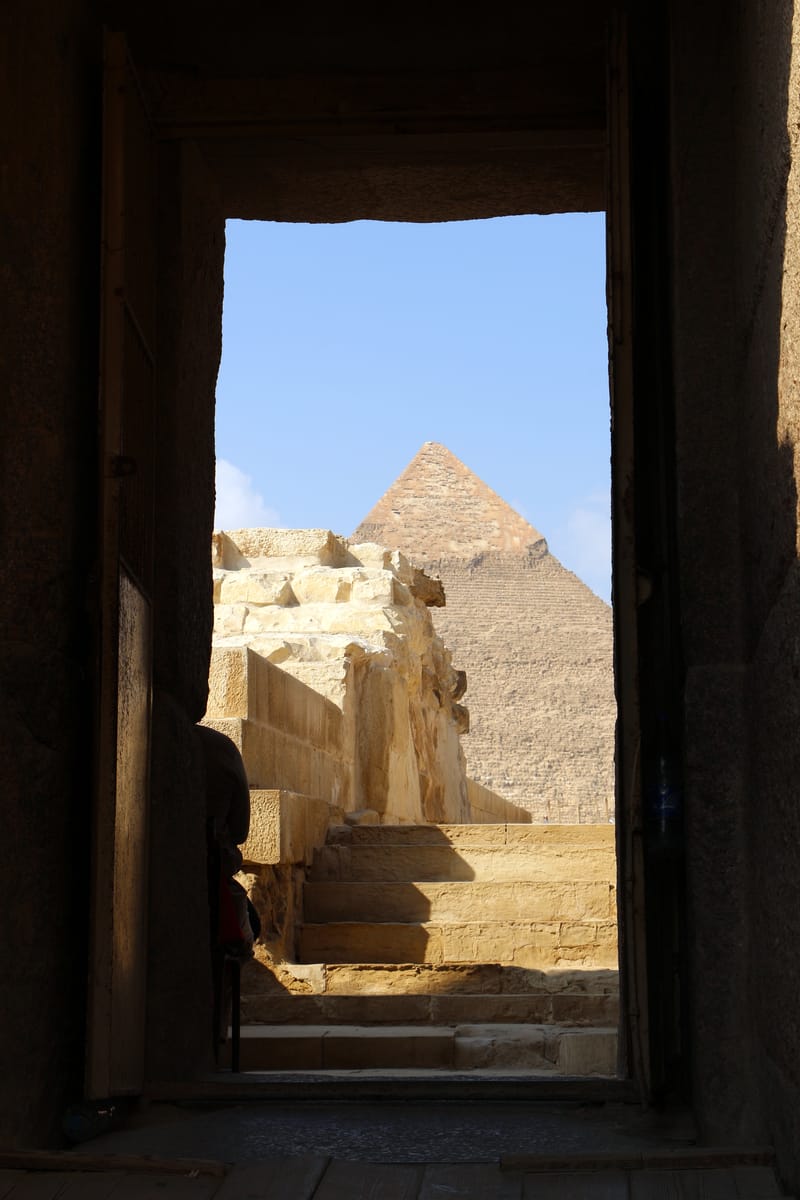
On the eastern edge of the Giza plateau, in the shadow of the second great pyramid and only a few metres from the Great Sphinx, stands what many archaeologists regard as the best-preserved building to survive from Egypt’s Old Kingdom: the valley temple of Khafre. Khafre — Chephren to the Greeks — was a king of the Fourth Dynasty who reigned in the mid-twenty-sixth century BCE and built the second of the three Giza pyramids, the one that still keeps a cap of its original casing near the summit. His pyramid did not stand alone. Like the great pyramid-builders before and after him, Khafre commissioned an entire funerary complex: the pyramid itself, a mortuary temple against its eastern face, a long covered causeway running down the slope, and, at the bottom edge of the desert where the cultivation and the Nile floodplain began, a valley temple — the ceremonial gateway to the whole ensemble. The Great Sphinx and its own temple lie immediately beside it, carved and built at the same time, so that the valley temple sits at the very heart of the most famous monumental landscape on Earth.
The valley temple’s purpose was religious and practical at once. It was the point where the sacred and the everyday met. A canal linked to the Nile brought the king’s body here by boat after death; in and around this building priests performed the rituals of purification and preparation that turned a dead pharaoh into an eternal, deified being, before the mummy was carried up the causeway to the mortuary temple and finally to the tomb. What makes the temple extraordinary, though, is not its decoration — it has almost none — but its sheer physical presence. It is built of some of the largest stones the Egyptians ever moved, cased in hard imported granite, and finished to a standard of fit and polish that still stops visitors in their tracks. It is a building that trades ornament for mass, and in doing so it raises, more sharply than the pyramids themselves, the question this site keeps returning to: how was this even possible to build?
The Structure
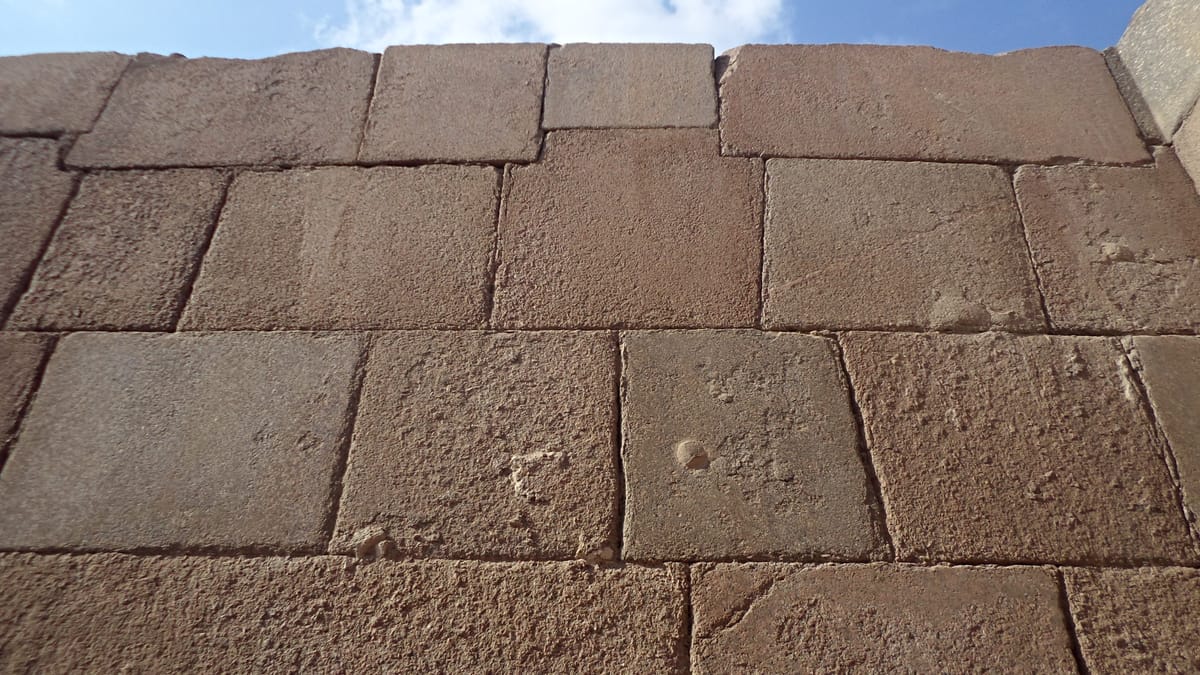
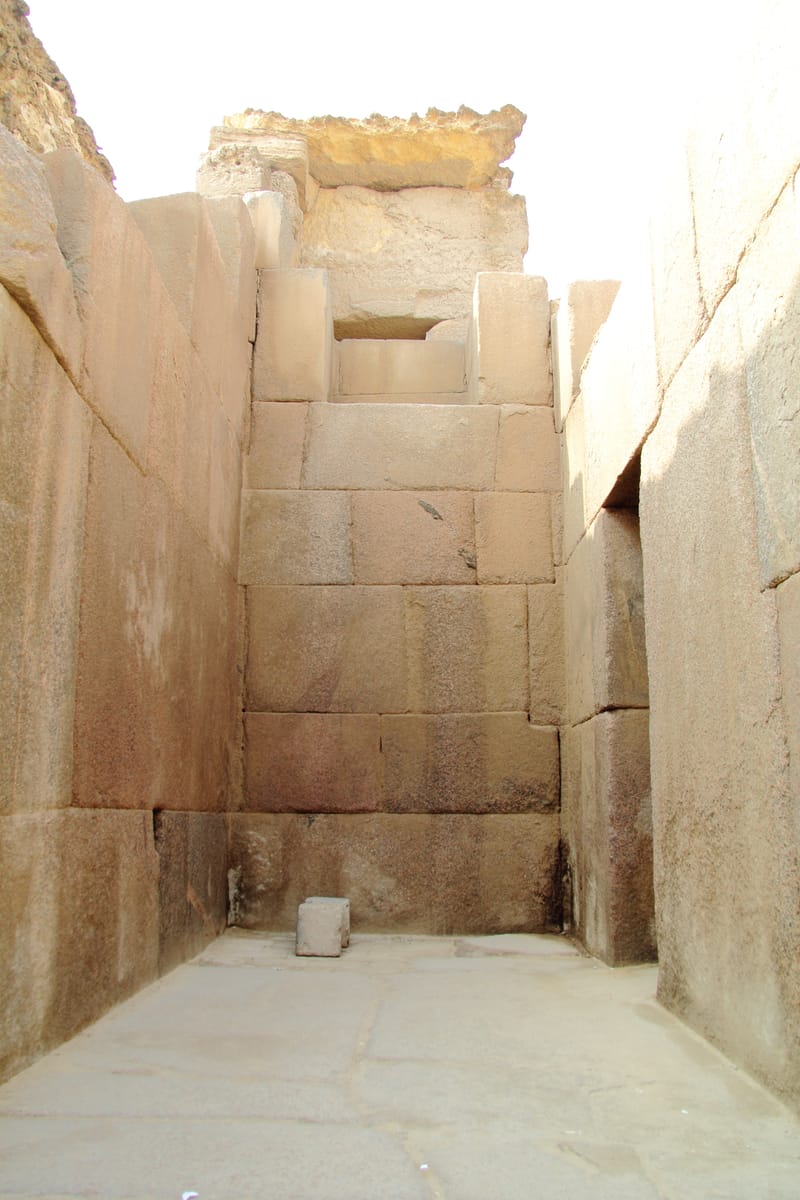
The valley temple is a nearly square, almost windowless block of masonry, austere on the outside and startlingly monumental within. Its outer walls were raised from colossal core blocks of local limestone, quarried from the plateau itself, many of them weighing far more than a hundred tonnes; the very largest are variously estimated at somewhere around 150 tonnes, with a few figures running higher still. For comparison, a typical block in the body of the Great Pyramid weighs only about two to three tonnes. These giant core stones were then sheathed, inside and out, in polished red granite brought roughly 900 kilometres down the Nile from the quarries at Aswan. The contrast in preservation is telling: where the granite casing survives it is crisp and almost unweathered, while the softer limestone core, wherever it is exposed, is deeply eroded — a reminder of how much the granite skin was protecting.
Two entrances on the eastern front, once flanked by sphinxes, led through a narrow vestibule into the temple’s centrepiece: a great T-shaped pillared hall. Its roof was carried on sixteen monolithic pillars of red granite, each a single squared shaft of stone standing something over four metres tall, arranged so that the hall opens crosswise and then runs back toward the causeway. There are no reliefs, no inscriptions, no painted scenes — only the deep red of the polished granite, the pale translucence of the alabaster (calcite) paving underfoot, and, originally, shafts of daylight admitted through narrow slit windows high at the junction of wall and ceiling, angled to fall on the statues below. It is one of the most powerful interiors in all of Egyptian architecture precisely because it is so bare.
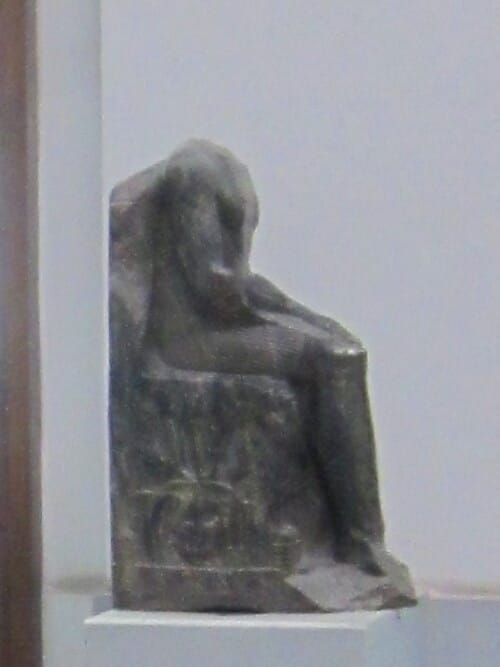
Those statues were the hall’s focus. Sockets cut into the alabaster floor show that twenty-three seated statues of Khafre once lined the walls of the T-shaped hall, a silent assembly of the king gazing out across the polished stone. Only fragments of most survive — but one came down to us nearly intact, and it is among the treasures of world art. In 1860 the French archaeologist Auguste Mariette, clearing the temple, found in a pit dug beneath the floor the seated statue now known as “Khafre Enthroned,” carved from a very hard, dark stone — anorthosite gneiss, quarried far out in the Nubian desert at Gebel el-Asr and traditionally called “diorite.” The king sits enthroned and serene, and behind his head the falcon-god Horus spreads his wings in a gesture of divine protection, fusing king and god in a single image. It stands today among the masterpieces of the Egyptian collection in Cairo. Beyond the hall, smaller chambers and a corridor led toward the causeway that climbed to the mortuary temple and the pyramid above.
How Was It Built?
Building the valley temple meant solving, in stone, two distinct problems: moving and setting enormous limestone core blocks, and then cladding them in granite cut to very fine joints.
The limestone core blocks were quarried on the spot — the plateau is itself limestone, and cutting the great enclosure around the nearby Sphinx produced exactly this kind of massive block as a by-product. Working a block free required only channels cut around it with copper tools and stone picks, and levers to break it loose along natural bedding planes. Moving a stone of a hundred tonnes or more is the harder feat, but the Egyptians had a repertoire for it: heavy blocks were rocked onto wooden sledges, hauled by large gangs over prepared trackways lubricated with water or wet silt, and raised into position on their courses using earthen construction ramps and embankments, levers, and packing. Because the temple is low and squat rather than tall, the blocks did not have to be lifted very high — a decisive practical advantage over building a pyramid, and one reason such outsized stones could be used here at all.
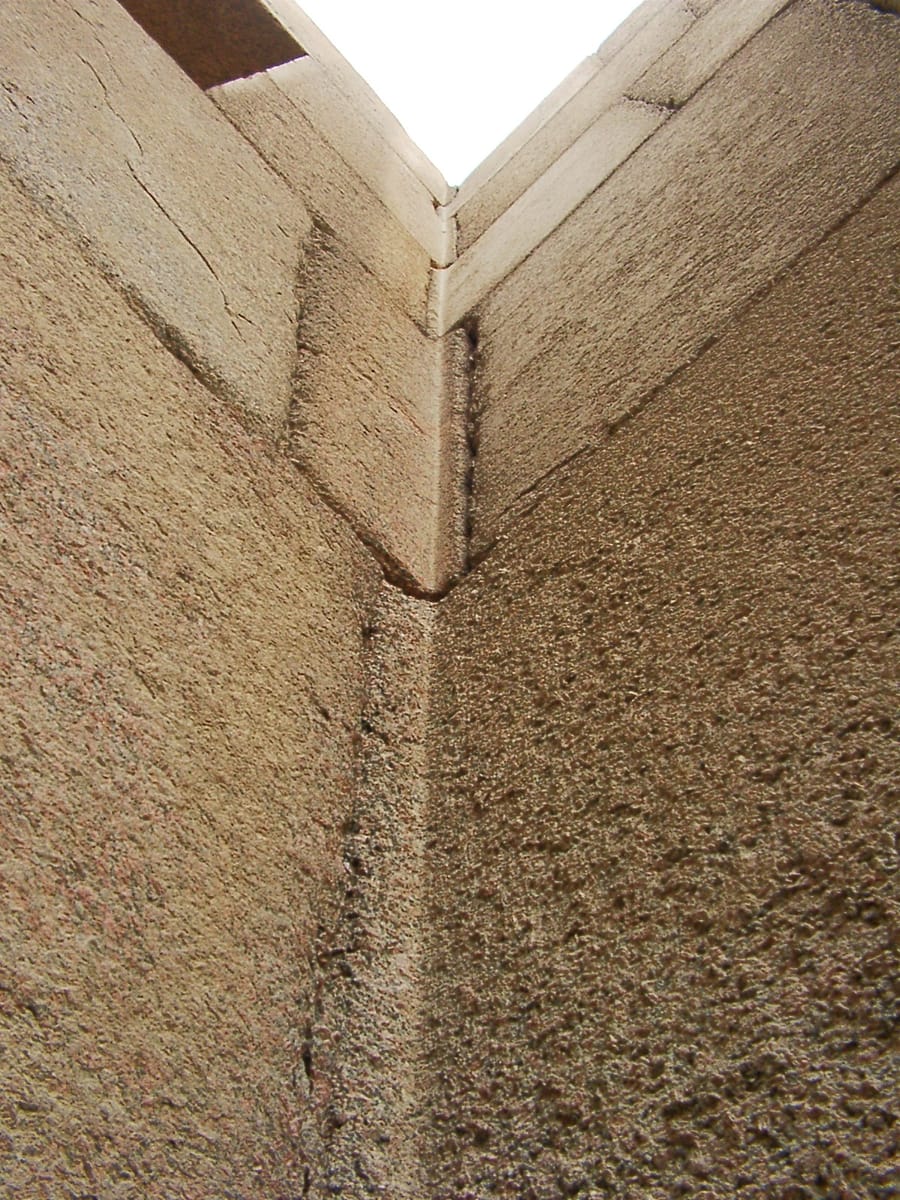
The granite casing and pillars are the finer work. Granite is far harder than limestone and cannot be carved with copper; it was shaped by pounding and grinding with dolerite hammerstones and abrasive sand, a slow but thoroughly attested Egyptian technique also used to dress obelisks and hard-stone statues. The casing blocks were not simply flat slabs slapped onto the core. In places — most strikingly at the corners — the granite is cut into interlocking L-shaped (“bent”) pieces that wrap around the angle, so that a single block turns the corner and keys into its neighbours, and the mating faces are dressed to joints so close they are hard to see. The Egyptians achieved such fits by repeatedly test-fitting and grinding adjoining blocks against each other, scraping away high spots until the surfaces matched — laborious, but well within the reach of a patient, well-organised workforce. The whole complex was a state project of the highest order, commanding the quarries at Aswan, a fleet to move granite downriver, and the labour and logistics of a centralised kingdom at its peak.
The Mainstream View
Egyptologists regard the valley temple as a securely understood monument. Its date and builder are not in doubt: it belongs to the reign of Khafre in the Fourth Dynasty, around the mid-2500s BCE, fixed by Khafre’s own statues and inscriptions found in and around it and by its integration into his pyramid complex as a single, coherent architectural unit. Its function is equally clear from its place in that complex and from parallels at other pyramids — it is the valley temple, the riverside reception point of the funerary cult, where the royal body arrived and the rites of purification and transformation (including, in the traditional understanding, ceremonies such as the “Opening of the Mouth” that restored the senses of the deceased) were performed before burial. The building’s austere, statue-filled hall fits this role as a hall of the king’s eternal, divine presence.
The construction, too, is seen as heroic but conventional Old Kingdom practice, not anomalous. Everything the temple required — quarrying limestone locally, moving very heavy blocks on sledges and ramps, shipping granite from Aswan, and dressing that granite with stone tools and abrasives to tight joints — is documented elsewhere in the same period, from the pyramids themselves to the transport and erection of multi-hundred-tonne obelisks and colossal statues. The valley temple concentrates these capabilities into one unusually massive, unusually well-finished building, but it does not require any technique the Egyptians are not otherwise known to have possessed. The temple’s survival in such good condition — the granite protecting the core, the whole structure partly buried by sand for much of its history — is why it can still show us this so vividly.
The Open Case
Being honest about this building means separating a real, narrow engineering question from the sensational claims that have grown up around it. The sensational version — that stones this large and joints this fine prove a lost high technology, or the hand of some vanished civilisation or visitors from elsewhere — does not survive contact with the evidence. The temple is inscribed with, and filled with statues of, a specific historical king; it is knit seamlessly into his pyramid complex; and every operation it demanded is attested in Old Kingdom Egypt. There is no missing builder to supply and no missing technology to invent. Presenting it as an alien or Atlantean relic would be to manufacture a mystery where the historical record is, in fact, unusually complete.
What remains genuinely open is narrower, and more interesting. Scholars broadly agree on the kinds of methods used, but the precise engineering of the extreme cases is still discussed and not settled in every detail. Exactly how the very heaviest limestone core blocks — stones of well over a hundred tonnes — were rigged, ramped, and manoeuvred into their final seats; exactly how the granite facing was dressed and test-fitted to produce joints of that closeness across such large, multi-angled contact faces; how much of the fit was achieved by grinding in place versus careful pre-shaping — these are legitimate questions of ancient engineering that experimental archaeology is still working to answer. The valley temple’s stark, mortarless, megalithic granite invites an obvious comparison with the equally austere, cyclopean masonry of the Osirion at Abydos, and both show the same Egyptian taste for overwhelming mass and precise fit in hard stone. The right response to standing in that red granite hall is not to reach for lost technology, but to sit with a harder and more honest kind of wonder: that a Bronze Age kingdom, with copper chisels, stone pounders, sledges, ropes, and ramps, chose to work at this scale at all — and pulled it off so well that the building still stands, its joints still tight, forty-five centuries later.
Sources
- Wikipedia — Pyramid of Khafre
- Wikipedia — Khafre Enthroned
- Ministry of Tourism and Antiquities — Pyramid Complex of Khafre (Khefren)
- Madain Project — Valley Temple of Khafre
- Ancient Egypt Research Associates (AERA) — Khafre's Monuments as a Unit
- ARCE — Khafre Enthroned
- Digital Giza (Harvard University) — Khafre's Valley Temple
- giza
- khafre
- chephren
- old-kingdom
- fourth-dynasty
- valley-temple
- megalithic
- red-granite
- aswan-granite
- great-sphinx
- khafre-enthroned
- pyramid-complex
- mummification
- opening-of-the-mouth
- alabaster
Gallery