The Treasury of Atreus
Corbelled roofs everywhere else in the ancient world stall out around five metres, because a false dome has no keystone to fight the span — so how did Bronze Age masons at Mycenae close one 14.5 metres across, and set a single 120-tonne lintel above its door, without iron, pulleys or a crane?
Why this rating?
- Construction difficulty
- 5/5
- Method uncertainty
- 3/5
- Capability gap
- 3/5
- Open questions
- 4/5
Raising a corbelled chamber 14.5 m wide and roughly 13 m tall out of thirty-three precisely cut rings — and setting above its door a single block of about 120 tonnes, the heaviest piece of masonry known from Greek architecture — is an extreme engineering problem for a culture with bronze tools, no pulleys and no iron; the dome that resulted went unmatched anywhere on earth for over a thousand years. The corbelling principle itself is well understood and legible in the stones, which keeps method uncertainty moderate, but no ramp, sledge, depiction or record of the lintel operation survives, and the tomb's date, its unique side chamber and the identity of everyone ever buried in it all remain unresolved.
Overview
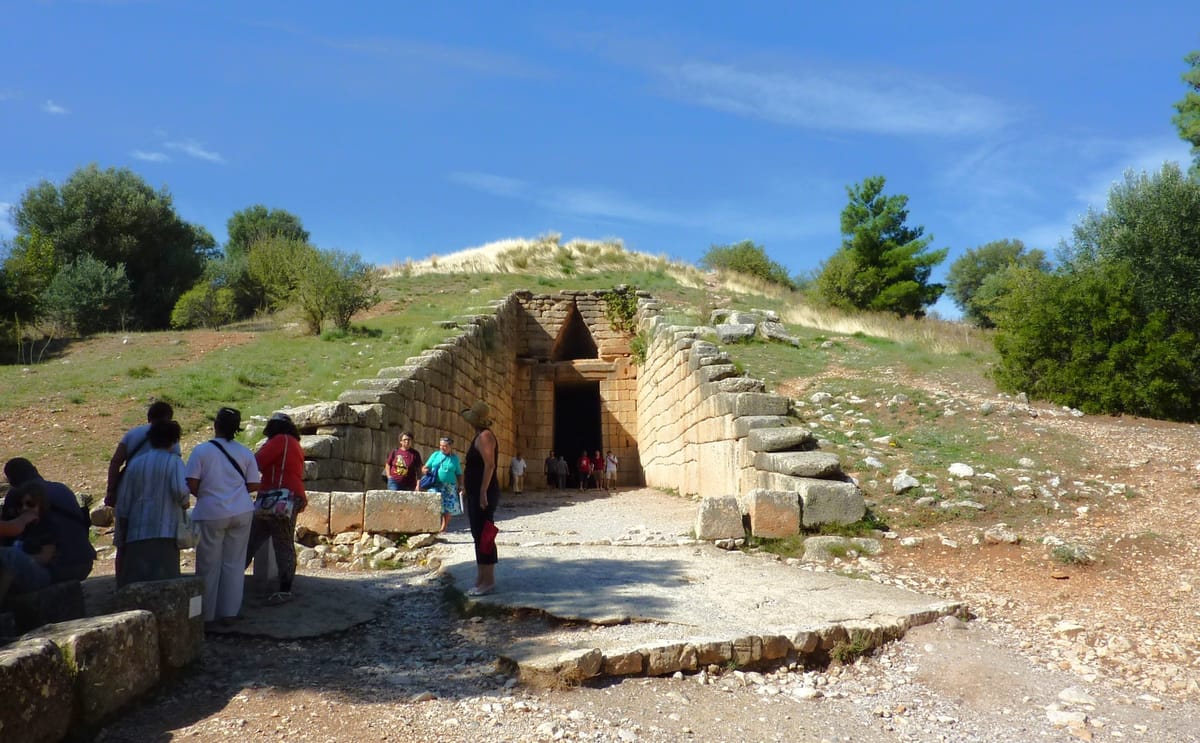
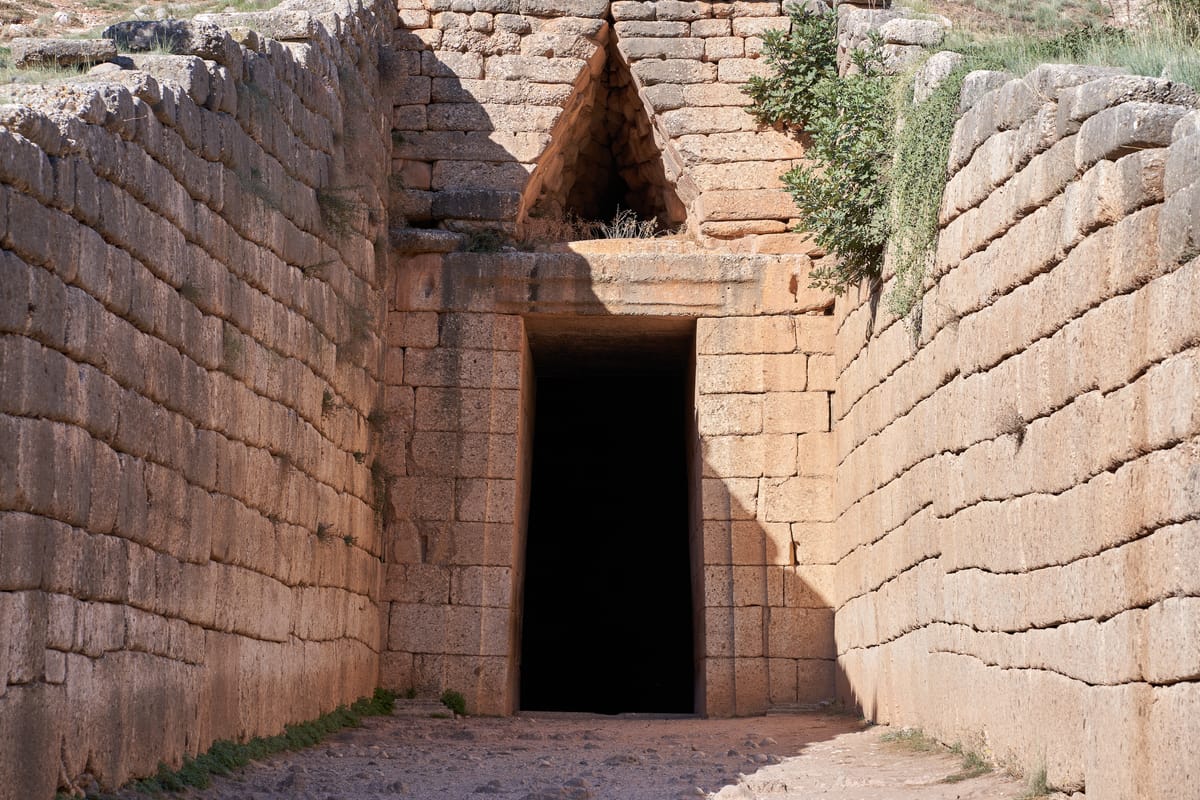
Below the citadel of Mycenae, in the hills of the Argolid about 90 km south-west of Athens, a trench 36 metres long runs straight into a hillside and ends at a stone façade. Through the doorway is a single circular room, 14.5 metres across and about 13.2 metres high, roofed by a dome of dressed stone that tapers to a point like the inside of a beehive. This is the Treasury of Atreus — a Late Bronze Age tholos tomb, built by Mycenaean Greeks somewhere in the range c. 1400–1250 BCE, and the largest and most elaborate of the nine such tombs known at Mycenae. It has been open and empty for at least two thousand years. The traveller Pausanias, writing in the second century CE, already knew it as one of the “underground chambers of Atreus and his children, in which were stored their treasures” — which is where the misleading name comes from. It is not a treasury, and there is no evidence connecting it to Atreus, Agamemnon, or any other figure from the Homeric cycle; it is a monumental grave, robbed long before anyone thought to record what was in it.
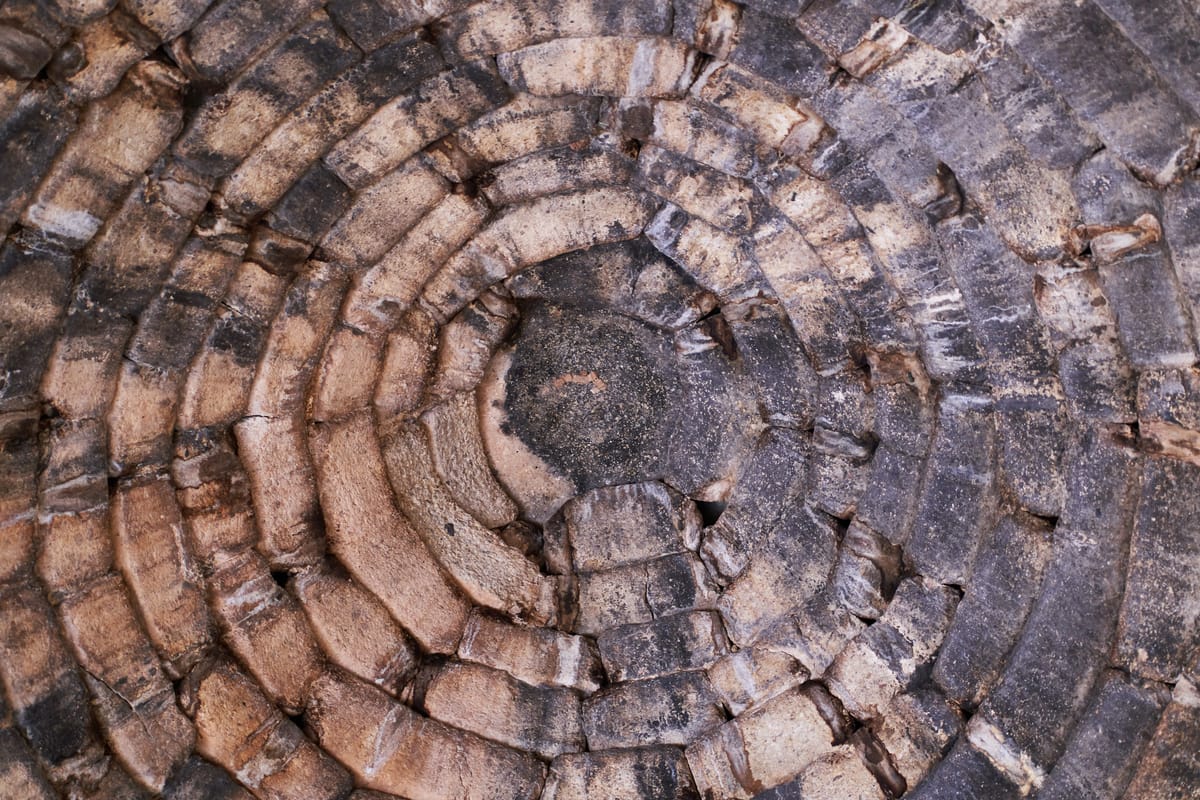
What makes it remarkable is not the myth but the ceiling. The dome is not a dome in the Roman sense. There is no keystone, no wedge-shaped voussoir, no true arch anywhere in the building. It is a corbel vault: rings of stone, each laid slightly further inward than the ring below, until after thirty-three courses they close overhead. That technique has been invented independently all over the world — in Neolithic Ireland, in Bronze Age Sardinia, in Maya Yucatán — and it almost always stalls out at around five metres of span, because without a keystone there is nothing to resist the outward thrust of a wide opening. Mycenae did not stop at five metres. The Treasury of Atreus was the tallest and widest stone dome anywhere on earth for well over a millennium, from around 1250 BCE until Roman concrete overtook it in the late first century BCE, and it remains the largest corbelled dome in the world. Mycenae and neighbouring Tiryns were inscribed together on the UNESCO World Heritage List in 1999, with the citation naming the Lion Gate and the Treasury of Atreus specifically as “outstanding examples of human creative genius.”
The Structure
The tomb follows the standard tripartite plan of a Mycenaean tholos, executed at unprecedented scale. First comes the dromos, an open passage oriented east–west, 36 metres long and 6 metres wide, cut down into the natural slope. For the 19 metres nearest the entrance its sides are faced with squared conglomerate blocks — the Treasury of Atreus is the first tomb at Mycenae to be lined with conglomerate throughout, a stone used inside the citadel to accentuate important architectural elements such as thresholds and door jambs. The walls climb from about half a metre high at the outer end to a full 10 metres at the façade, thickening from roughly 2 to 3 metres as they go, to hold back the increasing weight of earth behind them. Alan Wace estimated the dromos masonry alone at more than 600 cubic metres, over 1,200 tonnes of stone. The blocks are bonded not with lime mortar but with a yellow clay known as plesia, the standard Mycenaean bedding material.
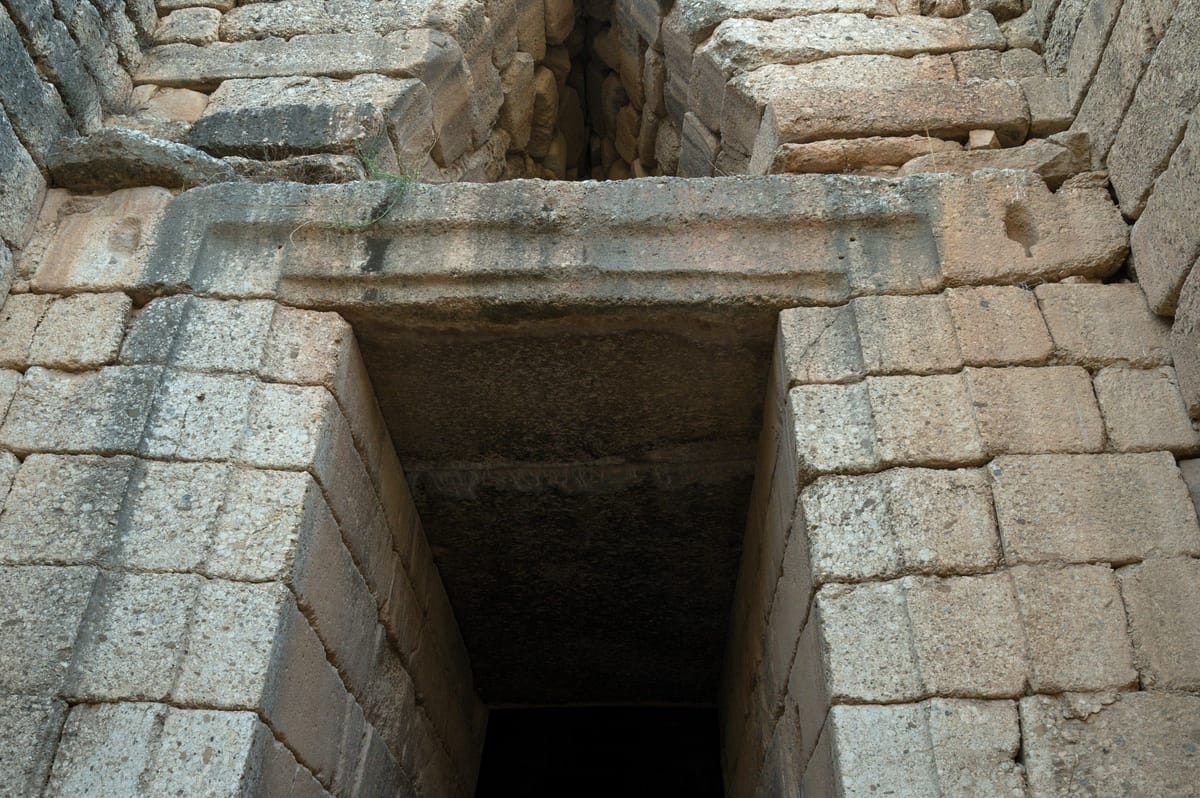
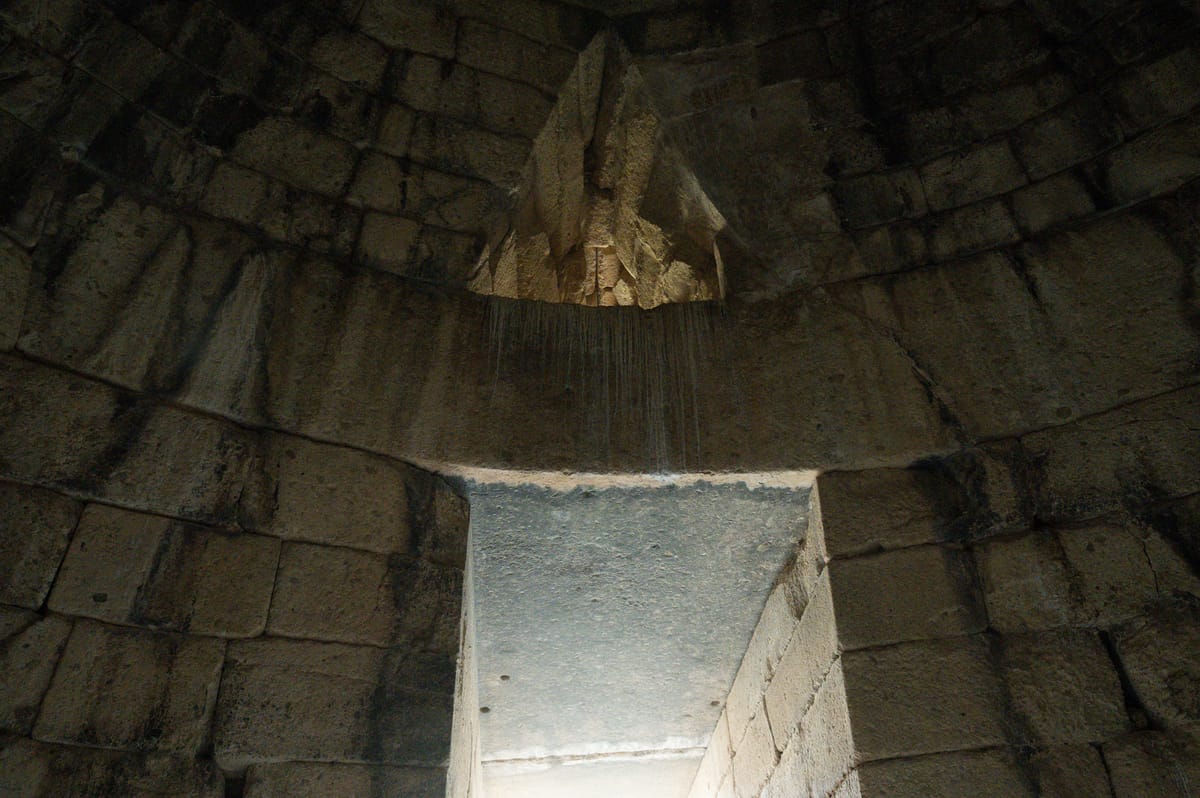
At the end of the dromos stands the stomion, the deep doorway, in a façade 10.5 metres high. The opening is 5.4 metres tall, 2.7 metres wide, and 5.4 metres deep — a tunnel through the wall rather than a door. Two lintel blocks span it. The inner one measures roughly 8 metres long, 5 metres deep and 1.2 metres thick, and is estimated at about 120 tonnes: the heaviest single piece of masonry known from Greek architecture, and by some estimates a block that would have required on the order of a thousand people to haul into position. Above it, a triangular void — the relieving triangle — lifts the weight of the dome off the centre of the lintel and channels it down through the jambs on either side. The device had been used earlier at Mycenae, at the Tomb of Aegisthus, but never at this scale; the same idea appears in the sculpted relief panel over the Lion Gate, which is generally thought to be broadly contemporary.
The façade was not bare stone. Fragments recovered over two centuries — now scattered between the National Archaeological Museum in Athens, the British Museum and collections in Germany — show semi-engaged columns of green marble carved with zigzag bands flanking the doorway, a second pair of smaller half-columns beside the relieving triangle, and horizontal friezes of rosettes and running spirals in red marble. In the 1960s Richard Hope Simpson, Reynold Higgins and S. E. Ellis traced the red stone (rosso antico, later called lapis Taenarius) to quarries on the Mani peninsula, more than 100 km to the south, and thought it highly probable the green came from the same region. Two gypsum reliefs carved with bulls may also have belonged to the façade or the side chamber. The tomb was, in its finished state, a polychrome monument in imported stone at the end of a ceremonial cutting — a conspicuous statement of reach and wealth as much as a grave.
Inside, the thalamos is a single circular chamber, 14.5 metres in diameter and 13.2 metres high, built of thirty-three courses of worked ashlar. (Published figures vary slightly; some accounts round the chamber to 14.6 metres across and 13.5 metres tall.) Traces of nails driven into the stone survive on the interior surface, generally read as evidence that ornaments — perhaps gilded rosettes — once hung from the vault. A doorway 2.5 metres high in the north side opens into a rectangular side chamber about 6 metres square, cut into the rock. Apart from the Treasury of Minyas at Orchomenos, which appears to follow the same plan, this is the only known Mycenaean tholos with a side chamber, and most scholars take it to be where the actual burials were made. Over the whole chamber, an earthen tumulus was heaped to raise the profile of the mound, retained by a wall of poros stone — preserved to 1.5 metres high and about a metre thick — quarried in the hills north-west of Mycenae toward Nemea. A terrace roughly 27 metres square was laid out in front of the tomb.
The context matters. Mycenae at its height around 1350 BCE held perhaps 30,000 people across the citadel and lower town, at the centre of a palace state that ran on Linear B bookkeeping and traded across the eastern Mediterranean. Alan Wace sorted the nine tholoi at Mycenae into three groups by material and refinement; the Treasury of Atreus belongs to the last and finest, alongside the Tomb of Clytemnestra and the Tomb of the Genii. It was probably the penultimate tholos built at the site. Within a few generations of its completion, the palace was destroyed in the wider Bronze Age collapse around 1200 BCE, and nothing on this scale was built in Greece again for centuries.
How Was It Built?
The construction sequence is reasonably clear from the building itself. A roughly cylindrical pit was quarried out of the hillside; the chamber was then built up inside that pit as free-standing masonry, and the space behind the wall backfilled, so that the surrounding hill and the added earth mound press inward on the vault from all sides. That confinement is the whole structural argument. A corbel vault standing in the open has to resist an outward thrust with nothing but the weight of the courses above it — which is exactly why open corbelled chambers rarely exceed a few metres. Bury the vault in a hillside and the earth becomes part of the structure, squeezing the rings together and holding each cantilevered block down. The Mycenaean builders were, in effect, borrowing compression from the hill. The dromos walls thicken toward the façade for the same reason: they are retaining walls first and an approach second.
The stones were laid ring by ring. Each block was set so that its inner edge overhung the course beneath, with the bulk of its mass — and the mass of everything stacked above — bearing down on the outer, buried end to prevent it tipping. Only after the vault was closed by its single capstone were the inner faces dressed down, trimming the stepped profile into the smooth curve visitors see today. Everything about the process is conventional Bronze Age heavy work: earthen and rubble ramps built up around the rising structure, timber levers and rollers, sledges, rope, and organised manpower. Estimates put the total labour at a minimum of about 20,000 worker-days, possibly involving up to 1,600 people over a period measured in years or decades. Elizabeth French has suggested that the crew who built the Late Helladic III palace megaron on the acropolis may have been redeployed to the tomb, plausibly under some form of corvée obligation.
The lintel is the part that stops being routine. Setting an 8-metre monolith of around 120 tonnes about five metres above the ground, with bronze tools, no iron, no pulley blocks, no capstan and no crane, is a problem of a different order from stacking multi-tonne wall blocks. The consensus reconstruction is that the block was quarried locally, dragged on a sledge along a prepared, watered or greased trackway by a very large hauling gang, then run up a long earthen ramp built to the height of the door head and levered into place — after which the ramp was dismantled. Every element of that is inference. No ramp survives, no sledge, no rope, no tally of workers, and no Mycenaean image or text describes the operation. What survives is the block, resting where they put it, and still sitting level after roughly thirty-two centuries.
The Mainstream View
Archaeologists do not treat the Treasury of Atreus as an unexplained object. It is understood as the culminating example of a well-documented Mycenaean building tradition: nine tholos tombs at Mycenae alone, dozens more across the Argolid and the Peloponnese, developing over three centuries from crude rubble-lined chambers to precisely cut ashlar. Every structural feature at Atreus has precedent somewhere earlier in that sequence — the corbel vault, the hillside cutting, the earth mound, the relieving triangle (first used at Mycenae on the Tomb of Aegisthus) — and every one of them is simply executed here at maximum scale with maximum finish. The engineering is orthodox Bronze Age megalithic work: gravity, friction, ramps, levers, and a great deal of coordinated labour by a state that plainly had labour to coordinate. The same people had already faced the Cyclopean walls of the citadel with blocks weighing well over 20 tonnes and set the Lion Gate. Nothing in the tomb requires a technology the Mycenaeans are not independently known to have had.
The dating rests on stratigraphy rather than legend. Wace’s 1939 excavation showed the dromos had been cut through a deposit containing Late Helladic IIIA1 pottery, giving a firm terminus post quem, and comparison with the securely dated Tomb of Aegisthus fixes Atreus as later. Most modern treatments place construction somewhere in c. 1400–1250 BCE, and regard the tomb and the fortification of the citadel — including the Lion Gate — as broadly contemporary projects of the same regime. On function, the mainstream reading is a monumental family or dynastic grave: an elite or royal burial place, used and reopened over time, whose extravagant façade and 27-metre forecourt were designed to be seen. James Wright has characterised tholos construction as a “monumental expression of power,” pointing to the deliberate echo between the tomb’s relieving triangle and the Lion Gate relief, and to the shared use of conglomerate to mark out significant architecture. The tomb is a political statement carved into a hillside.
And the record it set is not treated as mysterious either — just extreme. The tomb held the title of largest stone dome on earth from around 1250 BCE until the so-called Temple of Mercury at Baiae (actually part of a bath complex) in the late first century BCE or early first century CE, and then the Pantheon in the second century CE. Both of those are true domes in Roman concrete, a fundamentally different structural system. Compared like for like, no one has ever built a bigger corbelled dome.
The Open Case
Start with what the corbel is supposed to be able to do. It is the roof humans keep independently reinventing — Newgrange in Ireland, the nuraghi of Sardinia, the Puuc Maya arches of Yucatán — and in almost every case it hits a ceiling at roughly five metres of span, because a false dome has no keystone and no way to convert outward thrust into compression across an opening. Mycenae cleared 14.5 metres. Even accepting that the surrounding hill does much of the work, that is roughly three times the span everyone else settled for, achieved with the same basic idea and no better geometry, and it was not beaten by any structural system for something like twelve hundred years. The Mycenaeans reached the physical limit of a technique that stops most cultures early, and then stayed there — no one refined it further, and after the collapse around 1200 BCE the whole tradition simply ended.
Then there is the lintel. Around 120 tonnes is not a marginal escalation on Mycenaean practice; it is roughly six times the weight of the heaviest blocks in the citadel walls, and it is the heaviest single stone anyone in the Greek world is known to have set, in any period, including the classical one that followed. The reconstructions — ramp, sledge, levers, a thousand haulers — are physically plausible and widely accepted, but they are reconstructions. Nothing was left behind to test them against, and no ancient source explains it. That is a genuine, if bounded, gap: we know it was done, we know roughly how such things must be done, and we do not know how these builders actually did it.
The human questions are wider open still. Nobody knows who was buried here. The tomb was looted in antiquity — it was already empty and half-buried when Pausanias walked past it — so the burial that justified this staggering expenditure of labour and imported marble has left no body, no grave goods, no name. Even the number and sequence of burials is guesswork: most scholars assume the side chamber held the interments, while Wace argued it was an ossuary for earlier remains cleared out to make room for new ones. The date is still contested inside the accepted range, with George Mylonas placing the tomb late in Late Helladic IIIB1 and William Cavanagh, Christopher Mee and Elizabeth French putting it early in LH IIIA1 — a difference of well over a century, and with it a different story about which ruler commissioned it and why. Scholars also disagree about whether the dromos was backfilled after each burial, which would have hidden that elaborate façade almost immediately, or left open so it could be seen.
None of this points anywhere exotic. It points at a Bronze Age state that took the one roofing trick humanity keeps rediscovering, pushed it past the limit every other culture accepted, capped it with a stone no one before or after in Greek antiquity attempted to move — and then vanished so completely that we cannot say whose grave it was, or in which century they were laid in it.
Sources
- UNESCO World Heritage Centre — Archaeological Sites of Mycenae and Tiryns
- Wikipedia — Treasury of Atreus
- Wikipedia — Mycenae
- Wikipedia — Tholos tomb
- Wikipedia — List of largest domes (record-holder chronology)
- Encyclopædia Britannica — Treasury of Atreus
- World History Encyclopedia — Treasury of Atreus
- Dartmouth College, Aegean Prehistoric Archaeology — Lesson 19: Tholos Tombs
- Ancient World Magazine — The "Treasury of Atreus": a Late Bronze Age tomb near Mycenae
- TheCivilEngineer.org — Treasury of Atreus (historical database of civil infrastructure)
Connected findings
- Neither of These Is a Dome — One is a spiral staircase of stone dressed smooth into a curve. The other cracked apart early and has been standing as a ring of leaning wedges ever since. Between them they held the record for the largest roofed room on earth for close to three thousand years.
- mycenae
- mycenaean
- greece
- tholos-tomb
- beehive-tomb
- corbel-vault
- false-dome
- bronze-age
- megalith
- lintel
- ashlar
- unesco
Gallery