The Temple of the Inscriptions, Palenque
How do you build a pyramid around a tomb that has to be sealed forever — placing a multi-tonne carved lid inside a vaulted crypt before there is any pyramid to carry it — and then run a stone tube from the coffin to the temple floor above?
Why this rating?
- Construction difficulty
- 4/5
- Method uncertainty
- 2/5
- Capability gap
- 3/5
- Open questions
- 3/5
Building the crypt, its corbel vault and a 3.6-metre carved lid first and then raising a nine-tier pyramid around them is a sequencing problem rather than a lifting one, and it demanded that the whole structure be designed in advance and got right the first time — there is no second chance once a tomb is sealed. The techniques are well attested and the inscriptions tell us who and when, which keeps uncertainty low; what remains genuinely contested is the mismatch between Pakal's inscribed age at death and what his skeleton appears to show, and what the water channels found beneath the tomb in 2016 were for.
Overview
Palenque sits where the Chiapas highlands drop into the Gulf coastal plain, a Classic Maya city pressed against a forested ridge, celebrated for the lightness of its architecture — thin walls, wide doorways, delicate openwork roof crests — in a tradition that mostly built heavy.
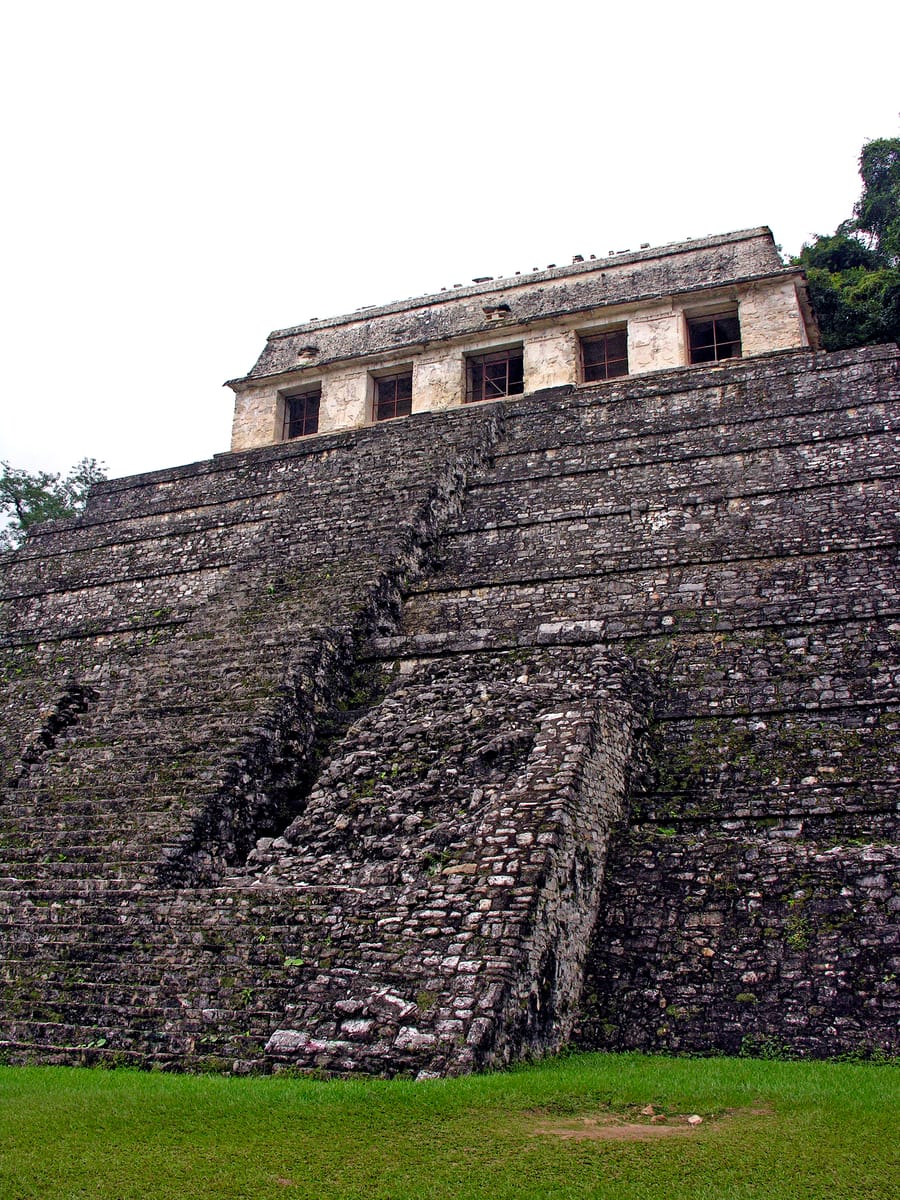
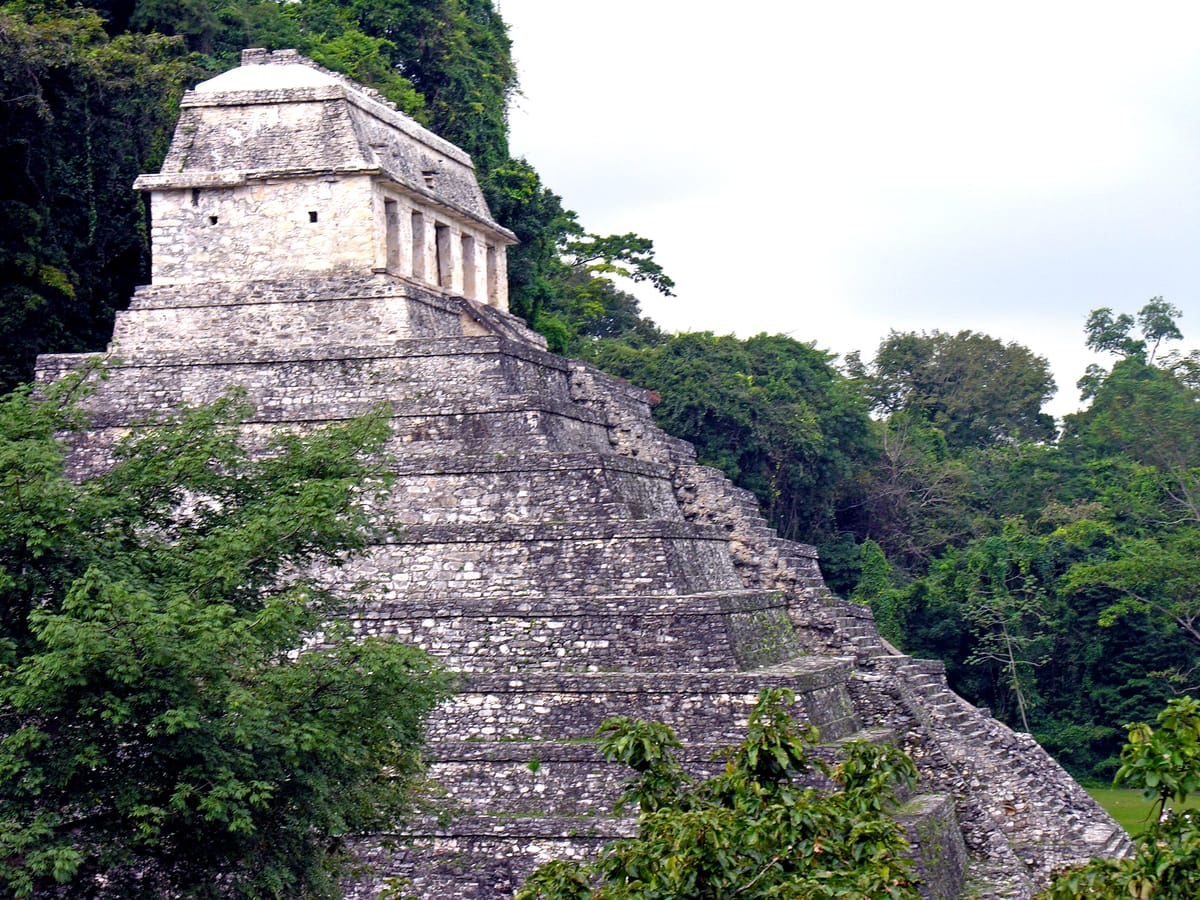
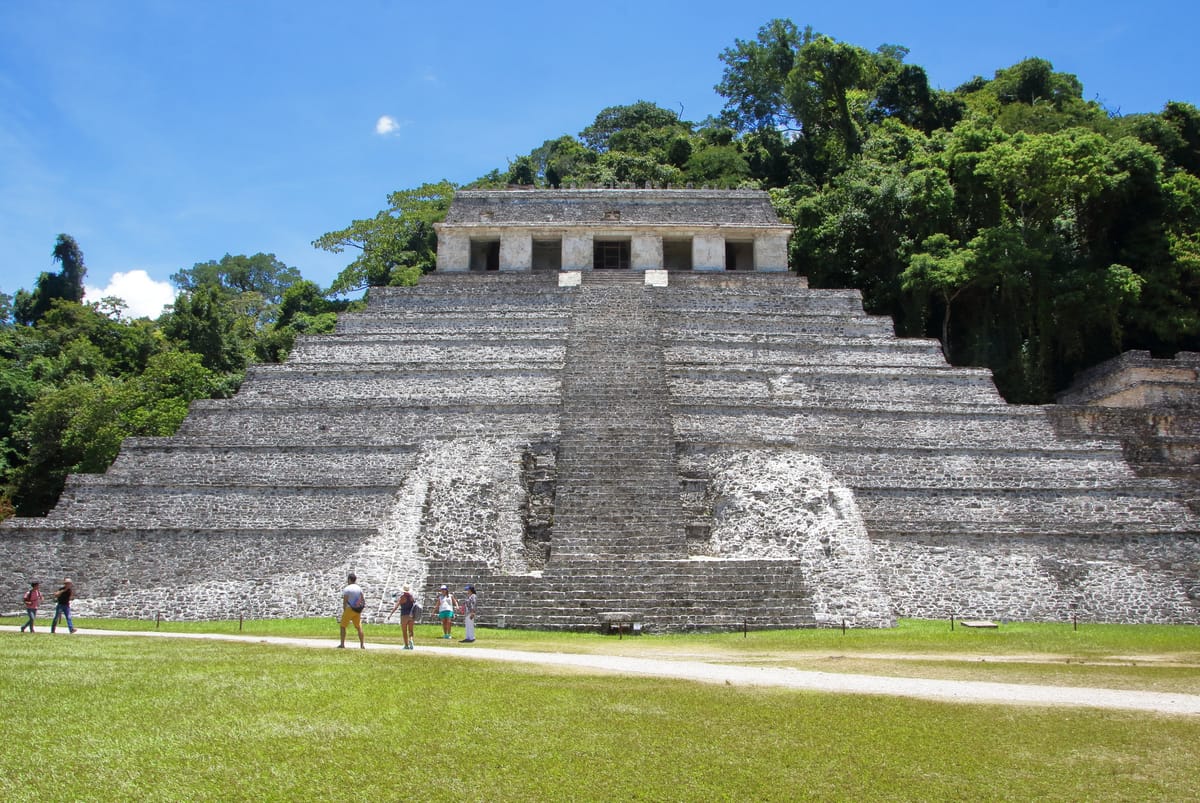
The Temple of the Inscriptions is its most important building. A temple stands on top of an eight-stepped pyramid, making nine levels in all, and takes its name from three great hieroglyphic tablets inside: the East, Central and West panels, comprising 617 glyphs and forming one of the longest Maya inscriptions known.
But the reason it matters is underneath. In 1952 the Mexican archaeologist Alberto Ruz Lhuillier lifted a slab in the temple floor and found a stairway packed with rubble descending into the body of the pyramid. It took two years to clear. At the bottom, at roughly the level of the plaza outside, was a vaulted crypt containing the sarcophagus of Kʼinich Janaabʼ Pakal I, who ruled Palenque for some sixty-eight years.
It remains the only known example of a Maya pyramid built around a tomb rather than over one.
The Structure
Construction began in the last decade of Pakal’s life and was completed by his son and successor Kʼinich Kan Bahlam II shortly after 683 CE. The pyramid stands about 20 metres above the plaza.
The interior stairway runs some 22 metres from the temple floor down to the crypt, in roughly 71 steps broken into flights with narrow landings, turning back on itself partway. It was deliberately filled with rubble after the burial — this was not a passage meant to be used again.
The crypt at the bottom is a corbel-vaulted chamber, reinforced with recessed buttresses to keep it from collapsing under the mass above. Thirteen sections of corbel vaulting connect the tomb to the chamber above it, a number that corresponds to the thirteen levels of the Maya heavens. Nine stone figures — the Nine Lords of the Night — are modelled in stucco on the crypt walls.
The sarcophagus is a monolithic limestone box. Its lid measures roughly 3.6 by 2.2 metres, cut from a single stone; published weight estimates vary, commonly around five tonnes and sometimes higher. The carving on it is among the most famous images in the Americas: Pakal at the instant of death, falling backwards into the open jaws of the underworld, the world tree rising above him. The sides of the box carry his ancestors, arrayed in a line going back six generations.
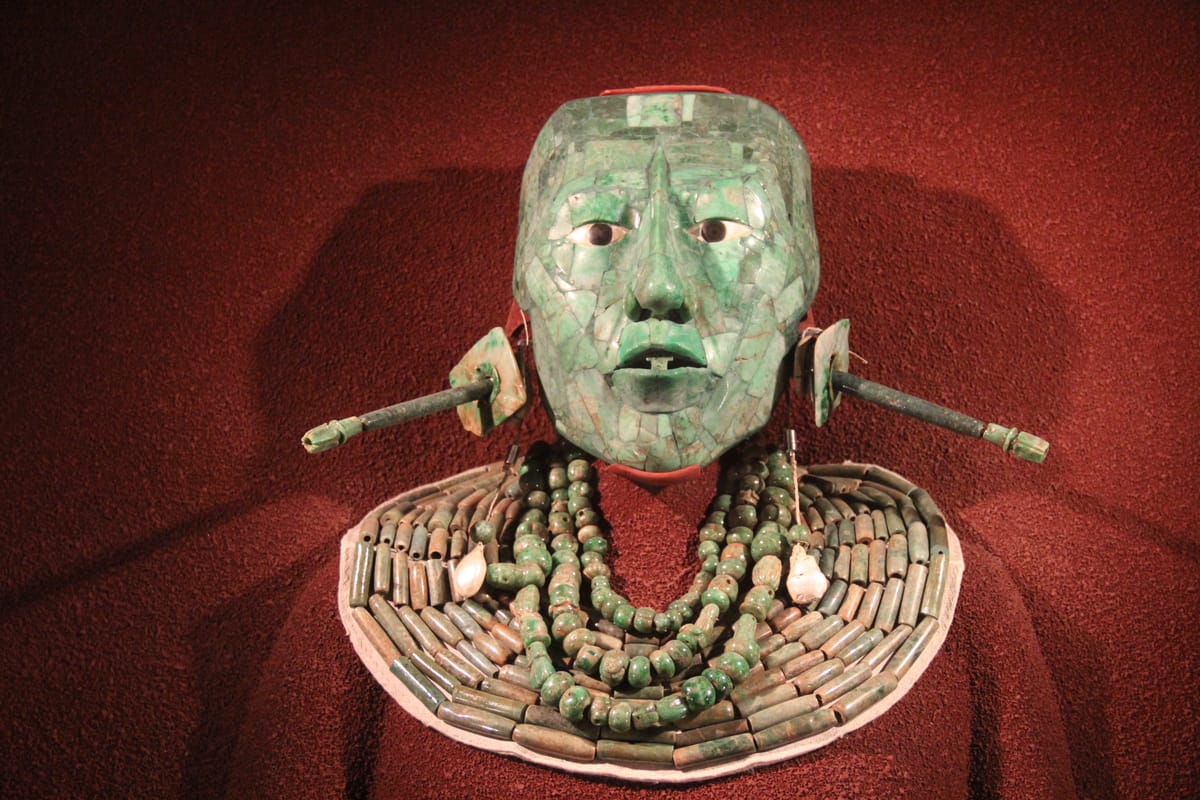
Inside, Pakal wore a funerary mask of mosaic jade, with eyes of shell, mother-of-pearl and obsidian, and a heavy jade collar. Five skeletons, male and female, were found at the crypt entrance — sacrificed attendants, intended to accompany him into Xibalba.
And running from the sarcophagus, up alongside the stairway, all the way to the floor of the temple at the top, is a hollow stone tube: the psychoduct. It has been compared to an umbilical cord — a channel by which the dead king could remain in contact with his descendants performing rituals above.
How Was It Built?
The Maya of Palenque built with limestone, lime mortar and lime plaster, roofed with corbel vaults, and had neither metal tools nor wheeled transport nor draft animals. In that respect the temple is ordinary. What is not ordinary is the order in which things had to happen.
Consider the problem. The crypt is at plaza level. The sarcophagus box and its 3.6-metre lid are inside it. The chamber is roofed with a corbel vault, and the vault is under about 20 metres of pyramid. There is no route by which a slab that size could be brought down a 22-metre stair with landings and switchbacks, and no way to lower it through a vault that is already closed.
So the sequence must have run the other way. The tomb chamber was built first, at ground level. The sarcophagus and its lid were installed while there was still open sky above them. The vault was closed over the box. Only then was the pyramid raised around and on top of the finished tomb — including, threaded up through the growing mass of it, the stairway and the psychoduct, whose positions had to be fixed before the masonry that would hold them existed.
The design also had to anticipate the burial itself. The sarcophagus and its cover were shaped so that the tomb could be prepared in advance and the lid slid into place over the body after Pakal’s death — a monument, in other words, built during its occupant’s lifetime, waiting for him.
This is why the Temple of the Inscriptions is an engineering story even though nothing in it is technically exotic. The hard part is not lifting; it is commitment. Every decision about the crypt was irreversible the moment the next course of masonry went on. There is no revision, no retro-fitting, no opening it back up to correct a mistake. The buttressed vault had to be right first time, because it would spend the next thirteen centuries holding up a pyramid.
The Mainstream View
There is very little argument about the basic account, because Palenque’s builders wrote it down. The tablets name the ruler, the dynasty and the dates; the epigraphy has been read since the decipherment breakthroughs of the later twentieth century, in which Palenque’s texts were central. Pakal acceded as a child, ruled for around sixty-eight years, and presided over the city’s greatest period of building. His son finished the funerary monument and added the inscriptions that record the succession.
The tomb-first construction, the psychoduct, the sacrificed attendants and the iconography of the lid all sit comfortably within Maya royal mortuary practice. The lid does not depict a spacecraft — a reading popularised in the 1960s and still circulating — it depicts a king falling into the underworld beneath a world tree, in an idiom used across Classic Maya art, and the elements of the composition can be matched motif by motif to other Maya monuments.
Ruz Lhuillier’s discovery is regarded as one of the great excavations of the twentieth century, and he is buried at Palenque, opposite the pyramid he opened.
The Open Case
Two questions genuinely remain, and one of them is about the man in the box.
The inscriptions state that Pakal was born in 603 and died in 683, making him roughly 80 years old. When Ruz Lhuillier’s team examined the skeleton in 1952, the physical anthropologists put its age at 40 to 50 — the teeth in particular were in unusually good condition, showing far less wear than expected. For decades this was used to argue that the inscriptions were dynastic propaganda, or that the body was not Pakal’s at all. The prevailing resolution is that standard osteological age markers, calibrated on ordinary populations, understate the age of an aristocrat who ate soft, well-prepared, low-grit food his whole life. Subsequent re-analyses have supported the advanced age. But the discrepancy is real, it has been argued over for seventy years, and it is resolved by an explanation rather than by direct evidence.
The second is water. In 2016 a team led by Arnoldo González Cruz, using sonar and then robots, identified a system of nine channels, about 17 metres long, running beneath the funerary chamber and out into the esplanade in front of the temple. The pyramid and its tomb appear to have been deliberately sited over a spring, and the water directed from under Pakal’s chamber out into the open plaza.
The reading offered is that this is a path — a route by which the dead king’s spirit could travel to the underworld, water being the medium of that passage in Maya cosmology. It is a compelling interpretation and it fits what the psychoduct already told us about how this building was meant to work. But it means the tomb’s placement was determined by something invisible underground, chosen before construction, which raises the question of how many other Maya monuments were sited the same way and nobody has checked.
The wonder here is not a lost technique. It is a building conceived entirely backwards from its own ending: a tomb first, then the mountain around it, a tube left in the masonry so the dead man could still be spoken to, and — it turns out — a stream routed under the coffin so he could leave.
Sources
- Wikipedia — Temple of the Inscriptions
- UNESCO World Heritage Centre — Pre-Hispanic City and National Park of Palenque
- Maya Ruins — Palenque: Temple of the Inscriptions & Tomb of Pakal
- Archaeology Magazine — Water Tunnel Discovered at Mexico's Temple of Inscriptions
- Phys.org — Mexico finds water tunnels under Pakal tomb in Palenque
- Mesoweb — Advanced Age Confirmed for Pakal of Palenque
Gallery