Sigiriya
In under two decades, a usurper king turned a sheer 180-metre granite monolith into a fortified palace with rock-cut summit cisterns and gravity-fed garden fountains that still spring to life in the monsoon today — how was a royal water-supply system this precise engineered, and hauled into place, at that height and on that timeline?
Why this rating?
- Construction difficulty
- 3/5
- Method uncertainty
- 3/5
- Capability gap
- 3/5
- Open questions
- 4/5
Turning a granite monolith into a fortified palace in roughly eighteen years, complete with rock-cut summit cisterns and a gravity-fed hydraulic garden system still functioning after 1,500 years, was an ambitious feat of hydraulic and logistical engineering, though one built on Sri Lanka's long-established irrigation tradition rather than an unprecedented leap. The exact engineering calculations behind the water system's capacity and overflow management, the pace of construction, and the original scope of the fresco gallery remain worked out from physical remains rather than any surviving blueprint.
Overview
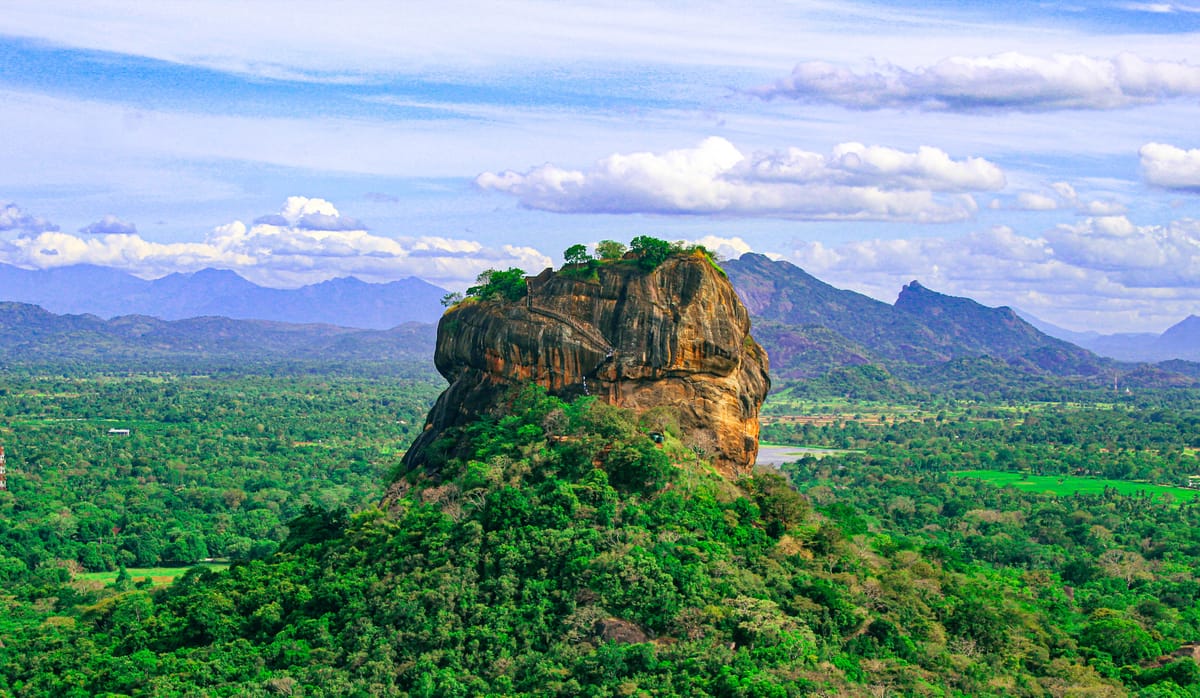
Sigiriya, the “Lion Rock,” is an ancient rock fortress and palace complex rising about 180 metres above the plains of Sri Lanka’s Central Province, near the modern town of Dambulla. The rock itself is an inselberg — the hardened remnant of magma from an extinct volcano, exposed over millions of years as the softer surrounding rock eroded away. Around 477 CE, King Kashyapa I of Anuradhapura made this monolith the fortified capital of his kingdom, crowning its summit with a palace and wrapping its base in some of the most sophisticated urban planning to survive from first-millennium South Asia: geometric water gardens, boulder and terraced gardens, defensive moats and walls, and a city laid out on a precise east-west axis. After Kashyapa’s death in 495 CE the site continued as a Buddhist monastery for centuries. Today Sigiriya is regarded as one of the best-preserved examples of ancient urban planning anywhere in the world, and it has been a UNESCO World Heritage Site since 1982.
The Structure
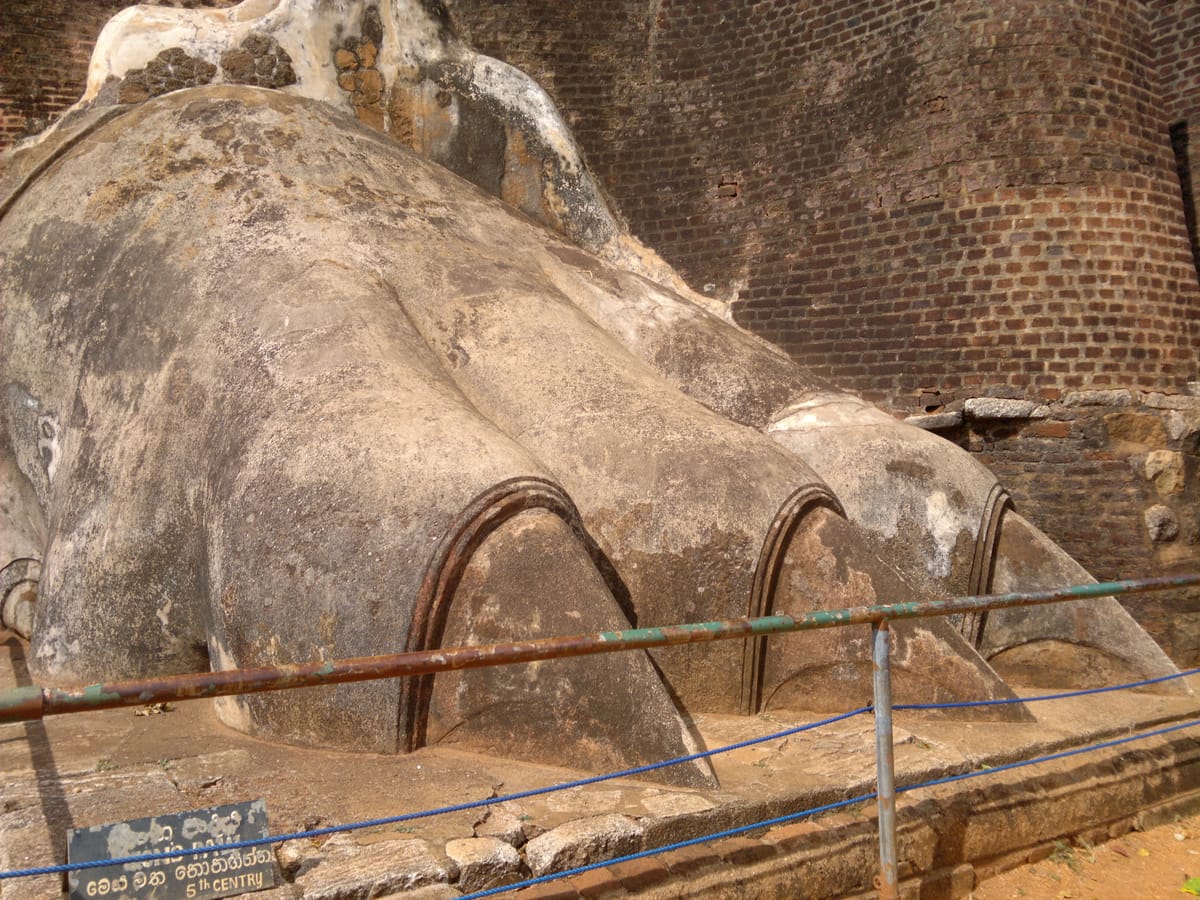
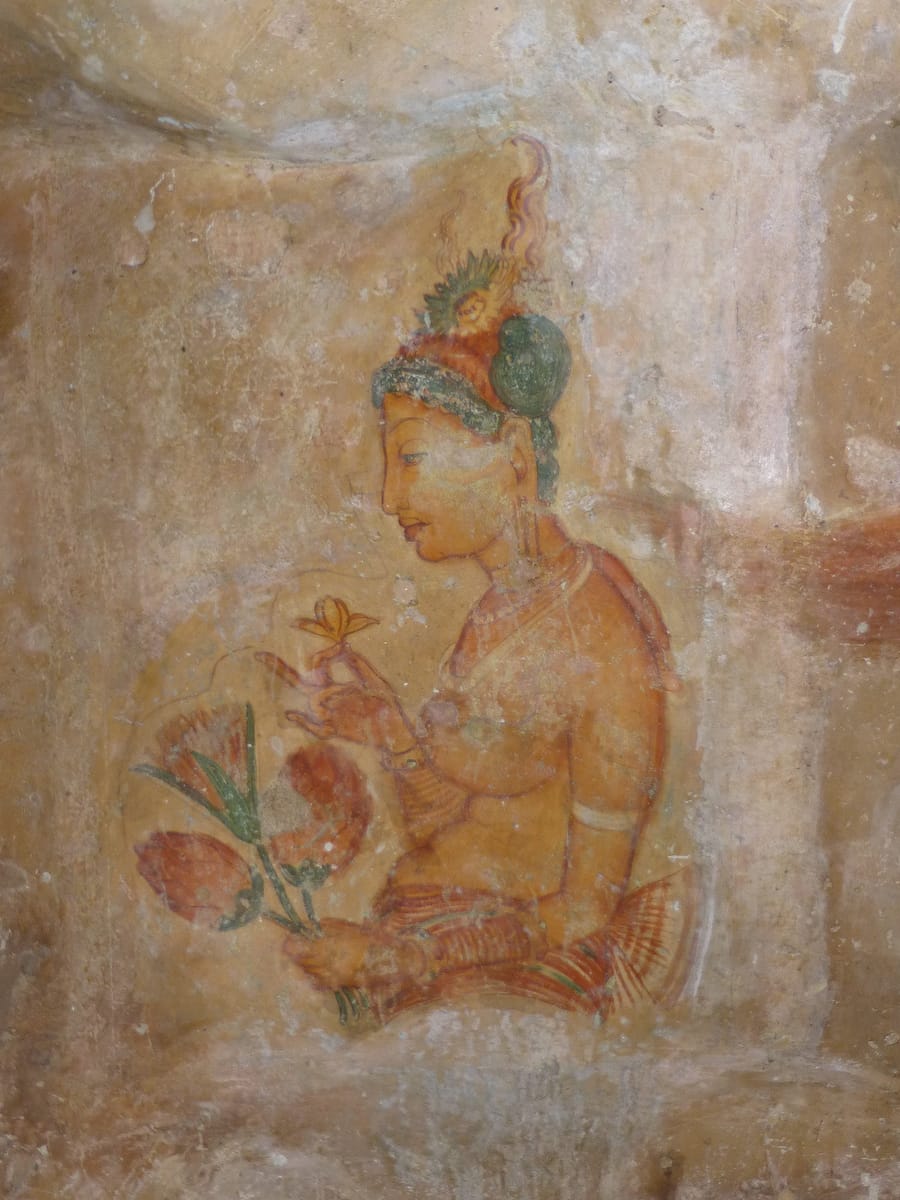
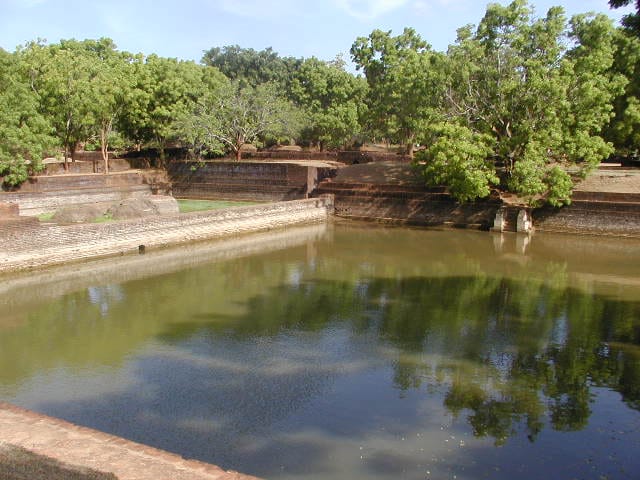
Sigiriya’s history is recorded, in outline, by the Sri Lankan chronicle the Cūḷavaṃsa. Kashyapa seized the throne from his father, King Dhatusena, imprisoning and (by most accounts) having him killed, and drove his half-brother and rightful heir, Moggallana, into exile in South India. Fearing Moggallana’s return, Kashyapa relocated his capital from Anuradhapura to the more defensible Sigiriya rock and, over the course of his roughly eighteen-year reign, built a citadel combining fortress, palace, and pleasure garden. The complex is laid out symmetrically around a long west-facing axis: at the base lie the water gardens, a set of moated, geometrically arranged pools, islands, and fountains; beyond them the boulder gardens, where paths and terraces wind among huge natural rocks (some once topped with pavilions); and above those the terraced gardens, concentric brick-retained tiers climbing toward the rock itself. Partway up the western face, sheltered in a natural rock pocket, is the gallery of frescoes — painted images of women, popularly called the “Sigiriya damsels,” of which roughly 18 survive today out of what may once have been several hundred. Further along is the mirror wall, a wall of polished white plaster that once reflected the frescoes and today bears more than 1,500 pieces of graffiti — short verses of praise, comment, and poetry scratched by visitors between roughly the 8th and 10th centuries, among the oldest surviving evidence of the Sinhalese language. The final approach to the summit passed through the Lion Gate, a colossal brick-and-plaster lion whose open mouth and front paws framed the last staircase; only the two paws and lowest steps survive, giving the rock its name. The summit itself is a roughly 1.6-hectare plateau holding the foundations of Kashyapa’s palace, along with rock-cut cisterns and a central reservoir.
How Was It Built?
Builders worked with the rock’s own geology rather than against it: granite that had already been shaped by weathering into terraces, boulders, and a level summit plateau, into which brick walls, stairways, and pavilion foundations could be keyed. The gardens at the base depended on a precisely graded hydraulic system: a reservoir (the Sigiriya Tank) and associated moats were set at a slightly higher elevation than the ornamental pools, so that water flowed to the fountains by gravity alone, through underground conduits and limestone spouts, on the principle of communicating vessels rather than any mechanical pump. At the summit, evidence points less to piping water up from below than to capturing it where it fell: the plateau’s natural slope was used to channel rainwater into rock-cut cisterns and a large central reservoir estimated to have held on the order of 300,000 gallons, enough to support the palace’s residents through dry spells, with overflow drained back down the rock face through a carved channel into the gardens below. Constructing all of this — quarrying and dressing stone, firing and laying brick for the terraces and the Lion Gate, plastering and painting the fresco pocket, cutting cisterns into solid rock at height, and coordinating a large labor force in a matter of years rather than generations — required a monarchy with real administrative reach. Sri Lanka’s kings had already been building large-scale irrigation tanks and canal networks for centuries by Kashyapa’s time, and Sigiriya’s hydraulics are best understood as that existing engineering tradition applied, at unusual scale and ambition, to a single royal building project.
The Mainstream View
Archaeologists and historians treat Sigiriya as a firmly 5th-century Sinhalese royal project, its date anchored by the Cūḷavaṃsa account of Kashyapa’s reign, by the style of its brick and stone work, and by systematic excavation beginning with British archaeologist H. C. P. Bell in 1898 and continued extensively by Sri Lanka’s Central Cultural Fund since the 1980s. The consensus account holds that Kashyapa’s palace and gardens were built quickly, by the standards of ancient monumental construction, using organized corvée-style labor, brick and lime plaster, and a hydraulic engineering tradition that Sri Lankan kingdoms had already perfected in their vast irrigation reservoirs elsewhere on the island. Whether Sigiriya was conceived primarily as a military stronghold, a secluded royal pleasure capital, or a symbolic re-creation of the mythical mountain palace of the god-king Kubera (as some scholars, following the fortress’s opulence and iconography, have argued) remains debated, but there is no serious scholarly dispute that it is a Sinhalese royal work of Kashyapa’s reign, later repurposed as a Buddhist monastic site until around the 14th century before being abandoned and eventually rediscovered by British surveyors in the 19th century.
The Open Case
What genuinely remains open at Sigiriya is not who built it, but the finer mechanics of how. The summit’s water system is the clearest example: researchers agree the palace plateau relied on some combination of rock-cut cisterns, a large central reservoir, and rainwater harvesting rather than water hauled or pumped up from the base — but the exact engineering calculations behind the system’s capacity, its resilience through dry seasons, and how precisely the overflow channel down the rock face was managed are still worked out from surviving physical remains rather than any explicit ancient blueprint. Lower down, the water gardens’ fountains — built on gravity and communicating-vessel principles from a reservoir set at higher elevation — still spurt water during the monsoon after roughly a millennium and a half with no maintenance to speak of, a level of hydraulic precision that continues to draw close study from engineers as well as archaeologists. The original scale and content of the fresco gallery is likewise debated: estimates of how many painted panels once covered the rock face range widely, and only a small fraction survive to be studied directly. And the sheer speed of construction — a fortified palace, cisterns, gardens, and decorative program apparently raised within Kashyapa’s roughly eighteen-year reign — raises open questions of labor organization and logistics that archaeology can only partly answer from the material record. None of this requires appeal to anything beyond 5th-century Sinhalese engineering and statecraft; it is a genuine, still-active field of study into exactly how that engineering was achieved, at that height, on that timeline.
Sources
- rock-fortress
- sri-lanka
- asia
- ancient-engineering
- hydraulic-engineering
- royal-palace
- unesco-world-heritage
- frescoes
Gallery