Plain of Jars
Who carved thousands of stone jars — the largest several tonnes each — from quarries kilometres away, moved and set them across some ninety hilltop sites, and used them in a mortuary tradition, all while leaving behind no written record and no certain descendants?
Why this rating?
- Construction difficulty
- 4/5
- Method uncertainty
- 4/5
- Capability gap
- 2/5
- Open questions
- 5/5
Carving and hollowing thousands of jars, the largest several tonnes each, and moving them kilometres from quarry to hilltop was a major sustained undertaking, but nothing about it exceeds the known capability of Iron Age stoneworkers — hence a modest capability gap. What stays genuinely high is method uncertainty and the number of open questions: the makers left no writing and have no confirmed descendants, the dating has just been thrown open by luminescence results suggesting some jars predate the Iron Age by a millennium, the exact carving-and-transport sequence for multi-tonne blocks is inferred rather than documented, and unexploded ordnance has kept the great majority of the megaliths unexcavated, so even basic questions about function and chronology remain unresolved.
Overview
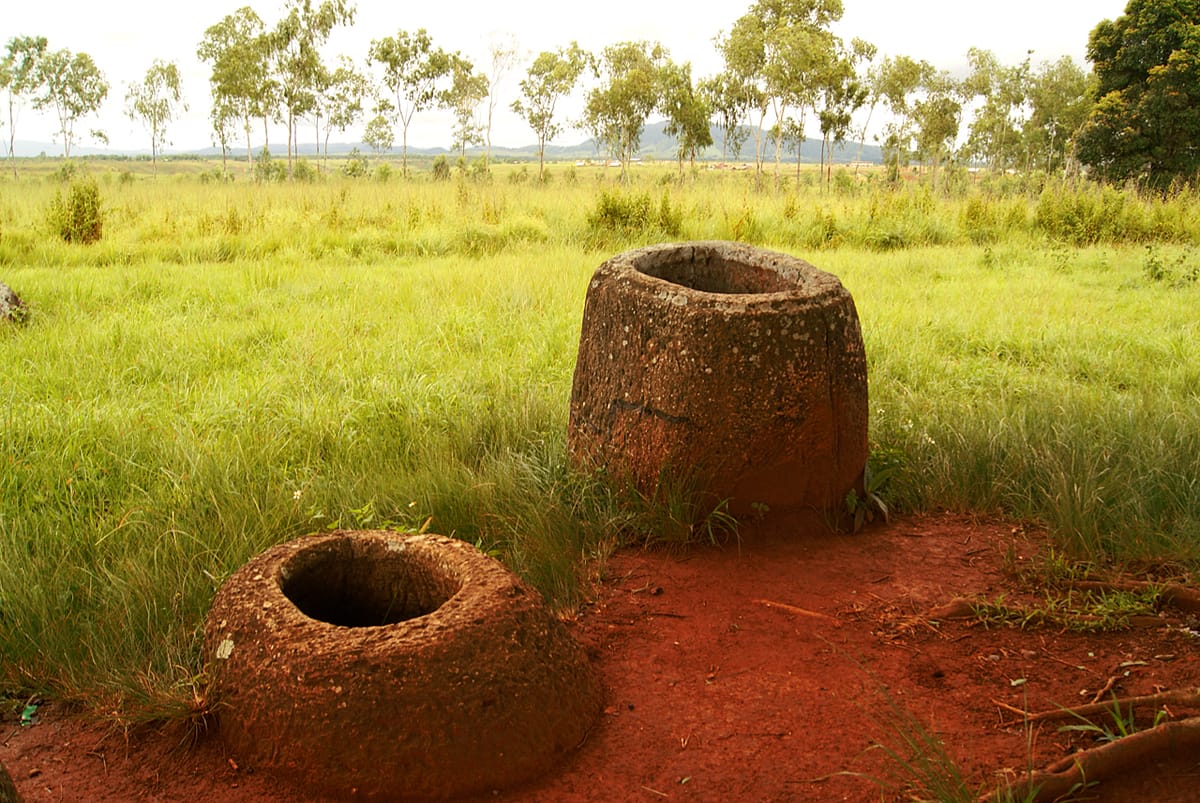
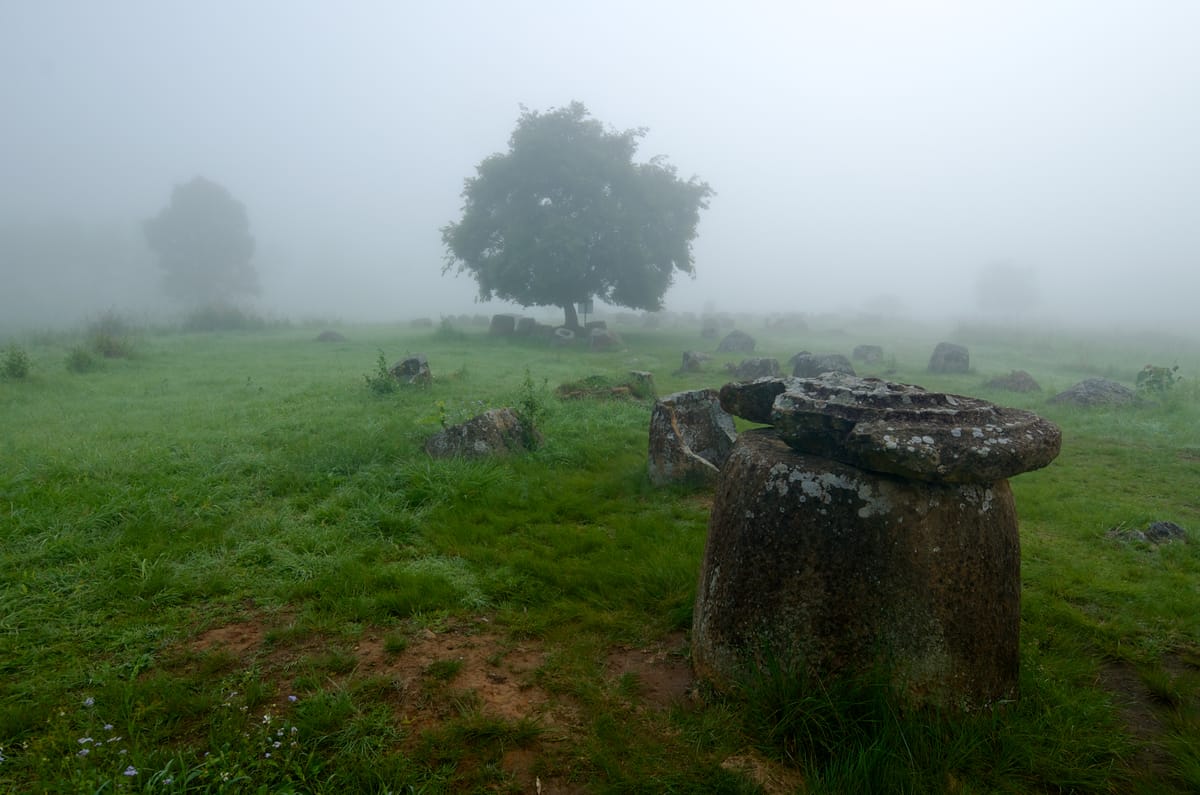
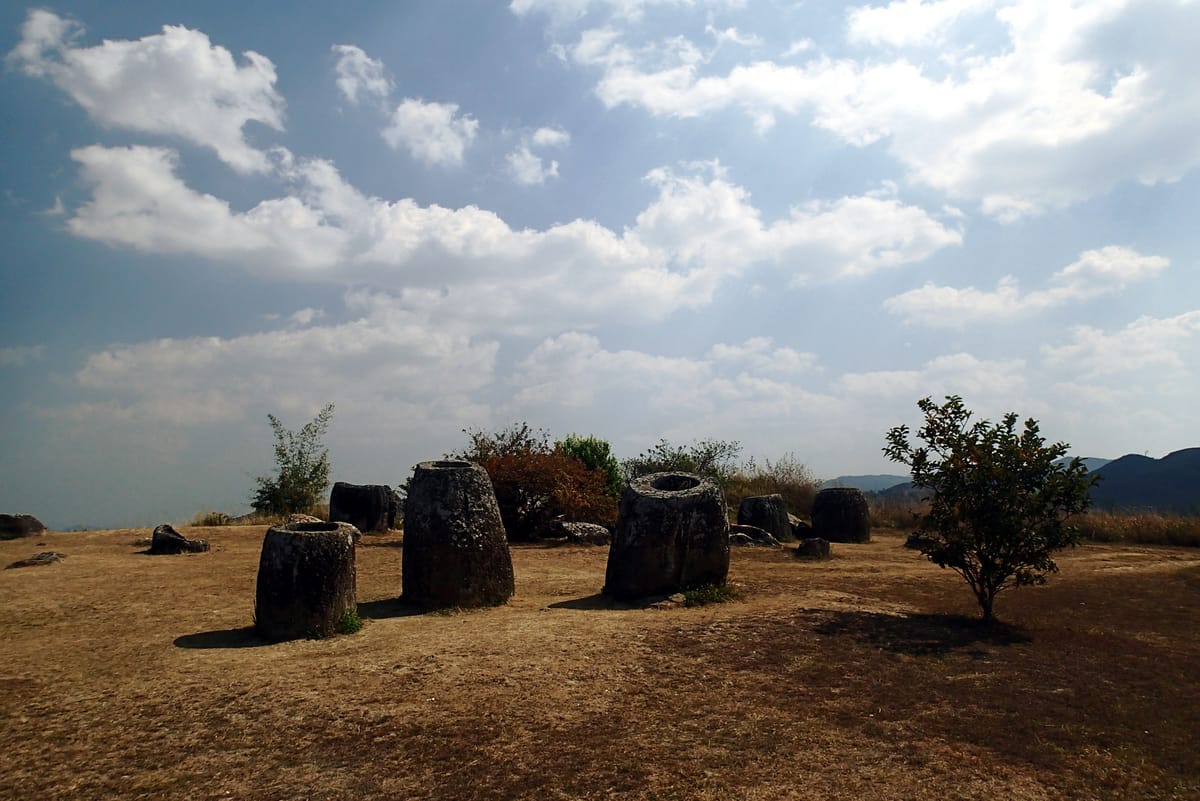
Across the rolling uplands of the Xieng Khouang plateau in northern Laos lie more than two thousand carved stone jars, standing alone or in loose clusters on hilltops and valley slopes. Some are barely knee-high; the largest rise to around three metres and weigh several tonnes. They are hollowed from single blocks of stone — mostly sandstone, with others in granite, conglomerate, limestone, and breccia — and their form is consistent enough to be unmistakable: a tubular or barrel-shaped body, always wider at the base than at the rim, occasionally still capped by a heavy stone disc. There are no inscriptions, no carved figures on most jars, and no surviving texts of any kind from the people who made them. Collectively the vessels give the landscape its name, the Plain of Jars, and in 2019 UNESCO inscribed the “Megalithic Jar Sites in Xiengkhuang – Plain of Jars” as a World Heritage property, a serial listing of jar fields, quarries, and associated burials. Behind that recognition sits one of Southeast Asia’s most stubborn archaeological puzzles: an entire megalithic tradition whose makers, precise age, and full purpose remain only partly understood, and whose study has been hemmed in for half a century by the physical debris of a modern war.
The Structure
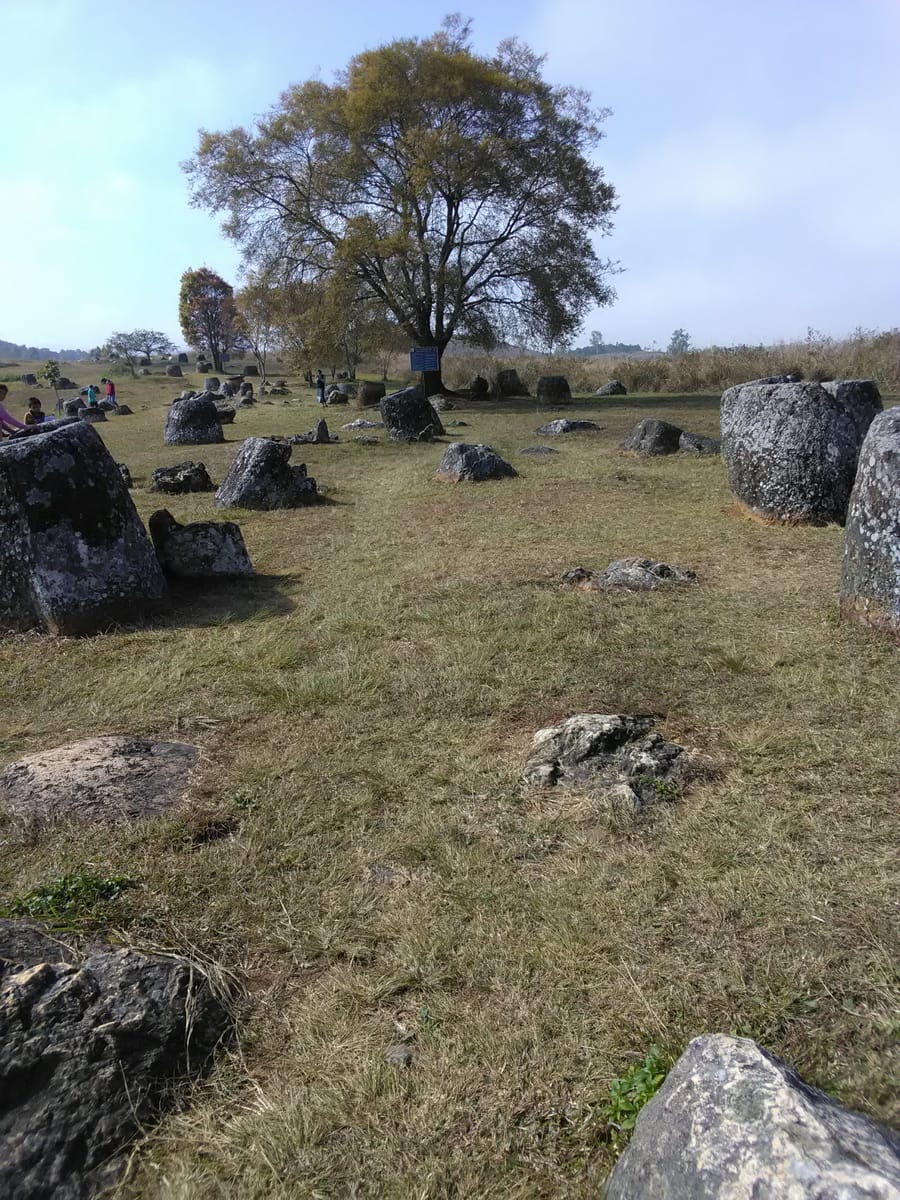
The jars are not confined to a single field but are spread across some ninety or more sites recorded on the plateau, ranging from a lone vessel to several hundred at the larger locations; Site 1, near the provincial capital Phonsavan, holds a few hundred jars and is the most visited. In total more than 2,100 jars have been documented, and recent survey work has pushed the count of known sites well past a hundred. The vessels were first studied systematically in the 1930s by the French archaeologist Madeleine Colani, who mapped sites, excavated jars and their surroundings, and recovered glass beads, bronze and iron implements, ceramics, and — crucially — human remains, both burnt and unburnt. She concluded that the jars belonged to a funerary tradition and proposed that a nearby cave at Site 1, with holes in its roof, had served as a crematorium. Later excavations by Japanese, Lao, and Australian teams broadly confirmed the mortuary association: burials have been found in and around the jars, including pits of secondary burial in which bones were interred after an earlier stage of treatment, sometimes alongside cremated remains. The jars are generally interpreted not as coffins in the ordinary sense but as elements of a distributed mortuary landscape — places where the dead were processed, stored, or commemorated. Stone discs, carved markers, and buried funerary goods accompany them, and it is this whole assemblage, rather than the jars alone, that defines the culture archaeologically.
How Was It Built?
Making a jar began at the quarry. Partly finished vessels and worked outcrops survive at several quarry sites, showing that the jars were roughed out at the source and then moved to their final positions — in at least one well-studied case, geological fingerprinting settles the question: uranium-lead dating of zircon crystals matched the sandstone jars at Site 1 to a quarry roughly eight kilometres away, confirming that finished or near-finished multi-tonne blocks were transported across that distance. Exactly how remains the central open engineering question. The plateau’s Iron Age inhabitants had iron tools, and chisel work is the most likely method of carving and hollowing, though experiments have shown that stone tools alone could also shape the softer sandstones. For moving the jars, the standard proposals are the familiar toolkit of pre-industrial megalith transport — sledges, wooden rollers, ramps, and human or animal haulage, with draft animals such as buffalo or elephants sometimes suggested — but no roadway, sledge, or haulage installation has been positively identified and excavated in association with the jars, so the specific technique is reconstructed by analogy rather than demonstrated. Nothing about the task lies beyond what Iron Age societies elsewhere are known to have accomplished with comparable stones; the difficulty is that the people who did it here left no depiction, no text, and, so far, no unambiguous physical trace of the method itself. The scale is what impresses: not one monument but thousands of jars, cut and placed across a wide upland, sustained over a long span of time.
The Mainstream View
Archaeologists treat the Plain of Jars as the work of a genuine but unnamed Iron Age culture of the Xieng Khouang highlands, engaged in a long-lived mortuary tradition. That much is well supported: the repeated association of jars with human remains and burial goods, documented from Colani’s day through modern excavations, anchors the funerary interpretation, and the jars’ consistent form, quarry-to-site provenance, and accompanying discs and markers point to a coherent shared practice rather than a scatter of unrelated objects. The conventional dating placed the jars in the Iron Age, roughly 500 BCE to 500 CE, on the basis of associated artefacts and burials — the range reflected in the World Heritage listing. Recent scientific dating has both refined and unsettled this picture. A 2021 study combining radiocarbon, optically stimulated luminescence (OSL), and U/Pb zircon analysis found that sediment beneath jars at one site had last seen daylight around 1240–660 BCE, implying that some jars may have been placed as early as the late second millennium BCE — potentially a thousand years before the traditional Iron Age date — while radiocarbon dates on burials showed that mortuary use around the jars continued into the medieval period, between roughly the ninth and thirteenth centuries CE. The mainstream reading of this is not that the mystery has deepened into the inexplicable, but that the tradition was far longer-lived than once thought: jars possibly erected in the Bronze Age and reused as ritual foci for two millennia or more. Local Lao tradition offers its own explanation, telling of a race of giants and a king, Khun Cheung, who had the jars made to brew and store rice wine after a great victory — a folk memory attached to monuments whose real origin was already lost.
The Open Case
What keeps the Plain of Jars genuinely open is not a shortage of plausible explanations but a shortage of evidence, much of it for a stark and specific reason. During the so-called Secret War of 1964–1973, the United States dropped an enormous tonnage of ordnance on Laos — on the order of hundreds of millions of cluster submunitions across the country, a large fraction of which failed to detonate — and the Xieng Khouang plateau was among the most heavily bombed regions on Earth. The resulting unexploded ordnance still contaminates much of the province and has kept most jar sites too dangerous to excavate; clearance by organisations such as the Mines Advisory Group has opened only a handful of sites, and by many estimates only a small percentage of the megaliths have ever been properly investigated. That single fact cascades into everything else. Because so few sites are excavated, the identity of the makers remains unknown — there is no confirmed cultural or genetic link between the jar-builders and any later population of Laos, and the culture’s own name for itself is irrecoverable without writing. The chronology is now actively contested: the OSL results argue for jars far older than the Iron Age label, but they rest on a small number of samples, and reconciling a possible Bronze Age placement with Iron Age artefacts and medieval burials at the same sites is unfinished work. The transport of the heaviest jars is understood only in principle. And the full function — burial, secondary interment, cremation-related processing, commemoration, or some combination that shifted over centuries — is still being pieced together jar by cleared jar. None of this requires an exotic explanation; every element is the kind of question ordinary archaeology answers, given access. The distinctive tragedy of the Plain of Jars is that the access itself was denied for two generations by a war fought long after the jars fell silent, leaving one of Asia’s great megalithic cultures known mostly by the stone it left standing.
Sources
- UNESCO World Heritage Centre — Megalithic Jar Sites in Xiengkhuang – Plain of Jars
- Wikipedia — Plain of Jars
- Archaeology Magazine — Plain of Jars (feature)
- PLOS ONE — Dating the megalithic culture of Laos: Radiocarbon, optically stimulated luminescence and U/Pb zircon results
- University of Melbourne, Pursuit — Laos' jars are slowly revealing their secrets
- New Atlas — Fresh analysis reveals Laos' ancient Plain of Jars predates the Iron Age
- Current World Archaeology — Plain of Jars
- laos
- xieng-khouang
- plain-of-jars
- megalith
- iron-age
- funerary
- sandstone
- granite
- unesco-world-heritage
- unexploded-ordnance
- southeast-asia
Gallery