Prasat Thom, Koh Ker
How did a usurper king raise a 36-meter, seven-tiered stone pyramid and more than 180 other monuments at a remote forest capital in well under two decades, and what happened to the giant lingam that once crowned its summit?
Why this rating?
- Construction difficulty
- 4/5
- Method uncertainty
- 3/5
- Capability gap
- 3/5
- Open questions
- 4/5
Raising a steep, laterite-cored, sandstone-faced pyramid to roughly 36 meters is a substantial engineering feat for any 10th-century Khmer project, and doing it (along with dozens of subsidiary temples and a large baray) inside a capital that lasted only about sixteen years implies an unusually intense, and still not fully explained, mobilization of labor and materials far from Angkor's established quarry and canal networks. The construction method itself follows known Khmer temple-mountain technique, but the lost summit lingam and pedestal, the precise logistics of the rapid build, and the reasons behind the sudden move to and from Koh Ker remain genuinely open questions in current scholarship.
Overview
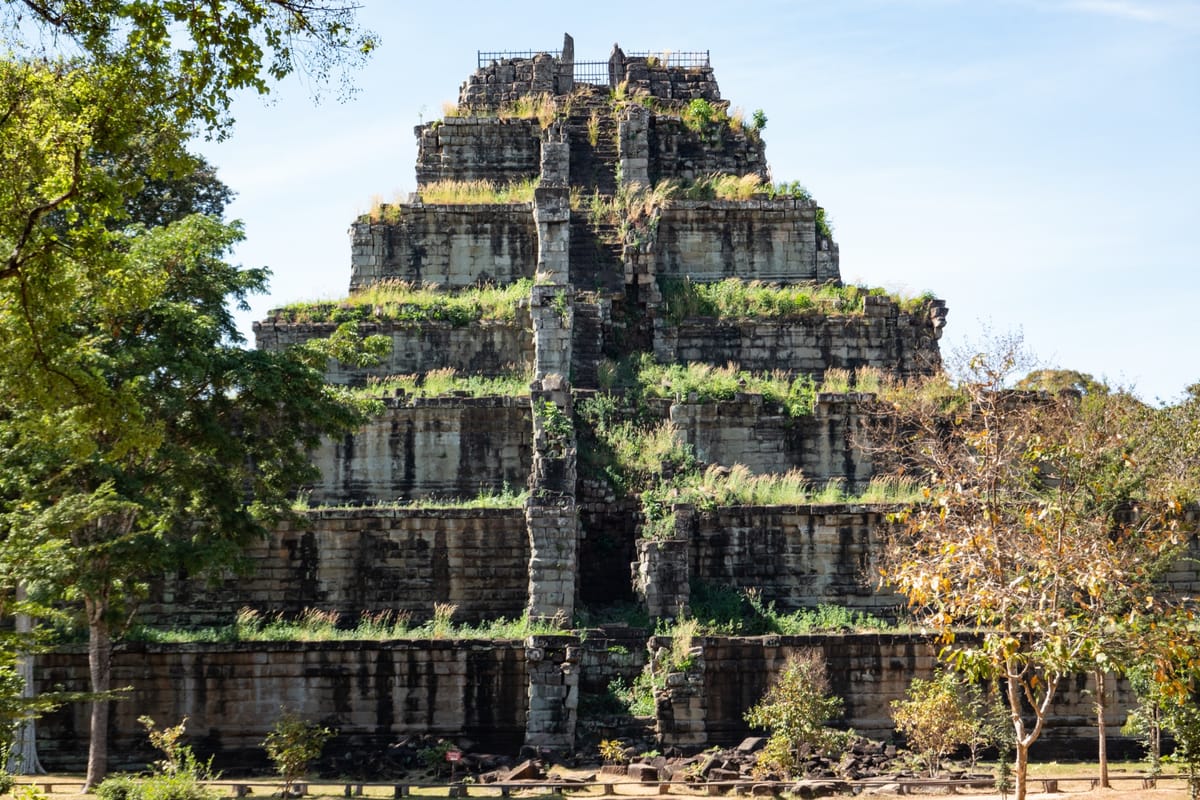
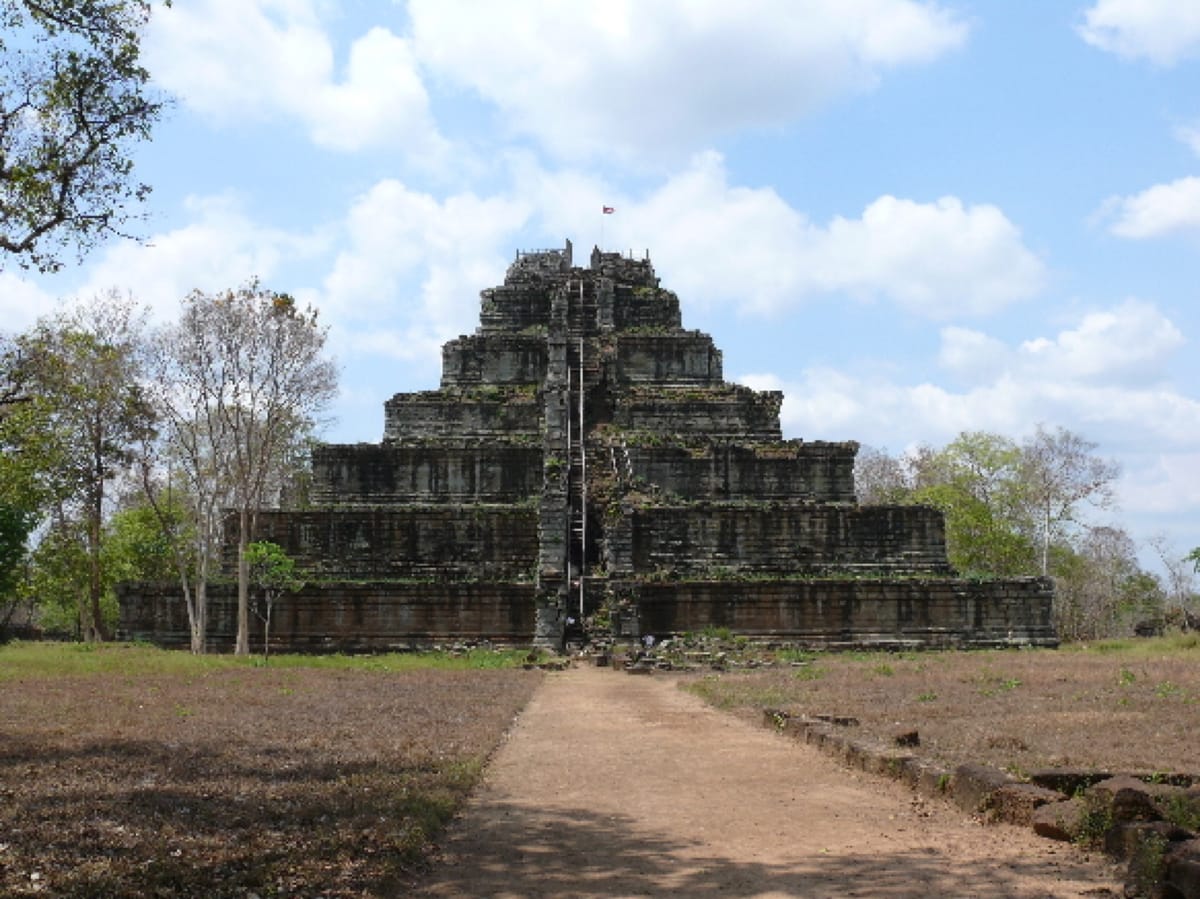
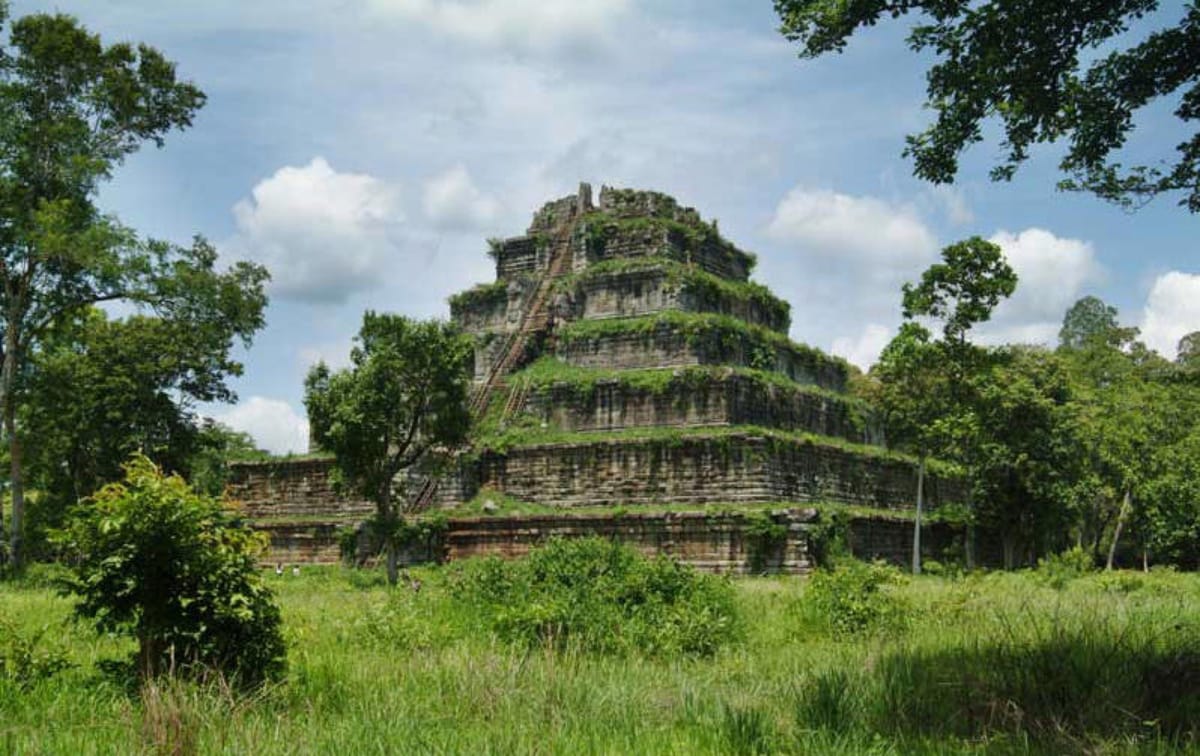
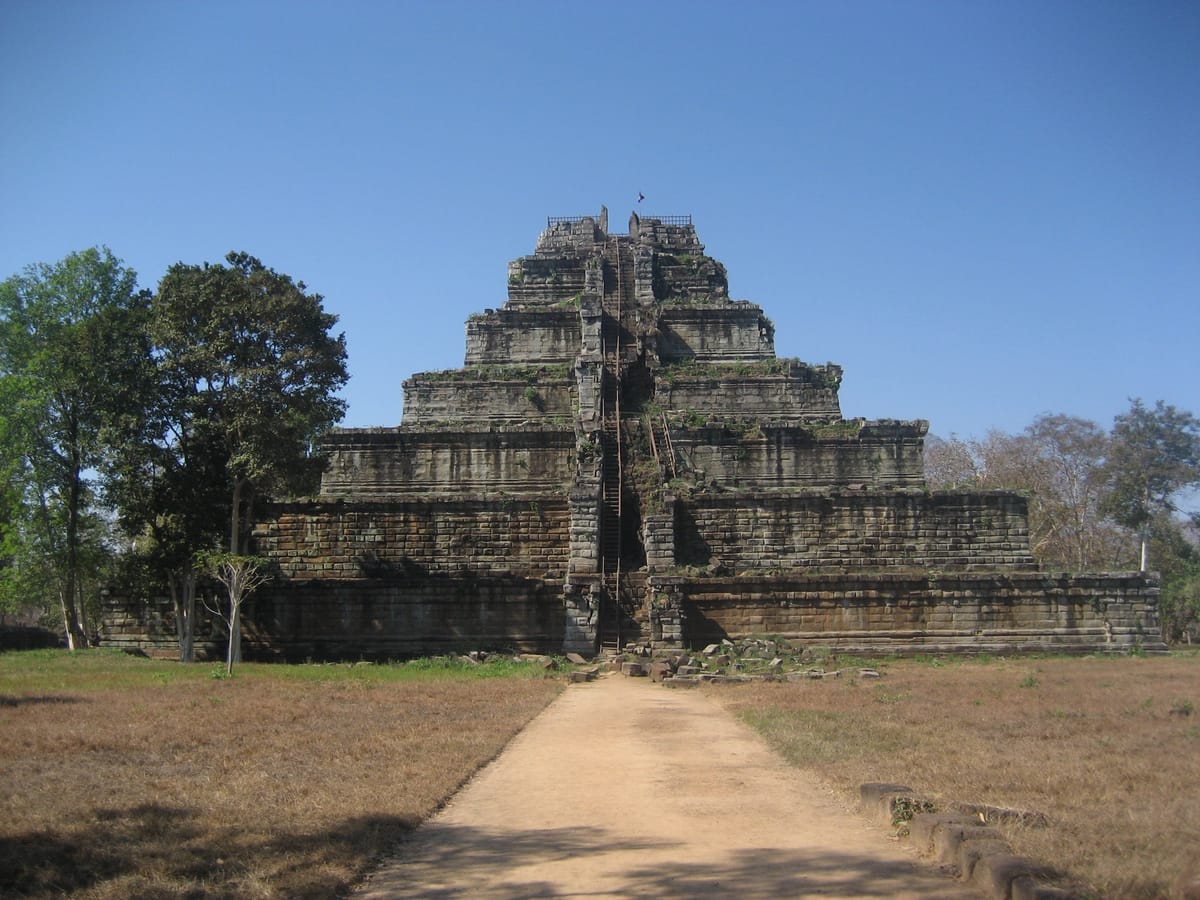
Prasat Thom, often called simply “the Prang,” is a stark, seven-tiered sandstone-and-laterite pyramid rising roughly 36 meters above the forest floor at Koh Ker, an archaeological site deep in Preah Vihear Province in northern Cambodia. Unlike the crowded, richly carved temple-mountains of Angkor, Prasat Thom is a strikingly plain stack of stepped terraces, almost entirely undecorated, climbing to a small summit platform that once held a colossal Shiva lingam. It was built as the state temple of King Jayavarman IV, who abruptly relocated the capital of the Khmer Empire from Angkor (Yashodharapura) to this remote site, then known as Chok Gargyar or Lingapura (“city of lingams”), around 928 CE. For a little over a decade and a half Koh Ker functioned as the seat of Khmer power, during which Jayavarman IV and, briefly, his son Harshavarman II oversaw one of the most concentrated building campaigns in Khmer history — more than 180 sanctuaries recorded across an 81-square-kilometer protected zone, of which only a few dozen are accessible to visitors today. When the capital reverted to the Angkor region under Rajendravarman II by the mid-940s CE, Koh Ker was largely abandoned to the surrounding forest, leaving Prasat Thom as the most dramatic remnant of a Khmer capital that existed, and then vanished, within a single generation. The wider site was inscribed as Cambodia’s fourth UNESCO World Heritage property in September 2023, under the name “Koh Ker: Archaeological Site of Ancient Lingapura or Chok Gargyar.”
The Structure
Jayavarman IV’s path to the throne was contested — inscriptions and later chronicles describe rival claims from the sons of the earlier king Yasovarman I, and some historians have characterized him as a usurper, though most now regard his claim (through marriage to a half-sister of Yasovarman I) as legitimate under Khmer succession custom. A Khmer inscription records that in 921 CE, some years before his formal accession, Jayavarman IV “left the city of Yashodharapura to reign at Chok Gargyar, taking the Devaraja with him” — a reference to the royal cult of the god-king central to Angkorian kingship, whose relocation signaled a genuine, not merely ceremonial, shift of the kingdom’s center. Once installed as king in 928 CE, he consecrated Prasat Thom’s summit lingam under the name Tribhuvaneshvara, “Lord of the Three Worlds” — a Sanskrit inscription dates this consecration to 921 CE, suggesting the temple’s core was already underway before Jayavarman IV’s formal enthronement. The pyramid itself is built on a square base roughly 55 to 62 meters per side, rising through seven levels — five stepped pyramid tiers set above two lower temple-foundation terraces — each roughly 5 meters high and narrowing toward the top, to a total height most commonly cited as about 36 meters (accounts in the literature range from roughly 30 to 40 meters, depending on the measurement baseline used). A single grand staircase originally climbed the eastern face; today a separate modern stair on the north side gives visitors safer access to the summit. Prasat Thom stood at the ceremonial heart of a walled city of roughly a square kilometer that also included a large baray (reservoir) and dozens of subsidiary shrines, several of which — including the tree-engulfed towers of nearby Prasat Pram — remain among Cambodia’s most photographed ruins. Koh Ker’s sculptors also left a distinctive artistic legacy: monumental sandstone figures carved in a “Koh Ker style” noted for its dynamic sense of motion, depicting scenes from the Ramayana and Mahabharata, though most of the finest statuary was looted from the site during Cambodia’s civil-war era and now survives mainly in museum collections.
How Was It Built?
Structurally, Prasat Thom follows the same basic technique used across Angkorian temple-mountains: a core of laterite, a soft, iron-rich stone that hardens on exposure to air and could be quarried in large blocks relatively quickly, faced with dressed sandstone for the finished, visible surfaces. This combination let builders raise a large, stable mass economically while reserving the more labor-intensive stone-cutting for the exterior. Unlike Angkor’s temple-mountains, which are typically covered in bas-relief and carved ornament, Prasat Thom’s tiers are almost entirely bare, an austerity some scholars read as a sign of the speed at which it was built rather than a deliberate aesthetic choice. At the summit, a vertical shaft — reported at roughly 12.5 meters deep — descends through the pyramid’s core beneath where the pedestal and lingam once stood, apparently built to hold or anchor the massive cult object above; the pedestal itself was decorated with carved lions at its base, a motif (“Atlantean lions”) distinctive to Koh Ker’s sculptural style. Contemporary inscriptions describe an efficient and, by some accounts, harshly enforced taxation and labor-levy system: provinces were required to supply rice, wax, honey, cloth, and elephants to the new capital, with punishment recorded for those who refused. Modern scholars take this as the likely engine behind Koh Ker’s construction pace — a centralized, coercive mobilization of labor and provisions from across the kingdom, concentrated on a single remote site rather than spread across the more gradual, multi-generational building programs typical of Angkor. Even so, raising a stone mass on this scale, along with an estimated 40-plus additional temples and a major reservoir, inside a capital period of only about sixteen years (928-944 CE) represents an unusually compressed building tempo by Khmer standards.
The Mainstream View
Historians and archaeologists agree on the broad outline of Prasat Thom’s origin: it was commissioned by Jayavarman IV as the state temple of his new capital at Chok Gargyar/Lingapura, built using standard Khmer laterite-core, sandstone-faced pyramid construction, and dedicated to a colossal Shiva lingam named Tribhuvaneshvara around 921-928 CE. Inscriptional evidence — including tax and labor records, dedicatory texts, and later chronicles referencing the Devaraja’s relocation — is treated as solid documentary support for this chronology, and it is corroborated by the broader archaeological record: laterite quarrying scars, structural surveys of the pyramid’s tiered construction, and the sheer density of contemporaneous 10th-century monuments clustered at the site. The mainstream explanation for the project’s speed points to Jayavarman IV’s evident political motivation — a king ruling from a base independent of the traditional Angkorian elite needed to assert legitimacy and authority quickly, and a state temple of unprecedented steepness and scale, paired with an aggressive taxation regime, served that purpose. Excavations since the early 2000s, including radiocarbon work reported in 2015, have also shown that parts of the Koh Ker area were inhabited and active well before Jayavarman IV’s arrival, dating back to at least the 7th or 8th century CE, which helps explain how a functioning settlement, road network, and labor pool could be mobilized so quickly once the king chose the site. None of this is seriously contested; specialists debate the finer chronology of individual monuments and the precise administrative mechanics of the labor levy, not whether Jayavarman IV’s Khmer state designed, quarried, and built Prasat Thom itself.
The Open Case
What remains genuinely unresolved is less “who built it” than several specific, still-debated details of how — and why — this happened so fast, and what has since been lost. The clearest open question sits at the summit: the giant lingam that gave the pyramid its religious purpose, reportedly more than 4 meters tall and weighing several tons, and the ornate lion-decorated pedestal that held it, are both gone, and no scholarly consensus exists on whether they were ever finished, how or when they were removed or destroyed, or whether a roofed shrine structure ever enclosed them at all — the bare summit platform visible today has been read by different researchers as either a completed, minimalist design or an unfinished project cut short. The pace of construction is itself a live puzzle: a temple-mountain and an entire supporting city, including a large reservoir and dozens of subsidiary shrines, appear to have gone up within roughly a decade and a half, far faster than comparable Angkorian projects, and while the tax-and-labor inscriptions explain the mechanism in outline, the finer logistics — how quarrying, transport, and construction crews were coordinated at a remote site lacking Angkor’s established canal and quarry infrastructure — are reconstructed from fragmentary epigraphy rather than direct record. Equally unresolved are Jayavarman IV’s original motives for abandoning Yashodharapura in the first place and the reasons his successors so quickly reversed course, returning the court to the Angkor region within a few years of his death; both remain matters of historical interpretation rather than settled fact. These are legitimate, actively researched questions about ancient logistics, succession politics, and a lost cult object — not evidence of anything beyond the reach of a 10th-century Khmer kingdom. Every strand of evidence at Koh Ker, from its inscriptions to its laterite quarry scars to its unmistakably Khmer sculptural style, points to the same builders responsible for Angkor itself. The wonder here is not that outside help was needed, but that so much was raised, so quickly, in a capital that lasted barely longer than a single king’s reign.
Sources
- khmer-empire
- cambodia
- temple-mountain
- pyramid
- hindu-temple
- shiva-lingam
- unesco-world-heritage
- medieval
- koh-ker
Gallery