Jetavanaramaya
How did 3rd-century Sri Lankan builders stack tens of millions of hand-made bricks into a 122-metre solid dome — the largest brick structure ever raised — and get the foundation, the brick chemistry and the dome's profile right enough that it is still standing 1,700 years later?
Why this rating?
- Construction difficulty
- 5/5
- Method uncertainty
- 2/5
- Capability gap
- 3/5
- Open questions
- 3/5
Raising tens of millions of hand-made bricks into a 122-metre solid dome is the largest brickwork task ever attempted anywhere, yet the method itself is unusually well understood — the materials, the thin slurry mortar, the bedrock foundation and the dome's profile have all been sampled, tested and modelled by finite-element analysis. What stays open is the organisation: published estimates of the brick count and build time differ by nearly half, and no record survives of how the workforce, kilns and supply chain were actually run.
Overview
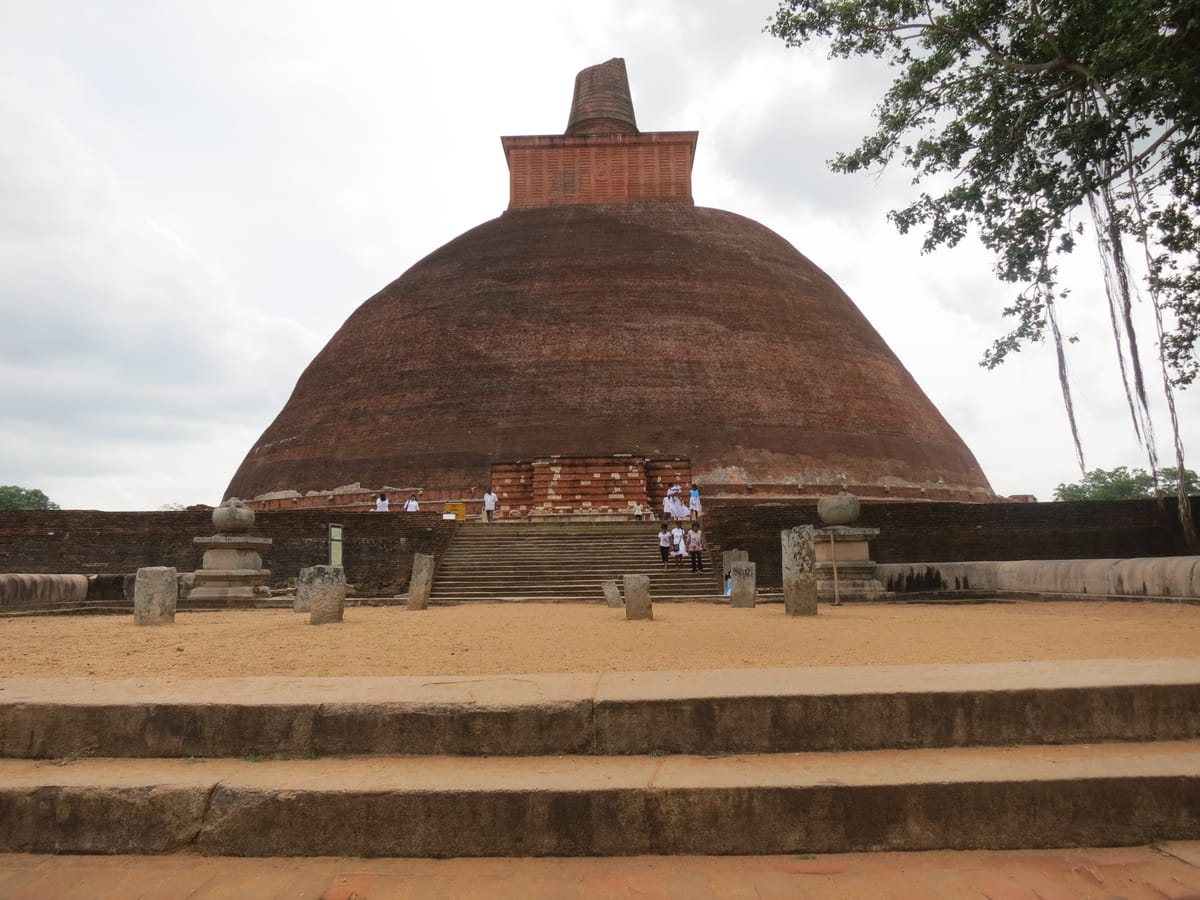
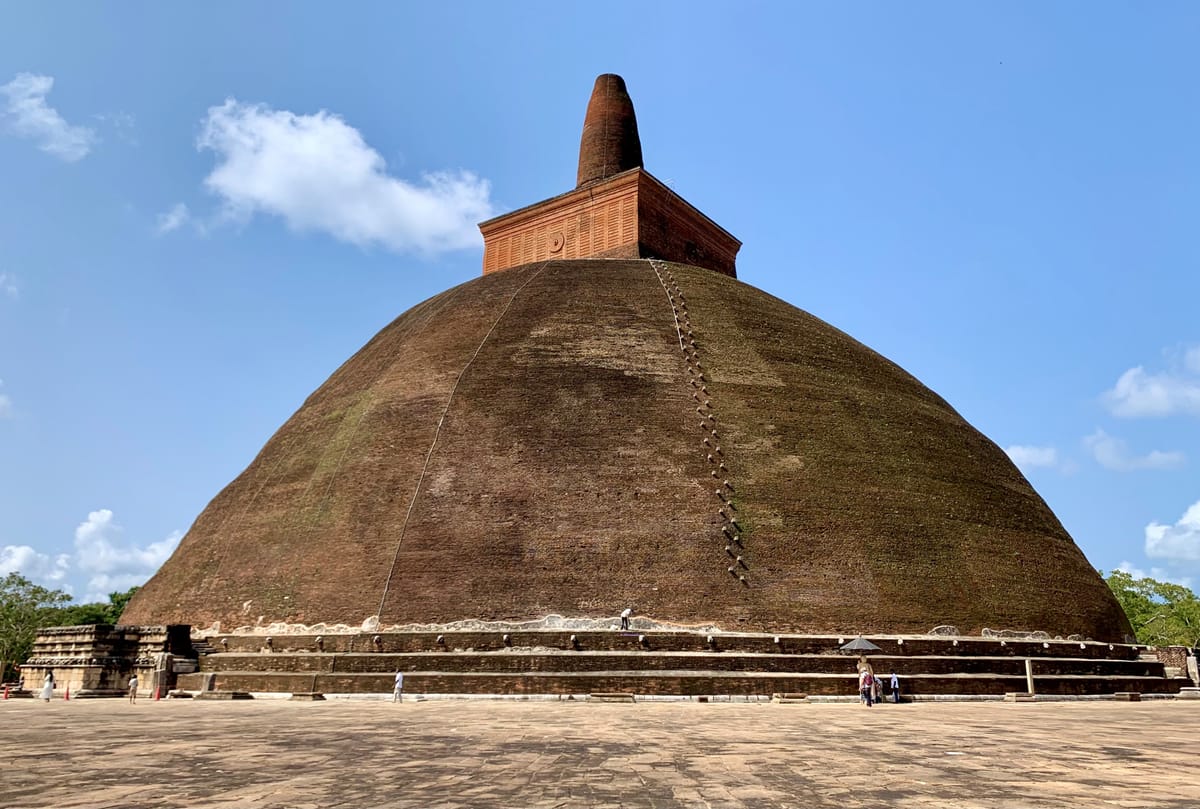
Jetavanaramaya is a stupa — a solid Buddhist reliquary monument — standing among the ruins of the Jetavana monastery in Anuradhapura, the ancient capital of Sri Lanka and a UNESCO World Heritage Site since 1982. By volume it is the largest brick structure in the world, and when it was finished in the late third or early fourth century CE it rose to about 122 metres (400 feet), making it the tallest building on Earth that was not a pyramid, and the third-tallest structure of any kind in the ancient world, surpassed only by the Great Pyramid of Giza and the Pyramid of Khafre. It is not a building you enter. Like all Sri Lankan stupas it is a solid mass of brickwork, built around a relic chamber and meant to be walked around rather than walked into; a piece of the Buddha’s sash or belt is traditionally held to be enshrined inside. Today it is a great weathered brick dome the colour of dried blood, its upper spire rebuilt, standing about 71 metres above its terrace after a medieval rebuild lowered it from its original height. It is one of the eight great sacred places of Anuradhapura and remains an active pilgrimage site.
The Structure
The stupa was begun by King Mahasena, who ruled Anuradhapura in the late third century (his reign is usually given as 273-301 CE, though some sources place it a few years earlier), and was completed by his son Kithsirimevan, also known as Sirimeghavanna. Its origins are entangled with one of the sharpest doctrinal conflicts in Sri Lankan history. Mahasena, influenced by the monk Sanghamitra, turned against the Theravada community of the Mahavihara, forbidding laypeople to give them alms; the monks left, and the Mahavihara was stripped of its valuables. The chronicle known as the Mahavamsa records that a rebellion by the minister Meghavannabhaya forced a reconciliation, in which the king apologised and undertook to build a monastery on the Mahavihara’s own ground. Jetavanaramaya is that undertaking — a monument that is also an act of penance, and that permanently marked the rivalry between the Mahavihara, the Abhayagiri and the new Jetavana fraternities. The Jetavana community followed the Sagalika sect, closely linked to Abhayagiri, and survived as one of the island’s three great monastic fraternities until King Parakramabahu I abolished it in his twelfth-century reforms.
The numbers are the point of the place. Its volume is about 233,000 cubic metres of brick — more than the volume of masonry in many of the Egyptian pyramids, and enough to make it, by common agreement, the largest brick structure ever built. One side of the terrace on which it stands measures roughly 176 metres, and the dome is about 102 metres across where it springs from that platform. Its present height above the platform is 70.7 metres, the result of a partial failure of the spire and a twelfth-century rebuild under Parakramabahu I that did not restore the original profile. Estimates of the number of bricks used range from around 62 million to about 93 million, depending on the assumptions made about the dome’s internal composition and the length of the build. The stupa sits at the centre of a walled precinct of roughly 5.6 hectares within a monastery said to have housed thousands of monks; excavations there have turned up glass and terracotta beads, ivory, coins and imported goods, evidence that Anuradhapura sat on the trade routes linking the Mediterranean, the Indian subcontinent and the Far East.
After the Chola invasion of 993 CE and the collapse of Anuradhapura as a capital, the city was largely deserted and its monuments were swallowed by scrub jungle. Jetavanaramaya remained buried under vegetation until 1909, when clearing began, and serious conservation work only got underway after the founding of Sri Lanka’s Central Cultural Fund in 1980 and the site’s inscription as part of the Sacred City of Anuradhapura in 1982.
How Was It Built?
The building block is the burnt brick, made by hand and considerably larger than a modern brick — big enough to need both hands. Sri Lankan stupa builders graded them by position: larger, stronger bricks for the basal rings and the outer shell of the dome, smaller ones for the spire above. Laboratory testing of ancient Jetavana bricks has found them stronger than the modern factory bricks made nearby — roughly 8 to 12 megapascals in compression against 4 to 7 for the modern product — and mineralogical analysis points to why: the ancient bricks run about 55-65 percent sand, where modern local bricks run 35-45 percent. (Published strength figures for Jetavana vary between sources, but the direction is consistent: the old brick outperforms the new.)
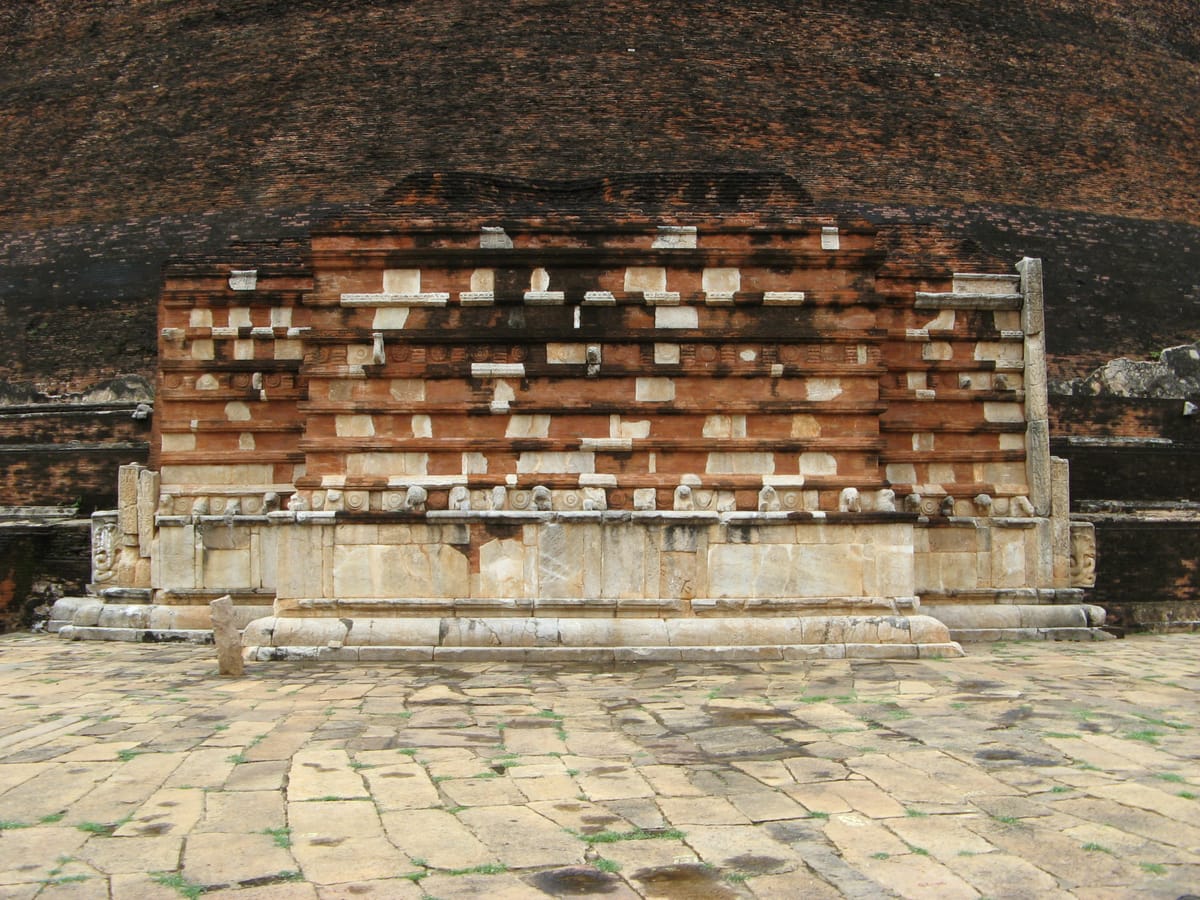
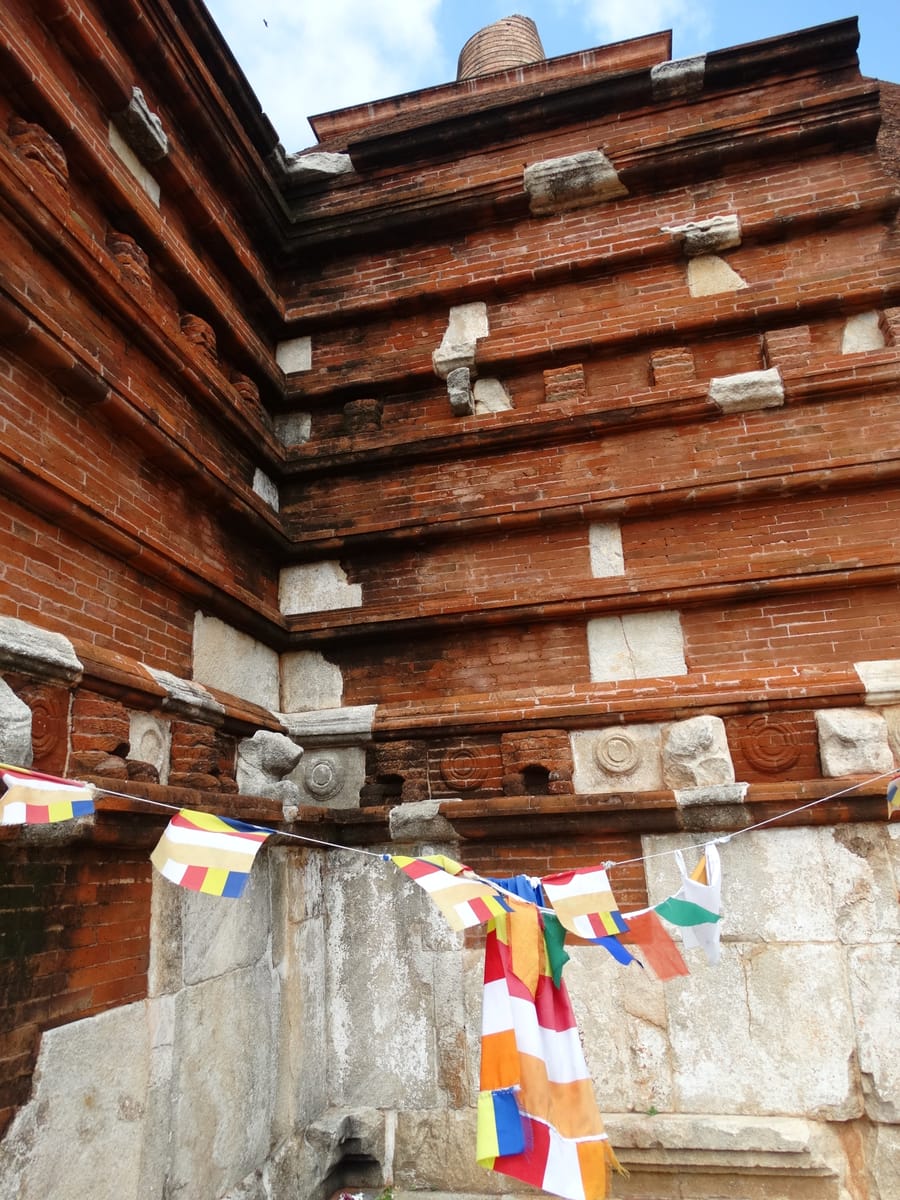
The mortar is the second surprise. Rather than the thick beds of modern brickwork, the ancient builders used a very thin, butter-clay slurry, so that bricks essentially sit stone-on-stone with the slurry filling only the gaps — a joint that adds strength rather than introducing a weak layer. Analyses of the bonding material describe finely crushed dolomite and limestone with sieved sand and clay; the clay stays pliable and accommodates small movements in the mass. One face of each brick was roughened to grip the slurry and resist sliding. Over the whole surface went a thick lime plaster to keep water out, reportedly mixed with an unlikely-sounding but well-attested recipe of seashell lime, plant resins, oils, egg white, coconut water and sugar syrup.
Underneath, the foundation runs about 8.5 metres deep and rests on bedrock. The Mahavamsa’s description of how the great Anuradhapura stupas were founded is unusually concrete: the ground was dug out, crushed stone was spread and stamped down by elephants whose feet were bound with leather, and over that went butter clay, brickwork, a rough cement with an iron network, and sheets of copper and silver — in effect a damp-proofed, reinforced raft. The chronicle applies this account most explicitly to the earlier Ruwanwelisaya, but it describes the tradition the Jetavana builders worked within, and excavation confirms that Jetavanaramaya’s mass was carried down to rock rather than floated on soil.
The shape was chosen, not inherited. Sri Lankan stupa domes come in several traditional profiles — bell, pot, bubble, lotus, paddy-heap — and for the colossal stupas the builders consistently used the paddy-heap, the profile of a poured heap of grain standing at its natural angle of repose. Modern finite-element analysis of Jetavana, whose dome is close to a solid ellipsoid of revolution, shows why that matters: under self-weight the paddy-heap dome is in compression everywhere, with no tensile ring stresses to crack it open. The inner core was economised with brickbats and earth fill while the outer regions took the strong, large bricks. Setting-out was precise; the survey of the neighbouring Abhayagiri stupa found the boundary walls oriented to within 1.5 degrees and the top of the spire displaced only 23 millimetres from the vertical through the centre of the base.
The Mainstream View
Archaeologists and structural engineers treat Jetavanaramaya as the high point of a mature, continuous Sri Lankan tradition of monumental brick building, not as an anomaly. Mega-stupas had been going up on the island since the third century BCE, and Jetavana was the last and largest in a documented sequence — Tissamaharama, Mirisaveti, Ruwanwelisaya, Abhayagiri — each pushing the scale further. The same kingdom was simultaneously building the vast irrigation reservoirs that made the dry-zone capital possible; Mahasena himself is credited with sixteen tanks and two canals, including the Minneriya reservoir, and is still popularly remembered as a god of that lake. Anuradhapura was, in other words, a state with deep, institutionalised experience of earthmoving, hydraulics and mass construction.
The engineering, when examined, is comfortable rather than miraculous. Finite-element modelling of Jetavana puts the maximum compressive stress at the centre of the foundation at roughly 839 kilopascals — about one tenth of the compressive strength of the bricks the builders used. The structure is not near its limits; it was deliberately over-provided, which is precisely why it is still standing. The Mahavamsa notes that stupa workmen were paid rather than conscripted and that materials were subject to strict quality control, and the surviving brickwork bears that out. What carried the monument was not an unknown technique but an ordinary technique applied with unusual discipline at extraordinary scale: correct site selection, foundations taken to rock, a profile chosen for structural stability, graded bricks, minimal mortar, and a waterproof skin.
Conservation practice today reflects that confidence. After a poorly planned restoration attempt collapsed the Mirisaveti stupa in 1987, thinking shifted decisively toward minimal intervention. Jetavanaramaya was conserved rather than rebuilt: the dome was cleared of vegetation and given a new protective layer of brick over the old, deliberately leaving a slightly asymmetric but stable profile, while the badly damaged square chamber at the summit was repaired and given a reinforced concrete ring beam to take the hoop tension that analysis showed concentrating there.
The Open Case
There is no mystery here about whether human beings could have built Jetavanaramaya, and no serious scholar suggests otherwise. The mystery is the organisation — a problem of logistics so large that the surviving evidence cannot fully close it. Take the two competing reconstructions. If the stupa took 27 years and around 62 million bricks, then at roughly 230 working days a year the builders had to make, carry and lay about 10,000 bricks every single working day for nearly three decades. If instead it took 15 years and 93 million bricks, as other published estimates have it, the daily rate approaches 27,000. Either figure implies a permanent industrial operation: clay pits, kilns, fuel, transport, scaffolding, water, food, and a workforce of skilled brickmakers, bricklayers and stonemasons held together across a generation — and not a single administrative record of how it was run survives. The chronicles tell us the workmen were paid and the materials inspected. They do not tell us how the supply chain was scheduled, how the dome’s curve was controlled as it rose beyond any sightline, or how quality was enforced across tens of millions of individually hand-formed objects.
Nor is the monument itself fully read. Its original height and the exact form of the lost upper spire are reconstructed rather than known. The internal composition of the dome — how much solid brick, how much brickbat and earth fill, and where the relic chamber actually lies — is known only in outline, because the conservation ethic that saved the stupa also forbids opening it. Excavation has already overturned expectations once: the Jetavana work found that the dome had been built before its basal terraces, the reverse of the order used at contemporary monuments, and that the original square platform sat some two metres below the present one. And the deeper question sits underneath all of it: the bricks these builders made in the third century have outlasted, and outperform in laboratory testing, the bricks made in the same district today. That is not lost technology in any exotic sense — the sand-to-clay ratio is measurable and reproducible. But it is a reminder that a society can know something thoroughly, build the largest brick object on Earth with it, and then let the knowledge slip away so completely that it has to be rediscovered by chemical analysis 1,700 years later.
Sources
- Ranaweera, M.P. — Ancient Stupas in Sri Lanka: Largest Brick Structures in the World (CHS Newsletter 70, 2004)
- Wikipedia — Jetavanaramaya
- UNESCO World Heritage Centre — Sacred City of Anuradhapura
- The archaeological aspects of the Jetavana conservation project (Ceylon Daily News, archived)
- The Sunday Times (Sri Lanka) — Jetavana, back to the people
Gallery