Husuni Kubwa
On a small coral island with no quarryable rock but the reef itself, Swahili masons raised a hundred-room palace roofed almost entirely in domes and vaults — a building type with no local precedent — and then walked away from it before the plaster was finished. How did they learn to vault in coral, and why was the largest stone building in sub-Saharan Africa abandoned almost as soon as it was occupied?
Why this rating?
- Construction difficulty
- 4/5
- Method uncertainty
- 3/5
- Capability gap
- 2/5
- Open questions
- 4/5
Roofing a hundred-plus rooms in barrel vaults, quarter-vaults and ribbed conical domes — in coral rag and coral lime, on an island whose only stone is the reef, with mangrove poles as the longest available timber — was a genuinely hard structural problem with no local precedent, and the centering, lime-burning and labour organisation behind it are nowhere recorded. The builders' capability is not in doubt: Kilwa was a wealthy, literate, coin-minting city with a long masonry tradition. What remains open is where the vaulting knowledge came from, why the palace was abandoned unfinished after barely a generation, and why a building of this scale was never reoccupied.
Overview
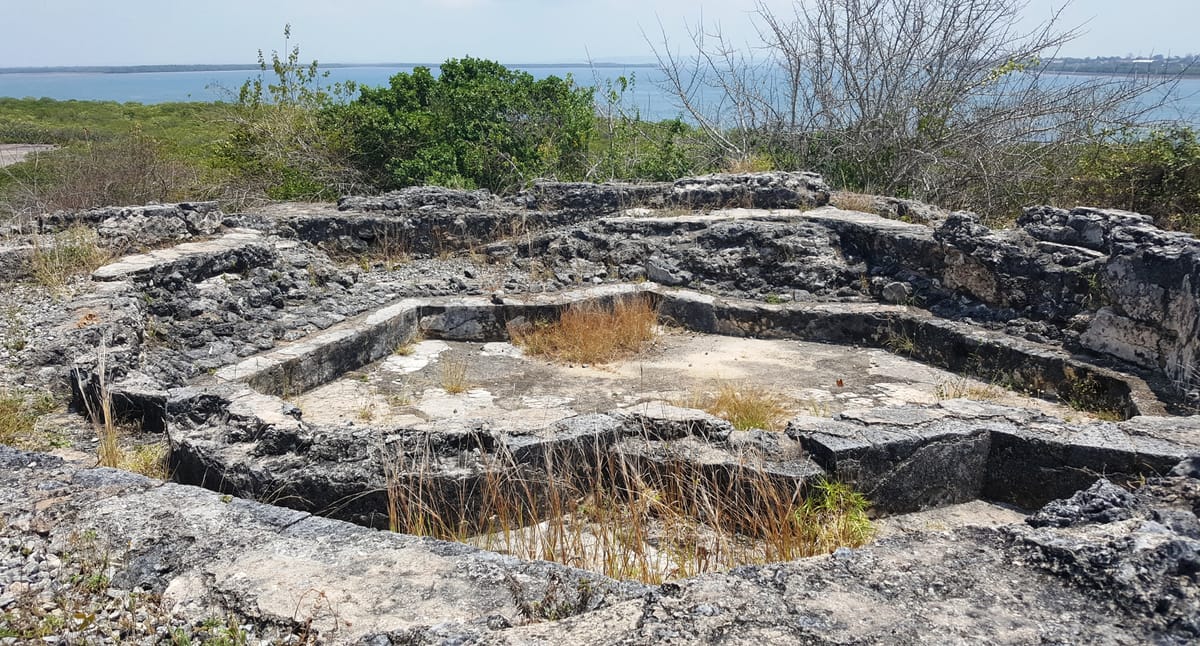
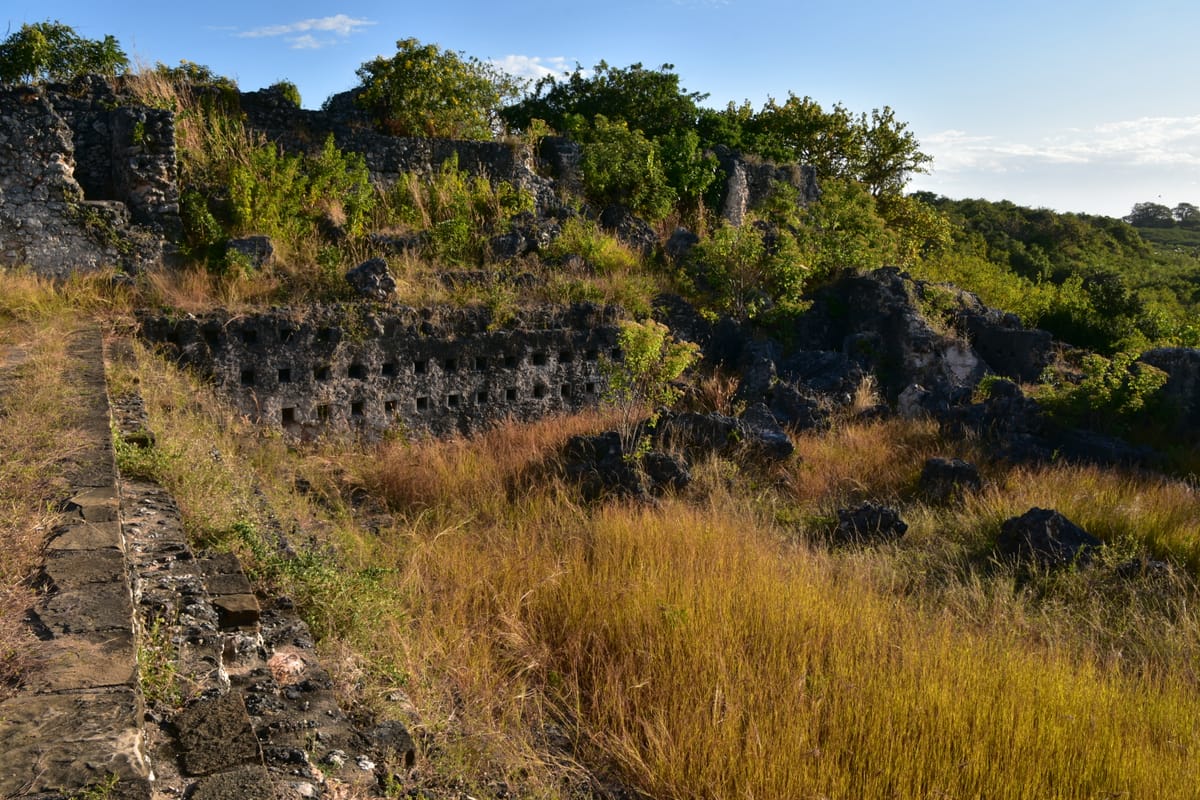
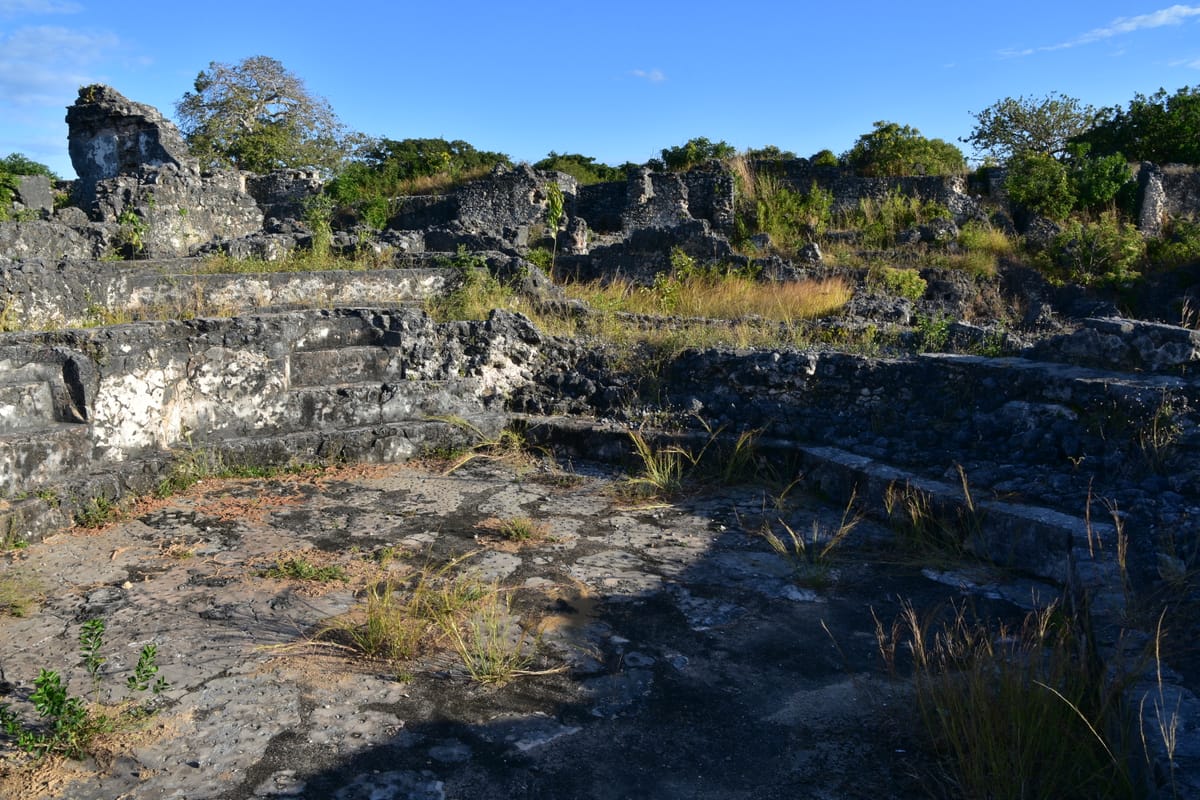
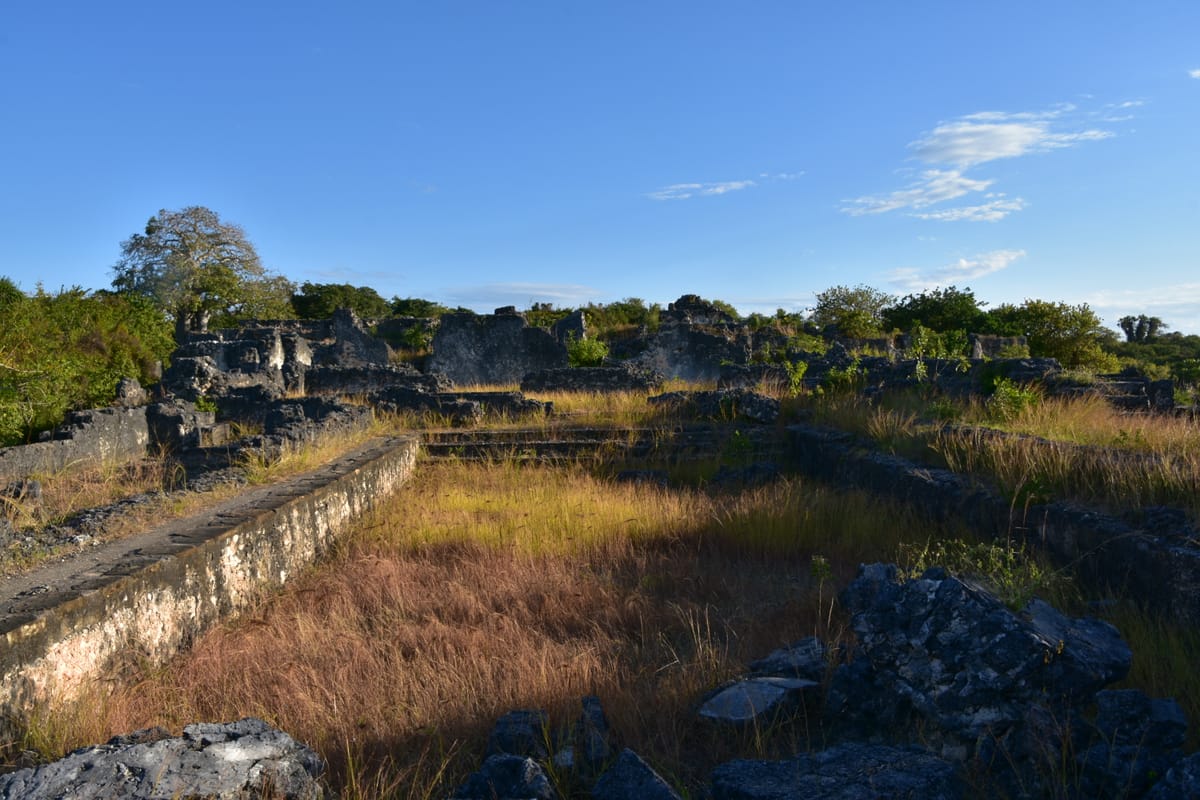
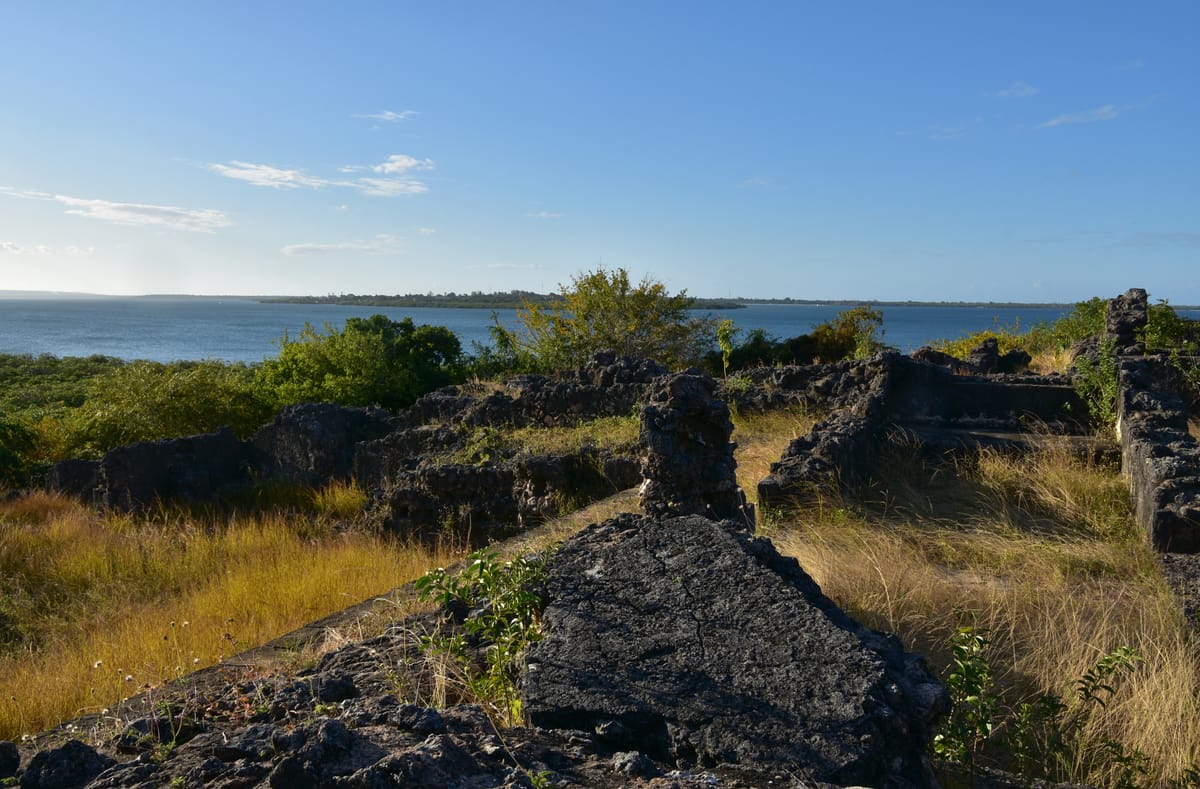
Husuni Kubwa — Swahili for “the large fort” — is the ruin of a palace and commercial emporium on the northern cliff of Kilwa Kisiwani, a small island off the southern coast of Tanzania. It was raised in the early 14th century for al-Hasan ibn Sulaiman, sultan of Kilwa from about 1310 to 1333 and the most powerful ruler of the Mahdali dynasty, at the moment when Kilwa controlled the export of gold from the Zimbabwe plateau into the Indian Ocean trade. The complex spread over roughly two acres of cliff top and contained more than a hundred rooms arranged around a series of courts, a stepped audience court, storerooms for trade goods, a private mosque, an octagonal bathing pool, and a stair cut down the face of the bluff to the water. It was built almost entirely of coral — jagged blocks of reef limestone called coral rag, set in mortar made by burning coral to lime — and roofed not with the flat mangrove-and-mortar ceilings usual on the Swahili coast but with barrel vaults, quarter-vaults and ribbed conical domes.
For centuries it was the largest single stone building anywhere in sub-Saharan Africa. The art historian Peter Garlake called it the earliest surviving major building on the East African coast south of Somalia, and by far the largest and most sophisticated. And it was a failure: excavation showed that Husuni Kubwa was occupied only briefly, that decorative carving on its bosses and panels was never finished, and that the sultans of Kilwa moved on to more modest quarters in the town. Today it is part of the UNESCO World Heritage Site “Ruins of Kilwa Kisiwani and Ruins of Songo Mnara” (inscribed 1981, reference #144), standing roofless and half-swallowed by scrub above the channel it was built to watch.
The Structure
Kilwa Kisiwani was a Swahili city-state — a Muslim, Swahili-speaking, African merchant society strung along the East African coast — and by the 14th century it was the richest of them. Its wealth came from a single strategic move: in the late 13th century Kilwa took control of Sofala, far to the south, the port through which gold from the Zimbabwe plateau reached the sea. Kilwa re-exported that gold, along with ivory, timber and tortoiseshell, and took in Chinese celadon and Ming porcelain, Persian glass, Indian cloth and glazed wares from the Gulf. At its height the city held perhaps 10,000 to 20,000 people, minted its own copper coinage, and — uniquely among Swahili states — struck gold coins under al-Hasan ibn Sulaiman in the 1320s. Kilwa’s coins have been found as far inland as Great Zimbabwe.
Husuni Kubwa was that wealth in built form, and it was not only a residence. The complex divides into two great parts: a southern court that functioned as a commercial precinct — a warehouse and trade emporium, with storage rooms and access to the shore for loading and unloading — and a northern domestic and ceremonial block, the sultan’s own apartments and audience spaces. The sequence a visiting merchant would have walked is still legible in the stonework: up from the beach by the cliff stair, into a stepped greeting court lined with guest rooms, through a pavilion and grand audience court, and only then into the private quarters. The domestic rooms stood about three metres tall, floored and finished in white lime plaster, some of it studded with fragments of Chinese porcelain set into the surface for ornament. Dadoes, doorjambs, cornices and the gabled ends of the barrel vaults were inlaid with carved coral panels. Elite Kilwa buildings, Husuni Kubwa included, had indoor plumbing. Three inscribed panels were recovered from the palace rooms, one of them invoking God’s guidance for al-Hasan ibn Sulaiman under the title al-Malik al-Mansur, “the victorious king” — the closest thing the building has to a signature.
Immediately beside it stands Husuni Ndogo, “the small fort”: a large rectangular enclosure of the same date, its walls articulated with regular buttresses or towers, containing almost nothing. What it was for is still unsettled; a fort, a caravanserai, a market enclosure and an early congregational space have all been proposed. Al-Hasan also enlarged Kilwa’s Great Mosque in the same campaign, adding a vaulted and domed extension — the same structural ambition, applied to the same coral, at the same time.
How Was It Built?
Kilwa Kisiwani has no granite, no sandstone, no building stone at all except what the sea makes. Swahili masons therefore quarried the reef. Two materials came out of it. Coral rag — the hard, irregular, fossilised limestone of the old raised reef — was hacked out in rough blocks and used for the body of the walls, bedded in generous quantities of mortar. Reef coral, and especially fine-grained Porites heads, was cut live from the shallows, where it is soft enough to shape with a blade; worked wet into panels, mihrab frames, quoins and bosses, it hardens on drying to a dense, almost marble-like finish that takes crisp relief carving. The mortar and plaster that held the whole thing together were themselves coral: blocks burned in kilns to quicklime, slaked, and mixed with sand. A building like Husuni Kubwa consumed a staggering quantity of fuel and labour before a single wall went up.
The roofing is the hard part. Standard Swahili practice was a flat ceiling of closely spaced mangrove poles with lime concrete poured over them — a system limited by the length of a mangrove pole, which is why Swahili rooms are characteristically long and narrow. Husuni Kubwa breaks that rule. Its rooms carry true vaults: simple barrel vaults over the long chambers, and more elaborate solutions where spaces meet — quarter-vaults, octagonal and conical vaults, and, at the corner where two differently vaulted wings intersect, a tall conical dome with a fluted interior and a ribbed exterior. Building those in coral rag requires timber centering shaped to each curve, mortar strong enough to carry the load while it cures, and masons who understand how thrust travels down into the walls. Mangrove poles supply the centering timber but not the knowledge. The vault and dome repertoire itself, along with the octagonal bathing pool and the formal audience court, belongs to the wider Islamic architectural world — the Gulf, the Red Sea, South Arabia — and arrived at Kilwa with the same ships and the same people that carried its trade. The work was directed by a sultan with gold coinage, Indian Ocean connections, and the authority to commandeer labour on an island city; no document survives that records how the workforce was raised, paid or housed.
The Mainstream View
Archaeologists agree on the essentials. Husuni Kubwa was built in the early 14th century, in one main campaign, for al-Hasan ibn Sulaiman, and the inscription naming him in the palace is the anchor for that attribution. Neville Chittick, excavating for the British Institute in Eastern Africa between the late 1950s and the mid-1960s and publishing in 1974, dug the complex, identified the sultan’s apartments and the palace mosque, and established the sequence that is still the framework for the site; later work, including the high-resolution Bayesian radiocarbon programme published by Horton, Olsen, Fleisher and Wynne-Jones in 2022, has refined Kilwa’s overall chronology — placing the island’s first coral buildings and coins at the end of the 10th century — without dislodging the early-14th-century date for the palace.
There is no mystery about who built it or why they could. Kilwa was a wealthy African city with a three-century-old stone-building tradition behind it, deep commercial ties across the Indian Ocean, a literate Muslim elite, and — briefly — a monopoly position in the medieval gold trade. Husuni Kubwa is what that combination produced when a confident ruler decided to build something the coast had never seen: local materials and local masons, executing an internationally current architectural programme at a scale nobody in the region had attempted. The building is normally read as exactly that — a statement of Kilwa’s arrival, and of al-Hasan’s own standing, made in the one durable material his island possessed.
The abandonment is generally explained economically rather than mysteriously. Al-Hasan died in 1333 with the palace unfinished; his successors did not complete it. By the 15th century the sultans were living in the Great House and later the Makutani palace in the town, and Husuni Kubwa was not reoccupied. The domed extension to the Great Mosque, built in the same ambitious idiom, collapsed later in the 14th century. Kilwa’s gold revenues faltered as world prices and trade routes shifted, dynastic conflict followed, and in 1505 Francisco de Almeida’s Portuguese fleet sacked the city and built Fort Santiago on it. The usual verdict is that Husuni Kubwa was simply over-ambitious: a building whose running costs and construction bill outran the revenues of the state that started it.
The Open Case
What is genuinely unresolved is narrower, and stranger, than “how did Africans build this” — a question the evidence closed long ago. It is this: nothing at Kilwa prepares you for Husuni Kubwa, and nothing follows from it either. The coast’s masons had been building in coral for three hundred years and had never vaulted at this scale; after al-Hasan, they largely stopped. The domed extension he added to the Great Mosque fell down. The palace’s carving was abandoned mid-chisel. Whether the vaulting was executed by Kilwa masons working from a description, by craftsmen brought in from the Gulf or South Arabia, or by some collaboration of the two, is not recorded and has not been settled archaeologically — and the collapse of the mosque dome hints that whoever did it was working at, or past, the edge of what they had actually mastered in this particular stone.
Then there is the question of why it emptied. A palace occupied for a generation and then left to the scrub, on an island that remained inhabited and wealthy for another two centuries, is an odd thing. Cost, a shifting gold trade and a change of dynastic taste are all plausible, and all inferred rather than documented; the Kilwa Chronicle, surviving in an Arabic version and in the Portuguese summary João de Barros made in the 16th century, does not explain it, and the two versions disagree with each other on much else besides.
And there is the smallest, sharpest puzzle of all. In 1331, while Husuni Kubwa was going up, Ibn Battuta landed at Kilwa and called it one of the finest and most substantially built towns he had seen — then wrote that all its buildings were of wood, roofed with dis reeds. The greatest traveller of the medieval world stood in a city of coral-stone mosques and palaces, praised it, and described it as a town of timber and thatch. Most scholars put it down to faulty memory or a conflation with somewhere else on the voyage. But it is a peculiar thing to misremember about a place, and it leaves the one eyewitness account of Kilwa at its zenith flatly at odds with the hundred vaulted rooms still standing on the cliff.
Sources
- UNESCO World Heritage Centre — Ruins of Kilwa Kisiwani and Ruins of Songo Mnara
- Archnet — Husuni Kubwa, Kilwa Kisiwani
- Archaeology Magazine — Stone Towns of the Swahili Coast: Husuni Kubwa
- Wikipedia — Kilwa Kisiwani
- Wikipedia — Al-Hasan ibn Sulaiman
- World History Encyclopedia — Kilwa
- African Archaeological Review — The Chronology of Kilwa Kisiwani, AD 800-1500 (Horton, Olsen, Fleisher & Wynne-Jones, 2022)
- coral-architecture
- africa
- tanzania
- swahili-coast
- medieval
- islamic-architecture
- trade-city
- palace
- unesco-world-heritage
Gallery