The Ġgantija Temples
How did a Stone Age farming population, with no metal tools or wheeled transport, quarry, move, and raise megaliths weighing up to 50 tonnes into two standing temples more than a thousand years before the pyramids of Giza?
Why this rating?
- Construction difficulty
- 4/5
- Method uncertainty
- 3/5
- Capability gap
- 4/5
- Open questions
- 4/5
A small, isolated Neolithic farming population with no metal tools, wheel, or draft animals raised megaliths up to 50 tonnes more than a thousand years before Stonehenge or the pyramids; the stone-sphere transport method is the leading reconstruction but not directly observed, and the social organization behind the labor, the temples' precise ritual meaning, and the culture's eventual disappearance around 2500 BCE all remain genuinely debated.
Overview
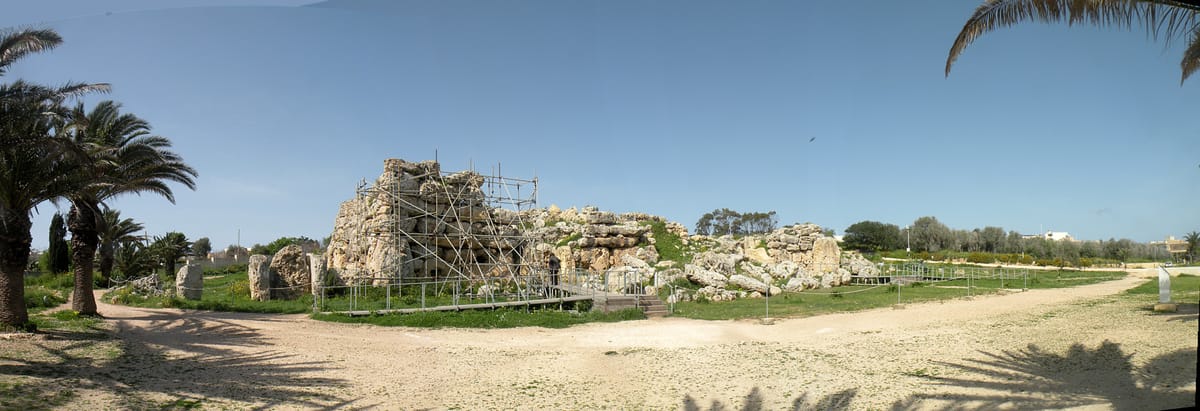
On a limestone ridge above the town of Xagħra, on the small island of Gozo in the Maltese archipelago, two temples stand side by side behind a single massive boundary wall. Together they are known as Ġgantija (pronounced roughly “jgan-TEE-ya”), a name that comes from the Maltese word ġgant, “giant” — local folklore held that the temples were built in a single night by a giantess named Sansuna, who carried the huge stones on her shoulders while nursing an infant, sustained only by fava beans and honey. The reality uncovered by archaeology is, if anything, more remarkable: Ġgantija was built by ordinary Neolithic farmers of Gozo and Malta, starting around 3600 BCE, using only stone, bone, and wooden tools. That makes it one of the oldest free-standing monumental stone structures anywhere in the world — significantly older than Stonehenge and Egypt’s pyramids, and outdone in age only by the very different, non- architectural site of Göbekli Tepe in Anatolia. Ġgantija is the type-site for the Ġgantija phase of Maltese prehistory (c. 3600–3200 BCE) and forms part of the “Megalithic Temples of Malta,” a UNESCO World Heritage Site (inscribed 1980, extended 1992) that groups Ġgantija with five other temple complexes across the islands.
The Structure
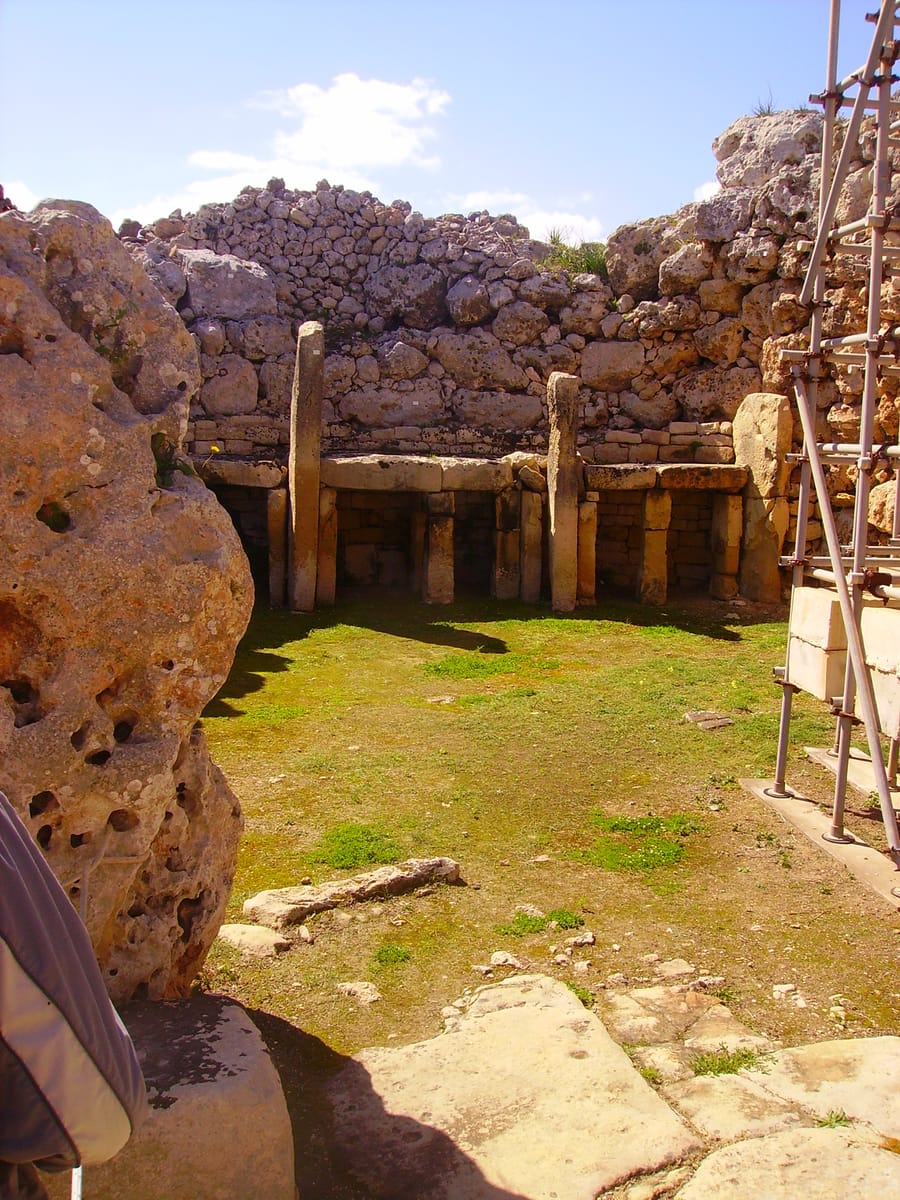
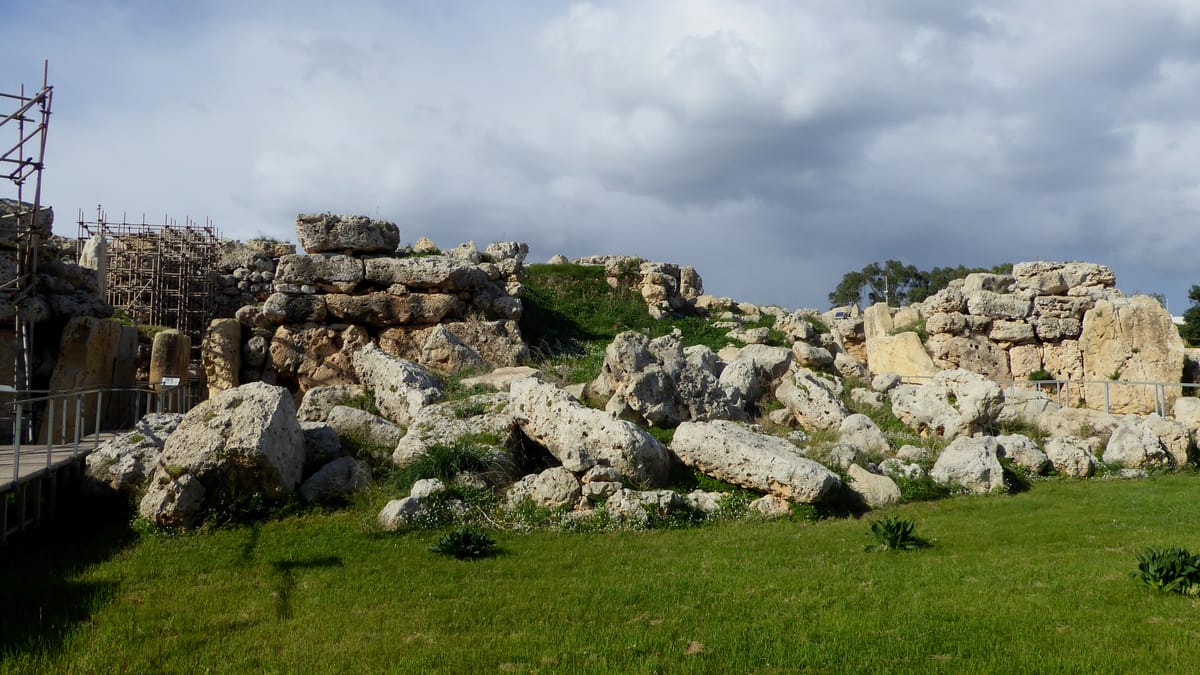
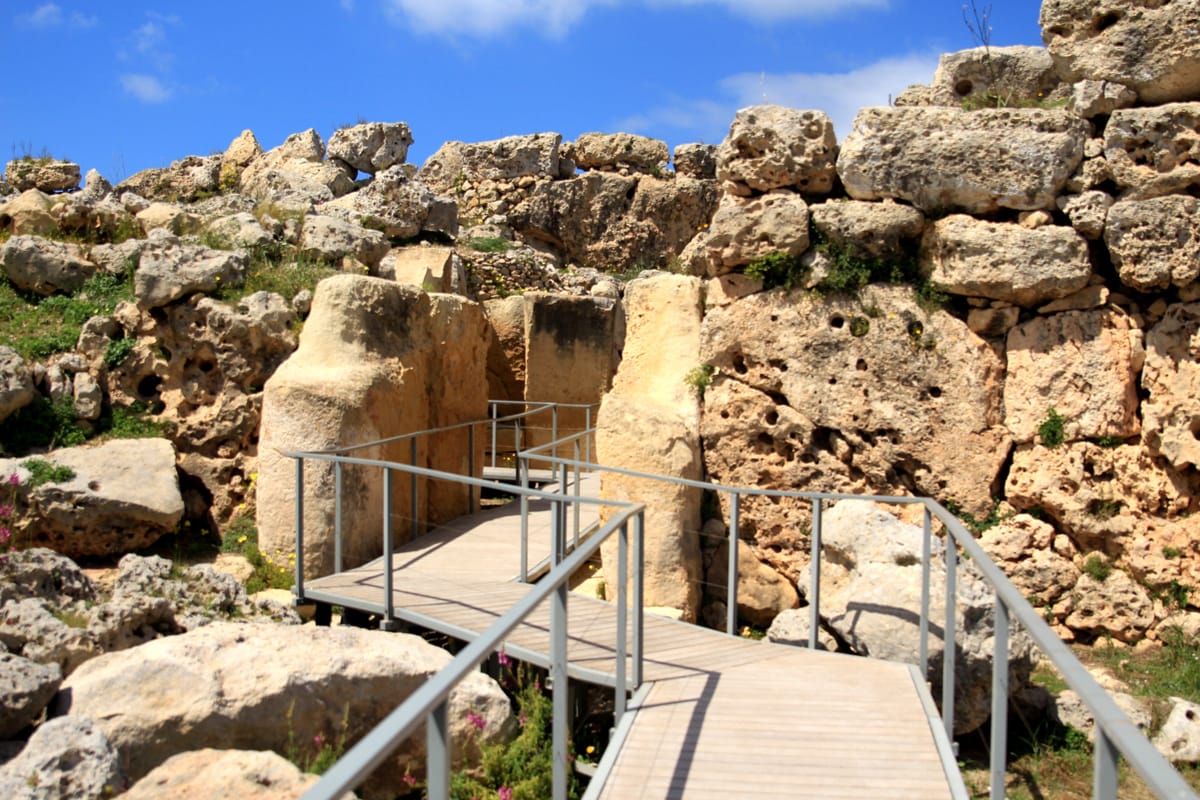
Ġgantija consists of two temples — conventionally called the South Temple and the North Temple — built at slightly different times but enclosed together within a single outer boundary wall up to 6 meters high in places, made of massive, roughly coursed megaliths. Each temple is entered through a concave, trefoil-like forecourt facade and follows the “clover-leaf” plan typical of Maltese temple architecture: a central paved passage flanked by pairs of semicircular chambers, or apses, that narrow toward the rear. The larger, older South Temple has five apses and is generally regarded as the earliest phase of construction, with the smaller North Temple added later along the same axis. Some of the facade and boundary-wall blocks exceed 5 meters in length and are estimated to weigh up to 50 tonnes; the builders used two different local limestones for different purposes — the harder, weather-resistant coralline limestone for the massive outer walls and facade, and the softer, more easily worked globigerina limestone for interior fittings such as door slabs, altars, and decorative elements. Excavated interiors preserve traces of plaster on the irregular inner wall faces, several stone altars set into the apses (including one with a “tethering hole” possibly used in animal sacrifice), a hearth, and quantities of animal bone, pottery, and figurines — evidence that the temples were active ritual and communal spaces rather than dwellings or tombs. A large threshold block with a carved recess near the entrance is thought to have served a ritual or purification function. Ġgantija was never truly “lost”: it stood in ruins visible above ground for millennia and drew antiquarian visitors from at least the 18th century, well before formal excavation began in the 1820s–1830s.
How Was It Built?
The people who built Ġgantija belonged to Malta’s Neolithic farming society, descended from settlers who had arrived from Sicily centuries earlier. They had no metal tools, no wheel, and no domesticated draft animals suited to hauling multi-tonne loads, yet needed to quarry, shape, transport, and raise stones far larger than a person. The generally accepted reconstruction begins at the quarry, where blocks were roughed out using harder stone hammerstones and picks, exploiting the natural bedding planes of the local limestone to split blocks to approximate size. Moving the finished blocks is thought to have relied on rolling rather than dragging: many dozens of small, carefully shaped spherical stones — essentially stone “ball bearings,” some just a few centimeters across — have been recovered at Ġgantija and other Maltese temple sites, and archaeologists widely interpret them as a transport technology, laid in tracks or troughs so that a massive block, resting on a wooden sledge or cradle, could be rolled forward on the spheres with far less friction than dragging across bare ground. Once at the site, blocks were likely raised and set using earthen ramps, timber levers, and packed supports, methods consistent with what is known of other Neolithic and early Bronze Age megalithic construction around the Mediterranean and Atlantic Europe. No contemporary written record explains the process — Malta’s Neolithic inhabitants left no texts — so this sequence is inferred from the finished monument, the tools and stone spheres found on site, and comparison with better- documented megalithic building elsewhere.
The Mainstream View
Archaeologists attribute Ġgantija, without serious dispute, to the indigenous Neolithic population of the Maltese Islands during what is often called the “Temple Period” (roughly 4100–2500 BCE), a remarkable era in which a relatively small, isolated island community developed monumental architecture, complex ritual practice, and sophisticated stoneworking skill well before comparable achievements elsewhere in the Mediterranean. This attribution rests on continuous material evidence: pottery styles and radiocarbon dates that place construction firmly within the local Ġgantija phase, tool marks and unfinished blocks consistent with stone-on-stone quarrying, the stone spheres found in direct association with the temples, and close architectural continuity with Malta’s other five UNESCO-listed temple complexes, which share the same clover-leaf plan, concave facades, and use of coralline and globigerina limestone. Archaeologists see the temples primarily as communal ritual centers — likely serving as focal points for a farming society organized around extended kin or clan groups — rather than palaces, fortifications, or tombs, based on the altars, animal bone deposits, and figurines found inside. This “temple culture” flourished for over a thousand years before its builders and their distinctive architecture disappeared from the archaeological record around 2500 BCE, giving way to the very different Bronze Age Tarxien Cemetery culture; the reasons for that disappearance, discussed below, remain debated, but the identity and general achievements of the builders themselves are not.
The Open Case
What makes Ġgantija genuinely puzzling is not who built it — the evidence for a local Neolithic origin is solid — but exactly how, and why, they built at this scale so early. No one disputes that Neolithic technology, in principle, could move large stones using ramps, levers, sledges, and rollers; the open question is how a comparatively small island population, without draft animals or metal tools, organized the sustained labor, planning, and engineering knowledge needed to consistently quarry, transport, and precisely raise blocks in the tens of tonnes — achieving this more than a thousand years before Stonehenge’s sarsens or the Great Pyramid, and apparently independently of the contemporaneous monumental building traditions taking shape elsewhere. The stone spheres are the leading physical clue to the transport method, but exactly how they were used in practice — as true rolling “bearings” under a sledge, or as part of some other lever-and-track system — is reconstructed rather than directly observed. Equally unresolved is the precise social and religious meaning of the temples: what rites were actually performed at the altars, what the concave facades and clover-leaf chambers were meant to evoke, and how the temple-building “priesthood” or elite (if one existed) organized labor across generations. Finally, the fate of the culture itself remains an open question: the temple builders vanish from the record around 2500 BCE, replaced by a markedly different Bronze Age population and material culture, and archaeologists debate whether resource exhaustion, environmental degradation, social collapse, disease, or a combination of these factors was responsible. None of this requires — or has any credible evidence for — outside intervention or lost advanced technology; the “giants” of Gozo’s folklore were a later people’s explanation for what their own Neolithic ancestors, working with stone, timber, and remarkable organization, had actually achieved. But the underlying engineering and cultural questions are real, and Ġgantija remains one of the clearest places on Earth to stand in front of them.
Sources
Gallery