Anji Bridge (Zhaozhou Bridge)
How did a single Sui-dynasty craftsman conceive and cut a flattened, open-spandrel segmental stone arch — a bridge form the West would not build for another 700 years — and execute it so soundly that its 37-metre span still carries visitors more than 1,400 years later?
Why this rating?
- Construction difficulty
- 4/5
- Method uncertainty
- 2/5
- Capability gap
- 2/5
- Open questions
- 2/5
Cutting 28 curved limestone voussoirs to fit a single 37-metre segmental arch, raising it on timber centering across a river, and piercing the shoulders with open spandrel arches was a demanding feat of masonry for the year 600 CE — but the method is thoroughly understood, documented, and well within Sui China's proven capabilities, so method uncertainty and any capability gap are low. The real wonder is conceptual rather than mysterious: a flattened open-spandrel segmental arch that would not appear in Europe for roughly seven hundred years, arrived at by one craftsman and executed so well the bridge still stands and still carries load after fourteen centuries.
Overview
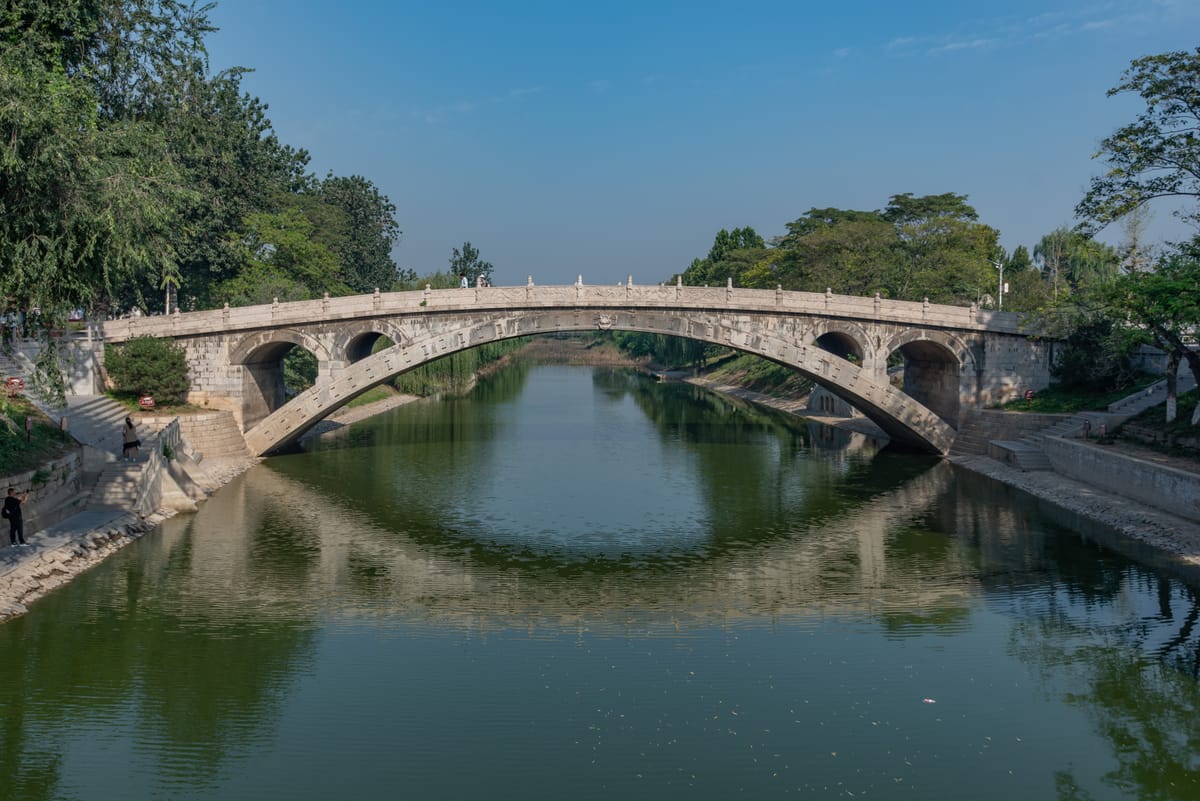
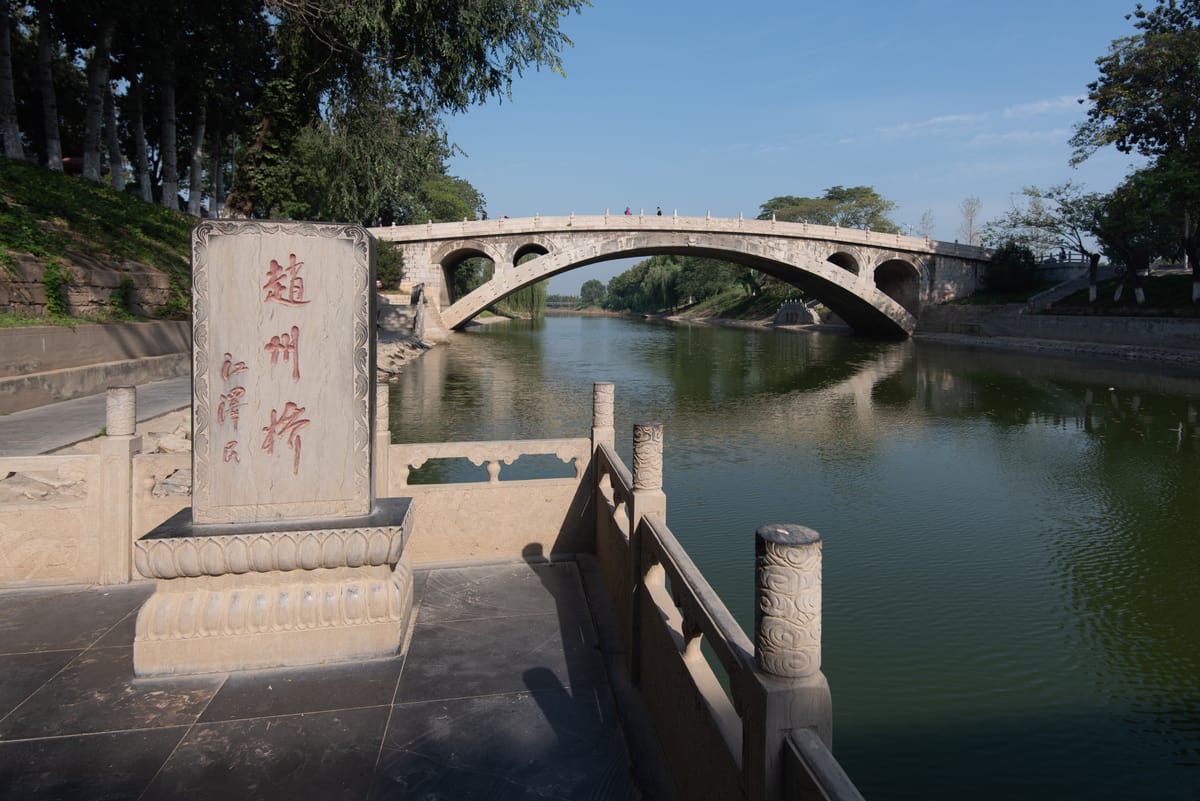
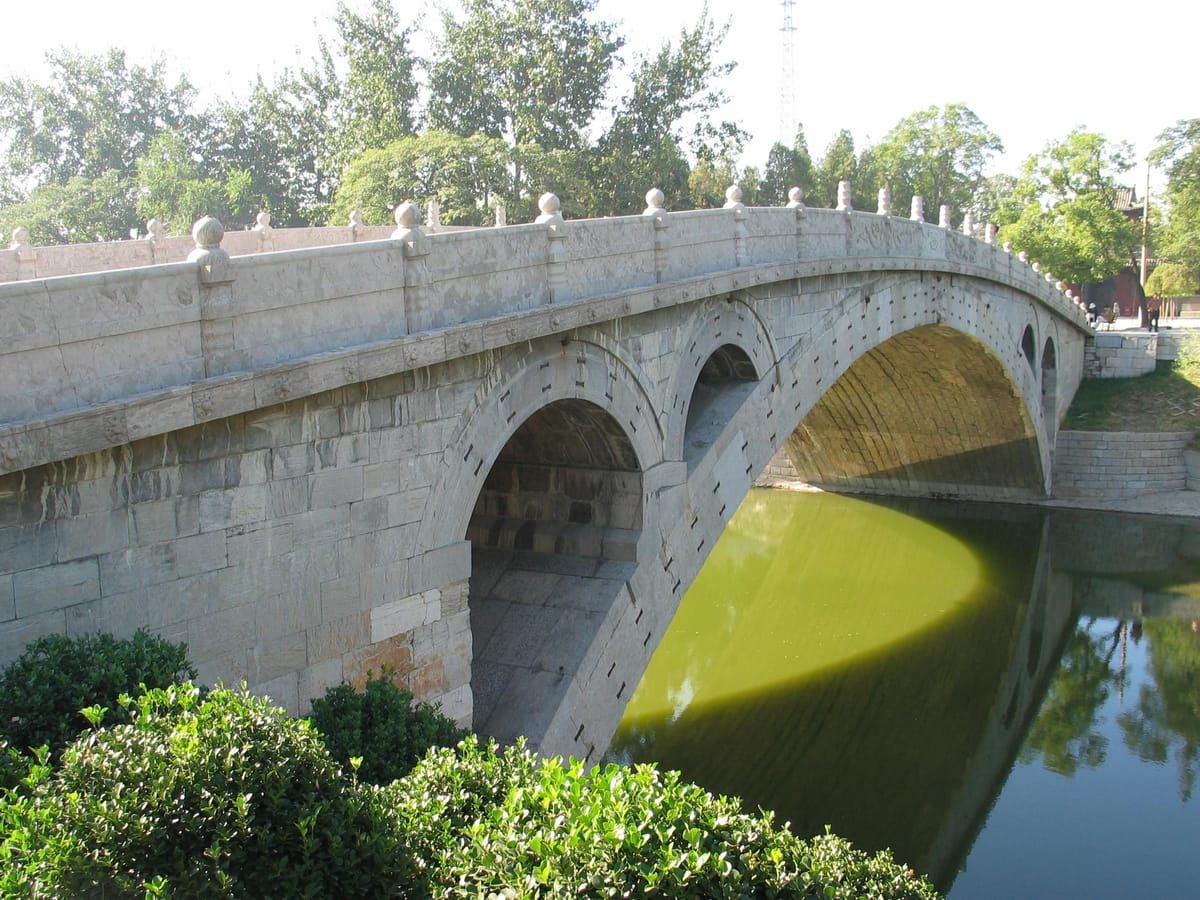
In Zhao County, in China’s Hebei Province, a single stone arch crosses the Xiao River in one long, low sweep. It is called the Anji Bridge — “Bridge of Safe Crossing” — though it is just as often known as the Zhaozhou Bridge, after the old name of the district. Built between roughly 595 and 605 CE, during the short-lived Sui dynasty, it is the oldest standing bridge in China and, more remarkably, the oldest open-spandrel stone segmental arch bridge anywhere in the world. Its designer was a craftsman named Li Chun, a figure otherwise almost unknown to history, who directed the masons and left behind a structure that engineers still single out as one of the great leaps in the history of bridge building. A reader who has never seen it can picture the essentials easily: one broad stone arch, unusually flat rather than a tall half-circle, with a pair of smaller openings pierced through the solid stone at each end, spanning a river it has spanned for more than fourteen hundred years. In 1991 the American Society of Civil Engineers made it an International Historic Civil Engineering Landmark, placing a Sui-dynasty bridge in the same company as the world’s most important works of engineering.
The Structure
The bridge is about 64 metres long overall and a little over 9 metres wide, but its heart is a single arch spanning roughly 37 metres — enormous for a stone arch of its age. What sets it apart is the shape of that arch. Almost every masonry bridge before it, and for centuries after, used a semicircular arch, tall and steep, because builders trusted that a half-circle was the only reliably stable form. Li Chun instead used a segmental arch: a shallow slice cut from a much larger imaginary circle, its radius about 27 metres and its arc sweeping through only some 84 degrees rather than a full half-circle. The result is a low, flat crossing that rises only about 7 metres over its 37-metre span — a rise-to-span ratio of roughly one to five, against the one-to-two of a semicircle. That flatness made the bridge easy to walk and cart across, and it used far less stone, but it also pushed the arch’s thrust hard outward against the abutments, which is exactly why earlier builders had avoided the form. The second innovation answers the first. At each shoulder of the main arch, where a conventional bridge would be a solid mass of masonry, Li Chun cut two open arches — four in all — straight through the structure. These open spandrels lighten the bridge by an estimated several hundred tonnes, ease the load on the foundations, and, crucially, give floodwater somewhere to go: when the river rises, water pours through the openings instead of piling up against a solid wall and tearing the bridge away. Ancient Chinese writers compared the finished bridge to “a crescent moon rising from the clouds” and “a long rainbow hanging over a mountain stream.”
How Was It Built?
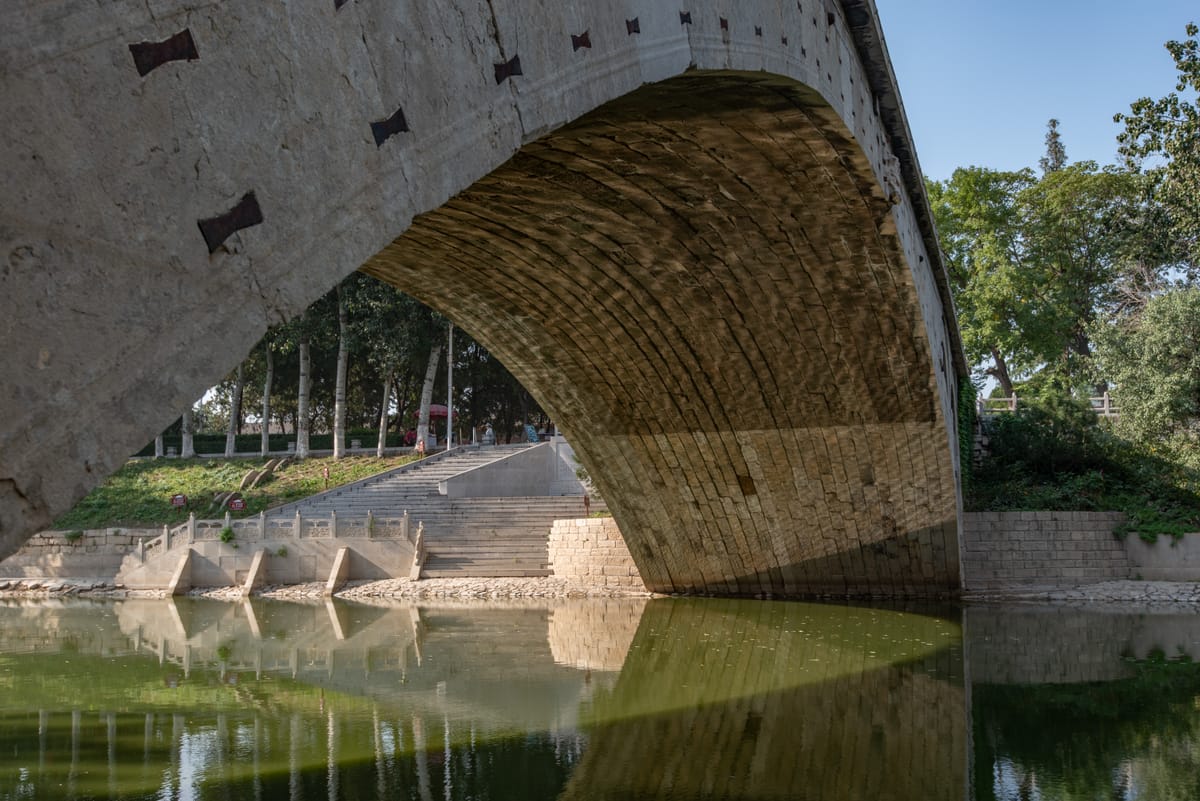
The main arch is not a single carved piece but an assembly of 28 thin, curved limestone slabs — the voussoirs — set side by side to form the arch barrel. Rather than bond the whole width into one rigid mass, Li Chun built it as a row of parallel arch ribs and tied them together with iron cramps: dovetail- or “butterfly”-shaped pieces of iron let into the faces of adjoining stones, which can still be seen dotting the underside of the arch today. This arrangement gives the bridge a slight, deliberate flexibility, letting the arch shift and settle a little with its abutments and with temperature without cracking apart. The construction sequence is the ordinary one for a masonry arch, executed at an unusual scale: a timber framework, or centering, was raised across the river to carry the shape of the arch; the shaped voussoirs were laid up over it, ring by ring, until the arch closed and could stand on its own; then the centering was struck and the spandrels, deck, and stone balustrades were finished on top. None of this is mysterious — it is well-documented masonry practice, and the stone itself is limestone, hard-wearing but far more workable than granite — but doing it with a 37-metre flattened span, cut and fitted closely enough that the arch has never fully failed, was a formidable piece of work. The genius lay less in the tools than in the design: knowing that a segmental arch would stand at all, and that pierced spandrels would strengthen rather than weaken it.
The Mainstream View
Among historians of engineering the Anji Bridge is not a puzzle but a celebrated, well-understood milestone. Its date, its builder, its materials, and its method are all essentially settled: Chinese records name Li Chun and place the work in the Sui dynasty around 595–605 CE, the segmental geometry and open spandrels are plainly visible and measurable, and the iron cramps and limestone voussoirs are exactly what an examination of the bridge reveals. There is no serious dispute about how it was made. What earns it a place in engineering histories is its precedence. The open-spandrel segmental arch — flat, efficient, and pierced to shed floodwater — is a design that European builders did not arrive at until roughly the fourteenth century, some seven hundred years later, and open-spandrel arches in stone did not become common in the West until later still. That a bridge embodying both ideas at once was standing in China by the year 600, and standing so well that it survived, made the Anji Bridge a favourite example of just how far ahead Chinese civil engineering ran during this period. Its endurance reinforces the point: over fourteen centuries it is recorded to have come through repeated floods, wars, and earthquakes — including major tremors whose epicentres lay not far away — with the main arch intact, needing periodic repair to its balustrades and deck but never a rebuilding of its structure.
The Open Case
Because the important questions about the Anji Bridge are answered, the genuinely open ones are narrow and technical rather than mysterious. We know almost nothing about Li Chun himself beyond his name and this one surviving work, so how he arrived at the segmental, open-spandrel design — whether he refined an existing regional tradition of arch building or reasoned it out largely on his own — is a question of lost biography rather than lost technology. The exact original construction details are likewise only partly recoverable: how the centering was framed across the river, how the foundations were laid in the riverbed, and how much of what stands today is Sui-era stone versus the product of later repairs, since the bridge has been restored a number of times over the centuries, with modern campaigns in the 1950s among the best recorded. Conservation is the practical open case — protecting a fourteen-hundred-year-old stone structure against continued weathering, traffic, and seismic risk while keeping it authentic. None of this reaches beyond the plainly demonstrated abilities of Sui China, one of the most advanced engineering cultures of its day. The lasting wonder of the Anji Bridge is not that we cannot explain it, but that a single craftsman, at the very start of the seventh century, saw how to make a stone arch both flatter and stronger than anyone around him believed possible — and built it so soundly that people are still crossing it today.
Sources
- china
- sui-dynasty
- bridge
- stone-arch
- open-spandrel
- segmental-arch
- limestone
- civil-engineering
- li-chun
- asce-landmark
- hebei
Gallery