Patterns Too Big to See
In Ohio, the Hopewell laid out circles and an octagon so exact they frame the moon's 18.6-year cycle. In Peru, the Nazca drew animals the length of football fields. Neither people could ever stand back far enough to see the whole of what they made.
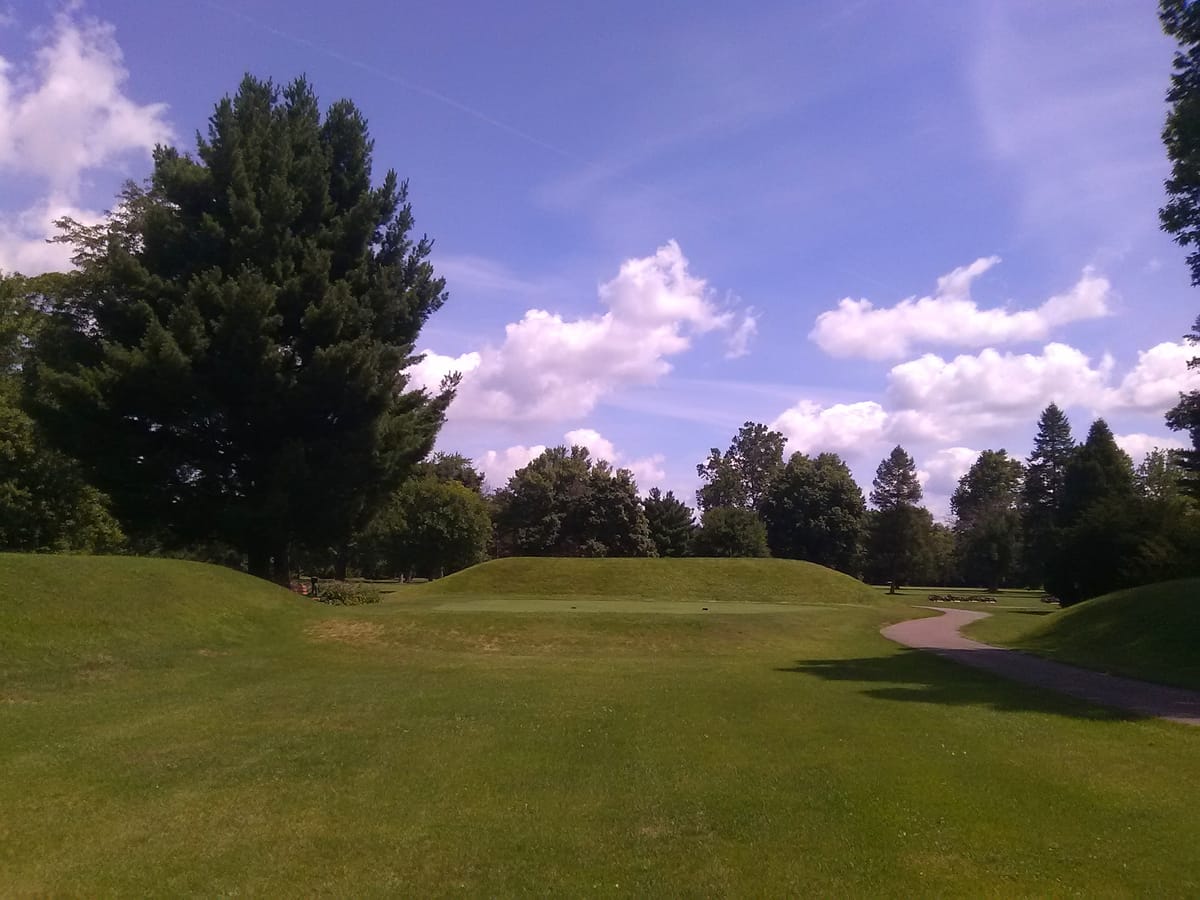
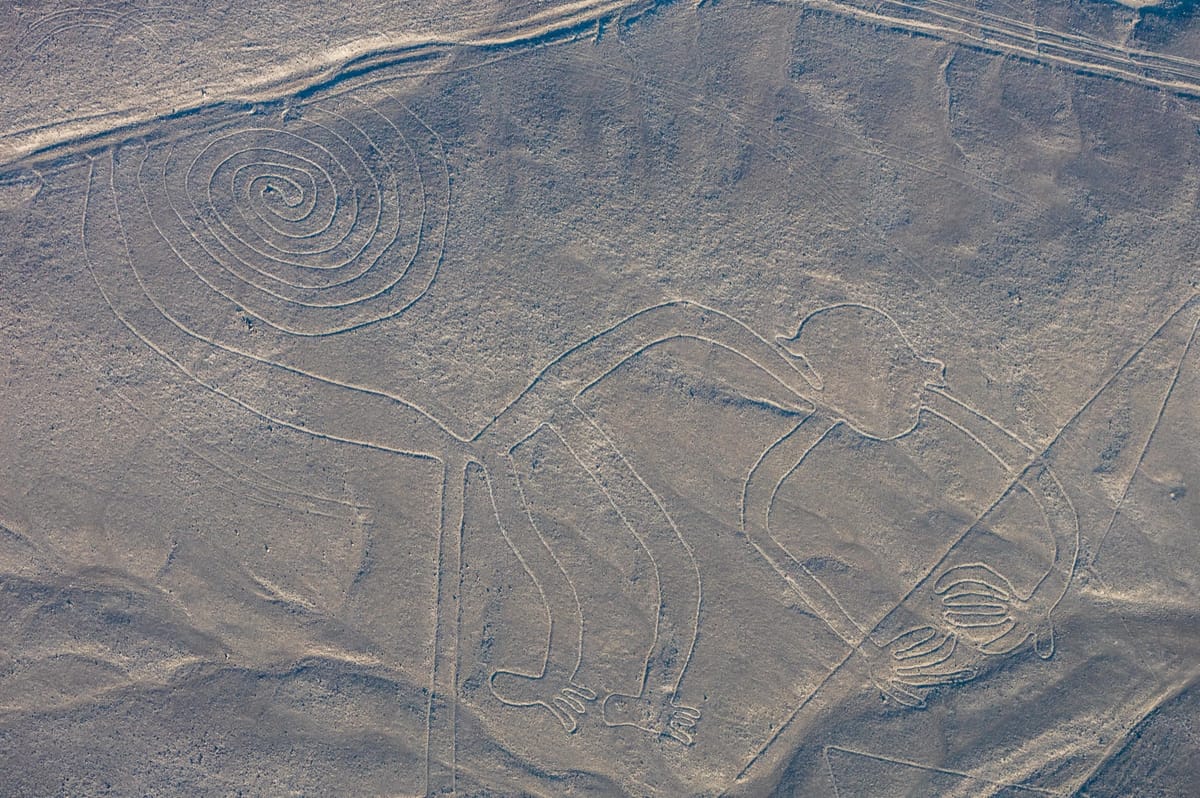
Stand inside the Octagon Earthworks in Newark, Ohio, and you cannot see the octagon. You are among long, low walls of heaped earth, each about 550 feet of grass-covered embankment, and from the ground they read as bumps and berms — a shape you have to be told is there. Two thousand years ago the Hopewell raised eight of those walls into a 50-acre octagon joined to a near-perfect 20-acre circle, and oriented the whole figure so its walls frame all eight extreme points where the moon rises and sets across its slow 18.6-year cycle. Four hundred kilometres inland from the coast of Peru, on a flat stony plateau, the Nazca cleared the dark stones from the desert floor to expose the pale ground beneath and drew a hummingbird 93 metres long, a monkey with a spiralling tail, a spider, a condor with a wingspan well over 100 metres. Stand next to any of them and you see a shallow pale groove wandering off toward the horizon. The bird only becomes a bird from the sky.
Neither people could ever occupy the vantage that would let them see their own work whole. The Hopewell had no way to rise above four square miles of Ohio and confirm their circle was round; the Nazca had no aircraft, and their largest figures resolve into images only from high above, an aerial view the makers never had. And yet the geometry came out right. The Newark circles are round to a degree hard to achieve even with modern instruments, the octagon’s walls near-uniform, and the same base unit — the roughly 1,050-foot span of the Observatory Circle — recurs at Hopewell sites more than fifty miles away, the octagon-and-circle lunar design repeating almost exactly at High Bank near Chillicothe. The Nazca held straight lines across kilometres of desert, over dry riverbeds and low ridges, barely deviating. Two peoples who never traded a word or a tool each solved the same quiet, staggering problem: how to be precise about something larger than you can perceive.
The method, in both cases, is understood, and it is human. The Nazca drove wooden stakes and pulled taut cords to sight and hold their long lines, and enlarged their figures from small preliminary drawings using a grid, a central reference point, and measured lengths — working outward accurately from known points, never needing to see the finished whole. In 1982 Joe Nickell and a small team reproduced the Nazca condor on an American field with nothing but stakes, cord, and sighting, and no view from above. The Hopewell worked in the same spirit, without writing or surveying instruments: to close a 1,200-foot circle and set an octagon’s angles, they needed staked sightlines, a shared standard of length, and a body of practical geometry carried in memory and repeated across a landscape. What neither method requires — and this is the twist that dissolves any hint of contact between them — is a bird’s-eye view. Precision at that scale was never about seeing the pattern. It was about trusting the geometry enough to lay it down piece by piece and let the whole emerge, unseen, correct.
So the wonder is not that these designs are alike. Superficially they are not: one is heaped earth aimed at the moon, the other scraped stone read from the air. The wonder is that two societies, alone on opposite sides of the world, arrived at the same relationship with scale — a willingness to commit an exact idea to the ground knowing they would never step back far enough to see it answered. The hummingbird has waited two thousand years for an eye high enough to take it in. The octagon still catches the northernmost moonrise for no one in particular. Their makers finished the work and walked away inside it, having built patterns too big to see and gotten them right on faith.
Read the full studies: Newark EarthworksNazca Lines
Sources
- Ohio History Connection — The Archaeoastronomy of the Newark Earthworks
- UNESCO World Heritage Centre — Hopewell Ceremonial Earthworks
- Wikipedia — Newark Earthworks
- UNESCO World Heritage Centre — Lines and Geoglyphs of Nasca and the Pampas of Jumana
- Wikipedia — Nazca lines
- Smithsonian Magazine — The Mystery of the Nazca Lines
- Sakai et al., PNAS (2024) — AI-accelerated Nazca survey nearly doubles the known relief-type geoglyphs