Where No Building Should Hold
In a Colorado canyon, a whole town was fitted into a hole in a cliff. On a Shanxi rock face, a temple was hung off beams hammered into bare stone. Seven centuries and half a world apart, two peoples committed their architecture to the vertical — and it held.
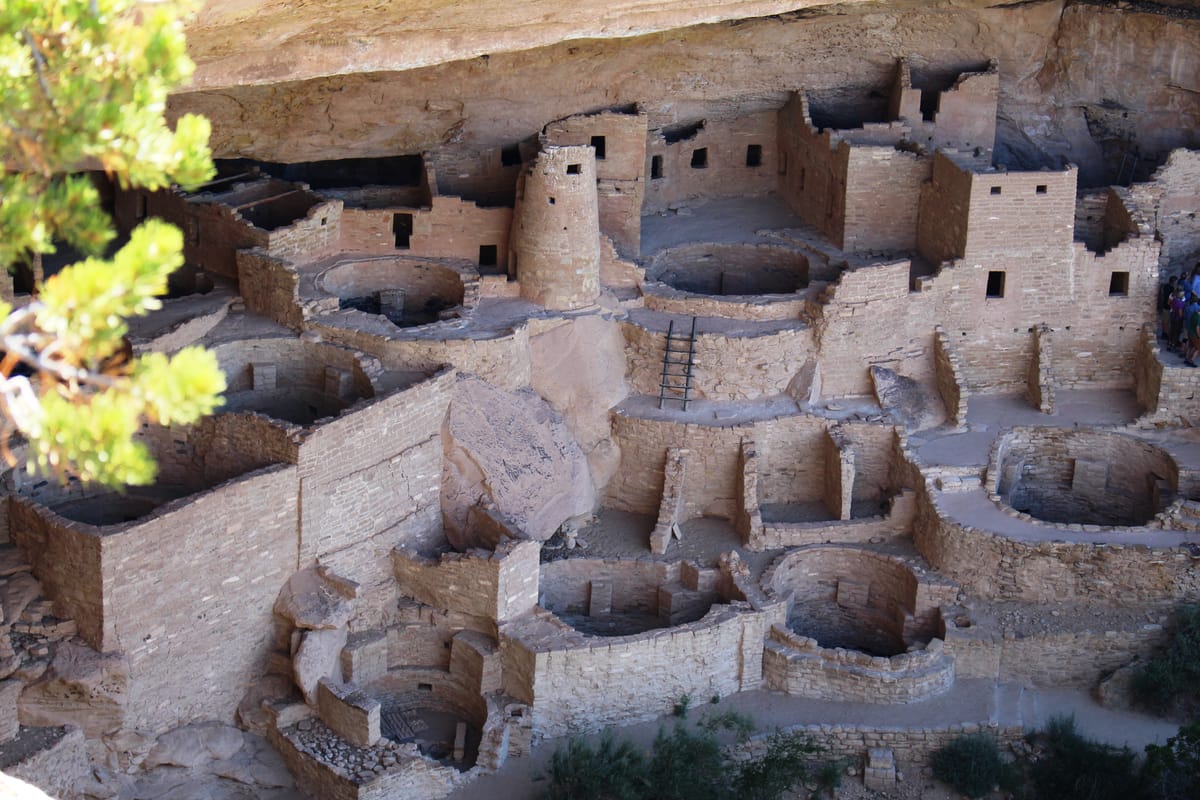
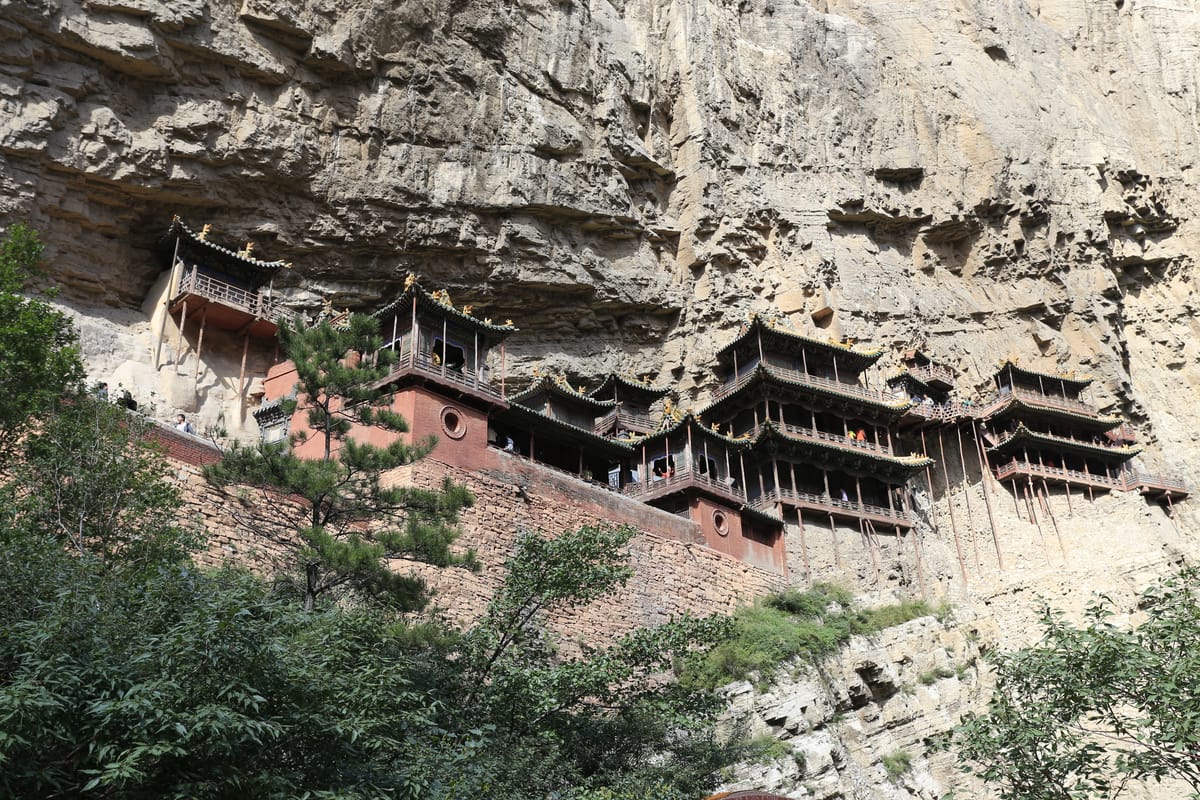
Stand at the canyon overlook in southwestern Colorado and it takes a moment to see it: a whole stone town, roughly 150 rooms and 23 round kivas, tucked into a hollow in the cliff face like something set on a shelf. This is Cliff Palace, the largest cliff dwelling in North America, raised by Ancestral Puebloan builders mostly between about 1190 and 1260 CE. There is no road to it, no stair. In its day you reached it by wooden ladders and by shallow finger- and toe-holds pecked one at a time into the bare sandstone — handholds that still scar the rock. Now cross to the other side of the planet, to a gorge below Mount Heng in Shanxi, China, and look up: a monastery of some forty painted timber halls, stacked two and three storeys high, apparently glued to a vertical wall dozens of metres above the valley floor with nothing beneath it but air. The Hanging Temple, founded around 491 CE. Two buildings, two continents, one shared act of nerve — architecture committed to a surface that offers a builder nothing to stand on.
The instinct behind each is the same, but the engineering is entirely opposite. The Ancestral Puebloans did not fight the cliff; they moved into it. Water seeping through porous Cliff House sandstone had, over ages, spalled out a broad arching alcove, and they filled that natural pocket with an ordinary masonry town — shaped sandstone laid in mud mortar, chinked with small stones, roofed with juniper beams — the same building tradition they had used for centuries on the open mesa tops above. The cliff shelters the town: a single sweep of overhanging rock keeps off rain and snow. The Shanxi carpenters had no such hollow to hide in, so they made the cliff hold their building against its will. They cut deep horizontal sockets into the rock and drove in roughly two dozen stout beams of oil-cured “iron fir,” each fitted with a wedge at its buried end that splayed the timber as it was hammered home, so the stone itself clamped down and gripped. Onto the outer half of those cantilevered beams they raised a flexible mortise-and-tenon frame that sways rather than shatters when the ground shakes. The much-photographed poles beneath the halls, most people are surprised to learn, carry almost nothing — the load runs the other way, back into the mountain.
Nestle a town into a natural cavity, or hang a temple off beams punched into blank rock: these are not two versions of one idea passed between cultures. They are two separate answers to the same defiant question, invented eleven thousand kilometres and seven centuries apart by people who never traded a tool or a word. Each was, in its way, a rational choice — the alcove gave the Puebloans shelter, defence, and cool summers close to their fields; the recess and overhang gave the monastery an enormous stone eave that has helped it ride out fifteen hundred years of floods and earthquakes. But strip away the reasons and what remains is the same astonishing decision, made twice and alone: to look at the one place a building should never stand — the sheer face of a cliff — and build there anyway. Both are still standing. In Colorado the pecked handholds wait in the sandstone for climbers who left seven hundred years ago; in Shanxi the plank walkways still thread between the halls, one person wide, with the gorge falling away beneath. Look long enough at either and the same quiet vertigo sets in — the sense that the rock has been holding its breath this whole time, and has simply chosen not to let go.
Read the full studies: Cliff PalaceHanging Temple (Xuankong Si)
Sources
- Wikipedia — Cliff Palace
- National Park Service — Cliff Dwellings of Mesa Verde
- Encyclopaedia Britannica — Mesa Verde National Park
- Wikipedia — Hanging Temple
- TravelChinaGuide — Hanging Temple (Hanging Monastery), Datong
- npj Heritage Science — Seismic vulnerability assessment of historical timber temples: a case study of the Hanging Temple in China