The Roof You Climb Onto
Karnak lost its stone ceiling centuries ago. One game puts it back — then sends you up a column to stand on it.
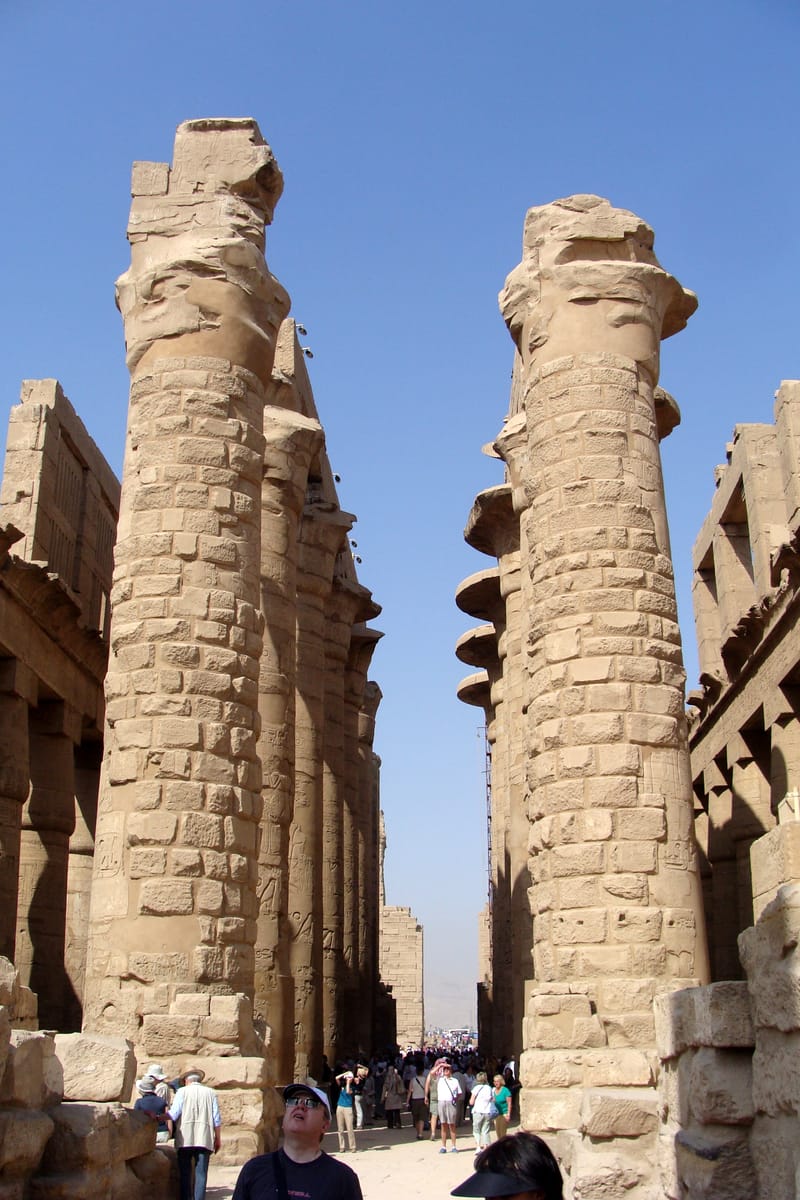
Every photograph of the Great Hypostyle Hall is a picture of a building with its lid off. One hundred and thirty-four columns, sixteen rows, five thousand square metres — and above them, nothing but sky. That is the ruin, not the room. The room was covered: stone architraves, stone roofing slabs, and grilled clerestory windows dropping a narrow band of daylight into an interior its builders deliberately kept dark. Games have been rendering Karnak for twenty-five years. Almost all of them build the ruin.
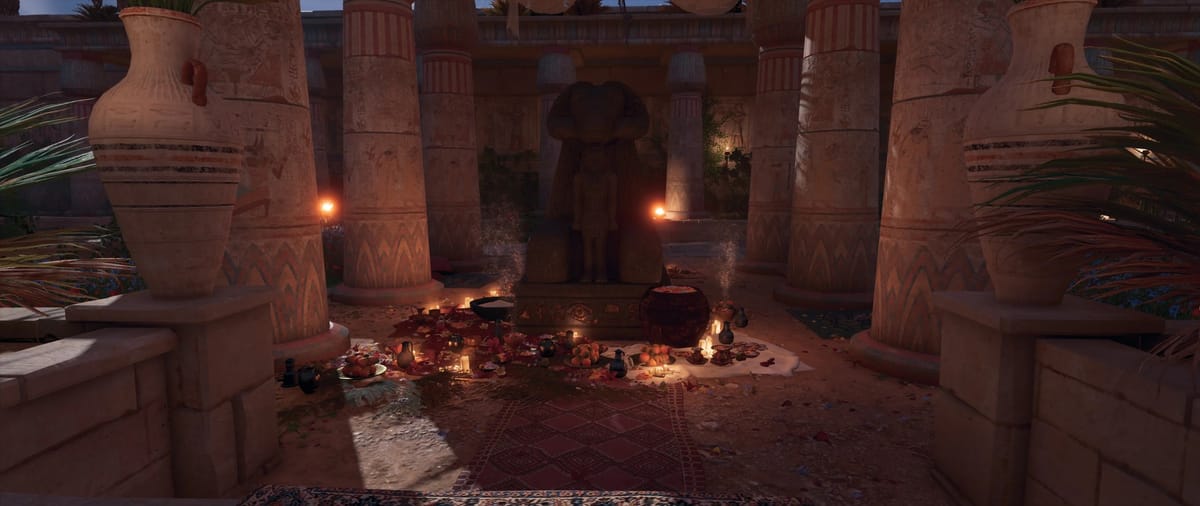
The Curse of the Pharaohs, the expansion Ubisoft added to Assassin’s Creed Origins in March 2018, is the exception, mostly because it had no choice. Its Thebes is dated 34 BCE, when Karnak was not a heritage site but a going concern, so the temple stands with its columns painted, its walls carved and coloured, a ram-headed Amun in the half-dark and offerings heaped at his feet by people frightened of a curse. Then the game does something better than scenery. The side quest “The Theban Triad” opens with a priestess shouting that those offerings have been stolen; Bayek picks up the trail from a broken vase, climbs a column, and comes out on top of the temple, where the thief’s ropes are still tied. The roof is not a distant texture. It holds your weight.
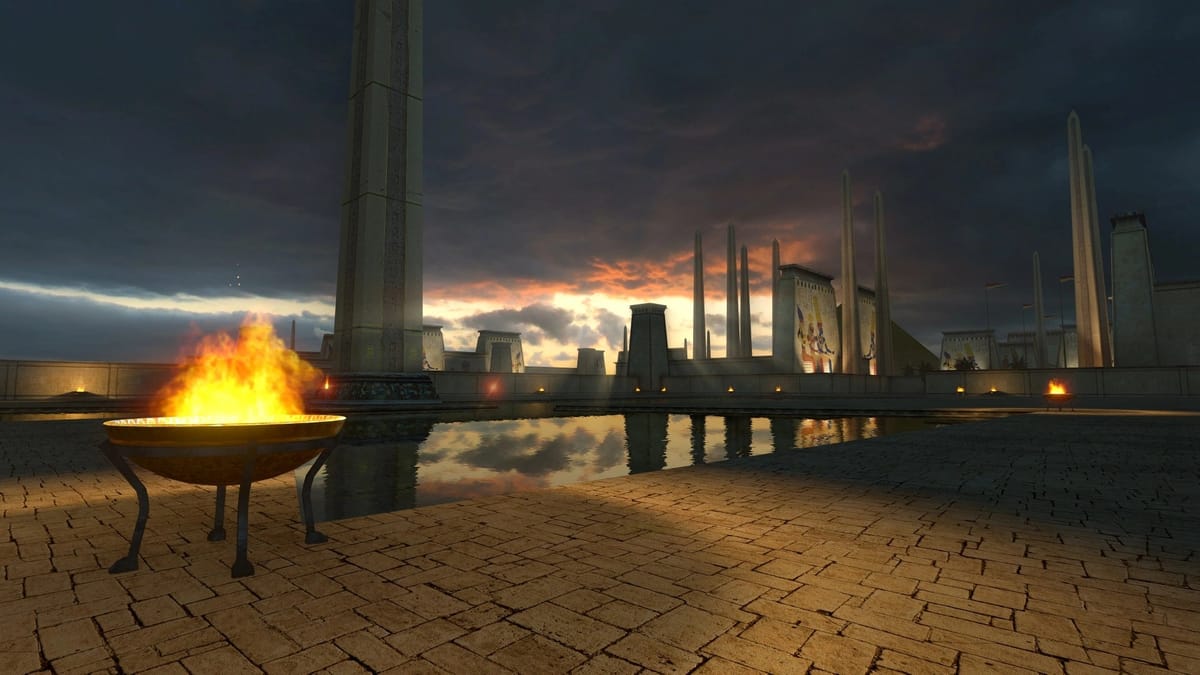
Croteam had got to Karnak seventeen years earlier and drawn the opposite conclusion. The eleventh level of Serious Sam: The First Encounter (2001) is called “Thebes – Karnak”, and it is Karnak as a shooting gallery: courtyards, pylons, obelisks, an ankh pool, columns whose main job is hiding a pair of secret switches, and a par time of seventy minutes spent mostly walking backwards. The logic is sound in its way — you cannot fight several hundred charging enemies inside a roofed forest of stone, because sightlines are the game. The level is stamped 1378 BCE, which puts Sam at Karnak nearly a century before Seti I set the first drum of the hall in place. There is no hypostyle hall here. Strictly speaking, there shouldn’t be.
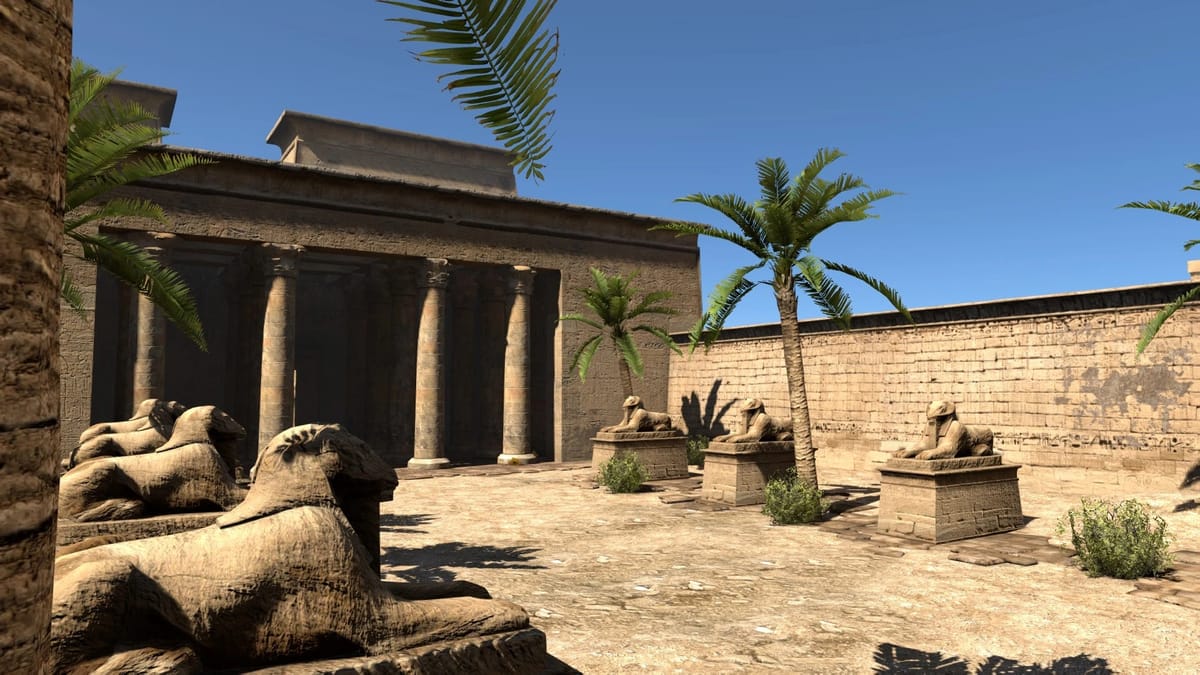
Ten years on, Serious Sam 3: BFE sent him back twice. “Unearthing the Sun” and “The Dark Bride” both play out at Karnak in a fictional May 2113, and this time it is a ruin — the biggest temples and pylons still up, the avenue of ram-headed sphinxes intact, everything open to a bright sky. That is the Karnak of the postcard, relocated ninety years into the future. Total War: Pharaoh (2023) doesn’t render it at all: it calls the place by its Egyptian name, Ipetsut, and sells it as a monument outpost for 100 gold and 500 stone, worth +6 Legitimacy. Four games, roughly three and a half thousand years of in-fiction time between the earliest and the latest, and exactly one of them lets you stand under the ceiling that made the hall worth building — long enough, at least, to walk out onto it.
Read the full study: Great Hypostyle Hall of Karnak
Sources
- Assassin's Creed Wiki — Karnak
- Assassin's Creed Wiki — The Theban Triad
- Wikipedia — Assassin's Creed Origins
- Serious Sam Wiki — Karnak (location)
- Serious Sam Wiki — Karnak (Serious Sam: The First Encounter level)
- Wikipedia — Serious Sam: The First Encounter
- Steam — Serious Sam 3: BFE
- Total War Wiki — Waset Province (Ipetsut Temple Complex)
- Wikipedia — Great Hypostyle Hall