The Mound You Build as Cahokia
Civilization VII hands you the Mississippians, a river tile and the largest earthwork in the Americas — and puts the builders' names on the completion screen.
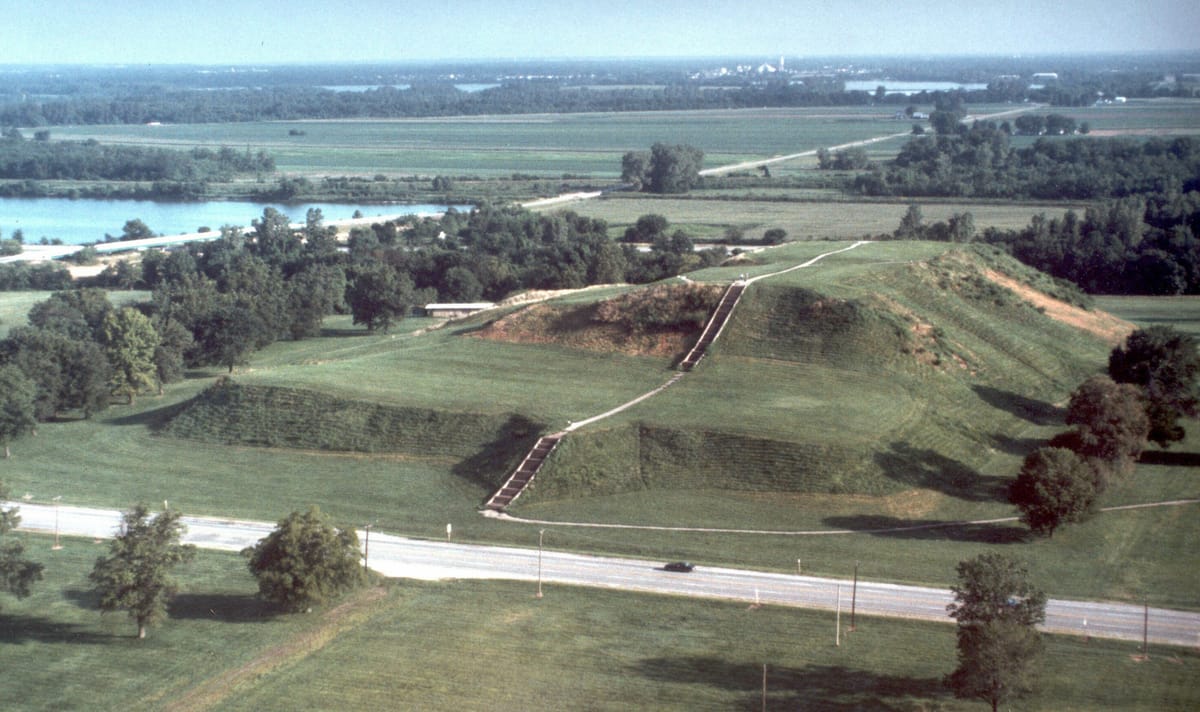
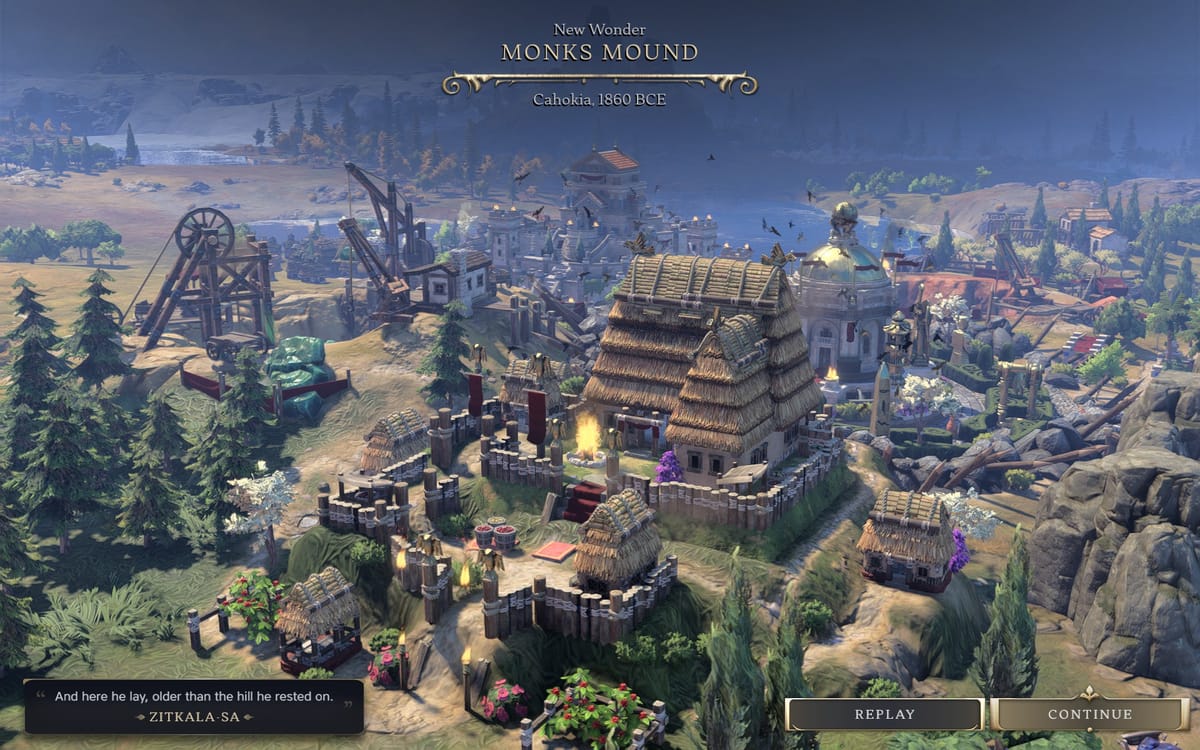
In Civilization VII you can play as the Mississippians, and when you do, the wonder waiting at the end of the Antiquity Age is Monks Mound. The rules are specific in the way this series likes: it has to sit next to a river, it feeds the settlement and expands what that settlement can hold, and your people raise it faster than anyone else’s. Finish it and the game gives you a card — the mound terraced and green, a plaza below it, thatched roofs crowding the slope — with the name of the city stamped underneath. Cahokia.
That is a stranger thing to see on a screen than it sounds. For most of the 19th century, American writers looked at this mound and refused the obvious answer. The earthworks were credited to Vikings, to Phoenicians, to a Lost Tribe of Israel, to a vanished white “race of Mound Builders” that Native Americans had supposedly wiped out — a story that was useful precisely because it made dispossession easier to justify. It took decades of excavation before the myth was abandoned by serious scholars. Civilization VII hands you the builders as a playable civilization, names their city, and closes the wonder screen on a line from Zitkála-Šá, the Yankton Dakota writer and activist who spent her life arguing for Native citizenship and against schools built to erase Native children: “And here he lay, older than the hill he rested on.”
What the game cannot give you is the labor. The real mound holds roughly 22 million cubic feet of earth, dug with stone, wood and shell, carried up in baskets on people’s backs — no wheels, no draft animals, no metal — and layered in deliberately alternating soils so that a 30-meter hill of dirt would drain instead of slump on saturated floodplain ground. It went up in at least a dozen stages, and much of its bulk may have been added in a few extraordinary decades around 1050 CE. In Civ you queue it and wait a number of turns.
Civilization VI had reached for the same city and solved it the opposite way: Cahokia appeared as a city-state, and winning its favor let you plant “Cahokia Mounds” on your tiles like farms — mounds as an agricultural improvement, scattered wherever they fit. VII does the harder, better thing. It makes the mound singular, puts it on a river, and attaches a people to it. The one question neither game can put on a card is the one the site still cannot answer: how a city that could organize all of that, and did, was empty inside three hundred years.
Read the full study: Monks Mound
Sources
- Sid Meier's Civilization VII — official game guide: Mississippian civilization
- Sid Meier's Civilization 7 Wiki — Monks Mound (Antiquity Wonder)
- Civilization Wiki — Cahokia Mounds (Civ6 improvement)
- National Park Service — Zitkála-Šá (Red Bird / Gertrude Simmons Bonnin)
- Ohio History Connection — The Moundbuilder Myth