Rice Terraces of the Philippine Cordilleras
How did the Ifugao sculpt tens of thousands of hectares of self-watering terraces into near-vertical mountainsides using only wood and stone hand tools, and are these rice fields two thousand years old, or barely four hundred?
Why this rating?
- Construction difficulty
- 4/5
- Method uncertainty
- 2/5
- Capability gap
- 2/5
- Open questions
- 4/5
The terracing and gravity-fed irrigation are well understood and still practised today, so the how-it-works is not a mystery; the wonder lies in the sheer hand-built scale on near-vertical slopes and, above all, in a genuinely unresolved scholarly dispute over whether the wet-rice terraces are two millennia old or only about four centuries old.
Overview
The Rice Terraces of the Philippine Cordilleras are not a monument but a mountainside turned inside out: thousands of flooded rice paddies stacked in curving tiers up the near-vertical slopes of the Cordillera range in northern Luzon, the Philippines. They are the work of the Ifugao, an Austronesian highland people who have farmed these mountains for centuries, and they remain a living, working farm — planted, harvested, and repaired every year by the same communities whose ancestors first cut them into the rock and soil. Rising to around 1,500 metres above sea level and watered entirely by gravity from forests kept deliberately intact on the ridgetops above, the terraces are a feat of vernacular engineering carried out with only wooden and stone hand tools and enormous communal labour. In 1995 UNESCO inscribed five clusters of Ifugao terraces as a World Heritage Site — the very first property ever placed on the list in the “cultural landscape” category, a class created to honour places shaped by the long partnership of people and nature rather than by architecture alone. A widely repeated tradition holds that the terraces are around 2,000 years old, and for most of the twentieth century they were celebrated as one of the oldest continuous agricultural landscapes on Earth. That age is now the subject of a sharp and genuinely unresolved archaeological debate.
The Structure
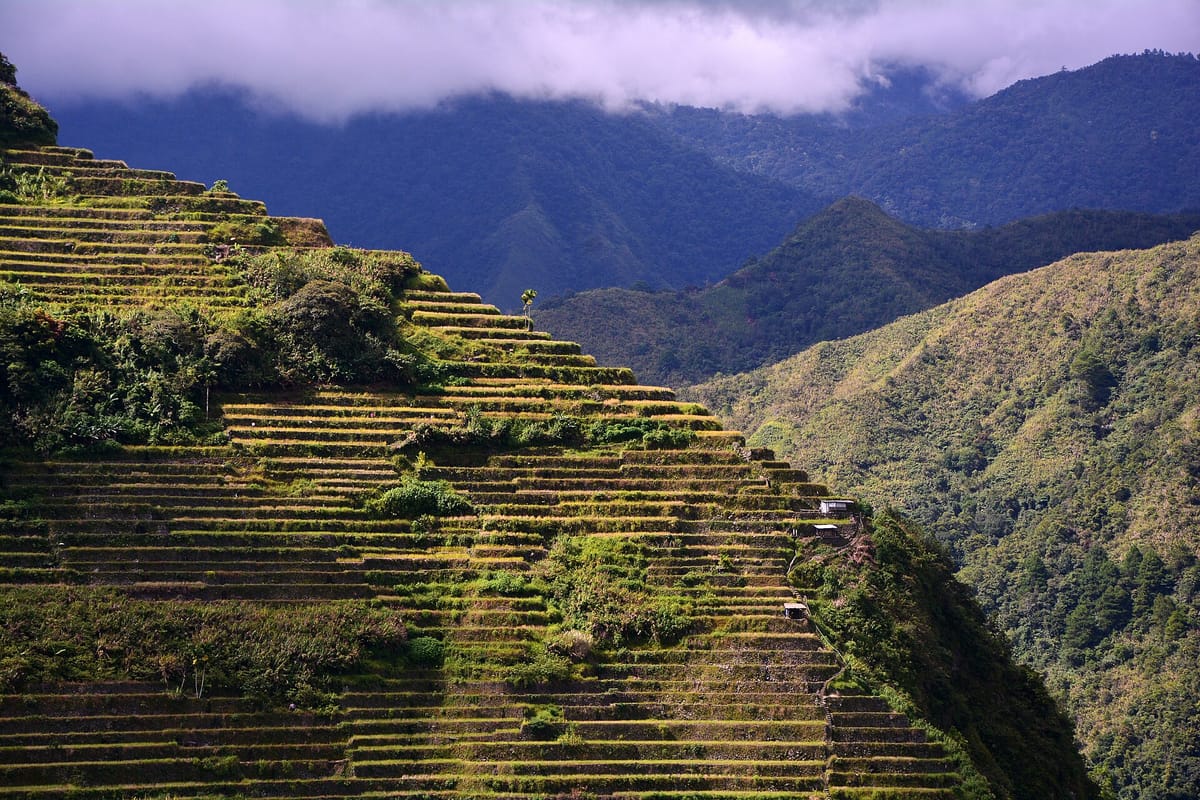
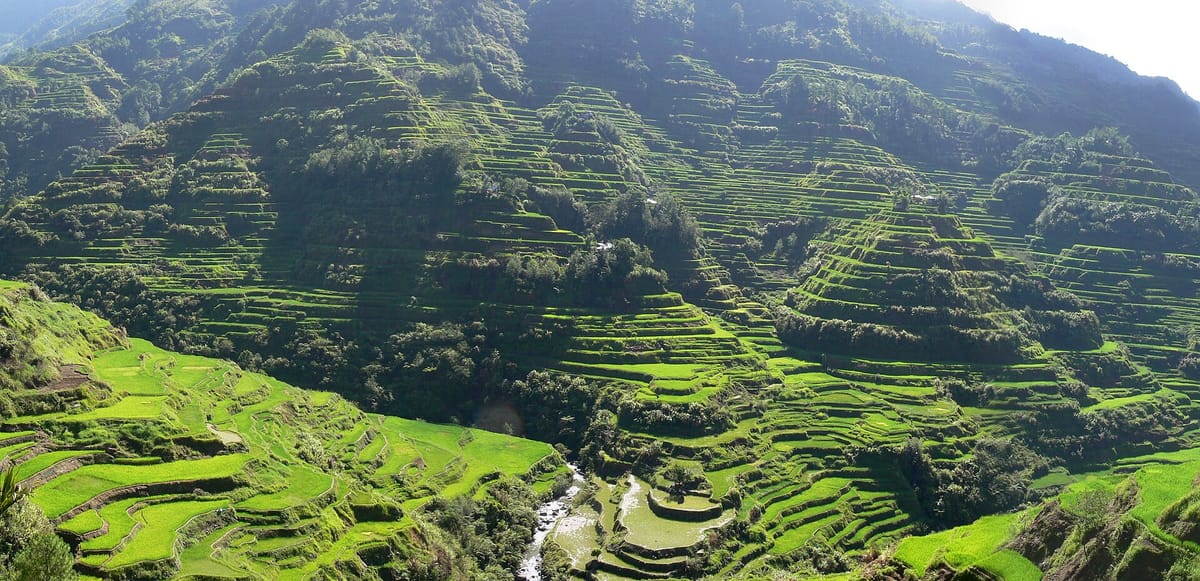
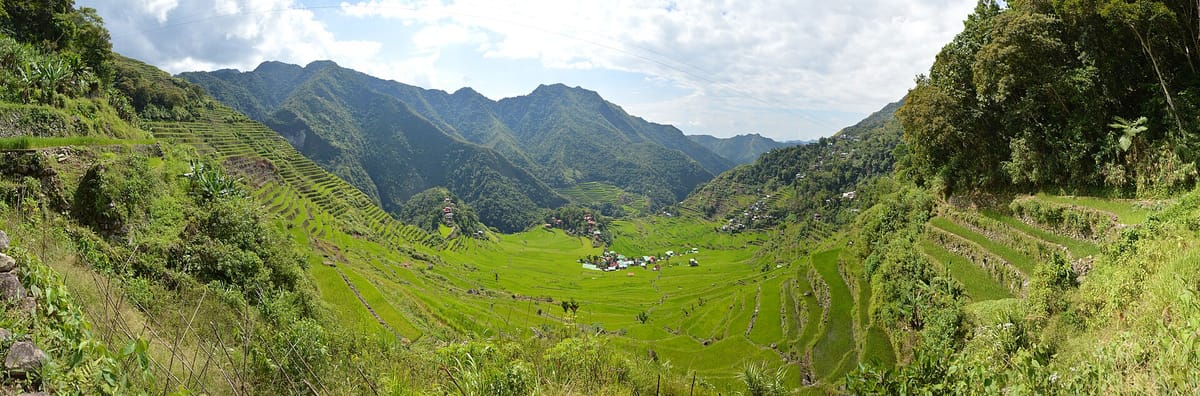
The World Heritage Site (UNESCO reference 722, inscribed at the Committee’s 19th Session in 1995) comprises five distinct terrace clusters, all within Ifugao Province: Batad and Bangaan in the municipality of Banaue, the central cluster of Mayoyao, Hungduan, and Nagacadan in Kiangan. Each has its own character — Nagacadan reads as two ascending rows split by a river; Hungduan fans out like a spider’s web; Mayoyao is dotted with traditional Ifugao houses (bale) and rice granaries (alang); Bangaan cradles a whole village; and Batad is nested in a dramatic, semi-circular amphitheatre with a hamlet at its base. Crucially, the famous Banaue terraces that most tourists photograph are not part of the inscription: despite their fame, the presence of numerous modern structures lowered their integrity under UNESCO’s criteria, so they were left off the list. The inscribed clusters were chosen precisely because they best preserve the traditional, largely unaltered landscape.
The scale is hard to overstate. The Ifugao terrace landscape covers on the order of 20,000 hectares, and a popular claim — repeated for generations, though impossible to measure precisely — holds that if the paddy walls of the wider region were laid end to end they would stretch some 20,000 kilometres, halfway around the globe. The retaining walls are built either of carefully stacked stone or of packed earth (mud walls) faced to hold their shape, forming perfectly level steps on slopes that would otherwise be useless for wet-rice farming. Above each cluster sits the muyong (also pinugo): a privately owned but communally governed cap of rainforest on the ridgetop, home to hundreds of indigenous plant species, which acts as a sponge and reservoir, holding water and releasing it slowly into the fields below. From these forests an intricate web of canals, small dams, and bamboo pipes distributes water down through each tier by gravity alone, keeping the paddies flooded year-round without a single pump.
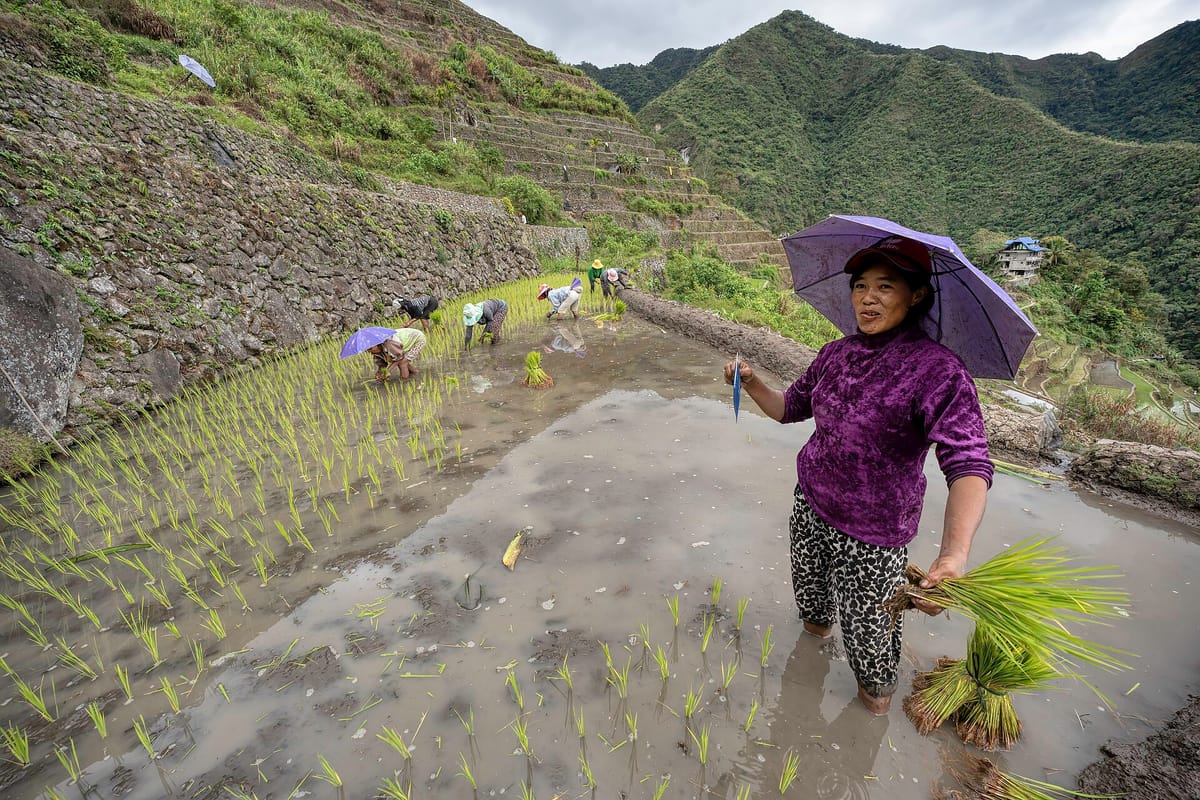
The terraces are also the physical stage of a whole culture. The Hudhud chants of the Ifugao — long narrative songs performed by elder women during the rice-sowing and harvest seasons and at funeral wakes — were proclaimed by UNESCO as a Masterpiece of the Intangible Heritage of Humanity in 2001 and later inscribed on the Intangible Cultural Heritage list. The rice varieties, the ritual calendar, the muyong forestry, and the communal labour that keeps the walls standing are all bound together; the landscape is treated by scholars as a single, integrated system of knowledge. That fragile system has been under strain: rural out-migration, tourism pressure, and the abandonment of some paddies led UNESCO to place the site on its List of World Heritage in Danger in 2001. After a sustained conservation and community-restoration effort, it was removed from the danger list in 2012.
How Was It Built?
The terraces were made entirely by hand, with the simplest of tools — implements of wood and stone, and later iron — plus immense muscle and generations of coordinated communal work. There is no mortar and no machinery in the traditional method. To make a single terrace, builders cut into the slope, moved earth and rock to create a level bench, and raised a retaining wall along its outer edge, either by dry-stacking stone or by building up and compacting an earthen embankment. The paddy floor behind the wall was then puddled with clay so it would hold standing water. Done over and over up a mountainside, this produces the stacked “staircase” that defines the landscape. The American Society of Civil Engineers, which recognises the terraces as a historic civil engineering landmark, describes the result as nothing less than a rearrangement of the Cordillera range “from bedrock to topsoil.”
The genius is less in the walls than in the water. Because the fields must stay flooded, the whole system is an exercise in hydraulic control on steep ground. The Ifugao protect the muyong forest above each terrace field precisely because it regulates the water supply — the trees capture rain and springs and feed a steady, year-round flow. From there, hand-dug canals and hollow bamboo conduits carry water laterally along contours and then let it cascade from one paddy down into the next, each terrace acting as both a field and a link in the irrigation chain. Overflow, silt, and drainage all have to be managed so that a heavy rain does not blow out a wall and take the terraces below it with it. This is why the terraces demand constant repair, extension, and reconstruction: they are less a finished structure than an ongoing act, and a wall left untended for a few seasons will slump and fail. The engineering knowledge is real and sophisticated, but it is vernacular and cumulative — refined field by field across many generations rather than designed at a stroke.
The Mainstream View
Archaeologists, agronomists, and cultural geographers do not regard the terraces as inexplicable. They are read as the outstanding product of an Austronesian farming society applying accumulated local knowledge to an extreme landscape over a long period, using well-attested techniques of terracing, puddled wet-rice cultivation, and gravity irrigation found across upland Southeast Asia. UNESCO frames the site as “an outstanding example of a living cultural landscape” and of a sustainable, harmonious interaction between humans and their environment — the emphasis is on continuity, ecological knowledge, and communal governance, not on any single lost technique. The irrigation, the muyong forestry, and the terrace-building are all things the Ifugao still do, and so the how of the terraces is directly observable rather than reconstructed from ruins.
Where the mainstream is genuinely divided is on the question of age. The long-standing popular and older scholarly view — reflected in the ASCE landmark citation, which dates the terraces to around 100 BCE, and in decades of guidebooks and documentaries — holds that the terraces are roughly two millennia old, making them among the oldest large-scale terrace systems in the world. This “2,000 year” narrative was built largely on ethnographic inference and on the assumption that so vast a landscape must have taken a very long time to create. It became so entrenched that it is woven into national identity and into the way the terraces are marketed to the world.
The Open Case
The heart of the mystery today is not how the Ifugao moved the earth — that is well understood — but when they did it. Beginning in the 2000s, the Ifugao Archaeological Project led by anthropologist Stephen Acabado subjected the “2,000-year-old” story to systematic testing: radiocarbon dating of excavated terrace and settlement layers, archaeobotanical study of what was actually being grown, and ethnohistorical research, much of it carried out in collaboration with Ifugao communities themselves. The results were startling. Excavations at sites such as the Old Kiyyangan Village returned dates suggesting that intensive wet-rice terracing in the region is far younger than believed — on the order of 400 to 500 years old, with key terraces dating to around 1600 CE. Tellingly, the earliest occupation layers yielded no rice at all, implying that the first highland settlers were not the wet-rice farmers of legend and that flooded-paddy agriculture arrived comparatively late.
Acabado’s interpretation reframes the terraces not as a relic of deep antiquity but as an act of resistance. In this reading, the great expansion of wet-rice terracing coincides with the arrival of the Spanish in the Philippine lowlands in the sixteenth century. As colonial pressure, taxation, and conversion advanced, highland Ifugao society may have intensified and reorganised around wet-rice production — concentrating population, wealth, and ritual in the mountains — as a deliberate economic and political response that helped them stay unconquered for centuries. The terraces, on this view, are a monument to defiance built in a few generations, not a slow accretion over two thousand years.
The debate is real and not fully settled. Defenders of a longer chronology point out that dating a constantly rebuilt, actively farmed landscape is intrinsically difficult — walls are repaired and soils are turned over, so a radiocarbon date may record recent maintenance rather than original construction, and different clusters may simply be of different ages. There is also a broader argument about narrative and identity: whether calling the terraces “only” 400 years old diminishes them, or whether — as Acabado argues under the banner “older is not necessarily better” — a story of ingenious, rapid, home-grown resistance to empire is more empowering than an unverified myth of prehistoric antiquity. What is not in dispute is the achievement itself. Whether the fields were carved over two millennia or over four centuries, a highland people with wood and stone tools re-engineered an entire mountain range into a self-watering farm that still feeds and defines them today — and the true measure of that feat, in years, remains an open question.
Sources
- UNESCO World Heritage Centre — Rice Terraces of the Philippine Cordilleras (#722)
- Wikipedia — Rice Terraces of the Philippine Cordilleras
- ASCE — Ifugao Rice Terraces (Historic Civil Engineering Landmark)
- Acabado, S. — The Short History of the Ifugao Rice Terraces: A Local Response to the Spanish Conquest (Journal of Field Archaeology, 2019)
- Acabado & Martin — Older Is Not Necessarily Better: Decolonizing Ifugao History through the Archaeology of the Rice Terraces (Land, 2024)
- Rappler — The Ifugao Rice Terraces are 400 years old. That matters.
- Ifugao Archaeological Project
Connected findings
- Same Staircase, Opposite Plumbing — Ifugao rice farmers and Inca stonemasons carved identical stone staircases into opposite sides of the Pacific — one built to hold water in, the other to force it out.
- ifugao
- philippines
- rice-terraces
- cordilleras
- banaue
- irrigation
- unesco
- luzon
- agriculture
- terracing
- southeast-asia
- cultural-landscape
Gallery