Ha'amonga 'a Maui
On a low coral island with no metal, no wheels, no draft animals and no quarryable hard rock, how did Tongan builders cut three coral-limestone slabs of perhaps thirty to forty tonnes each, stand two of them upright, and then lift the third more than four metres into the air and drop it into mortise slots cut in their tops — and what was the finished gateway actually for?
Why this rating?
- Construction difficulty
- 4/5
- Method uncertainty
- 4/5
- Capability gap
- 3/5
- Open questions
- 5/5
Cutting three coral-limestone slabs of roughly thirty to forty tonnes, standing two of them and then raising the third more than four metres to seat it in mortises is a serious feat without metal, wheels or draft animals, and no excavated ramp, sledge or record of the process survives to confirm how it was done. The builders' capability is not in doubt — Tonga's later royal tombs move comparable slabs — but the monument's purpose is genuinely unresolved, and its date is contested between genealogical tradition and radiocarbon.
Overview
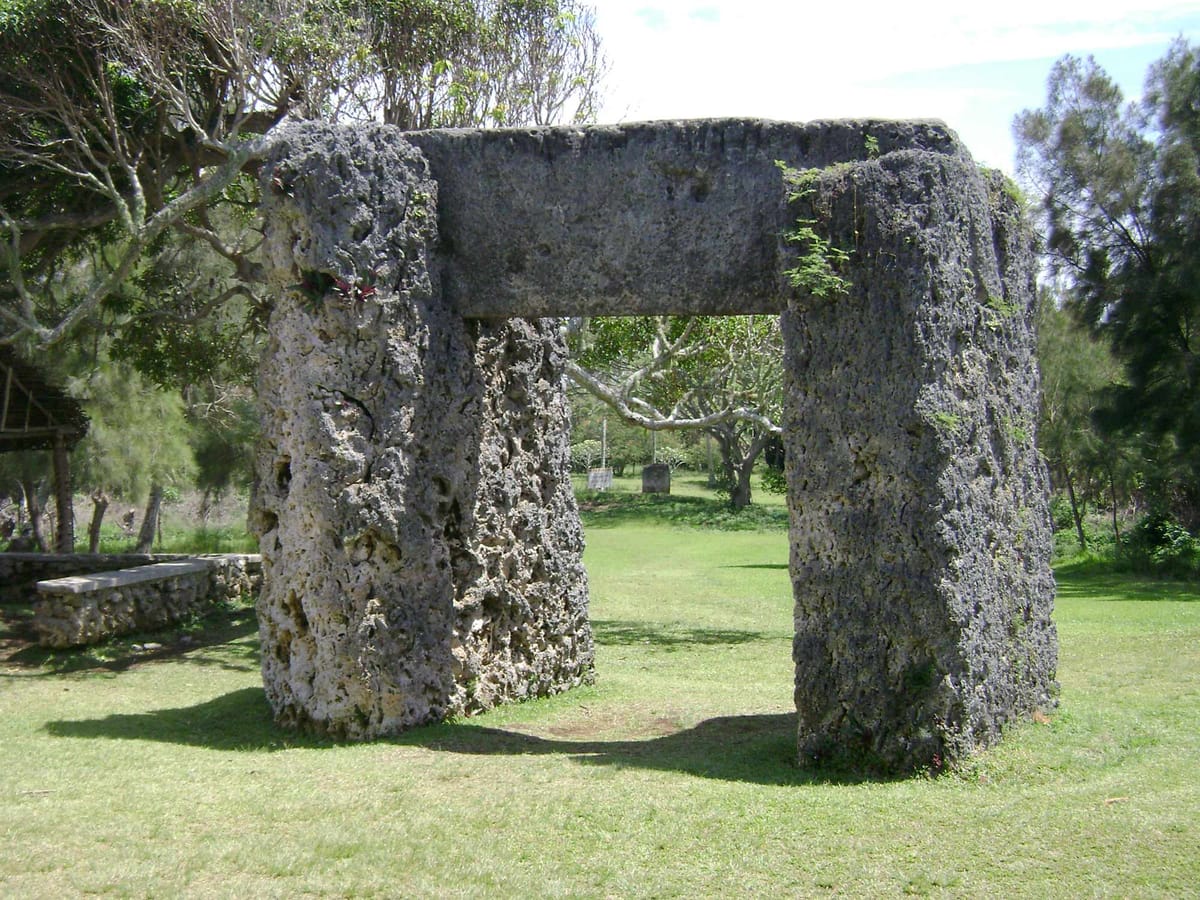
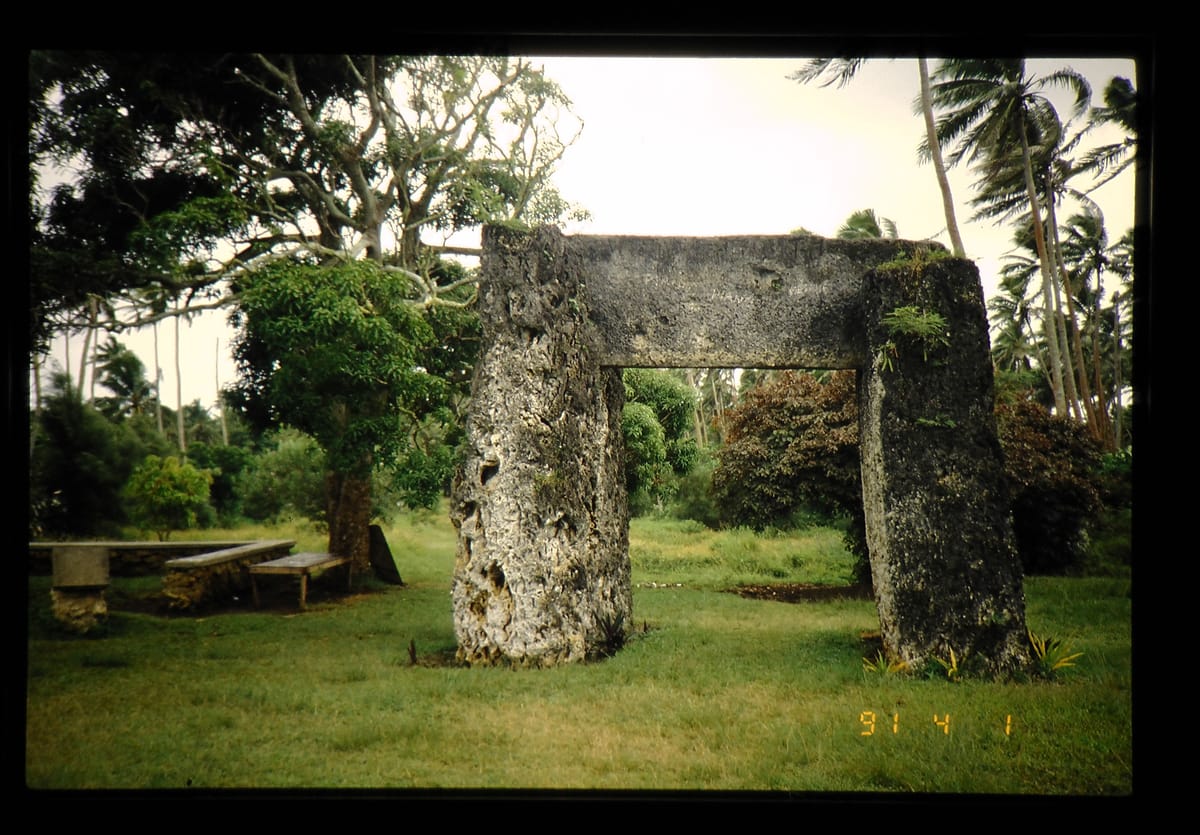
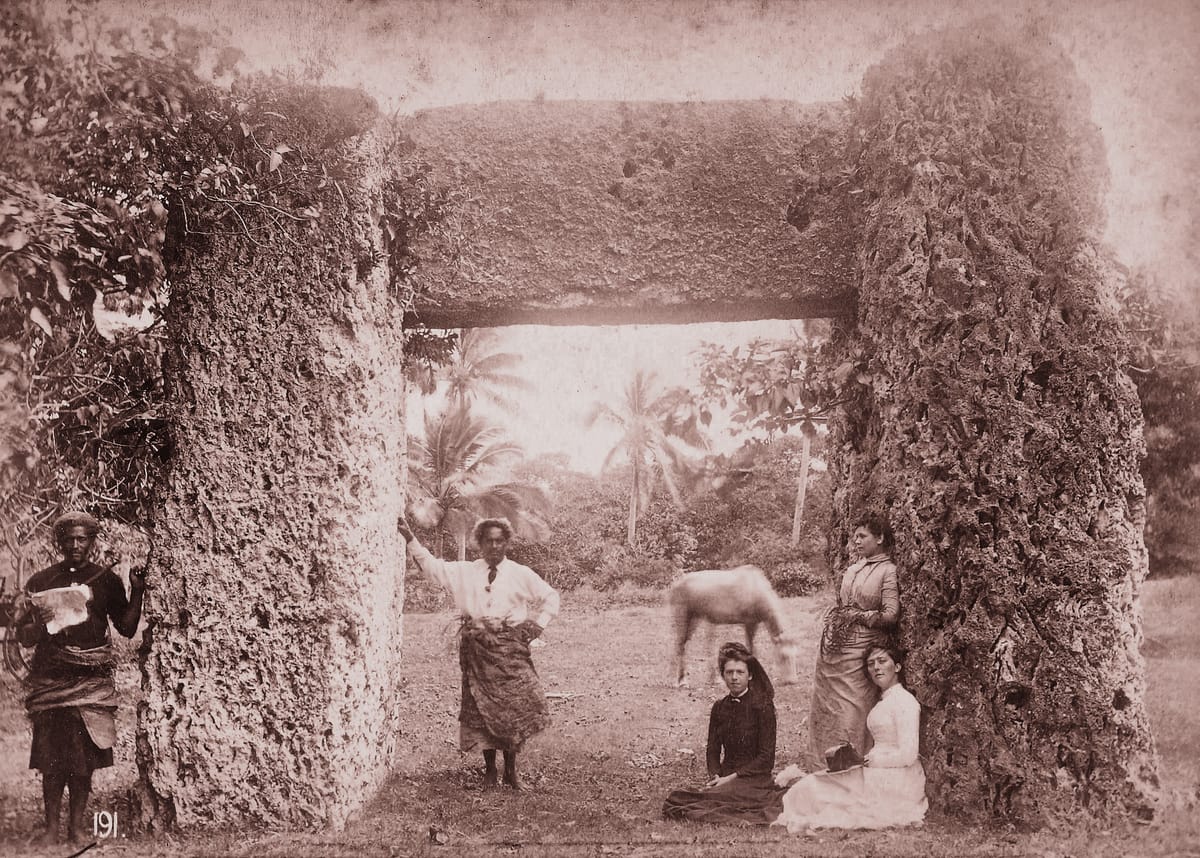
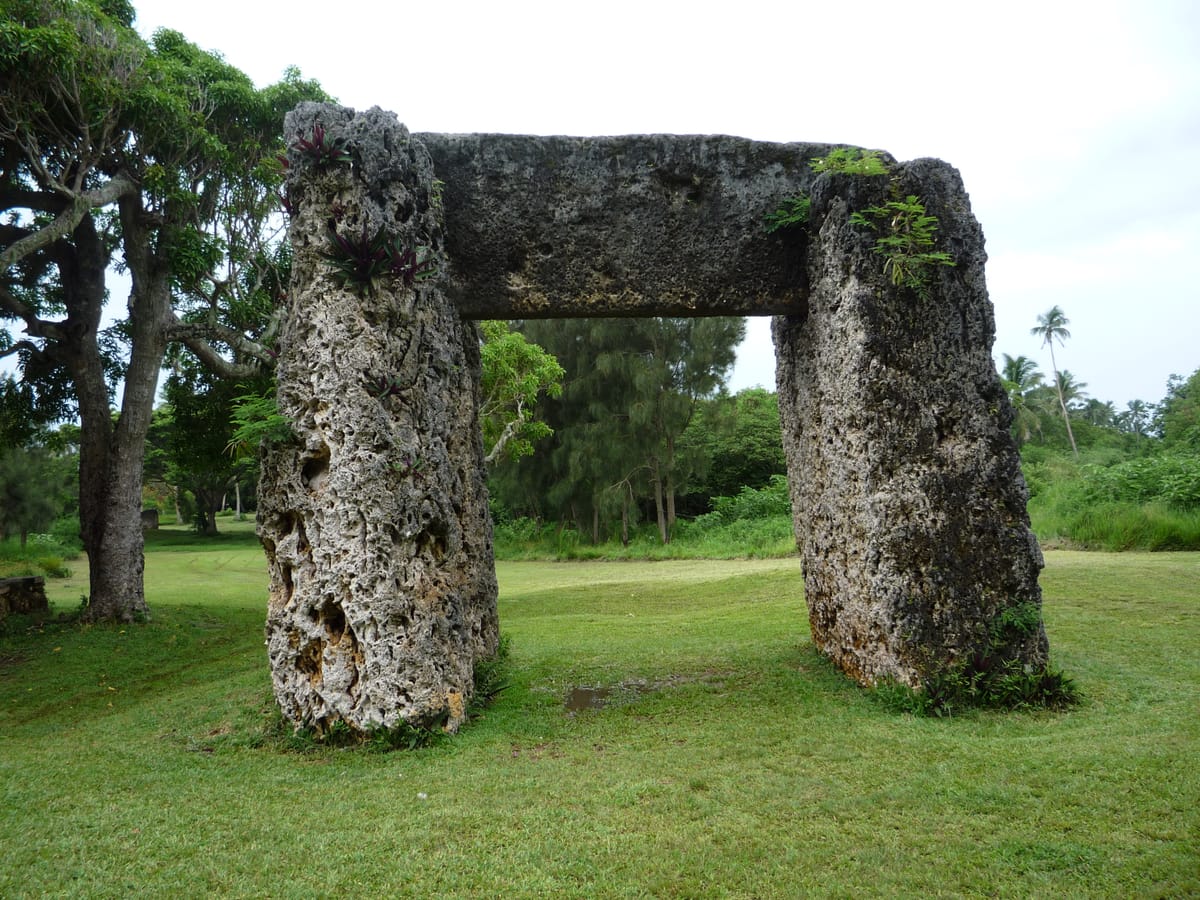
Ha’amonga ’a Maui is a stone trilithon — two upright slabs carrying a horizontal lintel — standing in a grassy clearing at Heketa, on the far northeastern tip of the island of Tongatapu in the Kingdom of Tonga, a short walk from the village of Niutoua. It is built entirely of coral limestone, the raised reef rock that is the only stone a low coral island has to offer, and it is the only structure of its kind anywhere in the Pacific. The whole monument is roughly 5.2 metres high and 5.8 metres across, and each of its three slabs is commonly estimated at somewhere between thirty and forty tonnes. Its name means something like “the burden of Maui”: a ha’amonga is the wooden carrying pole a Tongan slings across the shoulders with a load hanging at each end, and in the oral tradition the demigod Maui carried these stones as if they were nothing. Tongan tradition attributes the real construction to Tu’itatui, the eleventh Tu’i Tonga — the paramount sacred chief of the archipelago — who held his court at Heketa when Heketa was the capital of the rising Tongan chiefdom. It is Tonga’s most famous monument, protected as a historical park since 1972, and part of the group of ancient Tongan capitals that the kingdom has put forward on UNESCO’s Tentative List. The inevitable nickname, “the Stonehenge of the Pacific,” is unhelpful about almost everything except one detail: like Stonehenge, this lintel is not resting on flat tops. It is sitting inside slots cut into them.
The Structure
The two uprights are not matched twins. The western slab stands about 5.2 metres above ground and the eastern about 4.7 metres; both are roughly 1.4 metres thick, around 4.1 to 4.3 metres wide at the base and taper slightly towards the top, and they stand about 3.8 metres apart. Both are set at least 0.6 metres into the ground and probably reach down to the limestone bedrock. The lintel laid across them is about 5.8 metres long, 1.4 metres wide and 0.6 metres thick, and it is the most carefully finished piece in the monument — squared and dressed where the uprights are left rough. The surface of all three is the deeply pitted, cavernous, almost sponge-like texture of weathered raised coral limestone, which is what makes photographs of the site look, at a glance, as though the stones are made of fossil sponge. They are: this is ancient reef, lifted above sea level by tectonic uplift and then cut out of the ground.
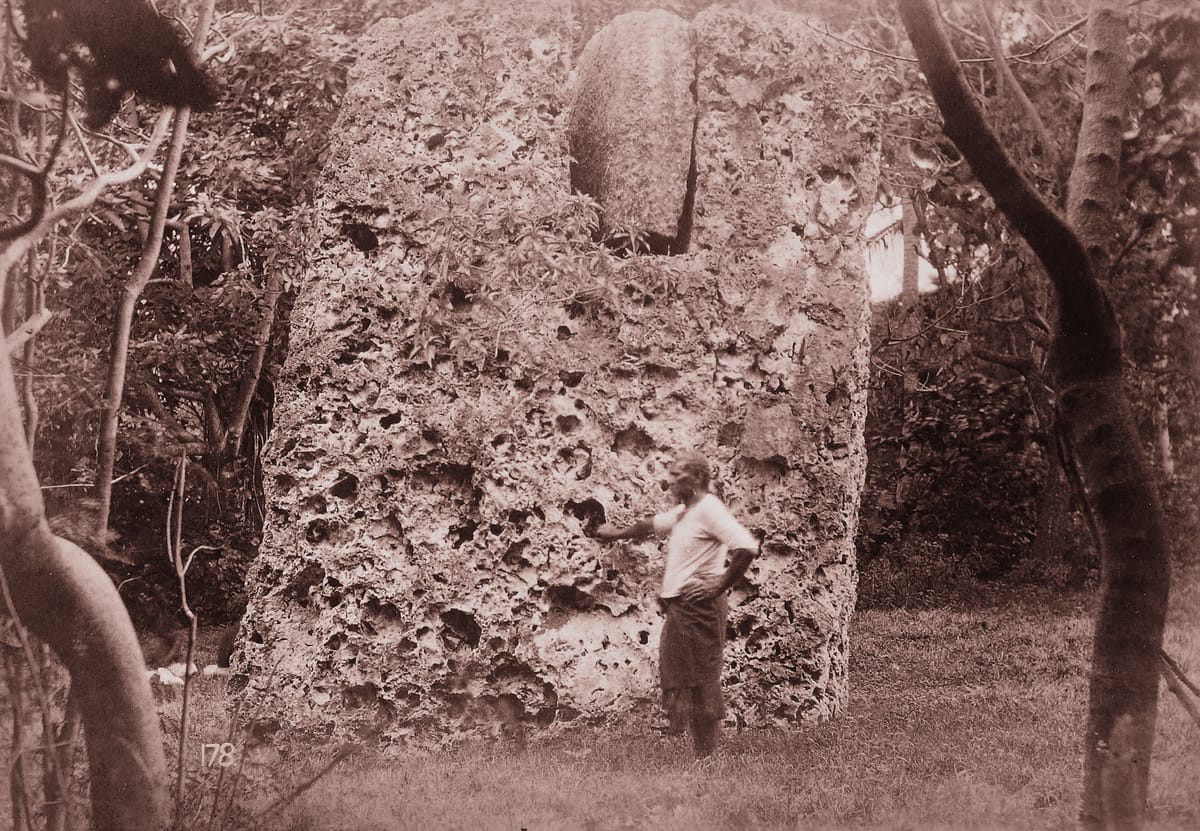
The trilithon does not stand alone. Heketa was a built ceremonial landscape, and recent fieldwork there has recorded stone-faced platforms for houses and for seats, and a three-tiered stone-faced tomb — the Langi Heketa, ancestor of the great royal langi tombs later built at Lapaha. About a hundred metres from the trilithon stands the ’esi maka fa’akinanga, “the stone to lean against”: a single upright slab with a worn hollow on its face said to fit a head, shoulders and back. Tradition holds that Tu’itatui — whose name is usually glossed as “the king who strikes the knee,” from his habit of rapping the knees of anyone who came too close — sat with his back to it so that no assassin could reach him from behind. Taken together these structures mark the setting of the new ceremonies the emergent Tu’i Tonga lineage instituted: the drinking of kava and the presentation of first fruits to the paramount chief, the rituals that turned a chiefdom into a maritime state whose influence eventually reached across the central Pacific. Heketa’s time as capital ended when the Tu’i Tonga seat moved west to Lapaha on the sheltered Fanga ’Uta lagoon, where the dynasty’s monumental energy went into a sequence of vast stepped royal tombs instead — and where a single beach-rock slab in one tomb has been measured at 9.9 metres long with an estimated weight of about fifty tonnes, comparable to the largest stones at Stonehenge.
How Was It Built?
Everything about Ha’amonga ’a Maui had to be done with wood, fibre, stone tools and people. Tonga in the second millennium CE had no metal, no wheel, no draft animals and no pulleys, and an estimated late-prehistoric population across the whole 169-island kingdom of only thirty to forty thousand.
The material, at least, was local. Researchers agree the coral limestone of the trilithon came from the nearby coast — most accounts put the source only a few hundred metres away — and that the slabs were carved on site rather than hauled across the island. That matters enormously, because raised coral limestone has a useful property: freshly cut, below the weathered crust, it is comparatively soft and workable, and it hardens on exposure to the air over years. A stone-tool technology that could never have touched granite can cut this. Tongan quarrying of beach rock and reef limestone elsewhere in the archipelago is well documented — the material is described in the archaeological literature as easily quarried — and the usual reconstruction here involves levering slabs free along natural bedding planes and joints with wooden wedges and stone tools, then dressing them to shape.
Moving and raising them is the harder part, and here the reconstruction is genuinely inferential: timber sledges or rollers, coconut-fibre rope, earthen ramps and timber cribbing, and a great many coordinated people. The uprights would have been dragged to prepared foundation trenches and levered upright, packed at the base to hold them plumb. The lintel is the real problem. It had to be raised more than four metres and then placed — not slid onto flat surfaces but lowered into deep mortise slots cut into the tops of both uprights, so that its upper edge finishes flush with them. The standard explanation is an earthen ramp or a timber crib built up alongside the standing uprights, with the lintel walked up it on rollers and eased across. Notably, the mortises are cut several inches wider than the lintel itself, which is usually read as a deliberate tolerance: a snug slot would have split the upright if the fit was imperfect, or if the stones ever shifted. Whoever cut them was thinking about failure modes. Once seated, nothing holds the lintel but gravity, and it has held for something on the order of six to eight centuries on an island that gets cyclones and earthquakes.
The Mainstream View
There is no scholarly doubt that Ha’amonga ’a Maui is a Tongan monument, built by Tongans, out of Tongan stone, for Tongan political and ceremonial purposes. Archaeology and oral tradition agree on the attribution to the Tu’i Tonga lineage at Heketa, and modern survey and landscape archaeology treat the trilithon as the first monumental stone construction built in Tonga — the opening move in a tradition of megalithic building that runs on through the langi tombs of Lapaha. Its function in that reading is political architecture: an enormous, permanent, visually unmistakable statement that the Tu’i Tonga commanded labour on a scale no rival could match. The ability to quarry, shape, move and erect forty-tonne slabs is the message.
The chronology is where the mainstream view diverges from the popular one. Genealogical tradition places Tu’itatui, the eleventh Tu’i Tonga, somewhere around 1100-1200 CE, and guidebooks accordingly date the trilithon to “about 1200.” Radiocarbon dating tells a later story: three marine samples taken beside the western upright by Clark and Reepmeyer returned ages placing construction of the monument between roughly 1320 and 1460 CE, and the broader stone architecture at Heketa dates to around 1320-1390 CE — the fourteenth century, not the early thirteenth. That puts the trilithon’s raising close to the end of Heketa’s life as a capital, shortly before the Tu’i Tonga seat shifted to Lapaha in the mid-fifteenth century. Tongan oral genealogy is a serious historical source, but like most oral king-lists it can telescope or shift generations; the dates in stone are the ones archaeologists now work from, while keeping the traditional attribution to Tu’itatui as plausible in substance if not in exact century.
The Open Case
What remains unresolved about Ha’amonga ’a Maui is not who made it but what it was for — and that question has never been settled. Three explanations compete. One is architectural: it was a gateway, the formal entrance to the royal compound at Heketa, a threshold you passed through to approach the Tu’i Tonga. One is commemorative: the two uprights are Tu’itatui’s two sons, Lafa and Talaiha’apepe, and the lintel is the bond between them — a father’s stone plea for his heirs not to quarrel. And one is astronomical. In May 1967 King Taufa’ahau Tupou IV, an amateur astronomer, proposed that marks on the top of the lintel — including a shallow V-shaped notch — sight the sunrise at the solstices and the equinox, making the monument a solar calendar for the agricultural year. The idea was popular and has been championed since, notably by the Tongan historian Tevita Fale. It has also been picked apart: the V-mark is only about 10 centimetres long, which the astronomer C. F. Velt argued is far too small to work as a reliable directional sight over that distance, and critics note that the alignment tradition itself is not ancient — it dates from 1967, with no Tongan record before that of the stones being used to read the sun. Alignment with a solstice sunrise is arguably plausible; deliberate design for it is not demonstrated.
The physical how has an open edge too. The quarry source is agreed in general terms but the extraction site has not been comprehensively excavated and published, no ramp, sledge, trackway or timber crib has been recovered archaeologically, and the weight estimates that everyone repeats — “thirty to forty tonnes” — are estimates from measured dimensions and assumed rock density, not weighings. How many people it took, how long it took, how the lintel was actually walked up and dropped into those slots without shattering a coral-limestone upright: all of it is reconstructed from the stones themselves and from comparison with other Pacific and Polynesian building traditions, not from any record of the work. Even the date is contested between two kinds of evidence that disagree by a century or more.
None of this is mysterious in the sense of being beyond people. Tonga was a stratified maritime chiefdom with the authority to command labour, and it went on to move heavier stones than these at Lapaha. What is genuinely arresting is the confidence of the thing — the decision, on a small, flat, stoneless-looking coral island, to cut three enormous slabs out of a fossil reef and assemble them into a form nobody else in the Pacific ever attempted, held together by nothing but the fit of a notch and the weight of the stone in it. Somebody stood at the base of two upright slabs, looked up four metres at an empty gap, and knew how to close it. We can still see exactly what they did. We are still guessing how, and why.
Sources
- Wikipedia — Ha'amonga 'a Maui
- World History Commons — Ha'amonga 'a Maui in Tonga
- Clark & Reepmeyer, 'Stone architecture, monumentality and the rise of the early Tongan chiefdom', Antiquity 88 (2014)
- Clark, Burley & Murray, 'Monumentality and the development of the Tongan maritime chiefdom', Antiquity 82 (2008)
- Frontiers in Earth Science — Bridging Legends and Science: Field Evidence of a Large Tsunami that Affected the Kingdom of Tonga in the 15th Century
- UNESCO World Heritage Centre — The Ancient Capitals of the Kingdom of Tonga (Tentative List)
- Wondermondo — Ha'amonga 'a Maui (Trilithon) and 'esi Maka Fa'akinanga
- Wikipedia — Monuments of Tonga
- megalithic-architecture
- trilithon
- oceania
- polynesia
- tonga
- tongatapu
- coral-limestone
- tui-tonga
- archaeoastronomy
Gallery