The Great Pyramid of Cholula
How does the largest monument ever built by anyone — four and a half million cubic metres of hand-made mud brick — end up so completely forgotten that the Spanish put a church on top of it thinking it was a hill?
Why this rating?
- Construction difficulty
- 4/5
- Method uncertainty
- 2/5
- Capability gap
- 2/5
- Open questions
- 4/5
The technique is humble and completely understood — sun-dried adobe, laid by hand — but the quantity is not: roughly 4.45 million cubic metres, sustained across some 1,200 years and at least six rebuilds, which is an organisational achievement far more than a technical one. What stays open is almost everything historical: only three of the stages have been studied in depth, the sequence of cultures responsible is partly inferred, the reason the city and its monument were abandoned in the late first millennium is unknown, and a colonial church on the summit means the structure can never be fully excavated.
Overview
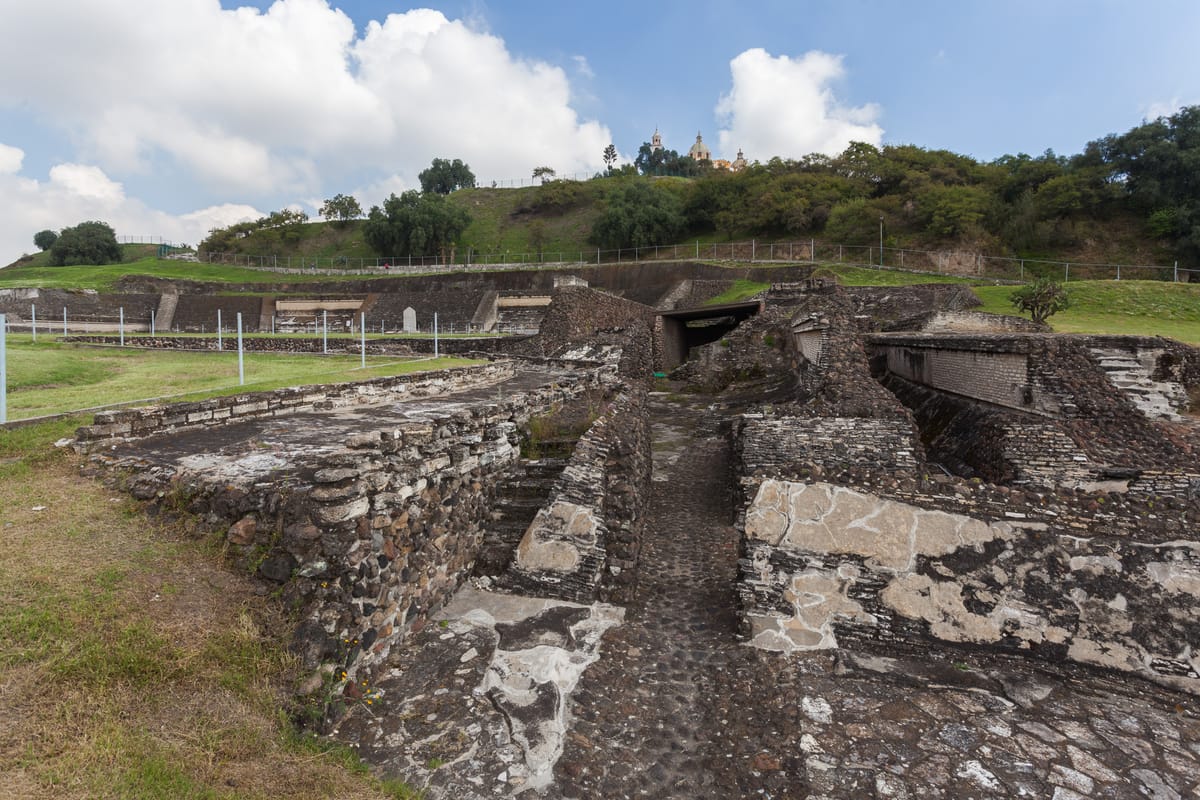
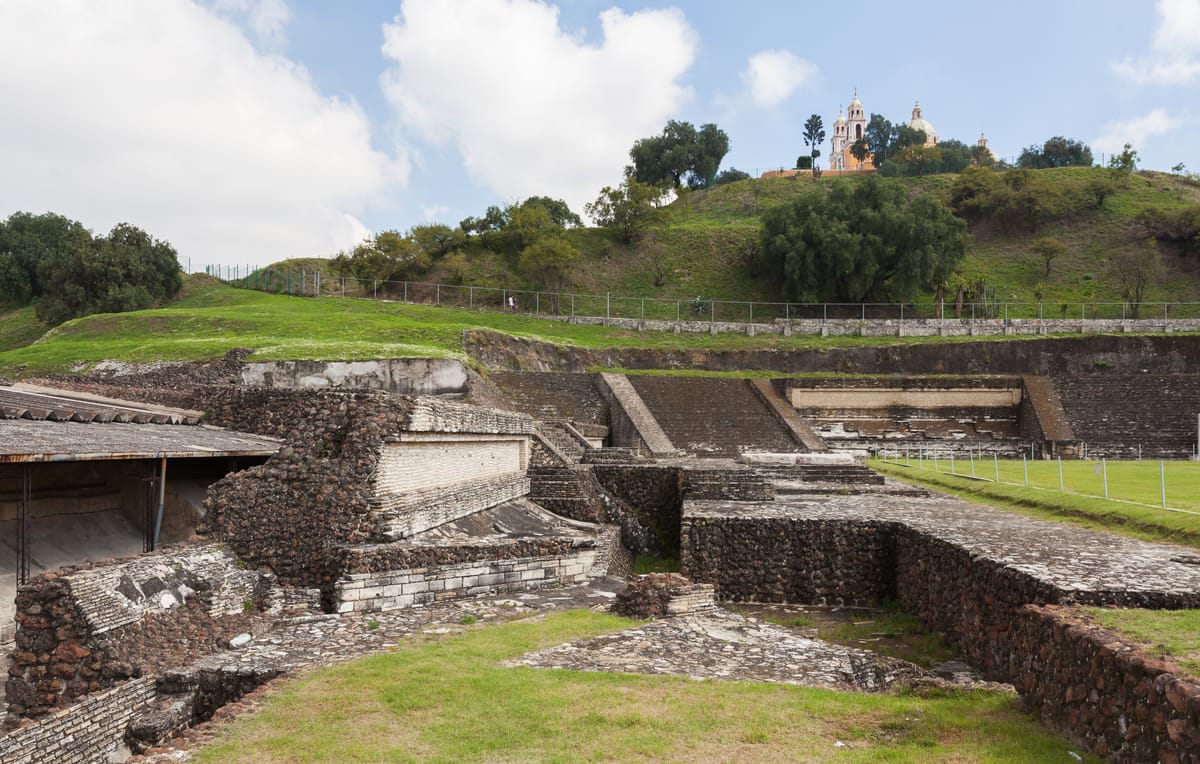
Twelve kilometres west of the city of Puebla, in central Mexico, there is a wooded hill with a yellow-domed church on top. The church is Nuestra Señora de los Remedios, built in 1594. The hill is not a hill.
It is the Great Pyramid of Cholula — Tlachihualtepetl in Nahuatl, “the hand-made mountain” — and by volume it is the largest monument ever constructed anywhere on Earth. Its base measures 300 by 315 metres, covering about 94,500 square metres, and its estimated volume exceeds 4.45 million cubic metres. The Great Pyramid of Giza, which is far taller, contains roughly 2.5 million.
Cholula’s pyramid is not tall. It stands about 25 metres above the surrounding plain. It is simply enormous in every other direction, and it is made of mud.
The Structure
The pyramid is built of adobe: sun-dried bricks of mud and straw, laid by hand, with rock and stucco used for facing in the later phases. Estimates of the brick count run to the order of a hundred million.
It is not one building but at least six, stacked. Mesoamerican practice was to bury an old temple inside a new and larger one, and Cholula did this for something like twelve centuries:
- Building A, called La Conejera, around 200-300 BCE — an early adobe structure raised around an earth mound with a stone core, predating Teotihuacan.
- Building B, the Pyramid of the Painted Skulls, 200-350 CE.
- Building C, the Pyramid of Nine Stories, 350-450 CE.
- Further phases through the 9th century CE.
Only three of these stages have been studied in any depth. The architectural style of the Classic phases shows strong Teotihuacan influence, and different segments were built by different peoples in different centuries — this is a monument with no single author.
Painted decoration survives in places. The most famous is the Bebedores — “the Drinkers” — a mural found in 1969 at a depth of 7.6 metres and running 57 metres long, showing a feast: 110 figures arranged in pairs, separated by 168 vessels, drinking what is most likely pulque.
More than 400 human burials have been excavated at the site, most of them Postclassic. That matters, because it shows the pyramid kept its religious significance for centuries after it stopped being built on and maintained.
At some point in the second half of the first millennium CE the population of Cholula dropped sharply and the pyramid was largely abandoned as an active temple — the reasons are not known. It was never restored. Neither the Toltec-Chichimeca nor, later, the Aztecs rebuilt it. Vegetation took the mud. By 1519 it read as a hill, and the Spanish, who built a church on it, appear not to have understood what they were standing on.
How Was It Built?
There is no technical mystery in an adobe brick. Mud, straw, a mould, sunshine. It is the most widely used building material in human history and the least glamorous.
What Cholula demonstrates is what happens when that material meets unbroken institutional patience. Each construction phase enclosed the one before it, so the pyramid grew by accretion the way a tree grows rings. Every generation that added a layer was working on a structure begun by people they never met, to a plan nobody alive had authored, and their work was in turn buried by successors they would never meet. That incremental growth is precisely how the pyramid became so vast: not one heroic campaign, but a thousand-year habit.
Adobe imposes its own geometry. Mud brick is weak in compression compared with cut stone and it does not tolerate concentrated loads, which is why Cholula spreads instead of soaring. To get more monument you cannot go much higher — you go wider. The result is a structure with the footprint of a small town and the height of an eight-storey building.
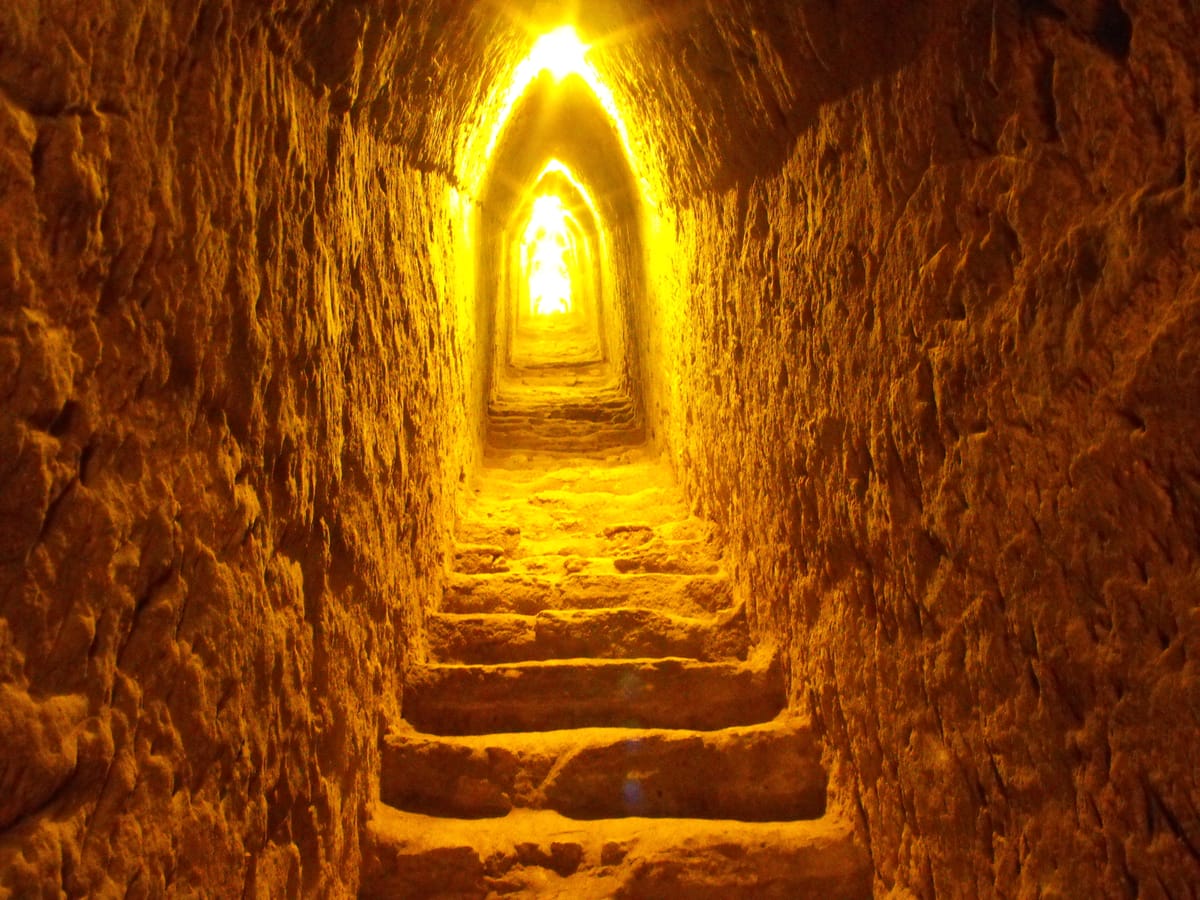
The archaeology has had to be done sideways. Because the 16th-century church is a protected monument in its own right, the pyramid cannot be dismantled or excavated from above. Instead, from 1931, the architect and archaeologist Ignacio Marquina began driving exploratory tunnels into it — two initial bores running north-south and east-west through the centre, then following the contours of the buried stages as they were found. By 1954 roughly 8 kilometres of tunnel had been cut. About 800 metres are open to the public today.
That is an unusual way to know a building: not by seeing it, but by walking through the negative space of it, in a corridor, reading the outer surfaces of older pyramids as walls.
The Mainstream View
Nothing about Cholula is disputed in outline. It is a Mesoamerican temple platform of entirely conventional type, built with entirely conventional materials, that simply kept being enlarged for longer than almost anywhere else. Its size is a consequence of duration and continuity of cult, not of unusual engineering.
Its “disappearance” is likewise well explained. Adobe under Mexican rainfall, left unmaintained for six or seven centuries, weathers into a soil-covered mound; vegetation colonises it; the profile softens. A pyramid is only a pyramid as long as someone keeps re-facing it. Cholula stopped being maintained, and so it stopped looking like architecture.
The church on top is not, in the usual telling, an act of concealment. Building Christian churches on indigenous sacred sites was standard colonial practice throughout Mexico, and Cholula’s hill was plainly a sacred place even if its artificiality was not recognised. The irony is that the church has protected the pyramid: because Nuestra Señora de los Remedios sits on the summit, the monument beneath it has never been stripped, reconstructed, or turned into a restored showpiece.
The Open Case
The unresolved questions at Cholula are historical rather than technical, and there are a lot of them — largely because so little of the structure has been examined.
Only three of the six-plus building stages have been studied in depth. Everything else is known from tunnel sections: a facade here, a stair there, dated by what was found against it. The full sequence of who built which phase, in a valley where influence passed between local peoples, Teotihuacan, and later arrivals, is partly reconstruction. A monument this size ought to be one of the best-understood buildings in the Americas. It is not, because you cannot see it.
The abandonment is genuinely unexplained. Somewhere in the second half of the first millennium CE, Cholula’s population fell sharply and work on the pyramid stopped. The site kept receiving burials for centuries afterwards, so it was not forgotten or desacralised — people were still bringing their dead there. But nobody re-faced it, and no later power, including the Aztec empire that dominated the region, chose to. Why the largest structure in Mesoamerica was allowed to turn into a hill while remaining holy is not answered.
And the volume figure carries the usual caveat of a mound that has never been fully sectioned. The 4.45 million cubic metres is an estimate derived from the pyramid’s external dimensions and what the tunnels reveal of its internal stages, not from a full survey of built material.
What is beyond argument is the shape of the achievement, and it is a peculiarly humble one. There are no precision-cut megaliths at Cholula, no astronomical impossibilities, no lost technique. There is mud, sunshine, and roughly twelve hundred years of people who kept going. It produced the largest thing anyone has ever built — and then, left alone for a few centuries, it turned quietly back into landscape, which is arguably the strangest fate available to the biggest monument on Earth.
Sources
Gallery