Gate of the Sun and Kalasasaya, Tiwanaku
How did the Tiwanaku, working at nearly 3,850 metres without iron tools, carve the Gate of the Sun and its intricate Sun/Staff God frieze from a single ten-tonne block of andesite, and lay out the cardinal-aligned Kalasasaya so precisely that the equinox sun still rises through its eastern gateway?
Why this rating?
- Construction difficulty
- 4/5
- Method uncertainty
- 3/5
- Capability gap
- 3/5
- Open questions
- 4/5
Carving a ten-tonne gateway and its fine, deeply undercut relief from a single block of andesite — one of the hardest stones the Tiwanaku worked — without iron tools, and laying out a cardinal-aligned enclosure whose doorway still tracks the equinox sun, is a serious feat of stoneworking and observation. The general Andean toolkit of stone hammers, abrasion, ropes and organized labor is well attested, so the method is broadly understood; what stays genuinely open is the gate's original position, whether its frieze encodes a working calendar, and the precise meaning of its imagery.
Overview
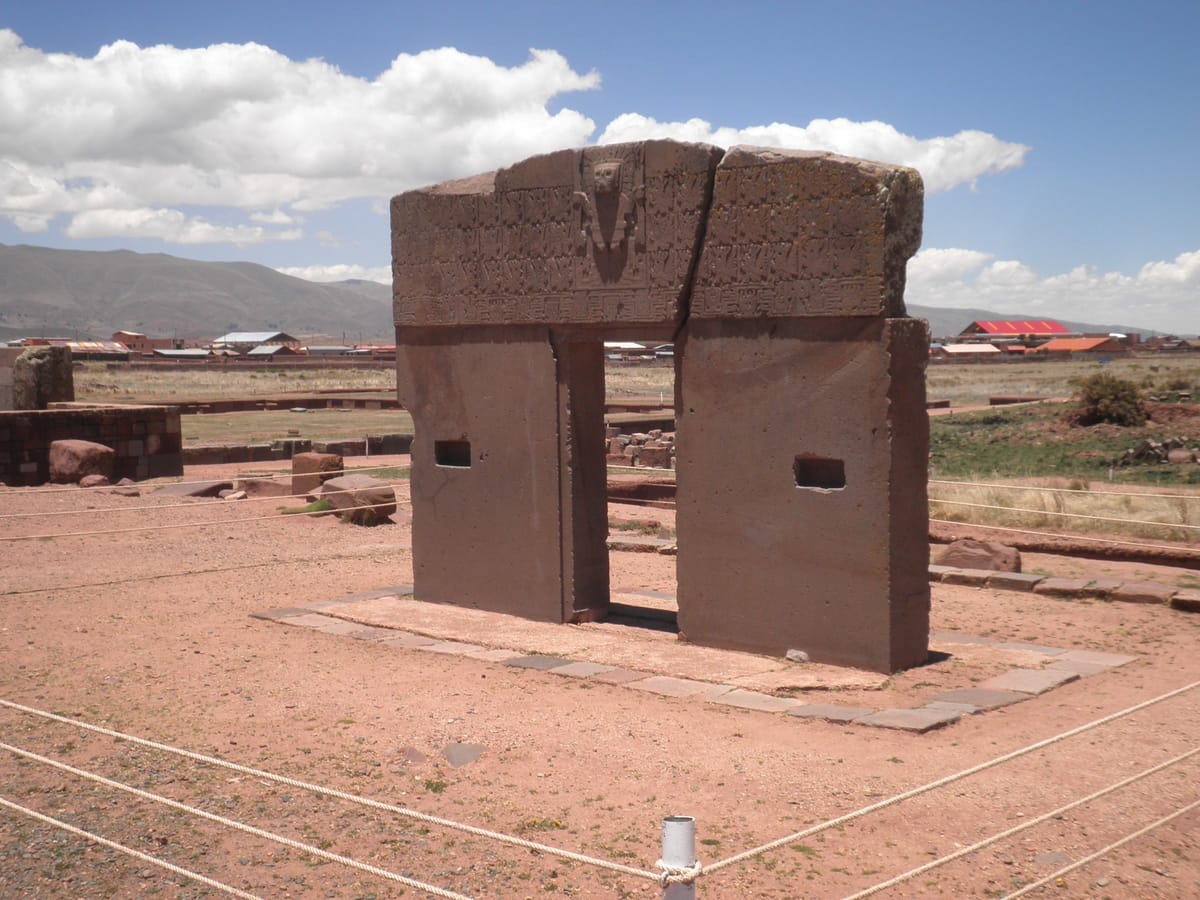
The Gate of the Sun, or Puerta del Sol, is a monolithic stone gateway carved from a single block of andesite on the high plain of western Bolivia, at the ruins of Tiwanaku near the southern shore of Lake Titicaca, roughly 3,850 metres above sea level and about 70 kilometres west of La Paz. It stands roughly 2.8 to 3 metres tall and about 3.8 to 4 metres wide, weighs an estimated ten tonnes, and is best known for the elaborate frieze carved across the top of its eastern face: a central, front-facing figure with a rayed head — usually called the “Sun God” or, in the wider Andean literature, the “Staff God” — holding a staff in each hand and flanked by three rows of smaller winged attendants who all turn to face him. The gate is the single most famous object at Tiwanaku, the ceremonial capital of a pre-Inca civilization that dominated the southern Andes during its apogee between roughly 500 and 1000 CE. It sits today in the northwest corner of the Kalasasaya, a large rectangular walled platform aligned to the cardinal directions, whose eastern doorway, sunken courtyard, and standing monoliths form one of the ancient Americas’ clearest surviving arrangements of monumental architecture and sky-watching. (A separate, even more finely cut complex, Puma Punku, lies a short distance to the southwest and is treated in its own study.)
The Structure
Tiwanaku was the heart of one of the earliest and most influential states in the south-central Andes. From a settlement on the altiplano it grew, over centuries, into a densely built ceremonial and political centre whose art and religion spread across what is now Bolivia, southern Peru, and northern Chile before the polity declined around 1000 to 1100 CE, well before the rise of the Inca, who later revered the ruins as a place of origin. The monumental core is a cluster of platforms and enclosures raised in cut stone: the terraced Akapana mound, the small Semi-Subterranean Temple with its wall of tenoned stone heads, and — the focus here — the Kalasasaya.
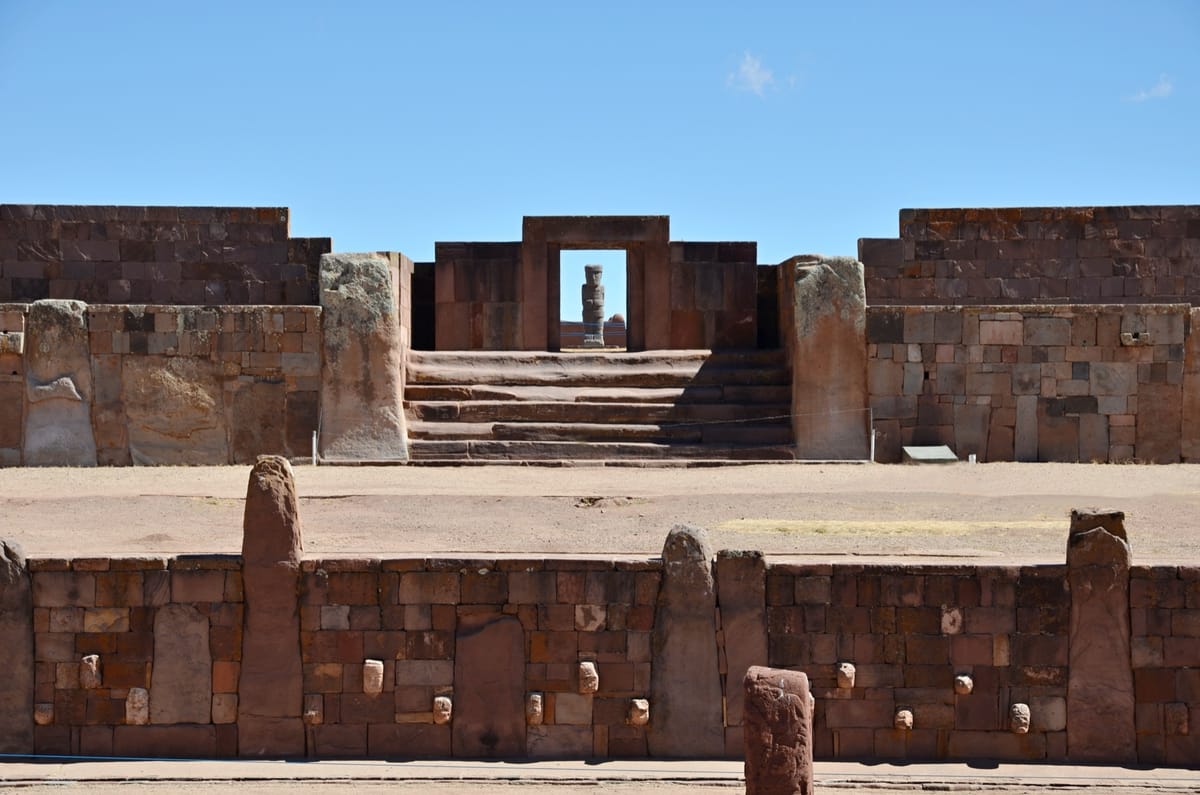
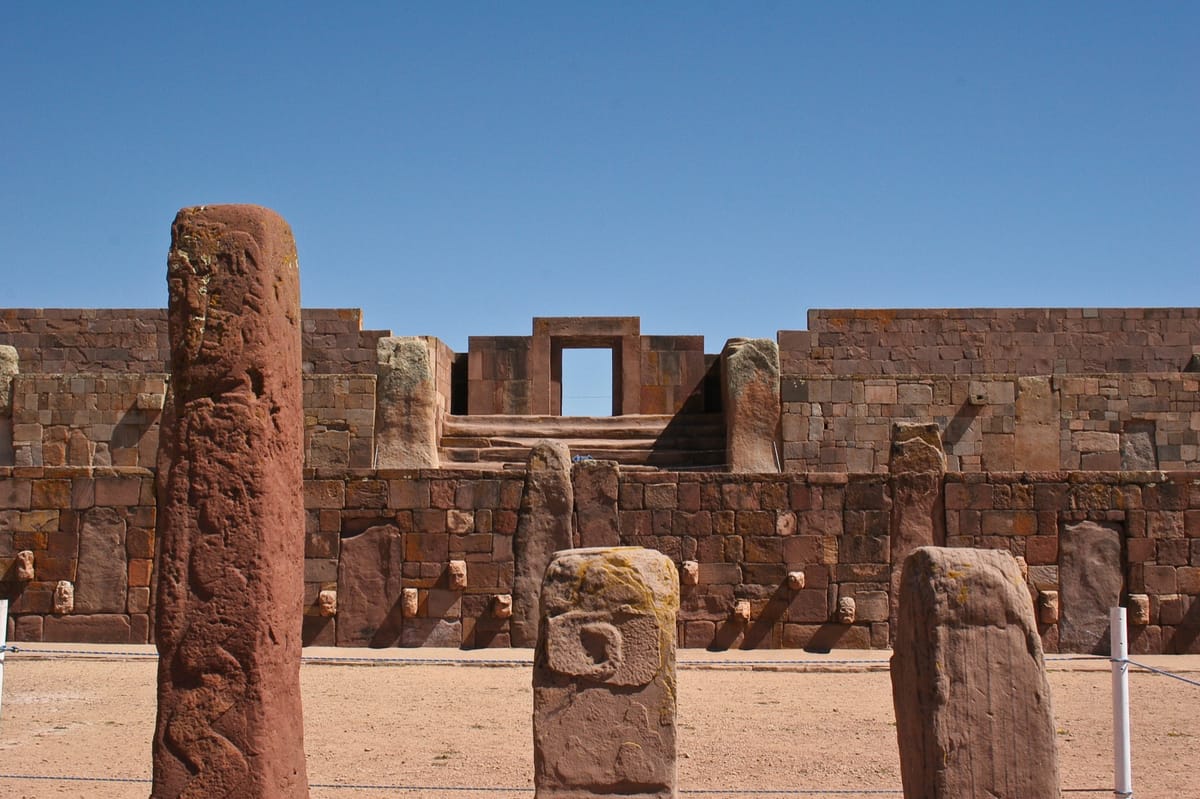
The Kalasasaya (Aymara for “standing stones”) is a low platform mound enclosing a large courtyard, measuring roughly 120 by 130 metres and laid out square to the cardinal points. Its walls are built in a distinctive style: tall dressed sandstone pillars set at intervals, with the gaps between them filled by panels of smaller, closely fitted ashlar blocks. A monumental staircase on the eastern side leads up through the wall into the enclosure, and directly outside that stair lies the Semi-Subterranean Temple, so that a visitor entering from the east passes from the sunken court up into the raised platform along an east–west axis. Much of the walling seen today was reconstructed between 1957 and 1960 under the Bolivian archaeologist Carlos Ponce Sanginés, a restoration that makes the enclosure legible but also means some details reflect mid-twentieth-century interpretation as much as original fabric.
Two great andesite statues anchor the Kalasasaya. The Ponce Monolith, excavated by Ponce Sanginés’s team in 1957 and named for him, stands about three metres tall in the courtyard, carved as a rigid front-facing figure gripping a qiru (a ceremonial drinking cup) in one hand and a snuff tablet or tray in the other, its body covered in low-relief clothing and iconography. A second statue, the Fraile (“Friar”) Monolith — so nicknamed by colonial-era Spaniards who thought it held a staff and chalice — stands near the enclosure’s southwest corner and carries the same paired objects. These monoliths, the pillared walls, and the Gate of the Sun together made the Kalasasaya a stage for public ritual, aligned so that celestial events could be read against its architecture.
How Was It Built?
Everything at Tiwanaku was built without iron tools, without the wheel, and without draft animals other than the llama, on a treeless plateau where even timber had to be brought from elsewhere. The gate itself was cut from a single block of andesite, a hard volcanic stone; the sandstone used in the Kalasasaya’s pillars is softer and was quarried from ranges perhaps ten kilometres south of the site, while the harder andesite favoured for statues and fine work came from farther afield, including sources near the Copacabana peninsula that required moving stone around or across Lake Titicaca. Blocks of this size were almost certainly split from the quarry with the wedge-and-lever methods used throughout the Andes, then dragged on sledges over prepared, sometimes water-slicked ground and up earthen ramps by large teams hauling on ropes — the same repertoire of organized human labor, not lost machinery, that Andean archaeology documents again and again.
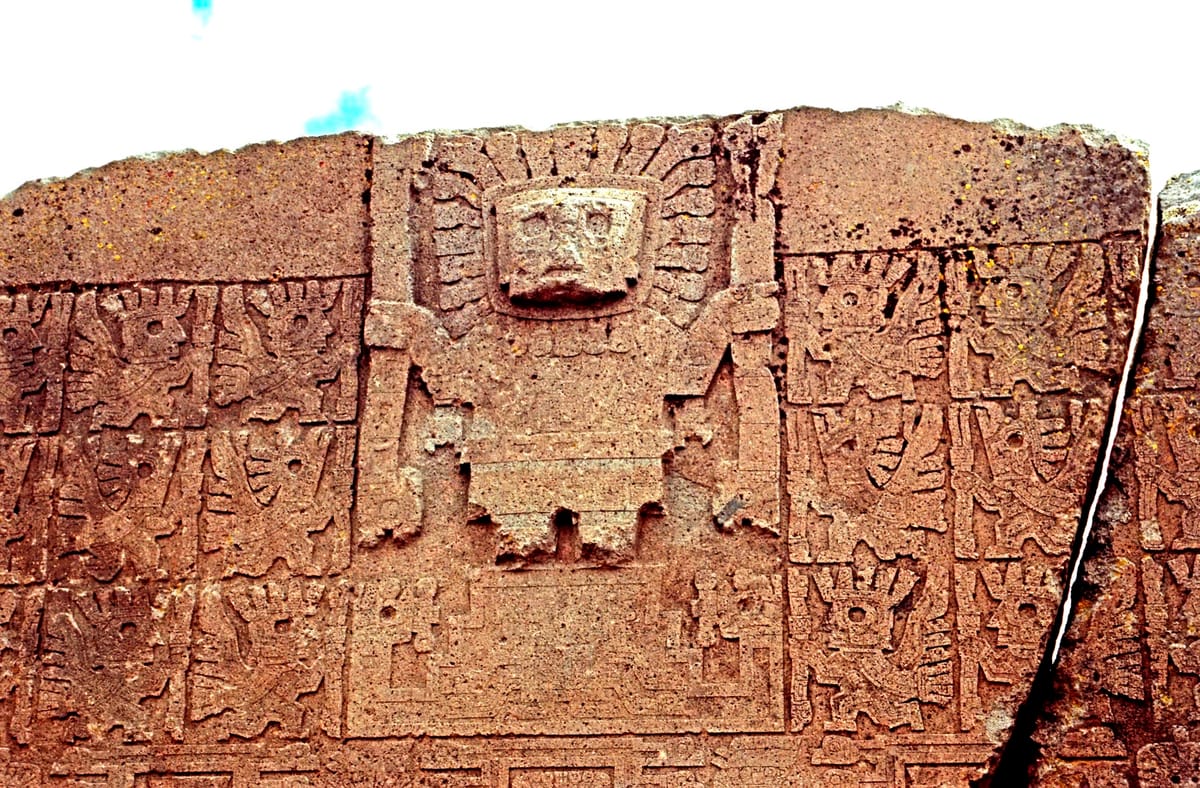
What sets the gate apart is not its bulk but its surface. Across the upper eastern face the Tiwanaku carved a deeply worked frieze in hard andesite: at the centre, a figure standing on a stepped platform, its head ringed by rays (several ending in circles, others in the heads of pumas or condors), “weeping” lines running from its eyes, and a staff in each hand — the right one often read as a spear-thrower. Ranged in three horizontal rows on either side are forty-eight smaller attendant figures, some with human heads and some with the heads of birds, each shown in profile as if kneeling or running toward the central deity; a lower band of interlocking, meander-like step motifs and small faces runs beneath them. Producing this much crisp, undercut relief in andesite meant patient pecking, grinding, and abrasion with harder hammerstones and sand, the accumulated skill of masons who had worked this stone for generations. Notably, the frieze appears unfinished — the carving does not extend across the whole face — which suggests the gate was still being worked when the effort stopped.
The Mainstream View
Archaeologists treat Tiwanaku as the deliberate creation of a powerful, well-organized Andean state, able to mobilize and feed the labor that quarrying, hauling, dressing, and raising megalithic stone demands. The Kalasasaya is read as a temple-platform and civic stage rather than an “observatory” in the modern sense, but its cardinal orientation is real and its alignments are taken seriously: researchers including Alexei Vranich, David Dearborn, and John Janusek have documented how the enclosure and the neighbouring Semi-Subterranean Temple frame the rising sun, with the eastern doorway and the Ponce Monolith positioned so that, at the equinoxes, dawn light passes through the gateway toward the standing stone. Tracking solstices and equinoxes had obvious value on the altiplano, where the farming year was tightly bound to the sun, and building that knowledge into ceremonial architecture fits a broader Andean pattern.
The central figure on the gate is generally understood as a version of the pan-Andean “Staff God,” a rayed, staff-bearing deity that recurs across Andean art for millennia; at Tiwanaku it is commonly linked to a solar or creator god, later echoed in Inca traditions of Viracocha, though some scholars connect it instead to the Aymara weather deity Thunupa. The winged attendants are read as supernatural messengers or a divine retinue, and the whole composition as a statement of cosmic and political order rather than a literal record. On the much-repeated claim that the frieze is a stone calendar — an idea argued forcefully in the early twentieth century by the Austrian-Bolivian scholar Arthur Posnansky, who read the attendants and the lower band as a solar year of twelve months — mainstream opinion is cautious to skeptical: the imagery is broadly agreed to be religious and cosmological, and while a calendrical or astronomical dimension is plausible given the site’s alignments, no calendar reading has been demonstrated to most specialists’ satisfaction.
The Open Case
What keeps the Gate of the Sun genuinely open is less how it was cut than what it was and where it belongs. The gate was found in the nineteenth century lying flat and split by a large crack, and it is widely thought not to stand in its original position — yet where it first stood, and how it functioned within Tiwanaku’s ceremonial plan, remain uncertain, which in turn clouds any argument that its frieze was meant to be read against a specific line of sky. The calendar question sits on the same fault line: the site demonstrably cared about solar alignment, and the frieze is strikingly orderly and countable, but whether that order encodes a working calendar or simply the symmetry of a sacred image is unresolved, and Posnansky’s confident reading is no longer accepted at face value. Even the identity of the rayed central god — solar deity, creator, weather god, or a fusion — is inferred from later cultures rather than from any surviving Tiwanaku text, since the civilization left no writing. The unfinished carving adds one more puzzle, hinting that work on the gate stopped before it was complete. Tiwanaku’s stonework has long drawn claims of impossible precision and lost technology, but the honest wonder here is more grounded and no less real: a people with stone tools and rope, farming at the edge of what crops can bear, chose to spend that surplus carving a ten-tonne doorway and aligning a walled court to the turning sun — and much of what they meant by it is still, more than a thousand years of altiplano sunrises later, waiting to be read.
Sources
- UNESCO World Heritage Centre — Tiwanaku: Spiritual and Political Centre of the Tiwanaku Culture
- Wikipedia — Gate of the Sun
- Wikipedia — Kalasasaya
- Wikipedia — Ponce Monolith
- Wikipedia — Tiwanaku (Pre-Columbian archaeological site)
- Smarthistory — The Sun Gate, Tiwanaku
- Smarthistory — Tiwanaku, an introduction
- World History Encyclopedia — Gateway of the Sun, Tiwanaku
- Encyclopaedia Britannica — Tiwanaku (ancient city, Bolivia)
- tiwanaku
- bolivia
- altiplano
- lake-titicaca
- andesite
- monolithic
- gate-of-the-sun
- kalasasaya
- staff-god
- archaeoastronomy
- calendar
- pre-inca
- monolith
Gallery