Derinkuyu Underground City
Who first carved Derinkuyu into the rock, when did they begin, and how did its builders engineer effective ventilation and manage the excavation and removal of so much stone for a refuge meant to hold thousands?
Why this rating?
- Construction difficulty
- 3/5
- Method uncertainty
- 3/5
- Capability gap
- 2/5
- Open questions
- 4/5
Carving soft volcanic tuff with hand tools is well understood and required no exceptional technology, but reliably ventilating a shaft-and-corridor network to depths near 85 meters left no written explanation, and who first began excavation, when, and how work was organized and coordinated across centuries of phased digging remain genuinely unresolved.
Overview
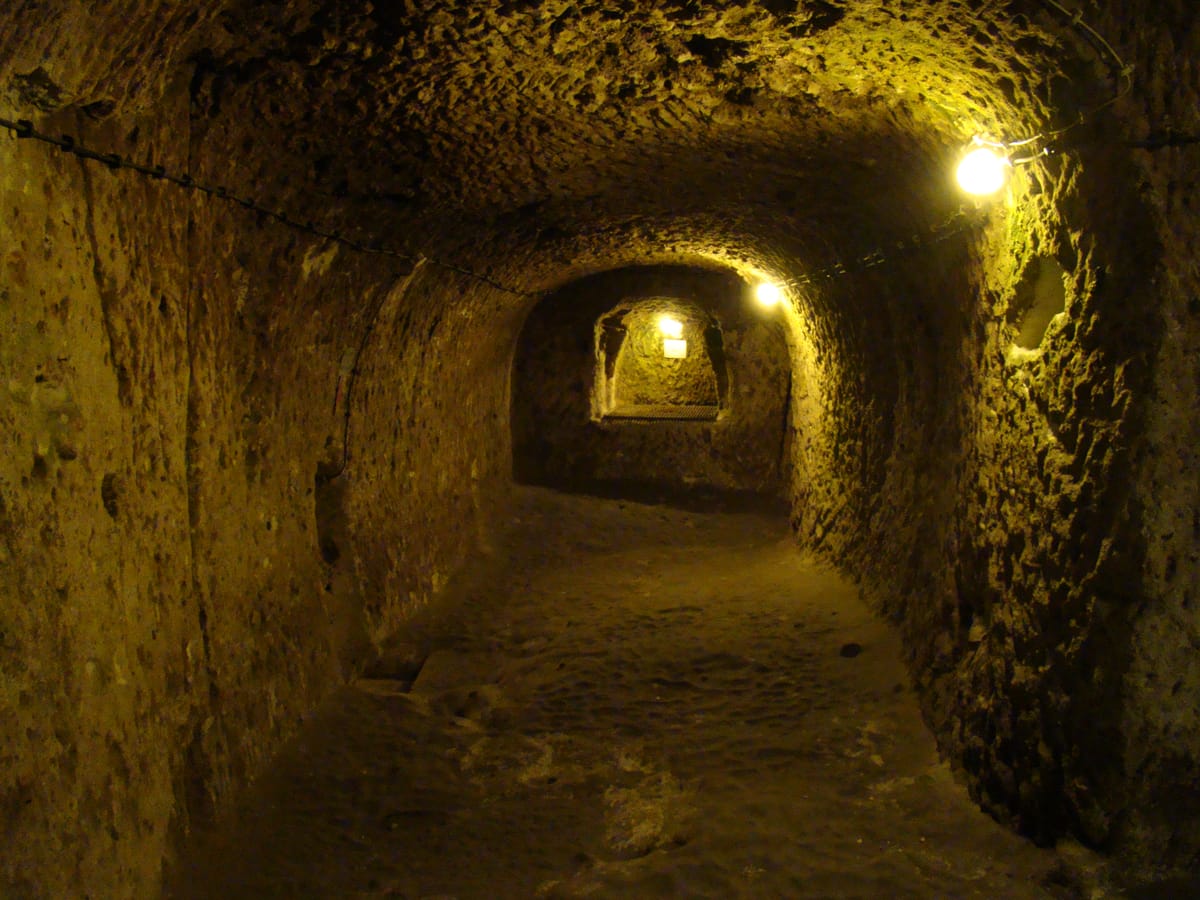
Derinkuyu is a vast, multi-level underground city carved into the soft volcanic rock beneath the modern town of Derinkuyu, in Nevşehir Province, in the Cappadocia region of central Turkey. It is the deepest of Cappadocia’s excavated underground settlements, descending roughly 60 to 85 meters through as many as 18 levels, and it is large enough to have sheltered thousands of people — commonly estimated at up to 20,000 — together with their livestock and stores of food for extended periods underground. Far from a simple network of caves, it was an engineered refuge: a honeycomb of interconnected rooms and corridors equipped with ventilation shafts, deep wells, stables, storerooms, wine and oil presses, chapels, and a cruciform church, all linked by narrow passages that could be sealed off level by level with massive rolling stone doors. Derinkuyu forms part of the “Göreme National Park and the Rock Sites of Cappadocia” UNESCO World Heritage Site, inscribed in 1985, and it is connected by kilometers of tunnels to a second major underground city at Kaymaklı. It is one of the most complete surviving examples of a long tradition, across this region, of digging entire communities into the earth for protection.
The Structure
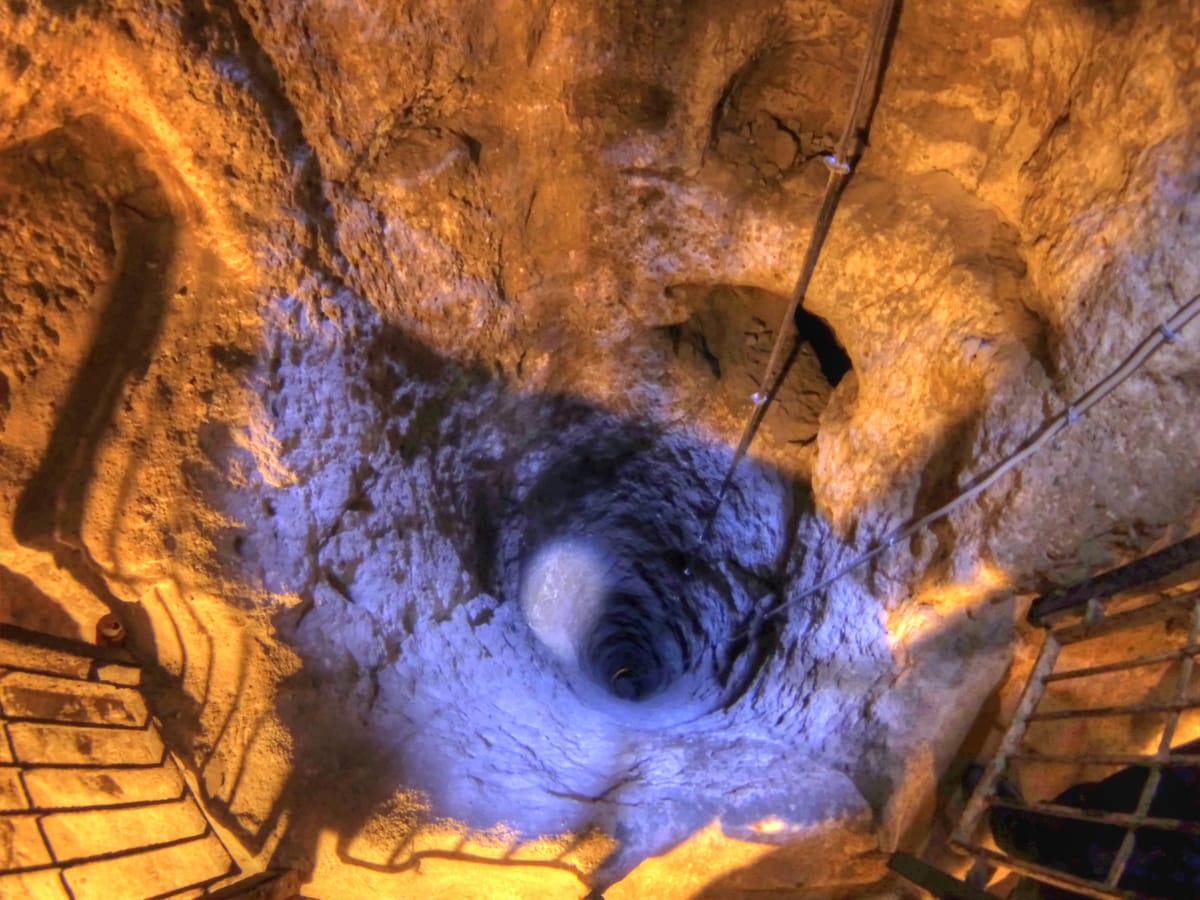
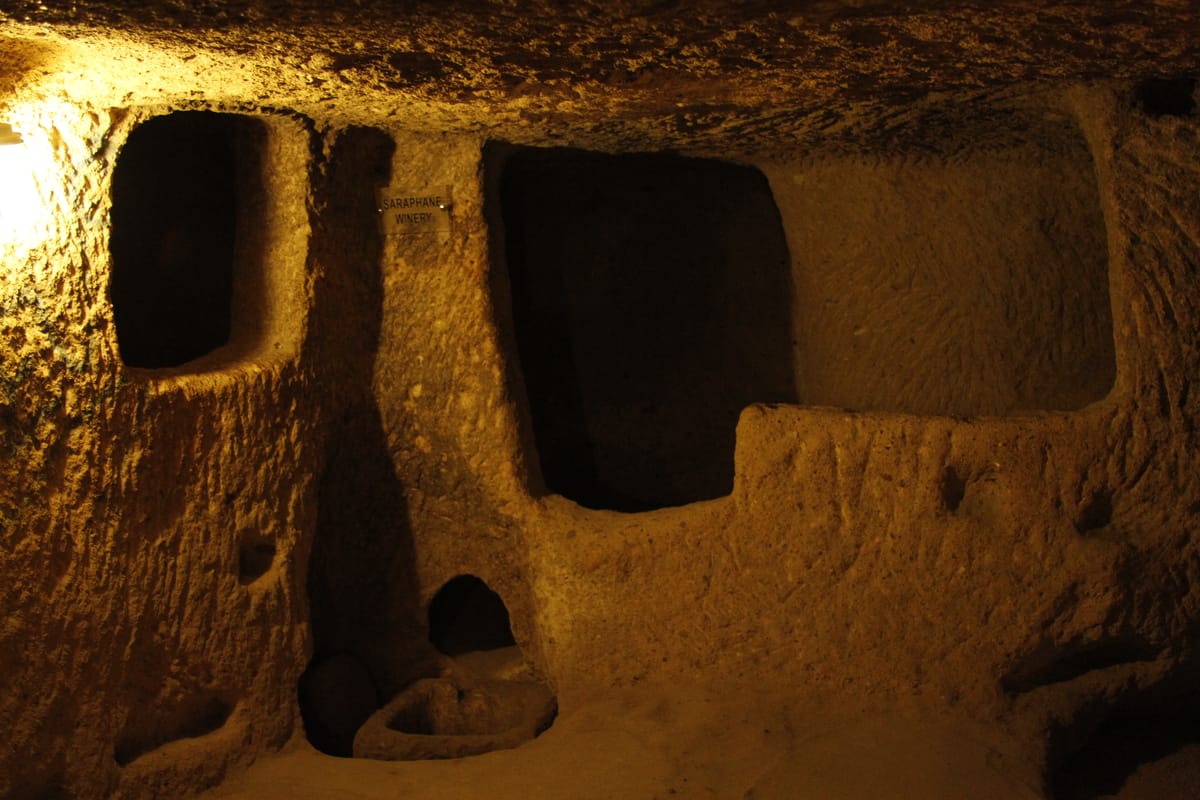
Cappadocia’s landscape was shaped by ancient volcanic eruptions that blanketed the region in thick layers of ash, which compacted over time into tuff — a rock soft enough to carve with simple hand tools, yet one that hardens and becomes structurally stable once exposed to air. That property made large-scale excavation practical without metal reinforcement, and it is the same rock in which Cappadocia’s famous “fairy chimney” pillars and cave churches were formed and carved. At Derinkuyu, generations of digging produced a complex spanning at least eight fully cleared levels (with further levels identified but not yet fully excavated), connected by steep stepped shafts and sloping corridors narrow enough that only one person could pass at a time — a deliberate defensive choke point. Rooms were organized by function: living quarters and stables nearer the surface, storage cellars, refectories, and wine and oil presses on middle levels, and on the lowest excavated level a chapel with a cruciform (cross-shaped) plan, identified as a church. A separate barrel-vaulted hall on an upper level has been interpreted as a religious school. The city’s water supply came from deep wells, including a shaft roughly 55 meters deep, dug so that the well could not be reached or poisoned from the surface — while also serving as part of the ventilation system. More than 600 separate surface entrances have been identified feeding into the network, most disguised within the courtyards of ordinary houses above. In 1923, the local Greek-speaking Christian population — who had called the underground city Malakopia — was removed under the Greek-Turkish population exchange, and the complex was largely forgotten by the town’s new residents until its rediscovery.
How Was It Built?
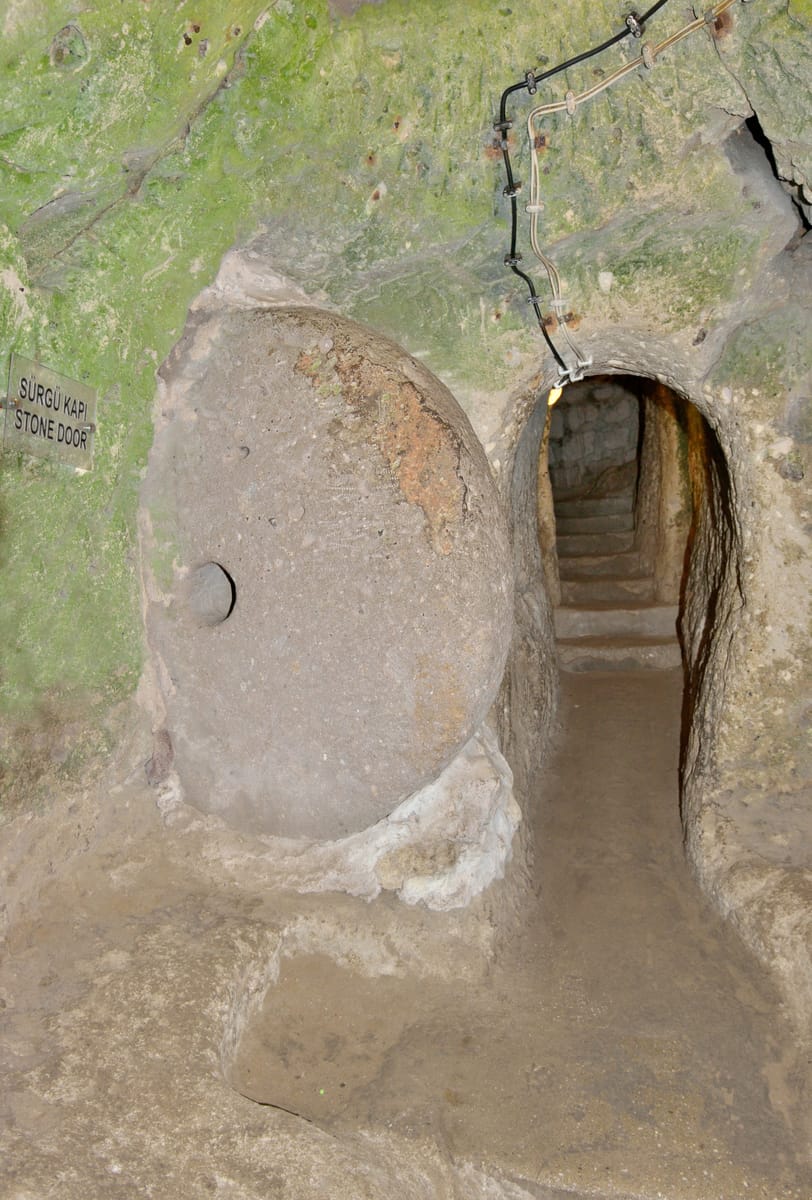
There is no surviving inscription or contemporary record naming who began digging Derinkuyu or directing its construction; what can be reconstructed comes from the excavated fabric of the site itself. The tuff was worked with simple hand tools — picks and chisels sufficed to cut the soft volcanic rock, which stiffens on contact with air, allowing carved chambers and shafts to remain stable without added supports. Excavation seems to have proceeded in phases over centuries rather than as a single planned project: passages were extended, new levels added beneath existing ones, and rooms repurposed as the community’s needs changed. The builders integrated a network of vertical shafts that served simultaneously as wells, ventilation flues, and routes for hauling excavated material and lowering supplies, with shaft openings staggered level to level so that airflow reached the lower chambers without one level’s shaft opening directly into another’s living space. Sections could be isolated from within: at chokepoints along the corridors, massive disc-shaped millstone doors, some over a meter across, were cut so they could be rolled across a passage and secured from the inside, sealing a level or wing against intruders while still allowing defenders to see and strike through a small central hole. Building the city was less a single act of construction than a sustained, communal labor tradition, refined and expanded by successive generations who inherited and built upon the excavation of those before them.
The Mainstream View
Archaeologists generally trace Derinkuyu’s earliest excavation to the Phrygians, an Iron Age Anatolian people who dominated central Turkey around the 8th to 7th centuries BCE, though some scholars instead place its origins in the Persian period that followed, and note that the region’s tradition of rock-cut dwellings may be older still. What is comparatively well established is that the underground city was substantially enlarged and intensively used far later, during the Byzantine era, when it and other underground complexes in Cappadocia offered Christian communities and their livestock refuge from Arab-Byzantine raids between roughly the 7th and 10th centuries, and again later from Seljuk and Mongol incursions. Scholars generally agree this Byzantine period is when Derinkuyu’s population came closest to its estimated capacity of up to 20,000, and when features such as the cruciform church were likely added. The site’s Greek-speaking Cappadocian Christian residents continued to know and use parts of the complex into the twentieth century, until the 1923 population exchange emptied the town of the community that had maintained that local knowledge. Derinkuyu then passed out of active use and largely out of memory, until a resident of the modern town, renovating his home in 1963, knocked through a wall and broke into one of its passages. The Turkish government began clearing and stabilizing the site soon after, and opened it to visitors in 1969, with excavation and clearance of further levels continuing since.
The Open Case
Derinkuyu’s existence and general chronology are not in doubt, but several specific questions remain genuinely unresolved among archaeologists. Exactly who cut the first chambers, and precisely when, is still debated: the Phrygian attribution rests on regional historical plausibility and comparison with other Cappadocian sites rather than on inscriptions or securely dated material recovered from Derinkuyu’s earliest levels, and a Persian-period origin remains a live alternative. How the builders, across centuries and without modern surveying instruments, engineered a shaft-and-corridor system that reliably moved enough air to sustain thousands of people, plus livestock, cooking fires, and oil lamps, at depths approaching 85 meters is a feat that is well documented in its results but not fully explained in its planning: it implies a working, transmitted understanding of airflow that left no written record. And because so much of the city was dug in phases whose sequence is hard to untangle from the finished rock alone, the sheer logistics of the project — how work was organized across generations, how excavated tuff was hauled to the surface and disposed of, and how one phase of digging coordinated with rooms and shafts already in use below — remain open questions actively shaped by ongoing excavation. None of this points to anything beyond determined human effort sustained over a very long time; the puzzle is not whether people could have built Derinkuyu, but the fine details of how, by whom, and over what span they actually did.
Sources
Gallery