Dendera Temple of Hathor
How did one of the best-preserved temples in all of Egypt — its painted ceilings, Hathor columns, and zodiac intact — come to be famous instead for a crypt relief that fringe writers insist is an ancient electric lightbulb?
Why this rating?
- Construction difficulty
- 2/5
- Method uncertainty
- 1/5
- Capability gap
- 1/5
- Open questions
- 2/5
Dendera is a superbly preserved but wholly conventional Greco-Roman-era Egyptian temple, built and decorated with well-documented Ptolemaic and Roman methods, and dated by its own inscriptions and cartouches. The only reason it registers as a 'mystery' at all is the 'Dendera light,' which is a resolved case: the crypt reliefs are religious images of a lotus-born serpent god, described in the surrounding hieroglyphic text, not electrical equipment — hence the very low method-uncertainty and capability-gap scores. The modest open questions are ordinary art history: the dating of individual sub-phases and why particular iconography was chosen.
Overview
The Temple of Hathor at Dendera is one of the most complete and best-preserved temples to survive from the ancient world. It stands on the west bank of the Nile in the Qena Governorate of Upper Egypt, at a place the Egyptians called Iunet and the Greeks Tentyris, roughly 60 kilometres north of Luxor. Where most Egyptian temples reach us as roofless skeletons — colonnades open to the sky, their ceilings long collapsed — Dendera still has its roof, its dark inner rooms, its stairways, its crypts, and, remarkably, much of its original painted colour. Walking into it is one of the closest things possible to walking into a functioning Egyptian temple as its priests knew it.
The building is dedicated to Hathor, one of the great goddesses of Egypt: a deity of the sky, of love, music, dance, motherhood, and joy, often shown as a cow or as a woman with a cow’s ears, and closely tied to the sun. Dendera was her chief cult centre, the home of her mysteries and of an annual festival in which her image travelled by river to the temple of her consort Horus at Edfu. The temple that stands today is comparatively young by Egyptian standards. Its construction began around 54 BCE, late in the Ptolemaic period — the Greek dynasty founded by one of Alexander the Great’s generals — under Ptolemy XII Auletes, the father of Cleopatra VII. The decoration continued for well over a century, carried on by Cleopatra herself and then by a succession of Roman emperors after Egypt became a Roman province in 30 BCE. Yet the site beneath it is far older: there is evidence of building here in the Old Kingdom, around 2250 BCE, an Eighteenth Dynasty temple from the New Kingdom, and a temple tradition so ancient that its own priests believed the ground plan had been handed down from the time of the early kings, with a foundation legend linking it to Khufu, the builder of the Great Pyramid.
To the wider public, though, Dendera is famous for something that has nothing to do with any of this. In one of its underground crypts is a relief that ancient-astronaut writers have promoted for decades as an “out-of-place artifact” — a depiction, they claim, of an electric lightbulb or a Crookes tube, proof that the Egyptians harnessed electricity. The relief is real, beautifully carved, and entirely explained by the hieroglyphic text carved right beside it. Both the genuine wonder of Dendera and the manufactured one share the same walls, and this study takes them in turn.
The Structure
The temple sits inside a large enclosure ringed by a massive mud-brick wall, alongside subsidiary buildings: birth houses (mammisi) celebrating the divine birth of Hathor’s son, a Roman-era gateway, a sacred lake, and a small sanatorium where pilgrims sought healing. The main temple is built of sandstone and oriented, unusually, toward the north rather than following the river.
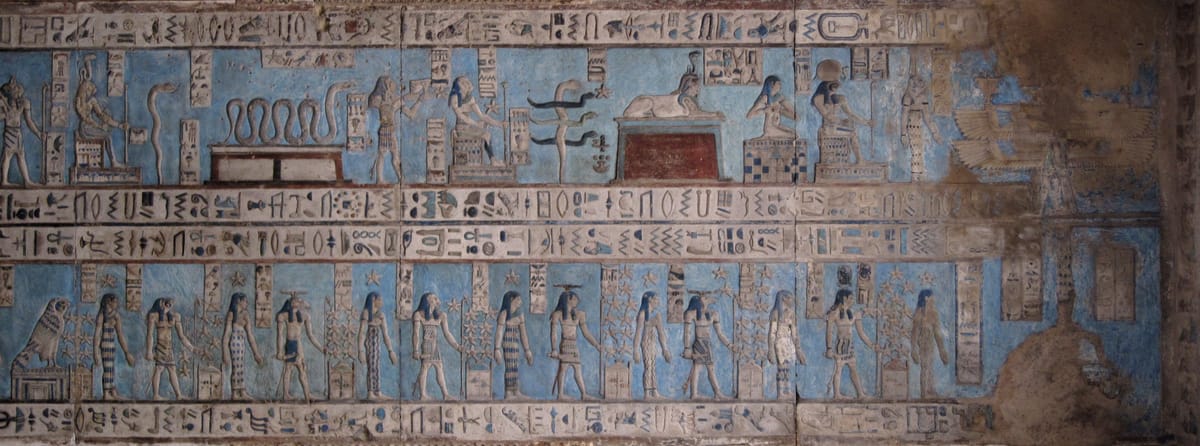
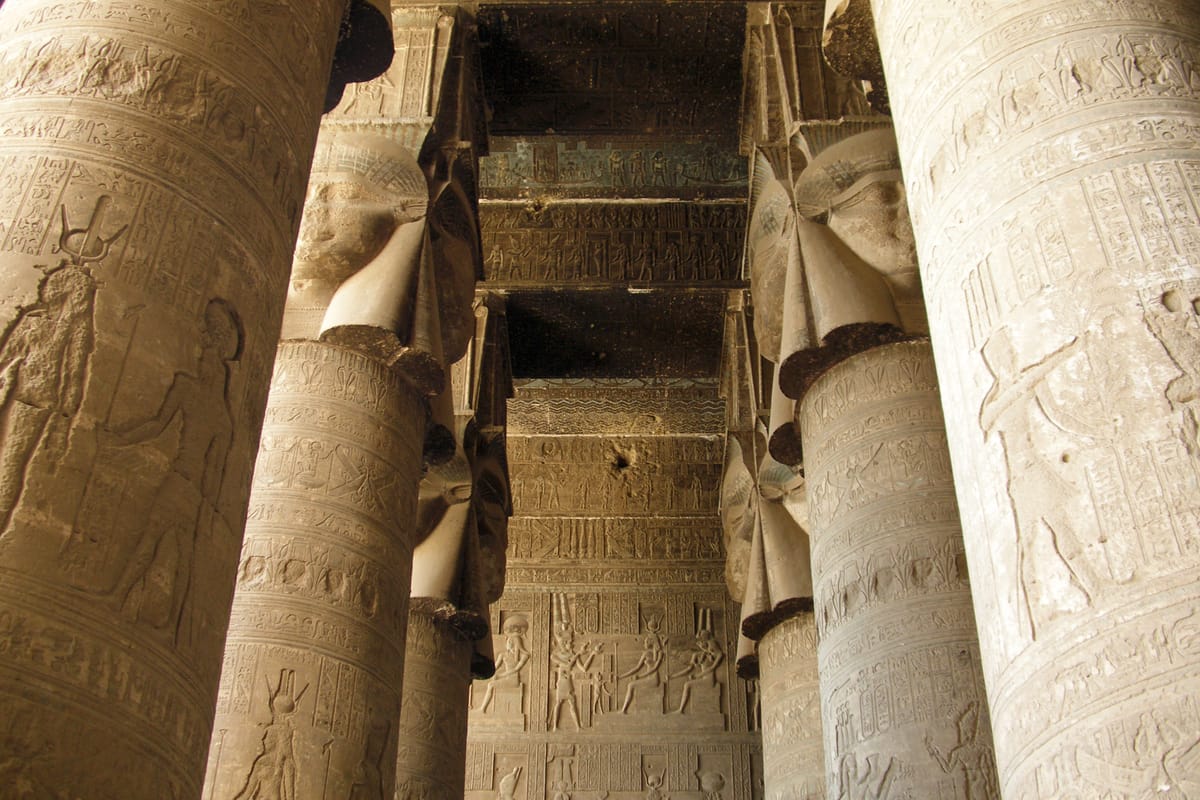
The visitor’s first and most overwhelming space is the great hypostyle hall, or pronaos, an inscription over whose entrance credits its construction to the Roman emperor Tiberius, with decoration added by emperors from Augustus through to Nero. Its roof is carried on 24 columns whose capitals take the form of a sistrum — the sacred rattle shaken in Hathor’s rites — each face of which is carved as the head of the goddess herself, with her characteristic cow’s ears, gazing out in all four directions. Row upon row of these serene Hathor heads make the hall instantly recognisable. Above them stretches the temple’s true glory: the astronomical ceiling, divided into bands and painted with the figures of the sky. Here the sky goddess Nut arches across the heavens swallowing and giving birth to the sun; the hours of the night, the decans (star-groups used to tell time), the planets as sailing gods, and the signs of the zodiac march in ordered rows. For centuries these ceilings were black — coated in soot from the fires of villagers who once sheltered inside the temple, and from the smoke of ordinary use. A major cleaning campaign by Egypt’s antiquities authorities, whose second phase was completed in 2021, lifted that grime away with careful compresses to reveal blues, reds, golds, and greens so vivid they look freshly painted. The rediscovery of these colours has been one of the most striking archaeological “before and after” stories of recent years.
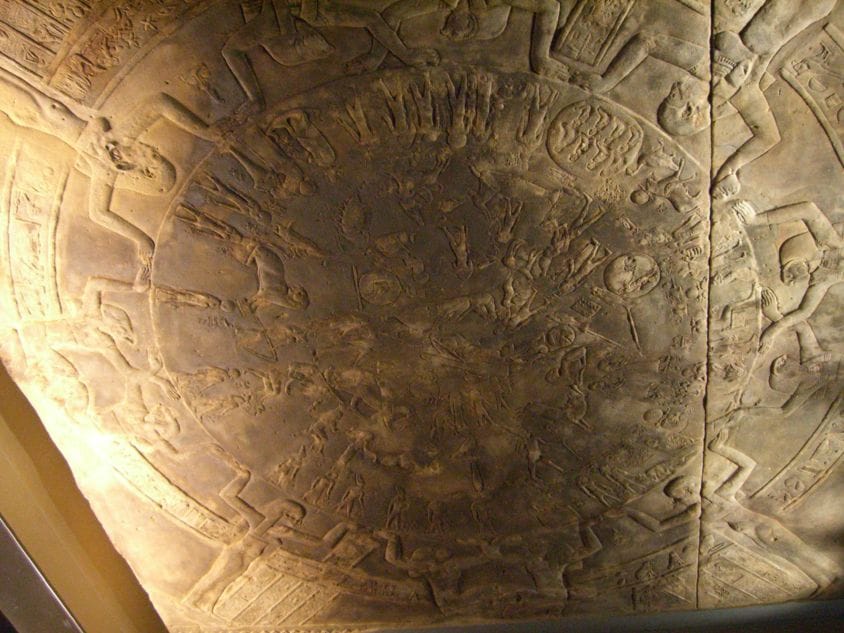
Beyond the hypostyle hall the temple narrows and darkens through a second, smaller columned hall and a series of offering rooms into the sanctuary, the innermost holy of holies where Hathor’s cult statue lived. Off these run chapels for the New Year rites, including a rooftop kiosk and a stairway — carved with a procession of priests carrying the goddess’s image — up which the statue was carried each New Year to be revived by the rays of the rising sun, and another stairway leading back down. It is on one of the ceiling chapels associated with the cult of Osiris that the famous Dendera Zodiac was placed, sometime after 51 BCE. This is a circular, sandstone sky-map: a planisphere showing the constellations, the familiar signs of the zodiac (many recognisably the same ones used today), the planets in their positions of exaltation, and the goddess Nut and other deities holding up the disc of the heavens. It is one of the only complete maps of an ancient sky to survive. In 1820–21 it was cut out of the ceiling and shipped to France, and it has hung in the Louvre in Paris ever since; a plaster cast now fills the gap at Dendera.
Threaded through the thickness of the temple’s walls and beneath its floors are the crypts — a dozen narrow, hidden chambers, some barely large enough to stand in, reached through concealed openings. They served as strongrooms for the temple’s most precious cult objects and ritual equipment, and their walls are densely carved with images and texts describing the statues and treasures they once held. It is in one of these crypts that the “Dendera light” relief is found.
On the rear exterior wall of the temple, facing outward, is one of the most historically evocative carvings in Egypt: a monumental relief of Cleopatra VII — the last active ruler of Ptolemaic Egypt — together with her son Caesarion (Ptolemy XV), whose father was Julius Caesar. Shown in full pharaonic style making offerings to the gods, it is a rare securely identified image of Cleopatra commissioned in her own reign, and it fixes the temple firmly to one of the most famous moments in ancient history.
How Was It Built?
In purely technical terms, Dendera is an entirely ordinary Egyptian temple, built with methods that had been refined over three thousand years and are documented in exhaustive detail. Sandstone, most of it quarried upriver at Gebel el-Silsila, was cut into blocks, floated down the Nile, dressed, and laid up in level courses to form thick walls, columns, and a flat stone roof — the standard Egyptian solution in a civilisation that never used the true arch for large monumental spans. The columns of the hypostyle hall were raised as stacked, carved drums; the crypts and the internal stairways were built into the mass of the masonry as it rose; and the whole was roofed with heavy stone slabs spanning between closely set supports.
The decoration followed the ordinary temple workshop sequence. Draftsmen laid out scenes and inscriptions, sculptors cut them — at Dendera mostly in sunk relief, the faster technique in which the outline is cut down into the surface rather than the background being removed — and painters finished the surfaces with mineral pigments over a thin plaster ground. The astronomical ceilings and zodiac represent the culmination of a long Egyptian tradition of astronomical decoration, updated in the Greco-Roman period with Babylonian and Greek elements such as the zodiac itself. Everything about the building’s construction and decoration lies comfortably within the well-attested capabilities of Ptolemaic and Roman Egypt; there is no engineering puzzle here at all. The temple’s exceptional state is a matter of luck and geography — it was buried in sand for much of its later history, which protected its roof and colour — not of any lost or extraordinary technique.
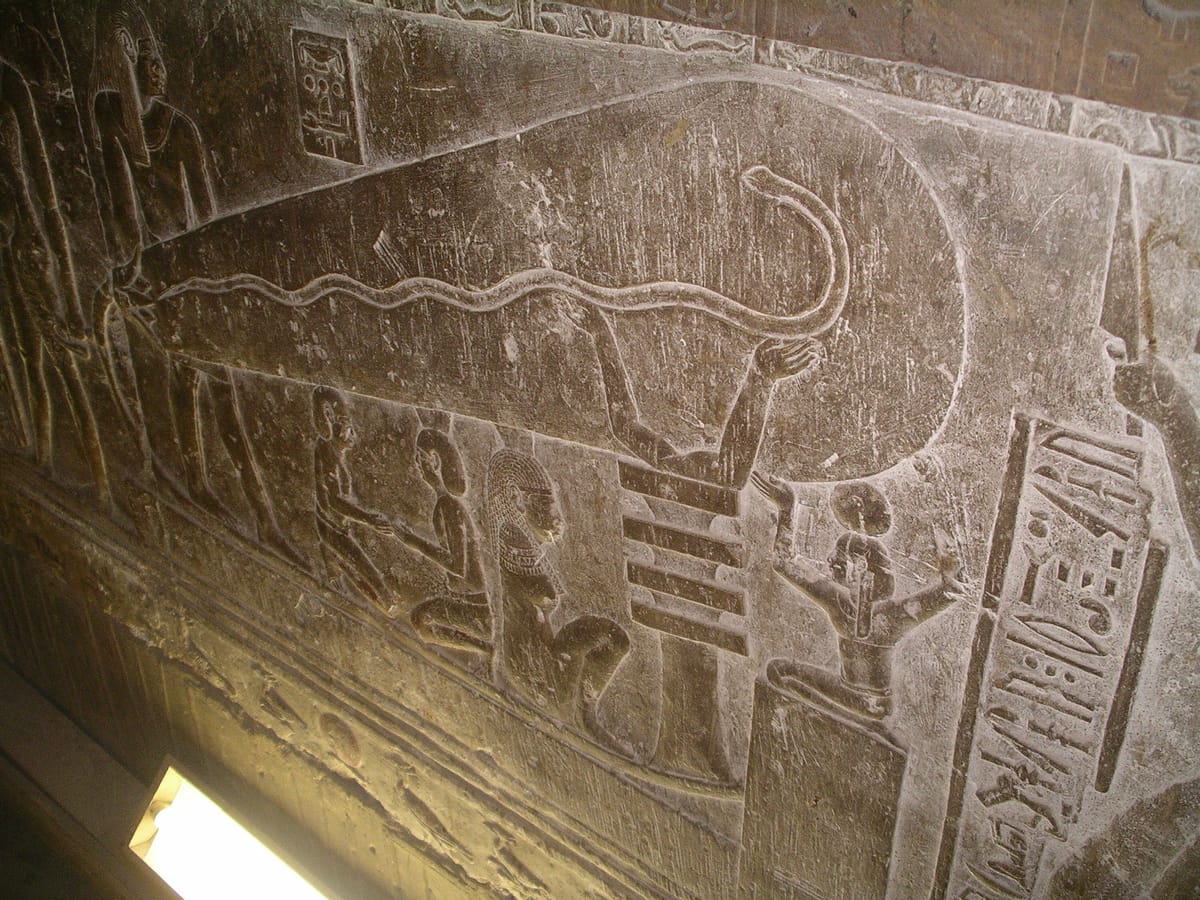
The one feature routinely cited as evidence of a “lost technology” is not a construction method but an image, and it belongs in the account of the temple’s decoration rather than its engineering. The “Dendera light” reliefs, in the crypt, show what fringe interpreters describe as an enormous lightbulb: a large, elongated teardrop or balloon shape, inside which a wavy serpent-like line runs from end to end, apparently supported on a pillar and tended by kneeling figures. Read through modern eyes, the outer shape can look like the glass envelope of a bulb, the wavy line like a filament, the supporting pillar like an insulator or cable, and a nearby figure like a high-tension wire. On this reading, promoted since the mid-twentieth century by ancient-astronaut authors, the Egyptians must have possessed electric lighting — which, the argument sometimes adds, would conveniently explain why there is so little soot in the deep interiors of tombs and temples. As construction history, however, the claim has nothing to build on: there is no wiring, no bulb, no glass, no generator, no battery, no scorch or residue, and no other trace of an electrical technology anywhere in the vast material record of ancient Egypt. The image is decoration, and its meaning is written beside it.
The Mainstream View
Egyptologists regard Dendera as a thoroughly well-understood monument. Its date, its builders, its religious function, and its construction all sit squarely within the richly documented history of Ptolemaic and Roman Egypt. The main temple was begun under Ptolemy XII around 54 BCE and decorated across the following century and a half by Cleopatra VII and a line of Roman emperors whose cartouches appear throughout; the hypostyle hall is Tiberius’s; the zodiac was added after 51 BCE; the Cleopatra and Caesarion relief dates to the very end of the Ptolemaic line. None of this is in dispute, and the temple’s astronomical ceilings are read as a magnificent but conventional expression of Egyptian cosmology, not as a technical anomaly.
That same settled understanding fully explains the “Dendera light.” The crypt reliefs depict a well-known episode of Egyptian creation and regeneration myth. The large teardrop shape is a lotus flower — the primeval flower that, in Egyptian cosmology, rose from the waters of chaos at the dawn of creation. Emerging from it is a snake: the god Harsomtus (a form of Horus, sometimes merged with the sun god Ra), who in this local theology is born as a serpent from the lotus, an image of the sun and of life renewing itself each day. The bulbous outer form that fringe writers read as glass is, in several versions, the hen — an oval sac or container that scholars including Wolfgang Waitkus have interpreted as a womb, associated with the sky goddess Nut, from which the god is reborn. The “cable” or “insulator” beneath is a djed pillar, an ancient and extremely common Egyptian symbol of stability and of the god Osiris, here shown as a supporting figure with raised arms. And the whole scene is not silent: it is surrounded by hieroglyphic inscriptions that describe exactly what is depicted, naming Harsomtus, the lotus, and the barque on which he sails, and giving the ritual details of the cult statues the crypt once held. The people who read the reliefs as electrical equipment are, in effect, ignoring the caption printed alongside the picture.
The specific electricity argument collapses under ordinary scrutiny, and Egyptologists and archaeologists have laid this out repeatedly. As the archaeologist Kenneth Feder points out, the simplest test is physical evidence, and there is none: not a single lightbulb, wire, socket, filament, battery, or generator has ever been excavated in Egypt, nor any burnt residue that such a device would leave. The claim that electric lamps are needed to explain the lack of soot in deep interiors is likewise unnecessary — the Egyptians are known to have lit interiors with reflected sunlight using mirrors or polished metal, and lamps with added salt burn with far less smoke. And the “filament,” “bulb,” and “cable” are only filament, bulb, and cable to a modern viewer; to the Egyptian priest who commissioned the relief they were a serpent, a lotus, and a djed pillar, each a standard element of a religious vocabulary attested on thousands of other monuments. The “Dendera light,” in short, is a snake being born from a flower — a statement of faith about how the sun is reborn, carved in a temple strongroom.
The Open Case
Honesty requires stating plainly that the “Dendera light” is not a genuine open mystery. It is not an unexplained artifact, a lost technology, or a coincidence still awaiting an answer. It is a resolved case of religious art being misread: the iconography is identifiable, the myth of the lotus-born serpent Harsomtus is well documented, the supporting djed pillar and the surrounding texts are clear, and the total absence of any corroborating electrical evidence anywhere in Egypt closes the matter. The ancient-astronaut reading survives only by discarding the very hieroglyphs the ancient carvers placed around the image to explain it, and by treating a modern object — the lightbulb — as the natural key to a two-thousand-year-old temple that predates electricity by nineteen centuries. To present this as a mystery would be to manufacture one.
The temple as a whole is likewise a low-mystery site, and that is no criticism of it — its wonder is of a different, quieter kind. Dendera is not baffling; it is complete, a rare chance to stand beneath an intact, freshly cleaned Egyptian sky-ceiling and read the cosmology the priests painted overhead. The questions that remain genuinely open are the ordinary, absorbing ones of art history and archaeology: the precise dating of individual construction and decoration phases across the long Ptolemaic-to-Roman sequence; how the older temples on the site, going back to the Old Kingdom and the New Kingdom, related to the present building and how much of an inherited plan it preserves; the exact astronomical content and sources of the zodiac, which blends Egyptian, Babylonian, and Greek traditions and has been used to argue about ancient star positions; and why this particular local theology chose to picture its sun god as a snake emerging from a flower. These are the real threads worth pulling at Dendera — and they are a far more honest place to direct a sense of wonder than a crypt carving that popular culture mistook for a lamp.
Sources
- Wikipedia — Dendera Temple complex
- Wikipedia — Dendera light
- Wikipedia — Dendera zodiac
- The Past — The celestial harmonies at Dendera
- Archaeology Wiki — Dendera Temple restoration and developing project continues
- Ancient Egypt Online — Temple of Hathor at Dendera
- NAU Museum Studies — The Dendera Light (The Hidden Harm of Pseudoscience)
- dendera
- hathor
- egypt
- ptolemaic
- roman-egypt
- temple
- dendera-zodiac
- dendera-light
- cleopatra
- caesarion
- ancient-astronauts
- pareidolia
- astronomical-ceiling
Gallery