Bent Pyramid of Sneferu
Why does this pyramid change its angle partway up — steep near the base, then suddenly shallower — and what does that visible 'correction,' frozen in stone, tell us about how the Egyptians learned to build a true pyramid?
Why this rating?
- Construction difficulty
- 4/5
- Method uncertainty
- 2/5
- Capability gap
- 2/5
- Open questions
- 3/5
Raising a ~105-metre pyramid of well over a million cubic metres of stone in a single reign was a genuinely formidable undertaking, so construction difficulty is high. But the methods are well understood in outline — quarried limestone, inward-leaning then horizontal courses, corbelled chambers, earthen ramps — and there is no real capability gap: this is early Egyptians visibly learning, not doing the impossible. The score sits in the middle because the site's honest open threads are narrow but real: the exact trigger for the angle change (interior cracking, ground subsidence, the trauma of Meidum, or ramp/logistics limits), the precise construction sequence and its two-or-three design phases, and why this pyramid alone was given two separate entrance-and-chamber systems remain matters of live scholarly debate rather than settled fact.
Overview
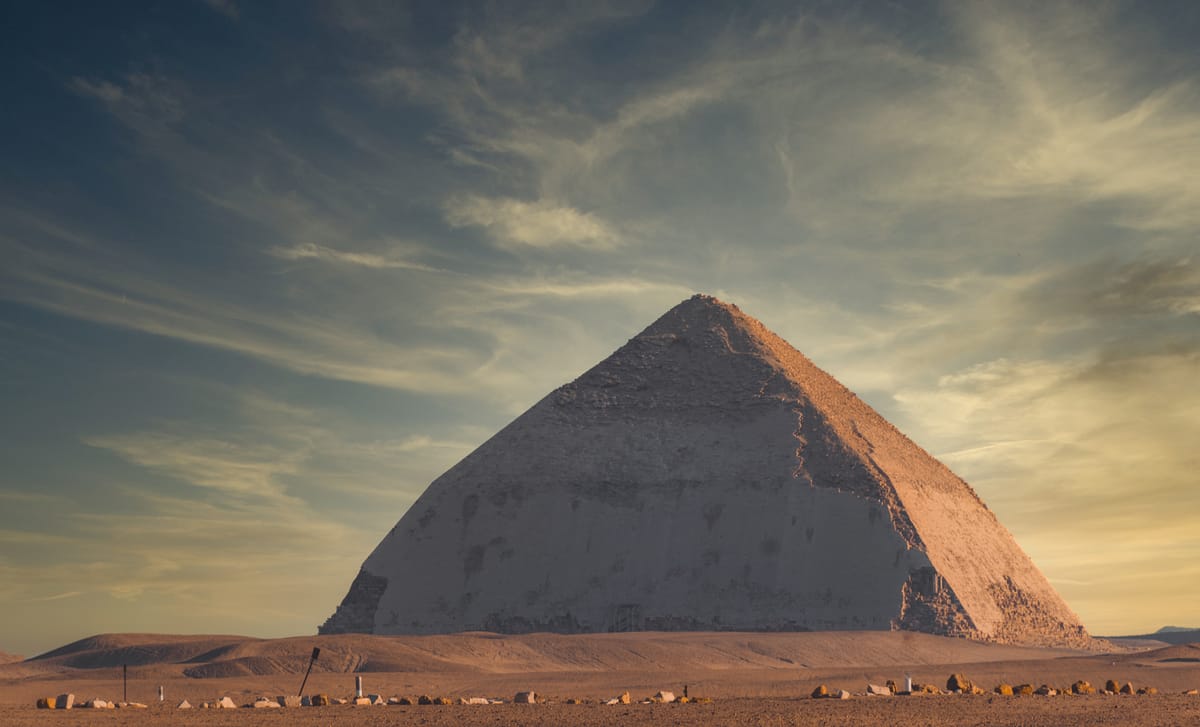
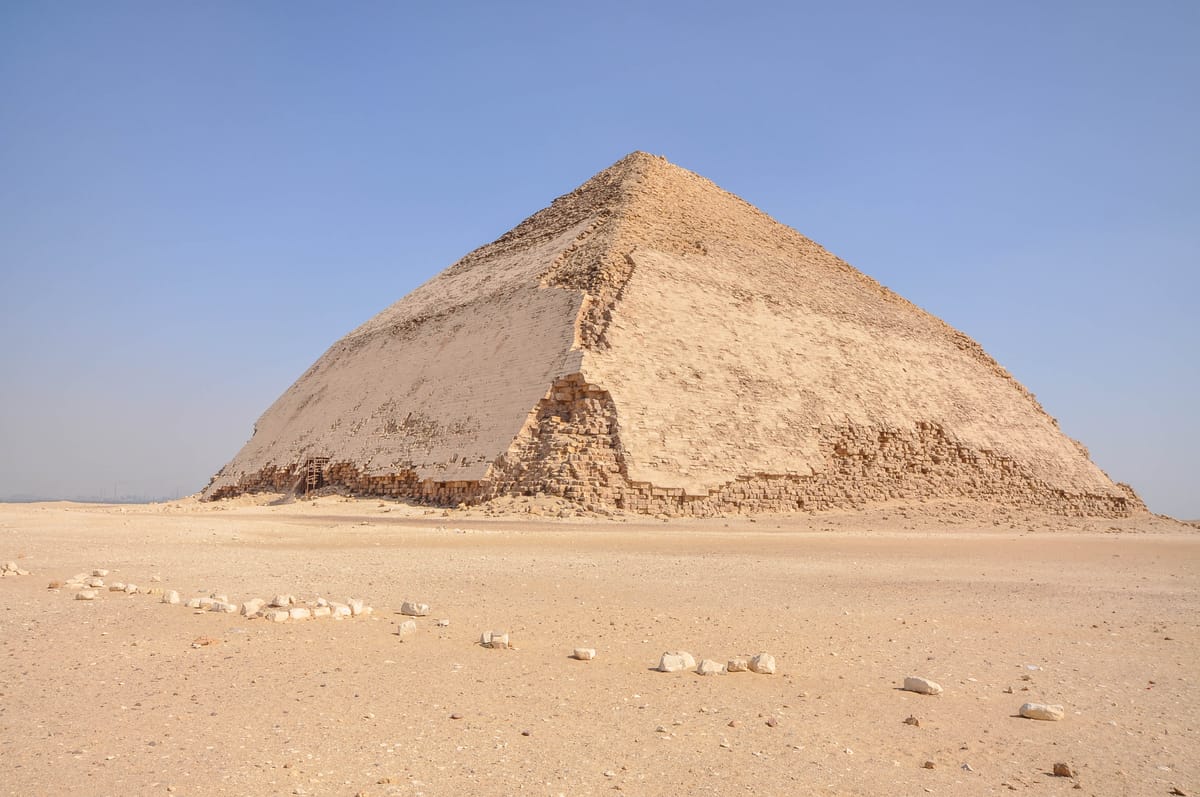
The Bent Pyramid stands in the desert at Dahshur, on the west bank of the Nile roughly 40 kilometres south of modern Cairo, and it is one of the most immediately recognisable — and most puzzling — monuments of ancient Egypt. Almost every pyramid presents a single clean triangular profile; this one does not. Its lower flanks climb steeply out of the sand, and then, about halfway up, the whole structure visibly changes its mind: the angle flattens, the faces lean back, and the pyramid finishes at a markedly gentler pitch than it began. The effect is unmistakable from kilometres away and gives the monument its modern name. To the Egyptians it was known by a grander title — something like “The Southern Shining Pyramid,” or “Sneferu Shines in the South.”
It was built by Sneferu, the founder of Egypt’s Fourth Dynasty, who ruled around 2600 BCE at the dawn of the Old Kingdom’s great age of pyramid building. Sneferu is a pivotal figure: he was the father of Khufu, builder of the Great Pyramid of Giza, and he was himself the most prolific pyramid builder in all of Egyptian history, responsible for more worked stone than any other pharaoh. The Bent Pyramid is the middle act of his extraordinary building career, and it is best understood not as a finished statement but as a snapshot of a problem being solved in real time. Within a single reign the Egyptians moved from the troubled step-to-smooth conversion at Meidum, through the mid-course correction visible in the Bent Pyramid, to the confident geometry of the Red Pyramid a short walk to the north — the first successfully completed true, smooth-sided pyramid. The bend is, in effect, the moment of learning left standing in stone. It is also, for accidental reasons, the best-preserved pyramid exterior in Egypt.
The Structure
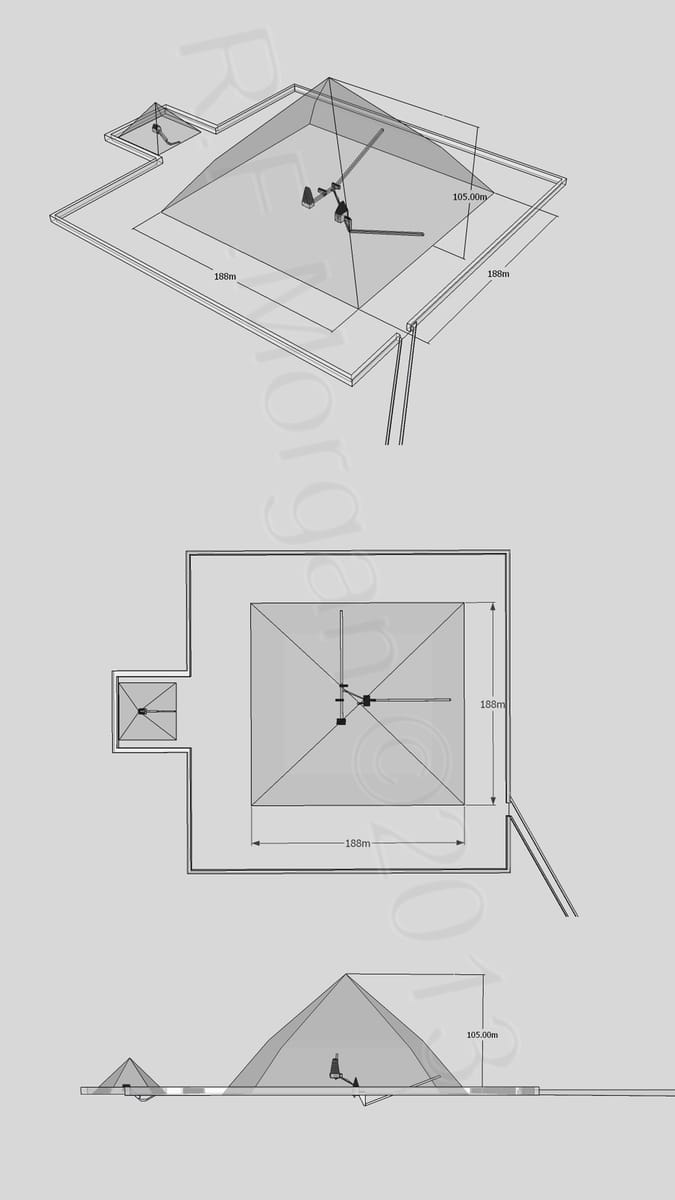
The Bent Pyramid is a large monument by any measure. Its base runs roughly 189 metres on a side and it rises to about 105 metres in height, containing well over a million cubic metres of stone. What sets it apart is the geometry of its faces. For the first stretch — approximately 47 metres of vertical height — the sides ascend at a steep angle of about 54 degrees. Then, at that level, the slope abruptly slackens to about 43 degrees, and it is this shallower pitch that carries the structure the remaining way to its apex. The transition is sharp and deliberate, not a gradual curve, which is why the silhouette reads as two different pyramids stacked one atop the other rather than as a single smooth cone of masonry.
Several other features make the Bent Pyramid unusual. The first is its casing. Egyptian pyramids were originally sheathed in a smooth outer skin of fine white Tura limestone, quarried across the river, which over the millennia was almost universally stripped away and burned for lime or reused as building stone. The Bent Pyramid is the great exception: large areas of its polished casing still cling to its faces, giving a rare impression of how these monuments were meant to gleam when new. Their survival is partly luck and partly geometry — the steep, slick lower faces made stone-robbing awkward and dangerous.
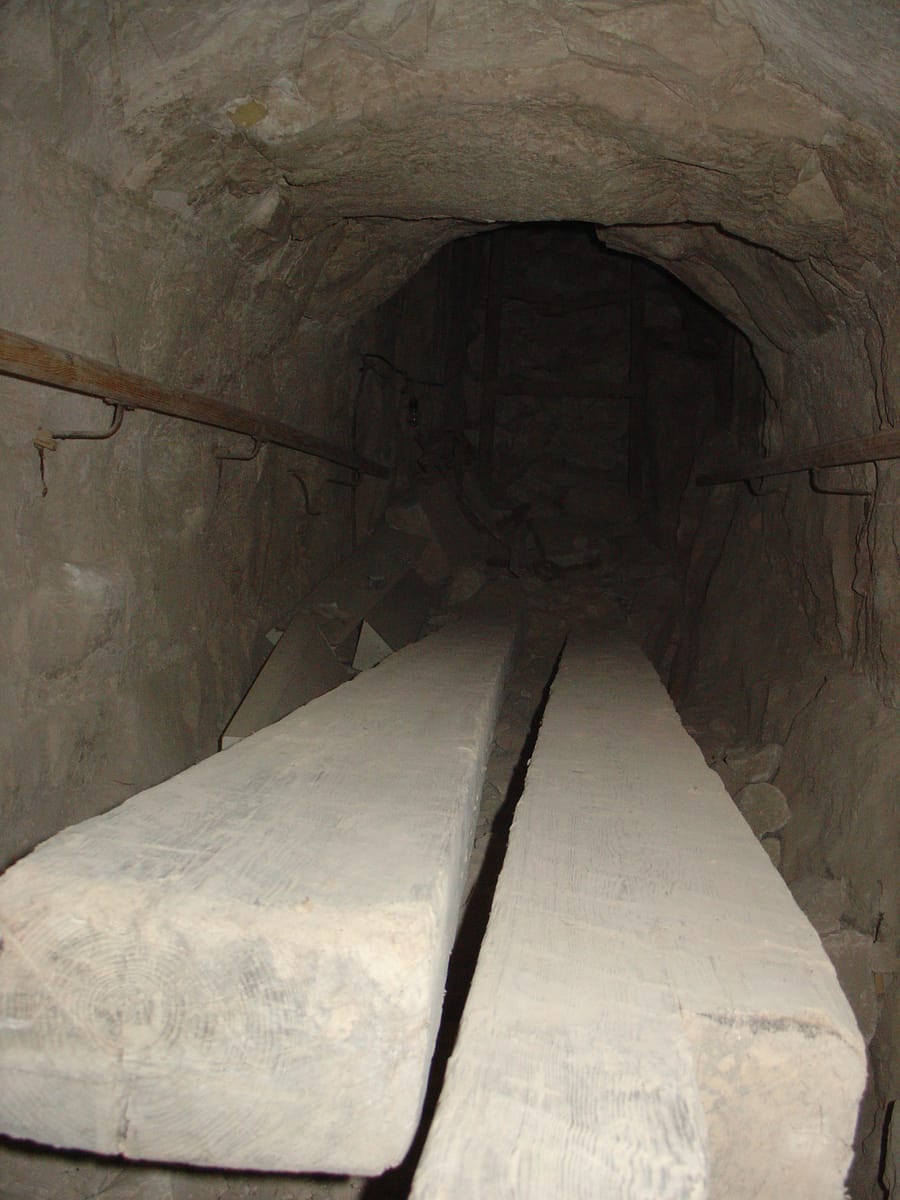
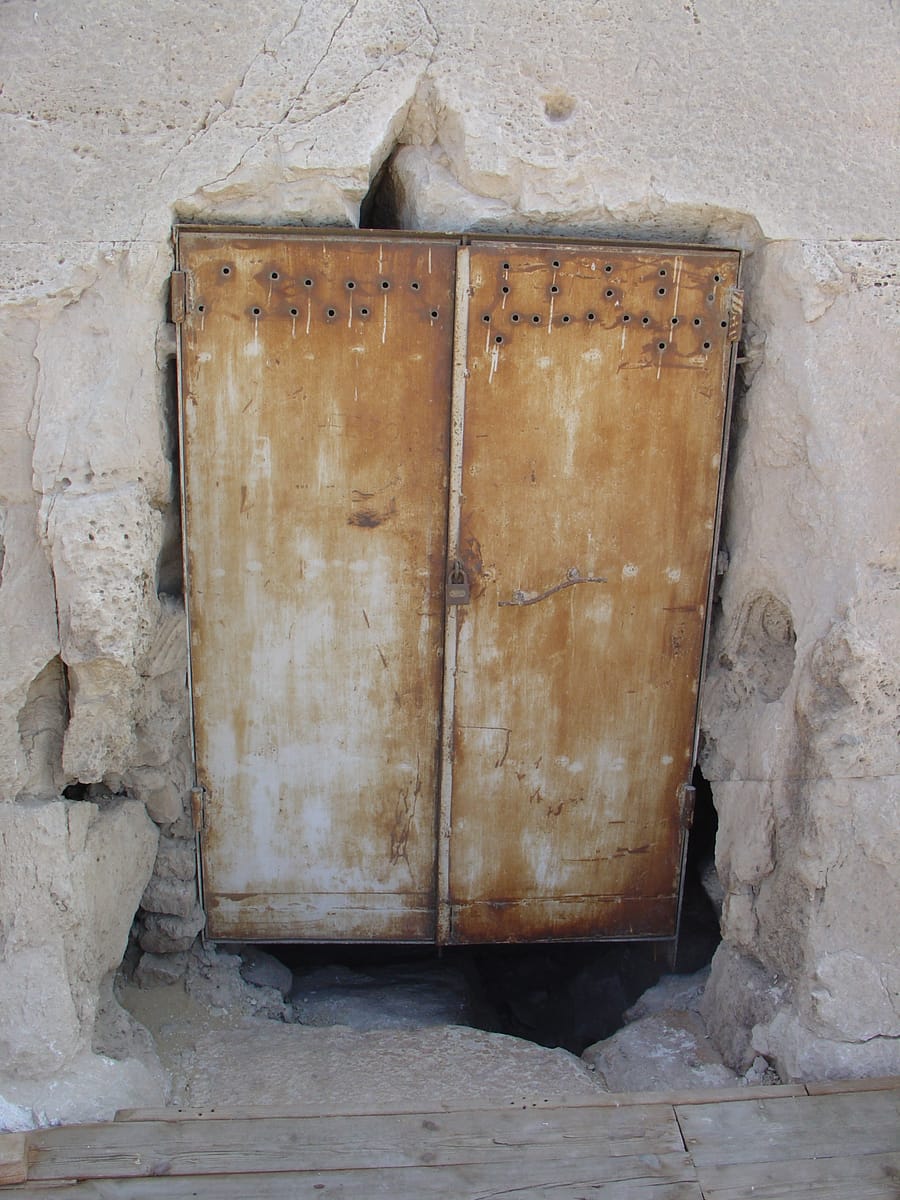
The second unusual feature is internal. Alone among the major pyramids, the Bent Pyramid has two separate entrances leading to two entirely independent systems of passages and chambers. One entrance opens fairly low on the north face and descends to a chamber roofed with a soaring corbelled vault; the other is set high on the west face and descends, past stone blocking-slabs, to a second high chamber. Both burial chambers are capped by tall corbelled ceilings — built by stepping successive courses of masonry inward until they nearly meet, a way of carrying immense overhead weight in an age before the true arch. Inside, ancient cedar beams imported from Lebanon still survive in the dry air, and one block bears an inscription naming Sneferu. No sarcophagus or burial was found; the king was almost certainly interred in his Red Pyramid instead. Just to the south stands a small subsidiary pyramid, originally around 26 metres tall, likely built for the cult of the king or a royal consort, complete with its own chapel and stelae.
How Was It Built?
In its essentials the Bent Pyramid was built by the same means as Egypt’s other Old Kingdom pyramids, using tools and techniques that are well documented: local limestone was quarried close at hand, dressed with copper tools and stone pounders, dragged into place, and laid up course by course, with the finer Tura limestone reserved for the outer casing and the harder passages. Massive earthen and rubble ramps, raised and lengthened as the monument grew, are the generally accepted means by which the blocks were brought up to the working level, though the exact ramp geometry used on any given pyramid remains debated. The corbelled chambers were roofed by the inward-stepping method described above.
What makes the Bent Pyramid’s construction genuinely revealing is that it appears to preserve a change of plan. Studies of the masonry suggest the builders altered their technique as they went. In the lower part, the courses were laid leaning inward, sloping down toward the centre of the pyramid — an older method, inherited from step-pyramid practice, that was thought to add stability. Higher up, around the level of the bend, the builders switched to laying the stone in horizontal courses, the method that would become standard for later true pyramids. Some analyses go further and reconstruct two or even three distinct design phases: an initial, even steeper and smaller-based pyramid begun at close to 60 degrees; an enlargement to a roughly 54-degree, wider-based monument; and finally the shallow 43-degree upper section that completed it. On this reading the Bent Pyramid is not one design but a sequence of designs, each responding to what the last had revealed.
The likely reason for the change lies in the physics of the lower design. A pyramid built at 54 degrees concentrates an enormous mass into a steep, top-heavy form, and the Bent Pyramid sits on relatively soft ground — clay, sand and gravel rather than solid bedrock — which is prone to settling under load. Cracking and inward movement have in fact been observed inside the pyramid. Flattening the upper half to 43 degrees dramatically reduced the volume of stone still to be added, lightening the load on the straining structure below and letting the builders finish the monument without it failing.
The Mainstream View
Egyptologists regard the Bent Pyramid as a broadly well-understood monument, and above all as a transitional experiment — the crucial middle term in Sneferu’s programme of learning to build a true pyramid. Its date and builder are secure: Sneferu, early Fourth Dynasty, around 2600 BCE, attested by inscriptions on the site. Its place in the sequence is likewise clear. Sneferu’s first great project, the pyramid at Meidum, was converted from a stepped form into a smooth-sided true pyramid, and at some point its outer mantle failed catastrophically, leaving the tower-like ruin that survives today. Whether that collapse happened during Sneferu’s own reign or much later is itself debated, but the structural lessons of steep, smooth-faced masonry on the Bent Pyramid were plainly being absorbed in real time.
Within this framework, the bend has a straightforward and widely accepted explanation: it is a mid-construction correction made for the sake of stability. The most commonly cited trigger is that the pyramid itself began to show signs of distress — interior cracking and settling on its soft foundation — as the steep lower design piled up mass faster than the ground and the masonry could safely bear. Reducing the angle for the upper half was the pragmatic fix, cutting the remaining load and allowing safe completion. Prominent Egyptologists including Zahi Hawass have attributed the alteration to subsidence and construction damage, and Egyptian antiquities officials have pointed to cracks appearing in the structure as the reason the builders changed course. Many scholars connect this directly to a loss of confidence prompted by trouble at Meidum. The clinching piece of evidence for the “it was about stability” reading is what Sneferu did next: his following pyramid, the Red Pyramid at Dahshur, was built from the ground up at the same cautious ~43-degree angle — and it stands to this day as the first true smooth-sided pyramid ever successfully completed. The Bent Pyramid, in the mainstream view, is exactly what it looks like: the record of a lesson learned.
The Open Case
The genuinely open questions here are narrow, technical, and entirely within the bounds of ordinary Egyptology — but they are real, and honesty requires distinguishing what is settled from what is not.
The single reason for the angle change, though confidently framed, is not proven beyond argument. The stability explanation is the strongest and best-supported, but scholars have floated other contributing factors: that raising ever-heavier blocks up ever-longer ramps to a steep 54-degree summit became impractical, and that the geometry and dwindling working space near the top favoured a shallower finish; or that the decision was as much about time and the pharaoh’s mortality — completing the tomb quickly — as about pure engineering. These are not competing fringe theories so much as candidate ingredients in a decision whose exact weighting is lost to us. Precisely what the builders saw, when they saw it, and how much each factor mattered cannot be recovered with certainty from the stone alone.
The construction sequence is similarly debated in its details. Whether the pyramid embodies two design phases or three, exactly where and why the switch from inward-leaning to horizontal coursing occurred, and how the successive enlargements relate to the change of angle, are all matters on which careful studies still differ. So, too, is the reason this pyramid alone was given two independent entrance-and-chamber systems — whether that reflects a change of plan mid-build, a symbolic or ritual doubling, or a structural response to the same instability that produced the bend. And the vexed question of the Meidum collapse — its date, and how directly it drove the choices at Dahshur — remains unresolved.
What should be said plainly is what the Bent Pyramid is not. It is not evidence of lost technology or non-human builders; it is the opposite — a monument that wears its human trial and error openly, a place where you can watch a civilisation guessing, over-reaching, and correcting within a single reign. That is a rarer and more moving thing than perfection. The Great Pyramid of Giza, built one generation later by Sneferu’s son, is flawless and gives nothing away. The Bent Pyramid, with its awkward, honest kink against the sky, shows the working.
Sources
On screen
- The Mistake You Collect — Partway up, Sneferu's builders changed the angle to save the pyramid from itself. Games rebuild that correction faithfully — the interesting part is which of them will admit what it is.
- bent-pyramid
- dahshur
- sneferu
- egypt
- old-kingdom
- fourth-dynasty
- pyramid
- tura-limestone
- corbel-vault
- meidum
- red-pyramid
- engineering
- transitional
Gallery