The Gommateshwara Statue of Bahubali
How did 10th-century artisans, working from scaffolding with only iron chisels and hammers, carve a correctly proportioned, 17-meter human figure directly out of a granite hilltop without a single seam or joint anywhere in the finished form?
Why this rating?
- Construction difficulty
- 4/5
- Method uncertainty
- 2/5
- Capability gap
- 3/5
- Open questions
- 2/5
Date and patronage are unusually well anchored by on-site inscriptions, and the top-down, in-situ carving method is well attested for the era's monolithic sculpture traditions. The narrower open puzzle is how a 17-meter, irreversible single-pass carving held consistent proportion using only iron tools and no surviving technical manual.
Overview
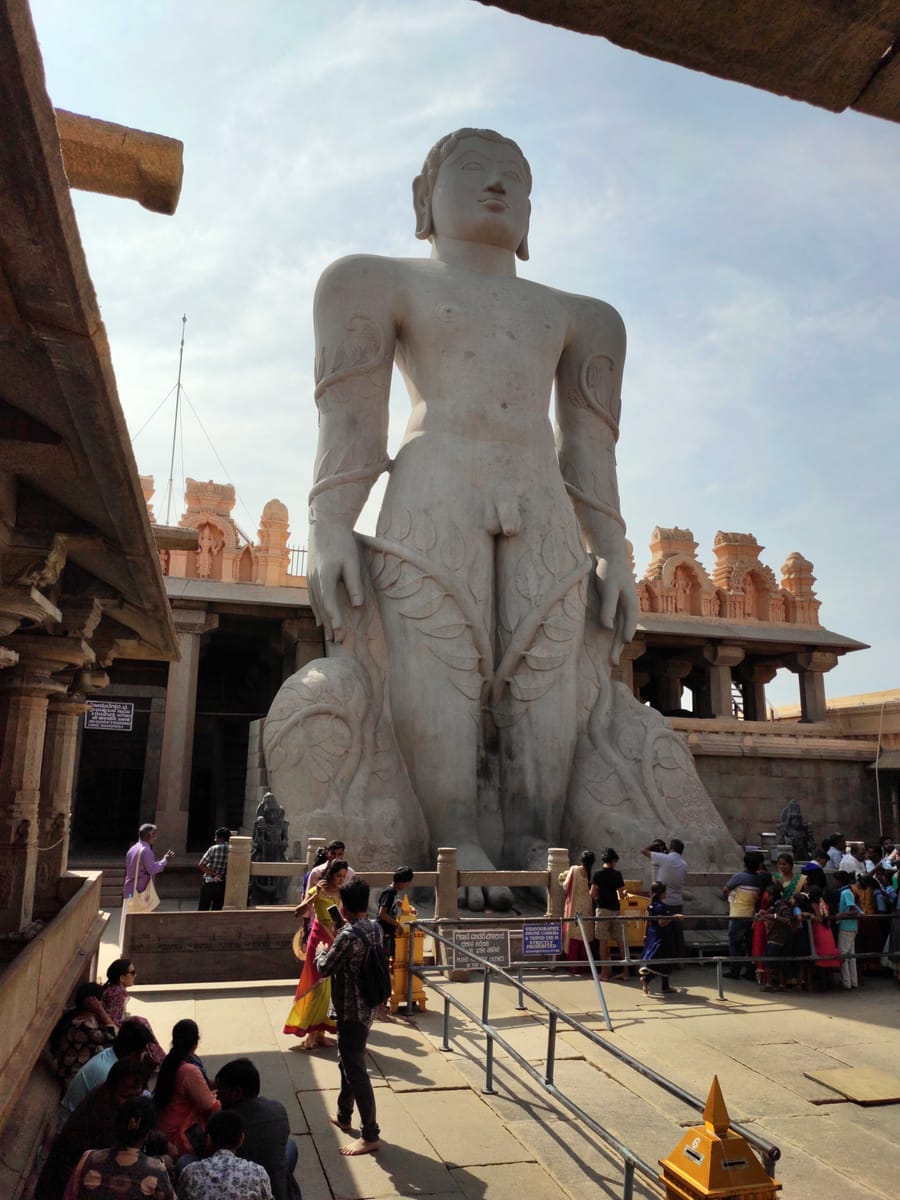
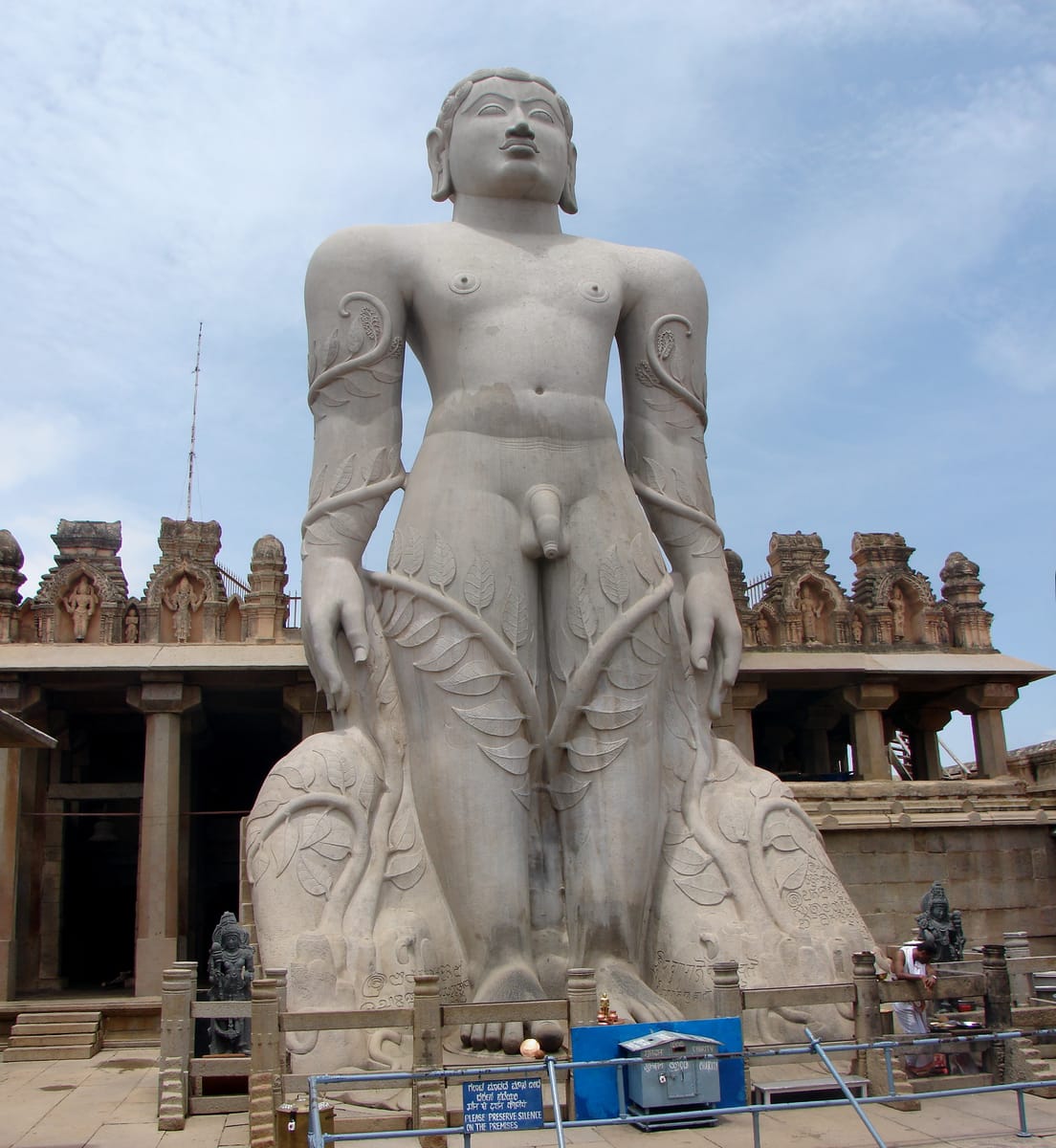
On the summit of Vindhyagiri Hill, one of two granite hills that rise above the town of Shravanabelagola in Karnataka, India, stands a colossal human figure carved from the hill’s own bedrock. The statue depicts Bahubali, a revered figure in Jainism also known by the honorific Gommateshwara, standing upright in silent meditation. At roughly 17 meters (about 57 feet) tall, it is one of the tallest free-standing monolithic statues in the world — meaning it was carved from a single continuous piece of stone rather than assembled from multiple blocks. An inscription at its base, along with corroborating temple records, dates the statue to around 981 CE, and credits its creation to Chavundaraya, a minister and military commander serving the Western Ganga dynasty. Nearly 950 years before the era of hydraulic lifts, power tools, or industrial scaffolding, workers under Chavundaraya’s direction transformed a granite outcrop into a serene, precisely proportioned human figure — and left it standing exactly where it was carved, seamless and unmoved, ever since. Shravanabelagola remains one of the most important living pilgrimage sites in Jainism, and the statue is protected by the Archaeological Survey of India as a nationally significant monument.
The Structure
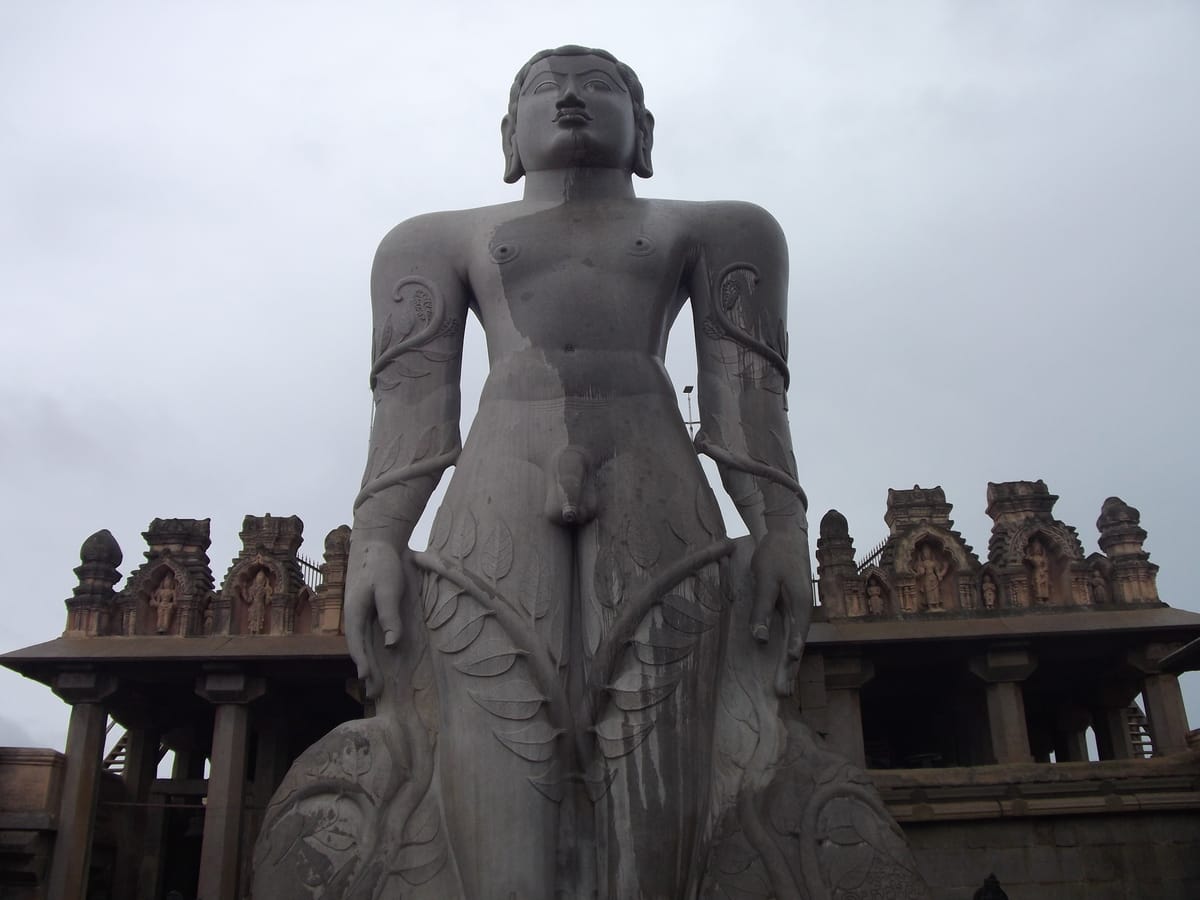
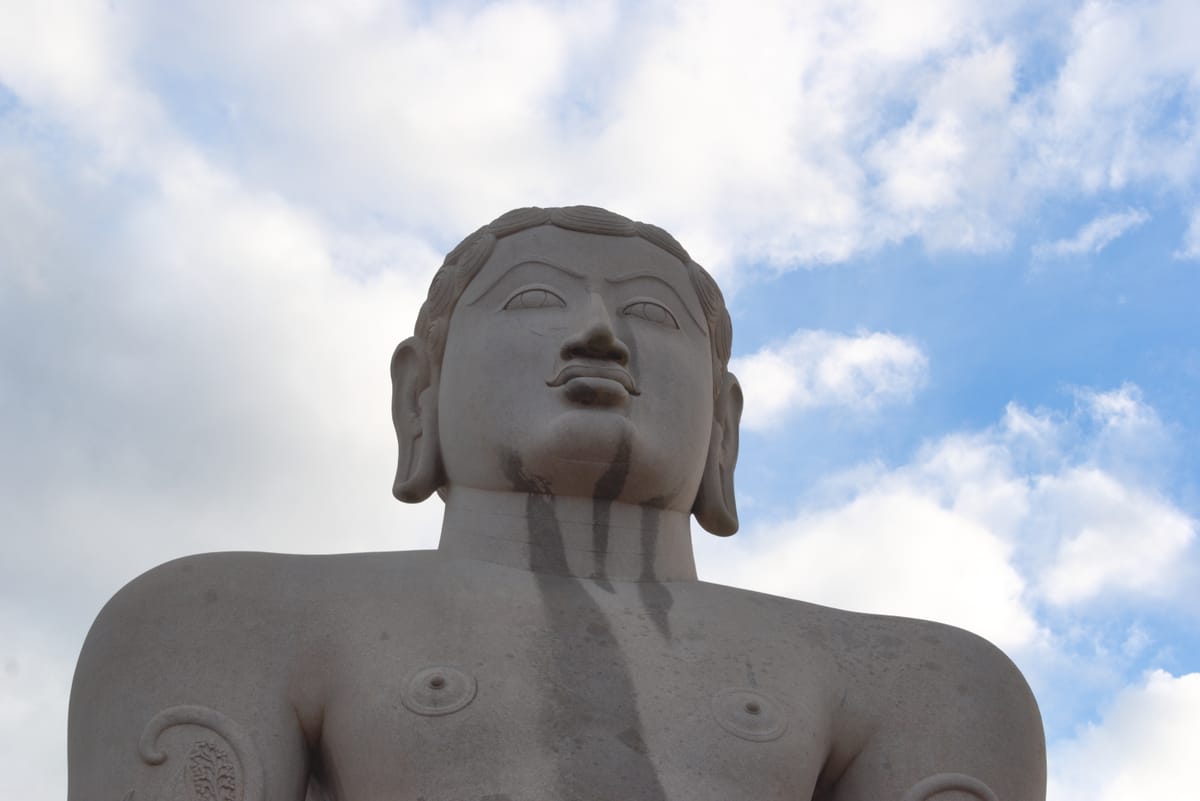
Bahubali, in Jain tradition, was the son of the first Tirthankara (spiritual teacher-founder), Rishabhanatha. According to Jain scripture, after winning a fierce contest for his father’s kingdom against his brother Bharata, Bahubali renounced the victory and all worldly power, choosing instead to stand in unbroken meditation until he achieved spiritual liberation. The statue captures this story directly in stone: Bahubali is shown in kayotsarga, a standing meditative posture with arms held straight at the sides and no support of any kind, his gaze fixed and serene. Climbing madhavi vines are carved twisting up around his legs and arms, and anthills and small carved creatures appear at his feet — traditional symbols meant to show that he stood in place, unmoving, for so long that the natural world grew up around him.
The statue was commissioned around 981 CE by Chavundaraya, a general and statesman who served the Western Ganga king (given in different sources as Rachamalla II or Rachamalla IV), and who is traditionally said to have built the statue in fulfillment of a promise to his mother. Inscriptions at the site — Shravanabelagola preserves more than 800 inscriptions in total, spanning roughly 600 to 1830 CE, among the richest epigraphic records in South India — anchor the statue’s date and patronage with unusual confidence for a monument this old. The statue stands within a walled courtyard at the hill’s summit, reached by a long flight of rock-cut steps, and is flanked by smaller carved attendant figures. Shravanabelagola’s twin hill, Chandragiri, holds its own dense cluster of Jain temples (basadis) and monastic memorials, some reportedly dating back to the 5th century CE, making the wider site one of continuous Jain religious use for over a thousand years. Roughly every twelve years, the statue is the focus of the Mahamastakabhisheka (“great head anointing”), a spectacular ceremony in which pilgrims and priests pour thousands of liters of milk, water, saffron, turmeric, sugarcane juice, and other substances from scaffolding erected around the statue’s head, drawing hundreds of thousands of devotees. The most recent Mahamastakabhisheka took place in February 2018; the next is scheduled for 2030.
How Was It Built?
Unlike statues assembled from quarried and transported blocks, the Gommateshwara statue was carved in situ: sculptors worked directly on a granite outcrop already in place at the hill’s summit, removing stone around the figure rather than building it up. Traditional accounts and architectural analysis describe the work proceeding from the top down, with wooden scaffolding built up around and anchored to the rock face so that carvers could reach the head and shoulders first, then work progressively downward as more of the figure was freed from the surrounding stone. This top-down sequence is common in monolithic in-situ carving generally, since it lets finished upper sections stay clear of falling debris and lets carvers use the removed rock below as a working platform for as long as possible.
The tools available to the sculptors were iron-age: chisels, hammers, and abrasive stones for finishing, without any mechanical assistance. Achieving a correctly proportioned 17-meter human figure with this equipment required extensive advance planning — establishing key measurements and reference points on the rock face before cutting began, and coordinating teams of carvers working different sections of the body over what was likely a period of years. No contemporary technical manual describing the exact planning method survives, so the specific system of measurement and layout the sculptors used has to be inferred from the finished statue’s proportions and from comparable South Indian sculptural traditions of the period, in which trained guilds of stone workers passed down proportional canons for depicting the human figure.
The Mainstream View
Historians and archaeologists are confident in both the date and the patronage of the statue, thanks to the inscriptional evidence at the site and its consistency with the wider historical record of Western Ganga rule and Jain patronage in the region during the 10th century. The statue is understood as a major undertaking of a regional dynasty and its minister, built to establish Shravanabelagola as a preeminent center of Jain pilgrimage — a goal it unambiguously achieved and has sustained for over a millennium. The carving technique — in-situ removal of stone from a standing outcrop using iron tools and scaffolding, worked top to bottom — is well attested for monolithic sculpture across South Asia in this period, and is consistent with other rock-cut monuments of the era, including cave temples and monolithic shrines elsewhere in India. This is not disputed as an achievement of skilled human craftsmanship: the mainstream account treats it as a masterwork of medieval Indian sculpture, made possible by experienced stoneworking guilds, sustained royal and aristocratic patronage, and a large coordinated workforce.
The Open Case
What makes the Gommateshwara statue a genuine wonder is not doubt about who built it or when — those points are unusually well anchored by inscriptions — but the sheer difficulty of the physical feat itself, achieved with no evidence of error correction visible in the final work. Carving a human figure at 17 meters in height, entirely by subtraction from a fixed mass of granite, leaves no room to undo a mistake: unlike a small sculpture built up from clay or correctable stone-on-stone construction, every cut into the outcrop was final, and a miscalculated proportion partway through carving the torso or limbs could not be patched or reversed without disfiguring the whole figure. Yet the finished statue is anatomically coherent and symmetrical across its full height, carved from a single mass of stone with no seams, joints, or added material anywhere in its surface. How the sculptors established and held consistent proportion and alignment across a vertical working face that size, using only iron tools, temporary wooden scaffolding, and (as far as any surviving record shows) no separate technical treatise describing their method step by step, remains only partially reconstructed. This is not a case for exotic explanations — no serious scholar doubts the statue is the work of skilled 10th- century Indian sculptors using known techniques of their craft. But the open question is a real one: exactly how a team of stoneworkers planned, measured, and executed a figure of this scale and precision directly into a hillside, correctly, in a single irreversible pass, using nothing but hand tools and hard-won experience.
Sources
Gallery