The Necropolis You Ride Into
Assassin's Creed sends you to Hegra about eight centuries too late — the tombs are already ancient when you get there.
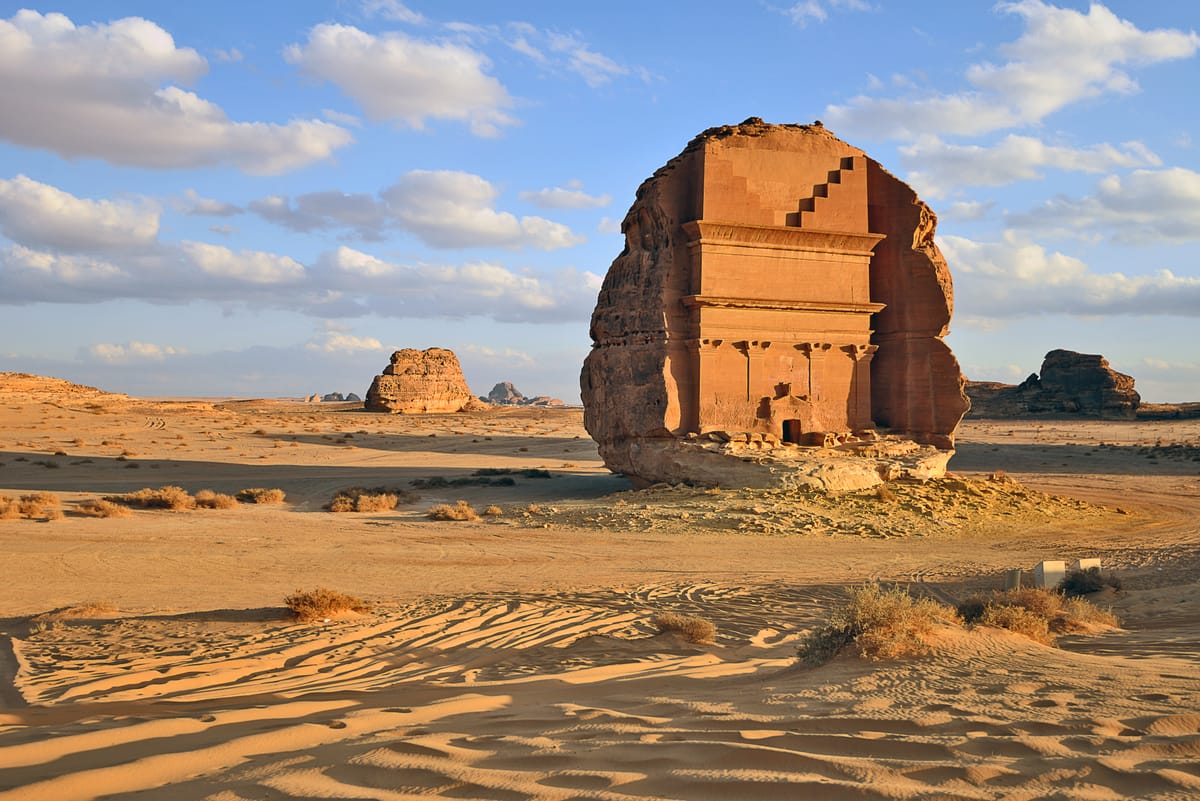
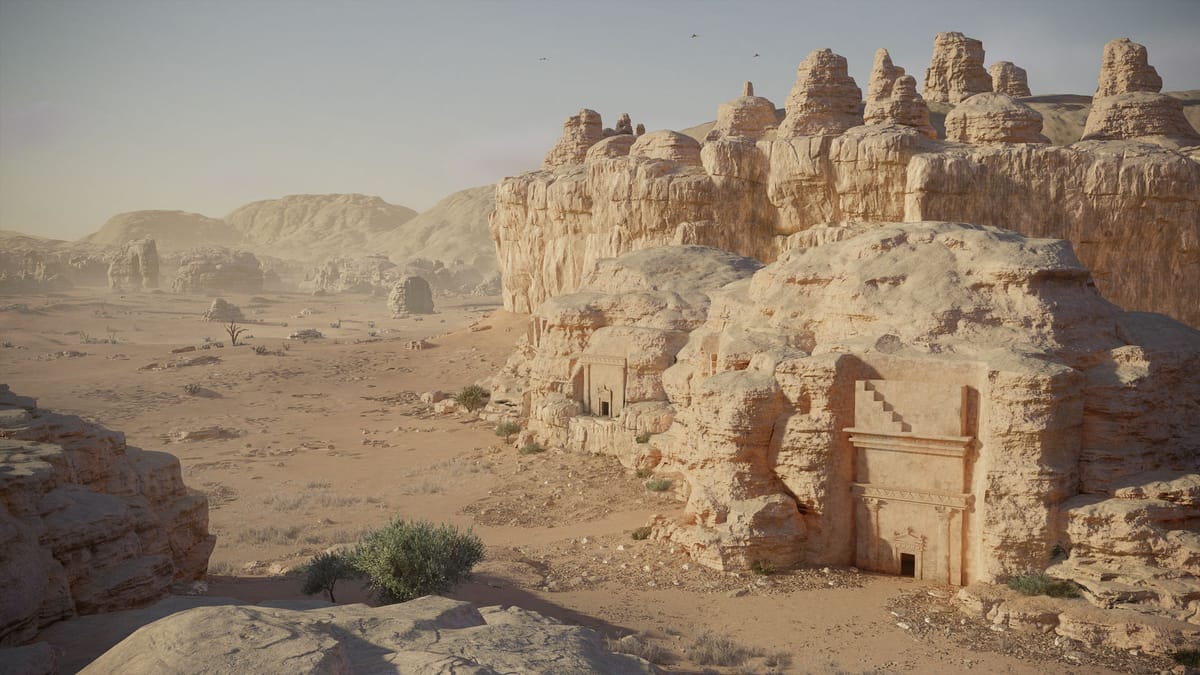
Most games that borrow an ancient site hand it to you new. You queue up a wonder, watch it rise, and collect the bonus. Valley of Memory — the free expansion Ubisoft released for Assassin’s Creed Mirage in November 2025 — does the opposite. It rebuilds AlUla as it stood in the 9th century CE, which puts you in the Hegra necropolis roughly eight hundred years after the last Nabataean carver put down his chisel. The tombs are already old. Ubisoft’s own description of the northern half of the map is blunt about it: this is the Land of the Dead, a stretch of desert, rock towers, and “necropolises carved into stone — including the iconic site of Hegra.”
The facades survive the translation intact. Ride up to a Hegra massif in-game and you get the real vocabulary: a doorway framed by pilasters, an entablature, and above it the crow-step merlons — two half-flights of stairs turning away from each other — that are the Nabataean signature. They sit exactly where the real ones sit, cut into standalone outcrops rising off a flat desert floor rather than lined up along a canyon wall. Ubisoft didn’t guess at this. The studio worked with the archaeologists currently excavating AlUla, who, creative director Olivier Leonardi said, “were feeding us pictures — actual pictures of objects they were digging, and actual pictures and blueprints of everything that they were actually discovering.” One location name was corrected weeks before launch when a fresh translation came through.
What no game engine can give you is the part the study is actually about. Hegra’s open question was never the carving — soft Quweira sandstone yields to iron picks, and the method is legible in the unfinished lower third of Qasr al-Farid, where the crown is dressed and the base is still raw rock. The question is the machinery behind it: who trained the workshops, how a shared design formula got enforced across more than a hundred tombs, how a caravan society with almost no surviving administrative records scheduled and financed all of it. Valley of Memory renders the answer’s output in full resolution and leaves the answer itself off-screen — which is precisely the position every visitor to the real Hegra has been in since the Nabataeans stopped coming.
So you climb them instead. Basim parkours up two-thousand-year-old grave markers the way tourists photograph them, which is its own quiet accuracy: by the 9th century these were already relics with a second life in local memory, the “cities of Salih” of later tradition rather than anyone’s working cemetery. The game does not explain the tombs to you. It just leaves them standing in the sand, finished and unattended, and lets you work out what you’re looking at.
Read the full study: Hegra (Mada'in Salih)
Sources
- Ubisoft News — Assassin's Creed Mirage Valley of Memory Launches for Free on November 18
- Ubisoft — Assassin's Creed Mirage: Valley of Memory (official page)
- Ubisoft — Valley of Memory: What You Need to Know
- Xbox Wire — Valley of Memory Update Brings New Missions, New Area to Explore, and More
- Game Rant — Valley of Memory DLC Breaks New Ground In Historical Accuracy
- Sportskeeda — All historical sites and their locations in Valley of Memory